Bearing Friction Apparatus | FrixoDynamics FX-521
Product Overview
A CE-certified precision laboratory apparatus for engineering experimentation and technical education, manufactured by Scientico India to ISO 9001:2015 standards. Supplied with calibration certificate, operation manual, and complete export documentation. Designed for Forces and Friction laboratories in engineering colleges and technical institutions.
[email protected]
Technical Specifications
| Parameter | Specification |
|---|---|
| Model | FrixoDynamics FX-521 |
| Mounting | Wall-mounted |
| Base Plate | Anodised aluminium |
| Flywheel Diameter | 300 mm |
| Flywheel Material | Galvanised steel |
| Flywheel Weight | 22.2 kg |
| Shaft Journal Diameter | 17 mm |
| Shaft Material | Stainless steel |
| Sliding Bearing Materials | Gun metal, cast iron, PTFE (3 sets, 2 shells per set) |
| Rolling Bearing Type | Grooved ball bearing, Type 6203 |
| Torque Application | Cable drum and dead weight hanger system |
| Weight Set | 1 x 1 N hanger, 5 x 1 N, 1 x 2 N, 3 x 5 N |
| Scope of Delivery | 1 experimental unit, 3 sets of sliding bearing shells, 4 roller bearings, 1 set of weights, 1 hanger, 1 thread, 1 instructional manual |
Key Features
Key Features
- Three interchangeable sliding bearing shell materials, gun metal, cast iron, and PTFE, for direct comparison of friction torque across material pairings on the same shaft and flywheel
- Type 6203 grooved ball bearing replaces plain bearing housing for direct rolling versus sliding friction comparison under identical loading conditions
- Flywheel dead weight (22.2 kg, 300 mm diameter) provides consistent, repeatable bearing load without additional loading mechanisms
- Stainless steel shaft with 17 mm journal ensures consistent surface finish and corrosion resistance across all bearing material tests
- Onset-of-motion method, weights added until flywheel just begins to rotate, provides a clear, repeatable friction torque measurement criterion
- Cable drum and dead weight hanger system for precise, incremental torque application
- Rolling bearing configuration supports additional rotational dynamics experiments using the flywheel
- Anodised aluminium base plate and wall-mounted bracket provide a rigid, stable installation
Applications
- Determination of friction torque for sliding bearings with gun metal, cast iron, and PTFE shell materials
- Determination of friction torque for a Type 6203 grooved ball rolling bearing
- Direct comparison of sliding bearing and rolling bearing friction torque under identical flywheel dead load
- Investigation of the effect of bearing shell material on friction torque in plain bearings
- Fundamental experiments in rotational dynamics using the flywheel with rolling bearings installed
- Undergraduate laboratory practicals in machine elements, tribology, mechanical engineering design, and applied mechanics
- Supplementary demonstration for courses covering bearing selection, lubrication, and power transmission efficiency
Construction and System Design
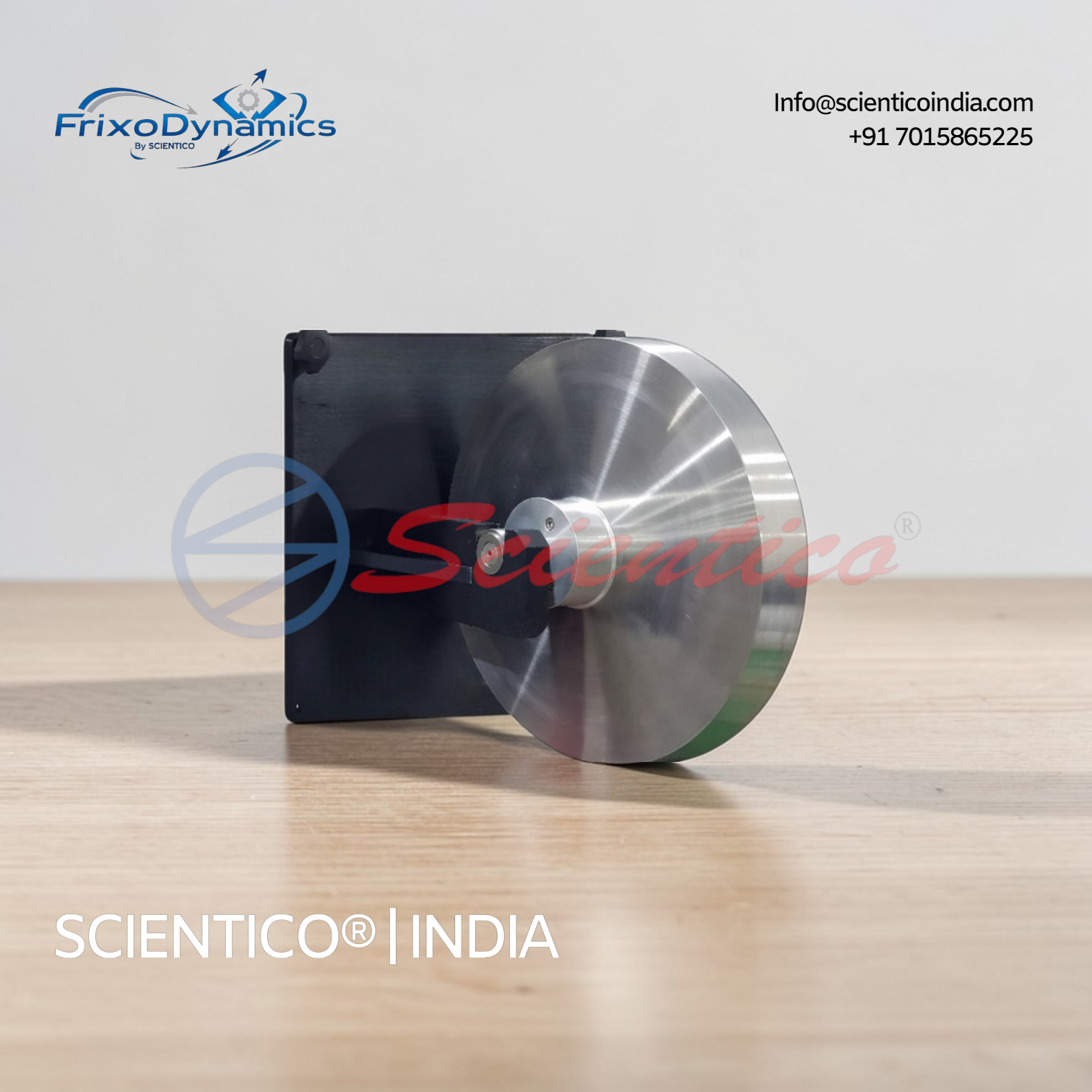
The FX-521 is wall-mounted on a bracket fixed to the laboratory wall, with the anodised aluminium base plate providing the structural interface between the wall bracket and the bearing housing. The bearing housing accepts either the plain bearing shell assembly or the Type 6203 ball bearing, and both configurations use the same stainless steel shaft and flywheel. Changing from sliding to rolling bearing configuration requires only the exchange of the bearing housing insert, keeping transition time between experiments minimal.
The 300 mm flywheel is secured to the shaft and its substantial dead weight, 22.2 kg, acts continuously as the bearing load throughout all experiments. This self-loading arrangement eliminates the need for a separate radial loading mechanism and ensures that the bearing load is identical across all material comparison experiments. The cable drum is mounted coaxially on the shaft, and the cable is wound around it with the free end leading to the weight hanger. As weights are added to the hanger, they apply an increasing torque to the shaft. At the critical weight, where the applied torque just equals the frictional torque, the flywheel begins to rotate slowly and steadily, providing a clear and repeatable criterion for recording the frictional torque value.
Three sets of sliding bearing shells are supplied, each set consisting of two half-shells that clamp around the shaft journal to form a complete plain bearing. The gun metal shells represent a traditional bearing material used in heavy-duty and marine applications. Cast iron shells offer a harder, more wear-resistant alternative with different friction characteristics. PTFE shells provide the lowest friction among the three, reflecting PTFE's widespread use in low-friction, self-lubricating bearing applications. All shell sets are precision-machined to fit the 17 mm shaft journal and the standard bearing housing, ensuring consistent contact geometry across all material tests.
Export and Supply Capability
The SCIENTICO FrixoDynamics FX-521 is available for supply to engineering colleges, technical universities, mechanical engineering departments, research institutions, and industrial training centres. SCIENTICO manufactures and exports laboratory equipment to institutions and distributors across multiple regions. Standard packaging is suitable for international shipment. Bulk orders, customised configurations, and institutional procurement enquiries are welcomed. Please contact SCIENTICO directly for pricing, lead times, and shipping terms.
Standards & Compliance
- Manufactured under ISO 9001:2015 Quality Management System
- CE Marking - European Conformity where applicable
- Supplied with calibration certificate, operation manual, and experiment guide
- 12-month manufacturer's warranty (parts & labour from installation)
Ordering & Delivery
- Incoterms: CIF to destination seaport, FOB Mundra/Nhava Sheva, or Ex-Works Ambala
- Lead time: 3–5 weeks production + sea transit to destination
- Payment: LC (Letter of Credit) or T/T bank transfer against proforma invoice
- Documentation: commercial invoice, packing list, bill of lading, certificate of origin, insurance certificate
Frequently Asked Questions
Q1: What is the bearing friction apparatus used for in engineering education?
The FX-521 is used to measure and compare the friction torque in sliding bearings of three different shell materials, gun metal, cast iron, and PTFE, and in a Type 6203 grooved ball rolling bearing, all under the same flywheel dead load. Students apply incremental torque via a cable and weight system until the flywheel begins to rotate, record the critical torque for each bearing configuration, and draw direct quantitative comparisons between sliding and rolling bearing friction performance.
Q2: How is the friction torque measured on the FX-521?
Friction torque is measured using the onset-of-motion method. Dead weights are added incrementally to the hanger on the cable drum until the flywheel just begins to rotate at near-constant slow speed. The total hanging weight at this point, multiplied by the effective radius of the cable drum, gives the frictional torque of the bearing under the flywheel's dead load. This measurement is taken for each bearing shell material and for the rolling bearing, allowing direct comparison.
Q3: Why does bearing shell material affect the friction torque in a sliding bearing?
Different materials have different surface hardness, surface roughness at the microscopic level, and affinity for lubrication films, all of which influence the friction force between the shaft journal and the bearing shell. Gun metal and cast iron produce higher friction torques than PTFE because PTFE has an inherently low coefficient of friction and is widely used as a self-lubricating bearing material. The FX-521 makes this difference directly measurable and quantifiable.
Q4: Can the FX-521 be used for rotational dynamics experiments?
Yes. When the rolling bearing configuration is installed, the flywheel rotates with very low frictional resistance, making it suitable for introductory experiments in rotational dynamics. The flywheel's known mass and diameter allow the moment of inertia to be calculated, and the low bearing friction means that deceleration experiments reflect the rotational dynamics of the flywheel rather than being dominated by bearing losses.
Q5: What is included in the scope of delivery for the FX-521?
The FX-521 is supplied as a complete experimental kit including: one wall-mounted bearing friction experimental unit with anodised aluminium base plate, galvanised steel flywheel (300 mm, 22.2 kg), stainless steel shaft, cable drum, and bearing housing; three sets of sliding bearing shells (gun metal, cast iron, PTFE, two shells per set); four roller bearings (Type 6203); one set of calibrated weights (1 x 1 N hanger, 5 x 1 N, 1 x 2 N, 3 x 5 N); one hanger; one thread; and one instructional manual.