Coriolis Force Apparatus | FrixoDynamics FX-518
Product Overview
A CE-certified precision laboratory apparatus for engineering experimentation and technical education, manufactured by Scientico India to ISO 9001:2015 standards. Supplied with calibration certificate, operation manual, and complete export documentation. Designed for Forces and Friction laboratories in engineering colleges and technical institutions.
[email protected]
Technical Specifications
| Parameter | Specification |
|---|---|
| Model | FrixoDynamics FX-518 |
| Rotating Arm Speed | 0 – 60 rpm (infinitely adjustable) |
| Submersible Pump Max. Flow Rate | 2 L/min |
| Nozzle | 1 x radial water jet nozzle |
| Water Circuit | Closed circuit, self-contained |
| Deflection Measurement | Graduated scale on water tank |
| Speed Measurement | Speed sensor with digital display |
| Water Tank | Transparent, mounted on rotating arm |
| Power Requirement | Standard power supply (power cord included) |
| Mounting | Bench-top, self-contained base unit |
| Scope of Delivery | 1 experimental unit, 1 power cord, 1 instructional manual |
Key Features
Key Features
- Direct, real-time visualisation of Coriolis force effect through water jet deflection on a rotating arm, observable without additional instrumentation
- Infinitely adjustable arm rotation speed from 0 to 60 rpm for systematic investigation of speed-dependent deflection magnitude
- Submersible pump (max. 2 L/min) projects a consistent radial water jet, with deflection clearly visible against the graduated tank scale
- Reversal of deflection direction with reversal of rotation direction directly demonstrates the vector nature of the Coriolis force
- Closed water circuit enables continuous, uninterrupted operation without an external water supply connection
- Digital speed display provides precise, real-time rotation rate confirmation throughout the experiment
- Transparent water tank allows unobstructed observation of the water jet path relative to the stationary reference trajectory
- Self-contained bench-top unit, requires only a standard power supply
Applications
- Visualisation and qualitative investigation of the Coriolis force effect in a rotating reference frame
- Demonstration of the interference of rotational motion on translational motion of a fluid jet
- Investigation of the dependence of Coriolis force deflection on the speed of rotation
- Demonstration of the reversal of deflection direction with reversal of rotation direction
- Study of inertial and apparent forces in non-inertial rotating reference frames
- Undergraduate and postgraduate laboratory practicals in dynamics, rotational mechanics, fluid mechanics, and geophysics
- Supplementary demonstration for courses covering atmospheric dynamics, oceanography, and rotating frame mechanics
Construction and System Design
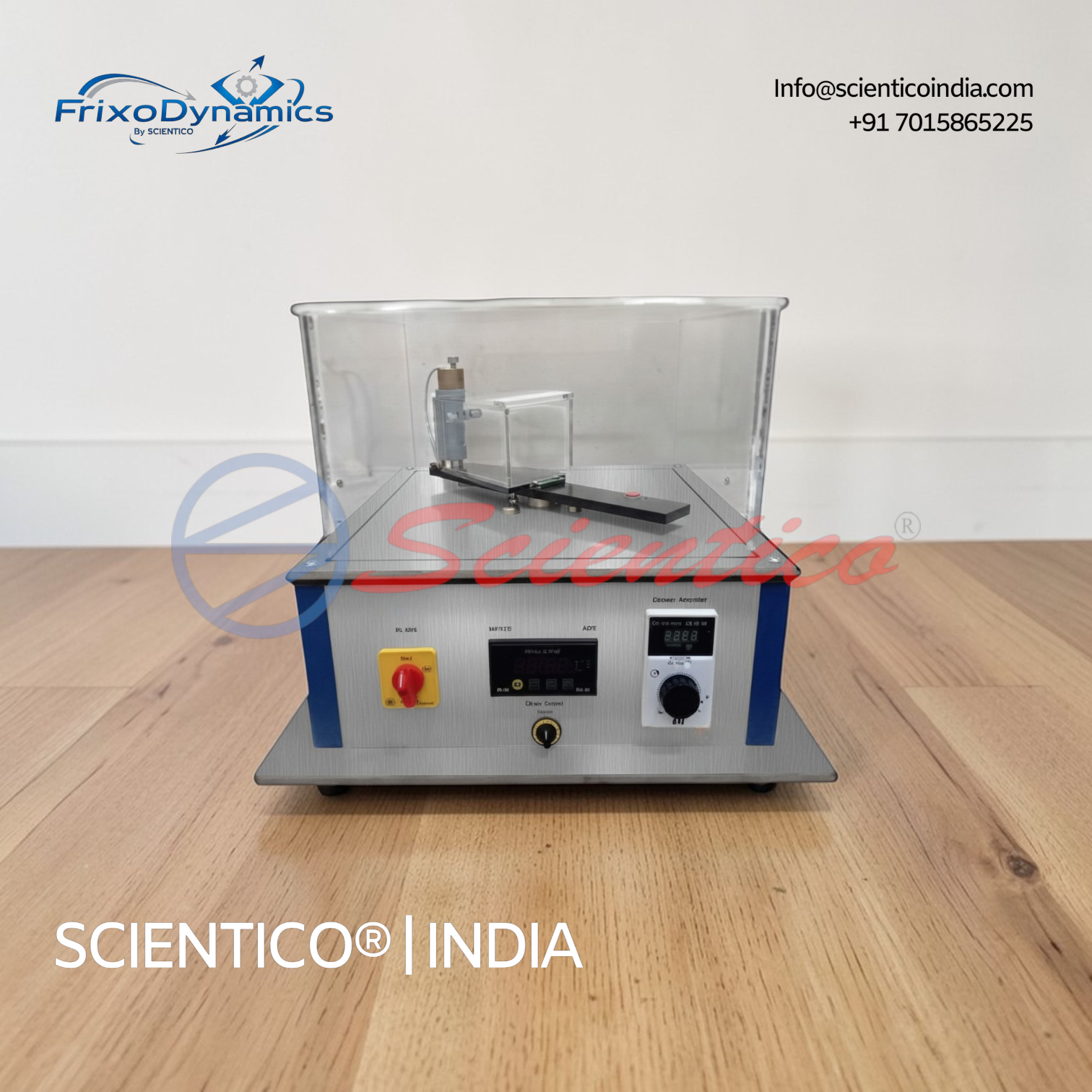
The FX-518 base unit houses the drive motor, control electronics, speed regulation system, and digital speed display. The horizontal rotating arm is mounted on the central pivot of the base and driven by the motor at a speed selected via the control panel. Speed is monitored continuously by a dedicated speed sensor and confirmed on the digital display.
The transparent water tank is fixed to the rotating arm and rotates with it. The submersible pump sits within the tank and draws water from the base of the tank, delivering it through internal tubing to the radial nozzle positioned at the arm end. The nozzle directs the water jet radially outward relative to the arm's rotation axis. The graduated scale on the tank provides a fixed reference grid in the rotating frame, against which the deflected jet position can be read directly.
Water projected by the nozzle falls back into the tank and is recirculated by the pump, maintaining a closed circuit. This eliminates the need for drainage or an external supply, making the apparatus fully self-contained. The transparent tank walls allow the jet trajectory to be observed clearly from any viewing angle. By comparing the jet position on the scale at zero rotation against its deflected position at a given rotation speed, students can directly measure the angular deflection attributable to the Coriolis effect at that operating condition.
Export and Supply Capability
The SCIENTICO FrixoDynamics FX-518 is available for supply to engineering colleges, technical universities, mechanical engineering and physics departments, research institutions, and industrial training centres. SCIENTICO manufactures and exports laboratory equipment to institutions and distributors across multiple regions. Standard packaging is suitable for international shipment. Bulk orders, customised configurations, and institutional procurement enquiries are welcomed. Please contact SCIENTICO directly for pricing, lead times, and shipping terms.
Standards & Compliance
- Manufactured under ISO 9001:2015 Quality Management System
- CE Marking - European Conformity where applicable
- Supplied with calibration certificate, operation manual, and experiment guide
- 12-month manufacturer's warranty (parts & labour from installation)
Ordering & Delivery
- Incoterms: CIF to destination seaport, FOB Mundra/Nhava Sheva, or Ex-Works Ambala
- Lead time: 3–5 weeks production + sea transit to destination
- Payment: LC (Letter of Credit) or T/T bank transfer against proforma invoice
- Documentation: commercial invoice, packing list, bill of lading, certificate of origin, insurance certificate
Frequently Asked Questions
Q1: What is the Coriolis force, and how does the FX-518 demonstrate it?
The Coriolis force is an apparent force experienced by a body moving within a rotating reference frame, causing it to deflect from a straight-line path as observed from within that frame. The FX-518 demonstrates this by projecting a radial water jet from a pump mounted on a rotating arm. When the arm is stationary, the jet travels in a straight radial line. When the arm rotates, the jet deflects from that reference path, to the left or right depending on the direction of rotation, with the deflection magnitude increasing with rotation speed.
Q2: How is the deflection of the water jet measured on the FX-518?
The deflection of the water jet is measured using a graduated scale marked on the transparent water tank, which rotates with the arm and therefore provides a fixed reference in the rotating frame. By comparing the jet position on the scale during rotation against the straight-line reference position observed when the arm is stationary, students can read the angular or linear deflection directly. The digital speed display allows this deflection to be correlated with a precise rotation rate.
Q3: Does the direction of Coriolis deflection change with the direction of rotation?
Yes. Reversing the direction of arm rotation reverses the direction of water jet deflection. This directly demonstrates the vector nature of the Coriolis force, which depends on both the velocity of the moving body and the angular velocity of the rotating frame. In the Northern Hemisphere analogy, the Coriolis effect deflects moving bodies to the right; in the Southern Hemisphere, to the left, mirroring the reversal observed on the FX-518 when rotation direction is changed.
Q4: Does the FX-518 require an external water supply?
No. The FX-518 operates on a fully closed water circuit. Water projected by the nozzle falls back into the transparent tank and is recirculated continuously by the submersible pump. The apparatus requires only a standard power supply connection and no external water inlet or drain connection, making it straightforward to set up and operate on any standard laboratory bench.
Q5: What is included in the scope of delivery for the FX-518?
The FX-518 is supplied as a complete unit including: one Coriolis force experimental unit with rotating arm, transparent water tank, submersible pump, radial nozzle, graduated deflection scale, speed sensor, and digital speed display; one power cord; and one instructional manual covering operating procedures, experimental observations, and the underlying theory of the Coriolis effect and rotating reference frames.