Drum Friction Apparatus | FrixoDynamics FX-520
Product Overview
A CE-certified precision laboratory apparatus for engineering experimentation and technical education, manufactured by Scientico India to ISO 9001:2015 standards. Supplied with calibration certificate, operation manual, and complete export documentation. Designed for Forces and Friction laboratories in engineering colleges and technical institutions.
[email protected]
Technical Specifications
| Parameter | Specification |
|---|---|
| Model | FrixoDynamics FX-520 |
| Drum Internal Diameter | 130 mm |
| Drum Material | Plain aluminium |
| Brake Shoe Configuration | Single pivoted shoe |
| Torque Application | Cord wound on drum perimeter, dead weights on hanger |
| Braking Load Application | Cord connected to brake shoe, dead weights on hanger |
| Leading/Trailing Shoe Transition | Reversal of drum rotation direction |
| Weight Set | 5 x 5 N, 4 x 2 N, 4 x 1 N, 2 x 0.5 N, 1 x 1 N hanger, 1 x 0.5 N hanger |
| Hangers | 2 |
| Scope of Delivery | 1 experimental unit, 1 brake drum, 1 brake shoe, 2 sets of weights, 2 hangers, 1 thread |
Key Features
Key Features
- Single pivoted brake shoe inside a 130 mm internal diameter plain aluminium drum for realistic drum brake simulation
- Direct comparison of leading shoe and trailing shoe braking behaviour by reversal of drum rotation direction, no reconfiguration of components required
- Torque and braking load both applied via cord and dead weight hangers for independent, precise control of each variable
- Tangential force versus braking load graph directly yields the coefficient of friction between drum and shoe
- Two independent weight sets and hangers allow torque and braking load to be varied simultaneously without weight transfer between hangers
- Compact bench-top design, self-contained, no power supply required
- Simulates the operating principle of a real single-shoe drum brake in a safe, controllable laboratory format
- Calibrated weight set with denominations from 0.5 N to 5 N for fine incremental braking load variation
Applications
- Experimental determination of the variation of tangential force with braking load in a drum brake system
- Determination of the coefficient of friction between an aluminium drum and a brake shoe
- Comparison of leading shoe and trailing shoe braking characteristics
- Demonstration of the self-energising effect in leading shoe brake configurations
- Study of the relationship between applied braking load, drum torque, and friction force
- Undergraduate laboratory practicals in machine elements, tribology, mechanical engineering design, and applied mechanics
- Supplementary demonstration for courses covering brake system design, friction, and power transmission
Construction and System Design
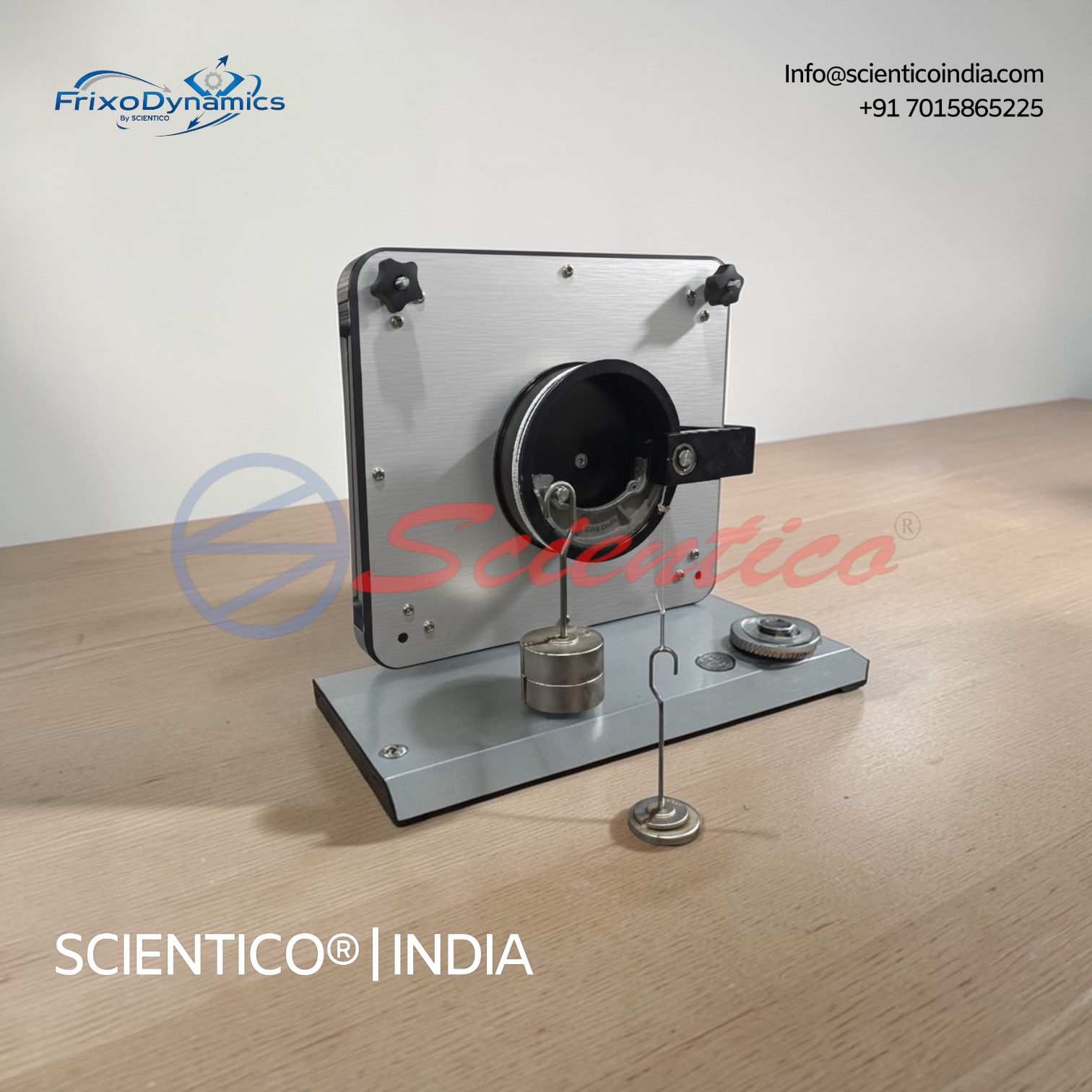
The FX-520 is built around a plain aluminium drum of 130 mm internal diameter, machined to a consistent surface finish to ensure repeatable friction conditions across experiments. The drum is mounted on the apparatus frame with its axis horizontal. A cord is wound around the outer perimeter of the drum and led to a weight hanger, providing the torque loading. The torque direction, and therefore the sense of drum rotation at impending slip, is determined by the direction in which the cord is wound.
Inside the drum, a single brake shoe is mounted on a fixed pivot point. The shoe is shaped to conform to the inner drum surface and carries a friction lining on its contact face. A cord attached to the shoe leads out of the drum to a separate braking load hanger. As the braking load hanger is loaded with weights, the shoe is pressed against the drum surface with a controlled normal force, generating a tangential friction force at the drum surface.
The student increases the torque hanger load incrementally until the drum rotates at near-constant speed under the applied braking load. This condition identifies the tangential force needed to overcome the shoe's friction resistance at that braking load level. The experiment is repeated at successive braking load increments, building up a dataset from which the coefficient of friction is extracted as the slope of the tangential force versus braking load graph.
To compare leading and trailing shoe behaviour, the cord on the drum perimeter is rewound in the opposite direction, reversing the rotation sense. With the same braking load applied, the torque required to rotate the drum at near-constant speed will differ significantly between the two configurations, more torque is required to overcome a leading shoe than a trailing shoe at the same braking load, directly illustrating the self-energising effect.
Export and Supply Capability
The SCIENTICO FrixoDynamics FX-520 is available for supply to engineering colleges, technical universities, mechanical engineering departments, research institutions, and industrial training centres. SCIENTICO manufactures and exports laboratory equipment to institutions and distributors across multiple regions. Standard packaging is suitable for international shipment. Bulk orders, customised configurations, and institutional procurement enquiries are welcomed. Please contact SCIENTICO directly for pricing, lead times, and shipping terms.
Standards & Compliance
- Manufactured under ISO 9001:2015 Quality Management System
- CE Marking - European Conformity where applicable
- Supplied with calibration certificate, operation manual, and experiment guide
- 12-month manufacturer's warranty (parts & labour from installation)
Ordering & Delivery
- Incoterms: CIF to destination seaport, FOB Mundra/Nhava Sheva, or Ex-Works Ambala
- Lead time: 3–5 weeks production + sea transit to destination
- Payment: LC (Letter of Credit) or T/T bank transfer against proforma invoice
- Documentation: commercial invoice, packing list, bill of lading, certificate of origin, insurance certificate
Frequently Asked Questions
Q1 : What is the drum friction apparatus used for in engineering education?
The FX-5210 is used to investigate friction in a drum brake system. Students apply a controlled braking load to a single pivoted shoe inside an aluminium drum and measure the tangential force required to rotate the drum at near-constant speed. From the relationship between these two quantities, the coefficient of friction between the drum and shoe is determined. The apparatus also demonstrates the characteristic difference in braking behaviour between a leading shoe and a trailing shoe.
Q2: What is the difference between a leading shoe and a trailing shoe, and how does the FX-520 demonstrate it?
A leading shoe is configured so that the friction force between the shoe and the rotating drum tends to draw the shoe tighter against the drum, amplifying the braking effect beyond the directly applied load, known as the self-energising effect. A trailing shoe is configured so that friction tends to push the shoe away from the drum, requiring a higher applied load for the same braking torque. The FX-520 demonstrates both configurations by rewinding the torque cord in the opposite direction to reverse the drum rotation sense, converting the shoe between leading and trailing without changing any other component.
Q3: How is the coefficient of friction determined using the FX-520?
The coefficient of friction is determined by recording the torque hanger load required to rotate the drum at near-constant speed for a series of braking load values. Plotting tangential force against braking load produces a straight-line graph whose slope equals the coefficient of friction between the drum surface and the brake shoe lining. Separate graphs for the leading and trailing shoe configurations allow direct comparison of friction coefficient values and the self-energising effect.
Q4: Why is the drum made from plain aluminium?
Plain aluminium is used for the drum because its consistent surface finish and well-characterised tribological properties make it suitable for repeatable, controlled friction experiments in a laboratory setting. Using a defined drum material also means the coefficient of friction determined experimentally reflects the specific pairing of the aluminium drum surface with the brake shoe lining material, which is a meaningful and realistic material combination found in certain brake applications.
Q5: What is included in the scope of delivery for the FX-520?
The FX-520 is supplied as a complete experimental kit including: one drum friction experimental unit; one plain aluminium brake drum (130 mm internal diameter); one pivoted brake shoe; two sets of calibrated weights (5 x 5 N, 4 x 2 N, 4 x 1 N, 2 x 0.5 N, 1 x 1 N hanger, 1 x 0.5 N hanger); two weight hangers; and one thread for cord setup and drum torque application.