Dry, Rough and Lubricated Friction Apparatus | FrixoDynamics FX-524
Product Overview
A CE-certified precision laboratory apparatus for engineering experimentation and technical education, manufactured by Scientico India to ISO 9001:2015 standards. Supplied with calibration certificate, operation manual, and complete export documentation. Designed for Forces and Friction laboratories in engineering colleges and technical institutions.
[email protected]
Technical Specifications
| Parameter | Specification |
|---|---|
| Model | FrixoDynamics FX-524 |
| Mounting | Wall or frame-mounted |
| Number of Discs | 3, dry (fine machined), lubricated (with trough), rough finish |
| Disc Configuration | Three identically dimensioned discs on a common shaft |
| Braking Lever | Repositionable over any of the three discs |
| Sliding Materials | Steel, brass, nylon, brake lining, rubber (5 samples) |
| Additional Test Element | Roller bearing |
| Pulley | 1 pulley on main shaft end |
| Hangers | 2 |
| Weight Set | 2 x 0.5 N hangers, 4 x 5 N, 4 x 2 N, 2 x 1 N, 2 x 0.5 N |
| Lubrication | Trough on lubricated disc, user-filled with grease or liquid lubricant |
| Scope of Delivery | 1 experimental unit, 5 sliding material samples, 2 sets of weights, 1 thread, 1 instructional manual |
Key Features
Key Features
- Three friction discs on a common shaft, dry fine-machined, lubricated (with integral trough), and rough surface, for direct comparison of surface condition effect on friction coefficient
- Five interchangeable sliding material samples, steel, brass, nylon, brake lining, and rubber, plus a roller bearing, enabling material pairing comparison across all three disc surfaces
- Braking lever repositionable over any disc without dismantling the apparatus, minimising experiment changeover time
- Roller bearing test sample demonstrates the reduction in friction from sliding to rolling contact under identical braking and effort conditions
- Onset-of-constant-speed method, effort load increased until shaft rotates at a steady rate, provides a clear, repeatable criterion for friction force determination
- Results expressible as calculated friction coefficients or graphical force-versus-braking-load representations
- Wall or frame-mounted design suitable for permanent laboratory installation
- Operating and maintenance manual includes example results for comparison against student experimental data
Applications
- Determination of the coefficient of sliding friction for five material pairings under dry, rough, and lubricated disc surface conditions
- Investigation of the effect of surface finish on friction coefficient for the same material pairing
- Demonstration of the effect of lubrication on sliding friction and effort required
- Comparison of sliding friction (five material samples) against rolling friction (roller bearing) under identical conditions
- Study of the relationship between braking (normal) force and the effort required to maintain constant shaft rotation
- Investigation of force equilibrium between friction force and normal force in a rotating disc system
- Undergraduate laboratory practicals in tribology, machine elements, mechanical engineering design, and applied mechanics
- Supplementary demonstration for courses covering lubrication theory, surface engineering, and brake system design
Construction and System Design
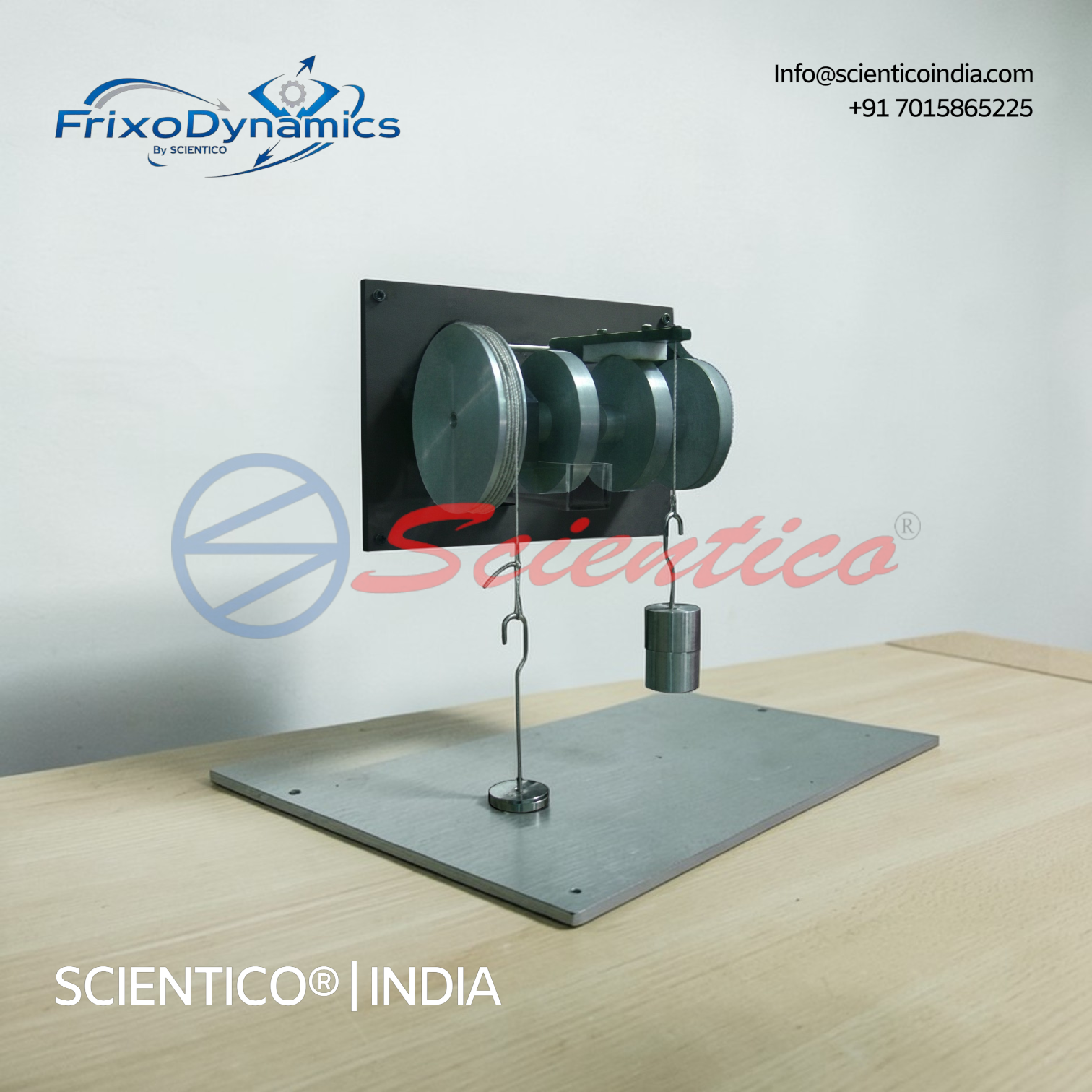
The FX-524 is mounted on a wall bracket or support frame, positioning the main shaft assembly at a convenient working height. The three discs are fixed at defined positions along the main shaft, with their surfaces accessible to the braking lever from above. The lubricated disc trough sits beneath its contact surface and is filled by the user with the chosen lubricant before the experiment begins, allowing different lubricant types or viscosities to be evaluated in successive tests.
The braking lever is mounted on a pivot above the shaft and can be positioned to bear down on any one of the three discs. The selected sliding material sample or roller bearing is held securely in the lever's sample seat, pressing against the disc surface under the lever's own weight supplemented by any additional braking load applied via a hanger on the lever arm. The braking force is therefore controlled and quantified by the weight on the lever hanger.
The effort pulley is mounted at the end of the main shaft. A cord is wound around the pulley and connected to an effort hanger. Dead weights are added to the effort hanger incrementally until the pulley, and therefore the shaft and all three discs, begins to rotate at a constant, slow speed. At this condition, the net torque on the shaft is zero: the effort torque equals the frictional torque at the braking disc surface. From the known effort load, pulley radius, braking load, and disc radius, the friction force and coefficient of friction are calculated directly.
The five sliding material samples, steel, brass, nylon, brake lining, and rubber, represent the range of materials commonly used in braking, bearing, and power transmission applications. Each sample is machined to fit the braking lever seat, ensuring consistent contact geometry across all material tests. The roller bearing is mounted in a housing that also fits the lever seat, providing a geometrically consistent rolling contact test under the same experimental conditions.
Export and Supply Capability
The SCIENTICO FrixoDynamics FX-524 is available for supply to engineering colleges, technical universities, mechanical engineering departments, research institutions, and industrial training centres. SCIENTICO manufactures and exports laboratory equipment to institutions and distributors across multiple regions. Standard packaging is suitable for international shipment. Bulk orders, customised configurations, and institutional procurement enquiries are welcomed. Please contact SCIENTICO directly for pricing, lead times, and shipping terms.
Standards & Compliance
- Manufactured under ISO 9001:2015 Quality Management System
- CE Marking - European Conformity where applicable
- Supplied with calibration certificate, operation manual, and experiment guide
- 12-month manufacturer's warranty (parts & labour from installation)
Ordering & Delivery
- Incoterms: CIF to destination seaport, FOB Mundra/Nhava Sheva, or Ex-Works Ambala
- Lead time: 3–5 weeks production + sea transit to destination
- Payment: LC (Letter of Credit) or T/T bank transfer against proforma invoice
- Documentation: commercial invoice, packing list, bill of lading, certificate of origin, insurance certificate
Frequently Asked Questions
Q1: What is the dry, rough and lubricated friction apparatus used for?
The FX-524 is used to determine the coefficient of sliding friction for different material pairings under three disc surface conditions, dry fine-machined, rough, and lubricated. Students apply a controlled braking force to a selected disc surface using one of five sliding material samples or a roller bearing, increase the effort load on the pulley until the shaft rotates at a steady rate, and calculate the friction coefficient from the measured forces. The experiment is repeated across surface conditions, material pairings, and braking load levels to build a comprehensive friction dataset.
Q2: How does the lubricated disc differ from the dry disc on the FX-524?
The lubricated disc is identical in base geometry to the dry fine-machined disc but incorporates an integral trough beneath its contact surface. Before the experiment, the user fills this trough with a chosen grease or liquid lubricant, which is drawn up to the contact interface during rotation. This introduces a lubricant film between the sliding material sample and the disc surface, reducing the coefficient of friction relative to the dry condition and directly demonstrating the effect of lubrication on friction and effort required.
Q3: What is the significance of including a roller bearing as a test element?
The roller bearing replaces sliding contact between the material sample and the disc with rolling contact. Since rolling friction is substantially lower than sliding friction for the same normal force, the roller bearing test gives a significantly lower friction coefficient than any of the five sliding material samples under the same braking and effort conditions. This comparison directly illustrates the engineering rationale for using rolling element bearings in applications where minimising frictional losses is important.
Q4: How is the coefficient of friction calculated from the FX-524 experimental data?
The coefficient of friction is calculated from the ratio of the friction force to the normal force at the disc contact. The friction force is derived from the effort load on the pulley hanger and the pulley and disc radii, using the torque balance condition at constant shaft rotation speed. The normal force is the braking load applied to the lever. With both values known, the coefficient of friction equals the friction force divided by the normal force. Results can be plotted graphically as friction force versus braking load to confirm linearity and extract the friction coefficient as the slope.
Q5: What is included in the scope of delivery for the FX-524?
The FX-524 is supplied as a complete experimental kit including: one wall or frame-mounted friction experimental unit with three-disc shaft assembly (dry, lubricated, and rough discs), braking lever, and effort pulley; five sliding material samples (steel, brass, nylon, brake lining, rubber); one roller bearing test element; two sets of calibrated weights (2 x 0.5 N hangers, 4 x 5 N, 4 x 2 N, 2 x 1 N, 2 x 0.5 N); one thread; and one instructional manual with operating procedures, maintenance guidance, and example results for student comparison.