Hooke's Coupling Apparatus | ProDynami - 1280
Product Overview
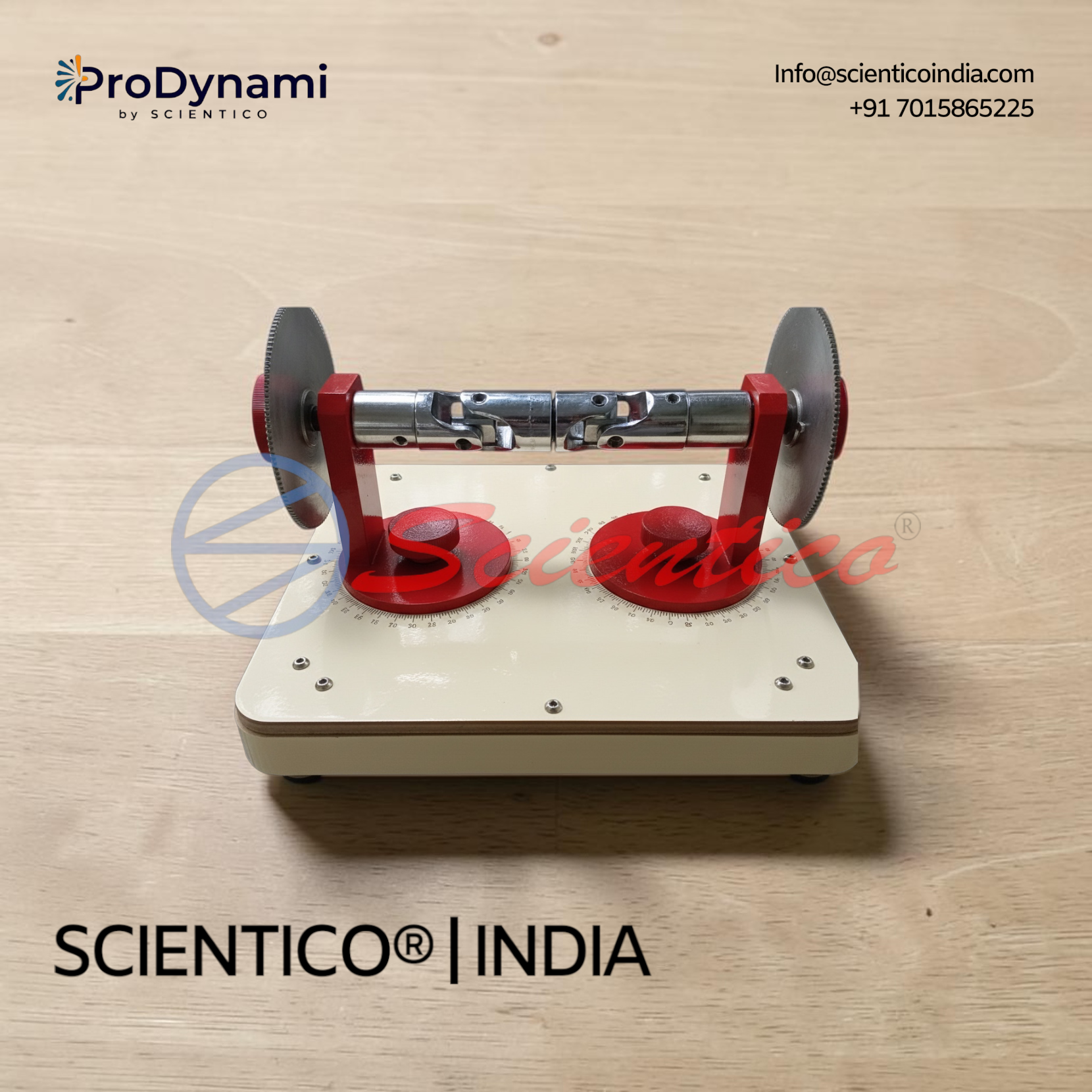
The Hooke's Coupling Apparatus ProDynami - 1280 demonstrates angular motion transmission and gimbal error using two Hooke's couplings connected by a split intermediate shaft. This Hooke's Coupling Apparatus features transparent plastic scales with 1° graduations for measuring shaft angle differences. It includes ball bearing mounted shaft ends and a solid, painted base plate. Drive is achieved by hand wheel for bench top experimentation.
[email protected]
Technical Specifications
Hooke's Coupling Apparatus ProDynami - 1280, Technical Specifications
| Specification | Detail |
|---|---|
| Format | Bench top experiment on gimbal error and its avoidance on articulated joints |
| Hooke's Coupling | Standard industrial parts |
| Scales | Made of transparent plastic |
| Shaft Ends | Ball bearing mounted |
| Base Plate | Solid, painted |
| Demonstration | Representation of universal joint |
Technical Data
| Parameter | Value |
|---|---|
| Shaft diameter | D=18mm |
| Scale disc diameter | D=120mm |
| Scale disc angle | 0….360° |
| Graduations | 1° |
Key Features
Key Features
- Hooke's Couplings: 2, standard industrial parts, connected by a split intermediate shaft
- Shaft Diameter: D=18mm
- Scale Disc Diameter: D=120mm
- Scale Disc Angle: 0 to 360°
- Graduations: 1°
- Shaft Ends: ball bearing mounted
- Base Plate: solid, painted
- Drive Mechanism: hand wheel
- Angle Measurement: transparent plastic scales on drive and power take-off sides, key to gimbal error assessment on this Hooke's Coupling Apparatus
Experiments
- Determination of the gimbal error on Hooke's couplings
Construction and Design
The Hooke's Coupling Apparatus ProDynami - 1280 consists of two Hooke's couplings, standard industrial parts, connected by a split intermediate shaft with a diameter of D=18mm. The deflection angle of both joints can be set individually and read on scales, each with a disc diameter of D=120mm, an angle range of 0 to 360°, and graduations of 1°. Drive is achieved by turning a hand wheel. Angle measuring scales made of transparent plastic are fitted on the drive and power take-off sides, allowing the difference between the angles of the shafts to be determined. Shaft ends are ball bearing mounted, and the base plate is solid and painted.
Scope of Delivery
- 1 Experimental unit
- 1 Instruction manual
Standards & Compliance
- Manufactured under ISO 9001:2015 Quality Management System
- CE Marking - European Conformity where applicable
- Supplied with calibration certificate, operation manual, and experiment guide
- 12-month manufacturer's warranty (parts & labour from installation)
Ordering & Delivery
- Incoterms: CIF to destination seaport, FOB Mundra/Nhava Sheva, or Ex-Works Ambala
- Lead time: 3–5 weeks production + sea transit to destination
- Payment: LC (Letter of Credit) or T/T bank transfer against proforma invoice
- Documentation: commercial invoice, packing list, bill of lading, certificate of origin, insurance certificate
Frequently Asked Questions
Q: What is the Hooke's Coupling Apparatus ProDynami - 1280 used for?
A: It is used to demonstrate the transmission of angular motion to joint shafts, the related gimbal error, and how this error can be rectified using Hooke's couplings.
Q: How many Hooke's couplings does the apparatus have?
A: The apparatus has two Hooke's couplings, connected by a split intermediate shaft.
Q: What is the shaft diameter and scale disc diameter?
A: The shaft diameter is D=18mm, and the scale disc diameter is D=120mm.
Q: How is drive achieved on this apparatus?
A: Drive is achieved by turning a hand wheel.
Q: What is the scale disc angle range and graduation?
A: The scale disc angle ranges from 0 to 360°, with graduations of 1°.