Non Linear Level Control
Model Prozessi PX 31
The Non Linear Level Control trainer Prozessi PX 31 teaches non-linear process control using spherical and conical tanks. Features capacitance level transmitter, pneumatic control valve with I/P converter and NI USB-6001 data acquisition. Nine experiments cover ON/OFF and PID control with open/closed loop tuning and Bode plot stability analysis. LabVIEW software with data logging and trend plots. Tabletop assembly 550W x 475D x 520H mm requires clean compressed air at 2 Bar.
The Non Linear Level Control trainer Prozessi PX 31 teaches non-linear control principles using spherical and conical process tanks. This Non Linear Level Control system demonstrates how tank geometry affects control dynamics and response characteristics through hands-on PID tuning experiments.
Product Overview
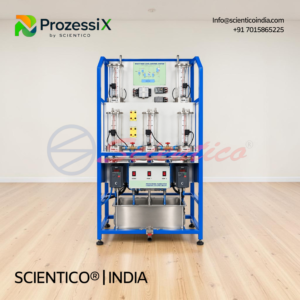
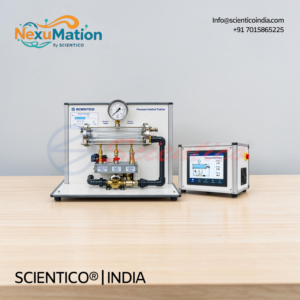
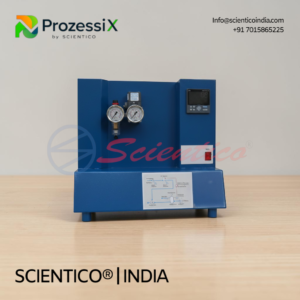
The Non Linear Level Control trainer Prozessi PX 31 features an SS304 spherical tank and a transparent acrylic cylindrical tank with a conical conversion kit to study how tank cross-section affects control behavior. A capacitance level transmitter (0-500 mmH₂O, 4-20 mA output) monitors tank level. An I/P converter transforms control signals into 3-15 psig pneumatic commands for a 1/4″ linear pneumatic control valve. A fractional horsepower submersible pump circulates distilled water from the supply tank. Two rotameters (16-160 LPH and 40-400 LPH) provide flow measurement. An NI USB-6001 data acquisition module with 4 analog inputs and 2 outputs connects via USB to a computer. LabVIEW-based software allows real-time PID control, tuning, data logging and Bode plot stability analysis. An air regulator and two pressure gauges monitor pneumatic pressure. The system measures 550W x 475D x 520H mm and requires clean compressed air at 2 Bar, 50 LPH.
Non Linear Level Control Trainer Prozessi PX 31 — Technical Specifications
| Specification | Value |
|---|---|
| Product Code | Prozessi PX 31 |
| Level Transmitter | Capacitance, Two wire, 0-500 mmH₂O, 4-20 mA output |
| I/P Converter | Input 4-20 mA, Output 3-15 psig |
| Control Valve | Pneumatic, 1/4″ size, 3-15 psig, Air to close, Linear characteristic |
| Process Tanks | SS spherical, Acrylic cylindrical with conical conversion kit |
| Rotameter 1 | 16-160 LPH range |
| Rotameter 2 | 40-400 LPH range |
| Pump | Fractional horsepower, Submersible type |
| Supply Tank | SS304 stainless steel |
| Computer Interface | NI USB-6001, 14-bit, 20 KS/S, AI 4, AO 2 |
| Air Regulator | Range 0-2.5 kg/cm² |
| Pressure Gauges | 0-2.5 kg/cm² (1 unit), 0-7 kg/cm² (1 unit) |
| Overall Dimensions | 550W x 475D x 520H mm |
Technical Data
Level Measurement and Control
| Component | Specification |
|---|---|
| Level Transmitter | Capacitance type, Two wire, 4-20 mA output |
| Transmitter Range | 0-500 mmH₂O |
| I/P Converter Input | 4-20 mA electrical signal |
| I/P Converter Output | 3-15 psig pneumatic signal |
| Control Valve | 1/4″ pneumatic, Linear characteristic |
| Valve Actuation | 3-15 psig pneumatic input |
| Valve Action | Air to close |
Process Tank Configurations
| Tank Type | Description |
|---|---|
| Spherical Tank | SS304 stainless steel, non-linear cross-section |
| Cylindrical Tank | Transparent acrylic for visual observation |
| Conical Conversion Kit | Converts cylindrical to conical geometry for non-linear study |
Data Acquisition and Communication
| Component | Specification |
|---|---|
| DAQ Device | NI USB-6001, 14-bit resolution, 20 KS/S sampling |
| Analog Inputs | 4 channels (transmitter signals) |
| Analog Outputs | 2 channels (control valve command) |
| Communication | USB port to computer |
| Software | LabVIEW-based with real-time control |
Pneumatic and Water Systems
| Component | Specification |
|---|---|
| Air Regulator | Range 0-2.5 kg/cm² |
| Pressure Gauge 1 | Range 0-2.5 kg/cm² |
| Pressure Gauge 2 | Range 0-7 kg/cm² |
| Water Pump | Fractional horsepower, Submersible |
| Rotameter 1 | 16-160 LPH direct reading |
| Rotameter 2 | 40-400 LPH direct reading
Key Features
Experiments
Construction and Design The Non Linear Level Control trainer Prozessi PX 31 is assembled on a tabletop frame (550W x 475D x 520H mm) with two distinct process tank configurations. An SS304 spherical tank provides a non-linear cross-sectional area that changes with height, creating variable process dynamics. A transparent acrylic cylindrical tank with a conical conversion kit allows students to reconfigure tank geometry and observe how shape affects control response. A capacitance level transmitter mounted on each tank senses level and outputs 4-20 mA signals. An I/P converter receives control signals from the computer via the NI USB-6001 DAQ module and outputs proportional pneumatic pressure (3-15 psig) to a 1/4″ linear pneumatic control valve. The valve manipulates water flow into the process tank. A fractional horsepower submersible pump circulates water from an SS304 supply tank. Two rotameters (16-160 LPH and 40-400 LPH) provide independent flow measurement across different ranges. An air regulator (0-2.5 kg/cm²) and two pressure gauges monitor pneumatic system pressure. The system requires clean, oil and moisture-free compressed air at 2 Bar, 50 LPH consumption. Software LabVIEW-based control software provides real-time level monitoring and PID controller implementation. Features include ON/OFF and proportional-integral-derivative control modes, open and closed loop tuning by process reaction curve or Ziegler-Nichols method, Bode plot generation for stability analysis, data access, trend plot generation, data logging and data export functions. Scope of Delivery
Optional Accessories
|
Key Features
- Non Linear Level Control: dual tank geometry for comparative study
- Spherical and conical tanks demonstrate non-linear process dynamics
- Capacitance level transmitter with 4-20 mA output
- Pneumatic control valve with I/P converter for smooth actuation
- NI USB-6001 DAQ with real-time computer control
- LabVIEW software with ON/OFF, P, PI, PD and PID control modes
- Open and closed loop tuning methods
- Bode plot stability analysis capability
- Two rotameters for multi-range flow measurement
- Data logging, trend plots and export functionality
Experiments
- Study of open loop response (Manual control)
- Study of on/off controller
- Study of proportional controller
- Study of proportional integral controller
- Study of proportional derivative controller
- Study of PID controller
- Tuning of controller (Open loop method)
- Tuning of controller (Closed loop method)
- Study of stability of the system (Bode plot)
Construction and Design
The Non Linear Level Control trainer Prozessi PX 31 is assembled on a tabletop frame (550W x 475D x 520H mm) with two distinct process tank configurations. An SS304 spherical tank provides a non-linear cross-sectional area that changes with height, creating variable process dynamics. A transparent acrylic cylindrical tank with a conical conversion kit allows students to reconfigure tank geometry and observe how shape affects control response. A capacitance level transmitter mounted on each tank senses level and outputs 4-20 mA signals. An I/P converter receives control signals from the computer via the NI USB-6001 DAQ module and outputs proportional pneumatic pressure (3-15 psig) to a 1/4″ linear pneumatic control valve. The valve manipulates water flow into the process tank. A fractional horsepower submersible pump circulates water from an SS304 supply tank. Two rotameters (16-160 LPH and 40-400 LPH) provide independent flow measurement across different ranges. An air regulator (0-2.5 kg/cm²) and two pressure gauges monitor pneumatic system pressure. The system requires clean, oil and moisture-free compressed air at 2 Bar, 50 LPH consumption.
Software
LabVIEW-based control software provides real-time level monitoring and PID controller implementation. Features include ON/OFF and proportional-integral-derivative control modes, open and closed loop tuning by process reaction curve or Ziegler-Nichols method, Bode plot generation for stability analysis, data access, trend plot generation, data logging and data export functions.
Scope of Delivery
- Non Linear Level Control trainer Prozessi PX 31 complete assembly
- SS304 spherical process tank
- Transparent acrylic cylindrical tank with conical conversion kit
- Capacitance level transmitter with 4-20 mA output
- I/P converter with inlet and outlet connectors
- 1/4″ pneumatic control valve, linear characteristic
- Fractional horsepower submersible pump
- SS304 supply tank
- Two rotameters (16-160 LPH and 40-400 LPH)
- NI USB-6001 DAQ device with USB cable
- Air regulator and pressure gauges
- LabVIEW control software with training materials
- Interconnecting tubing and fittings
- Frame assembly, 550W x 475D x 520H mm
- User documentation and experimental procedures
- Power cord
Optional Accessories
- Support table, 800W x 800D x 750H mm
- Additional level transmitter units
- Mini compressor for independent air supply
- Extended USB cable for remote operation
Q1: Why is non-linear level control important?
A: Many industrial tanks are spherical or have irregular cross-sections, causing level change rate to vary with height. Non-linear control compensates for this geometry effect to maintain stable level control.
Q2: How does tank geometry affect control response on the Non Linear Level Control trainer?
A: The spherical tank has a small cross-section at the bottom and large section at the top, so the same flow change produces different rate of level change at different heights. The conical tank shows another non-linear geometry.
Q3: Can the conical tank be converted back to cylindrical?
A: Yes, the conical conversion kit is removable, allowing students to study both cylindrical (linear) and conical (non-linear) control dynamics on the same system.
Q4: What tuning methods are supported?
A: The Non Linear Level Control trainer supports open loop tuning by process reaction curve method and closed loop tuning by Ziegler-Nichols method with automatic or manual parameter adjustment.
Q5: What data can be logged and exported?
A: The LabVIEW software logs real-time level, control valve output, error signal and time data. All logged data can be exported for offline analysis in Excel or MATLAB.
Need Assistance? We're Here to Help!
Connect with our team for product specifications, pricing, and customized solutions for your institution or project.