Radial Heat Conduction Module | ThermoFlux - 7049/2
Product Overview
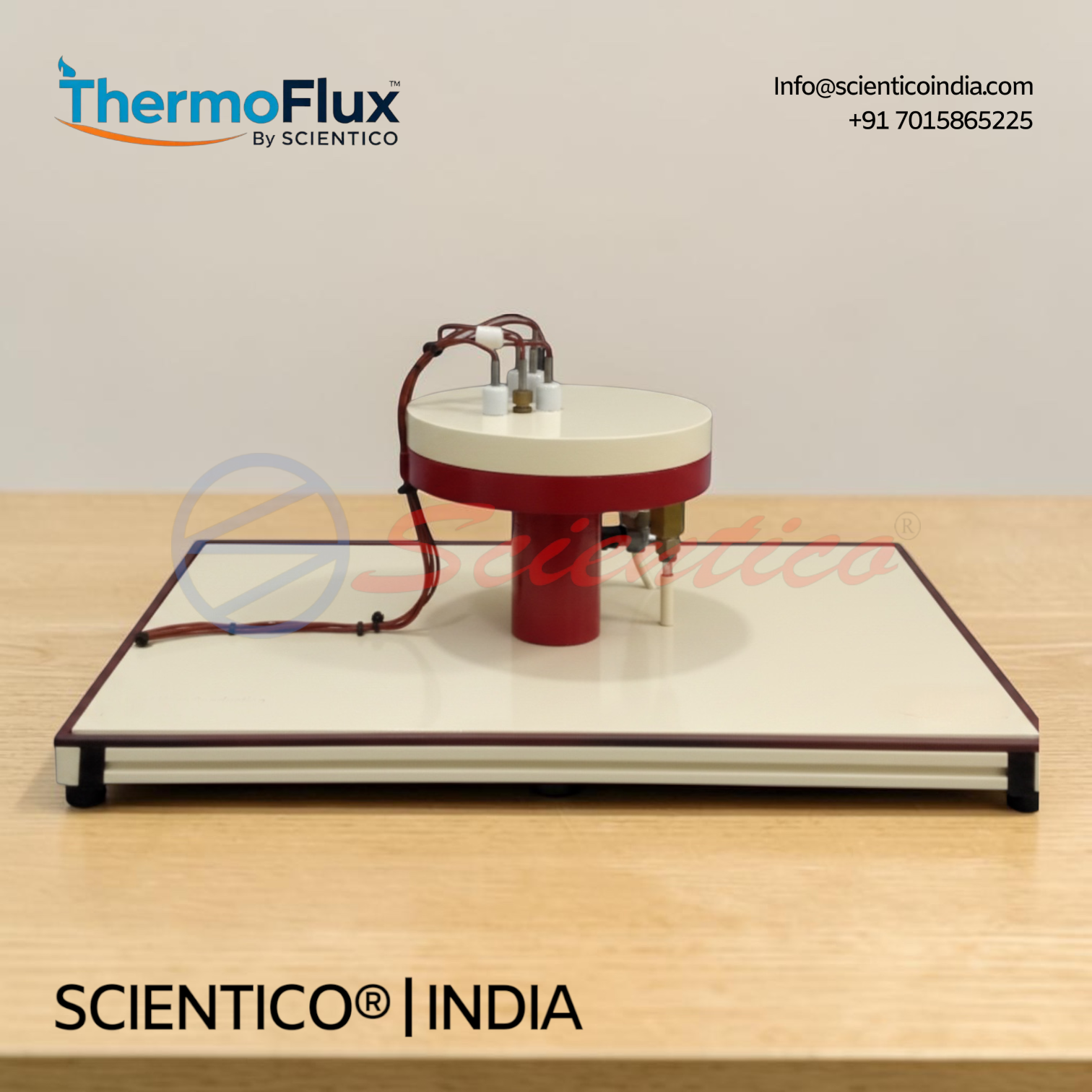
The Radial Heat Conduction Module ThermoFlux-7049/2 is a bench-mounted thermodynamics accessory for investigating radial heat conduction through a solid brass disc (110 mm diameter, 6 mm thickness). This radial heat conduction module uses a centre-mounted electric heater and peripheral water cooling to establish a steady radial temperature gradient, with six equally spaced thermocouple measurement points providing a complete radial temperature profile. It supports steady-state and unsteady-state conduction experiments, Fourier Rate Equation analysis, and thermal conductivity (k) determination for the disc material. The Heat Transfer Service Unit ThermoFlux-7049 is required for operation and sold separately.
[email protected]
Technical Specifications
Technical Specifications
| Parameter | Detail |
|---|---|
| Model Reference | ThermoFlux-7049/2 |
| Category | Thermodynamics |
| Disc Material | Brass |
| Disc Diameter | 110 mm |
| Disc Thickness | 6 mm |
| Heating Method | Electric heater at disc centre |
| Cooling Method | Water flow through copper tube bonded to disc periphery |
| Thermocouple Positions | 6, at equal radial increments from centre to edge |
| Thermocouple Connection | Direct to Heat Transfer Service Unit ThermoFlux-7049 |
| Mounting | Bench support frame |
| Required for Operation | Heat Transfer Service Unit ThermoFlux-7049 (sold separately) |
Technical Data
Radial Module
| Parameter | Value |
|---|---|
| Material | Brass |
| Diameter | 110 mm |
| Thickness | 6 mm |
| Heating | Electric heater at centre |
| Cooling | Water flow through bonded copper tube at periphery |
| Thermocouple Holes | 6, equally spaced radially |
Key Features
Key Features
- Disc Geometry: brass disc, 110 mm diameter, 6 mm thickness, specifically designed for radial conduction experiments
- Centre Heating: electric heater at disc centre, power controlled and measured by Heat Transfer Service Unit ThermoFlux-7049
- Peripheral Cooling: water flow through a copper tube bonded to the disc periphery maintains a steady temperature gradient on this radial heat conduction module
- Thermocouple Layout: 6 holes at equal radial increments from heated centre to cooled edge for complete radial temperature profiling
- Real-Time Monitoring: thermocouples connect directly to Heat Transfer Service Unit digital panel meter
- Steady and Unsteady State: supports both steady-state temperature distribution and unsteady-state conduction time analysis
- Thermal Conductivity Determination: Fourier Rate Equation applied to calculate thermal conductivity (k) of the brass disc
- Mounting: bench support frame for stable, compact laboratory installation
- Required for Operation: Heat Transfer Service Unit ThermoFlux-7049, sold separately
Experiments
- Measure the temperature distribution during steady-state conduction of heat energy through the wall of a thick cylinder, demonstrating radial energy flow
- Demonstrate the impact of variations in heat flow on the temperature distribution
- Understand the application of the Fourier Rate Equation in calculating the rate of heat flow during steady-state conduction through the wall of a thick cylinder
- Observe unsteady-state conduction of heat in the system
- Use the Fourier Rate Equation to determine the constant of proportionality (thermal conductivity, k) for the disc material
- Analyse the time required to reach stable thermal conditions during unsteady-state conduction
- Investigate the effects of different materials on thermal conductivity through comparative measurements
- Explore practical applications of thermal conductivity in real-world and engineering contexts
Construction and Design
The Radial Heat Conduction Module ThermoFlux-7049/2 is constructed around a circular brass disc measuring 110 mm in diameter and 6 mm in thickness, mounted on a bench support frame. The disc is insulated to minimise external heat loss and ensure that conduction occurs primarily in the radial direction. An electric heater positioned at the centre of the disc provides the heat source, with power supply, control, and measurement handled by the Heat Transfer Service Unit ThermoFlux-7049. A copper tube is bonded to the outer edge of the disc and carries cooling water to maintain the periphery at a lower, consistent temperature, establishing the radial temperature gradient required for conduction experiments. Six thermocouple holes are drilled at equal radial increments between the centre and the edge, providing six discrete measurement points across the full radial span of this radial heat conduction module. Thermocouples inserted into these holes connect directly to the Heat Transfer Service Unit for real-time digital temperature display. The setup allows full investigation of steady-state radial conduction and transient unsteady-state behaviour, with all data required for Fourier Rate Equation calculations available from the six radial temperature readings and the measured heater power input.
Required for Operation (Sold Separately)
- Heat Transfer Service Unit ThermoFlux-7049: provides heater power control, power measurement, and digital temperature display for thermocouple inputs
Scope of Delivery
- 1 experimental module
- 1 set of hoses
- 1 instruction manual
Standards & Compliance
- Manufactured under ISO 9001:2015 Quality Management System
- CE Marking - European Conformity where applicable
- Supplied with calibration certificate, operation manual, and experiment guide
- 12-month manufacturer's warranty (parts & labour from installation)
Ordering & Delivery
- Incoterms: CIF to destination seaport, FOB Mundra/Nhava Sheva, or Ex-Works Ambala
- Lead time: 3–5 weeks production + sea transit to destination
- Payment: LC (Letter of Credit) or T/T bank transfer against proforma invoice
- Documentation: commercial invoice, packing list, bill of lading, certificate of origin, insurance certificate
Frequently Asked Questions
Q1: What is the disc material and geometry used in the Radial Heat Conduction Module ThermoFlux-7049/2?
The disc is made of brass, 110 mm in diameter and 6 mm thick, with an electric heater at the centre and a copper cooling tube bonded to the periphery.
Q2: How many temperature measurement points are available on this radial heat conduction module?
Six thermocouple holes are positioned at equal radial increments from the heated centre to the cooled edge of the disc, providing a complete radial temperature profile.
Q3: Is the Heat Transfer Service Unit included with the ThermoFlux-7049/2?
No. The Heat Transfer Service Unit ThermoFlux-7049 is required for operation and must be ordered separately. It provides heater power control, power measurement, and digital temperature display.
Q4: What equation is used to determine thermal conductivity from the experimental data?
The Fourier Rate Equation is applied to the measured radial temperature distribution and heater power input to calculate the thermal conductivity (k) of the brass disc material.
Q5: Does the module support unsteady-state as well as steady-state conduction experiments?
Yes. The module supports both steady-state radial temperature distribution experiments and unsteady-state conduction analysis, including measurement of the time required to reach stable thermal conditions.