Roof Truss Apparatus | FrixoDynamics FX-502
Product Overview
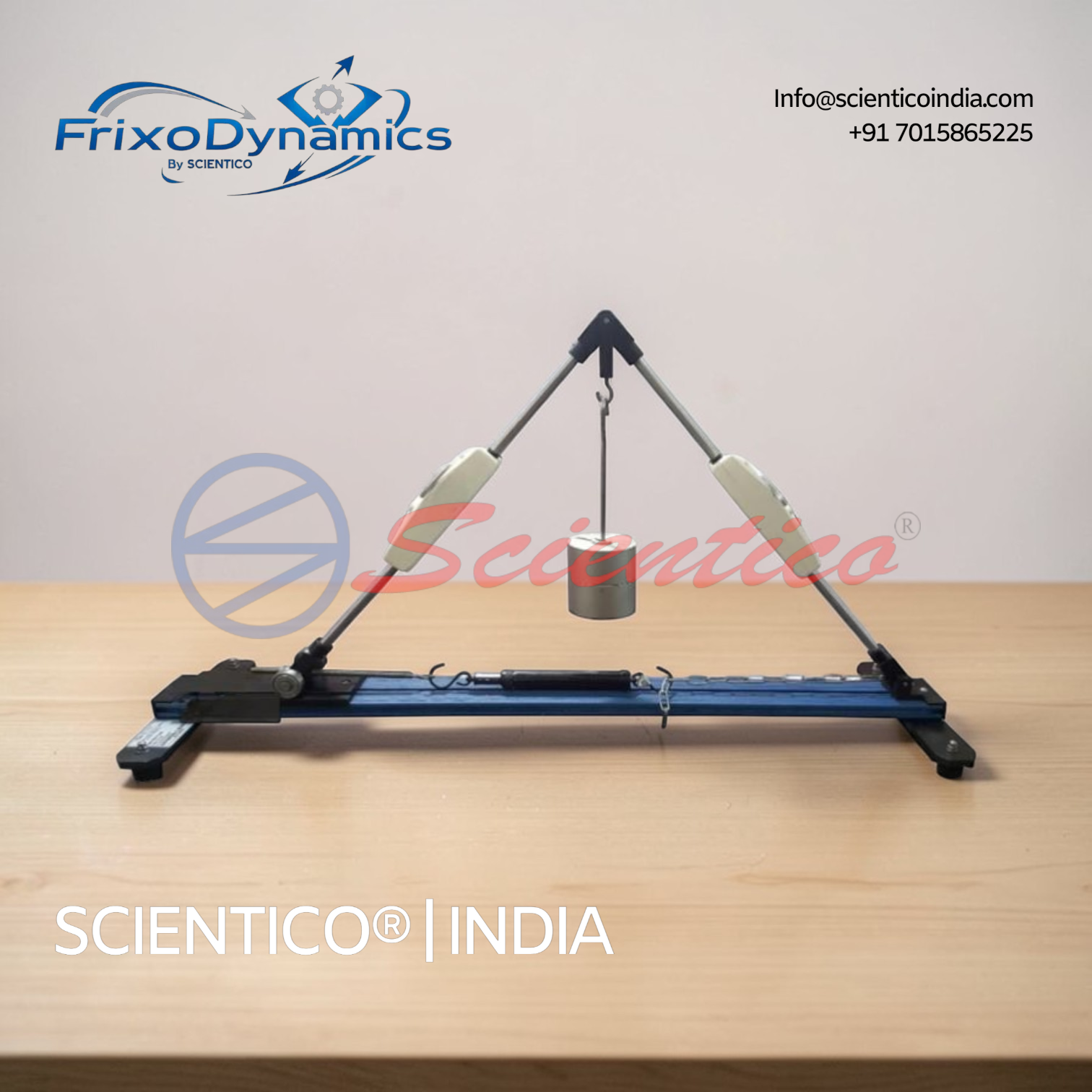
A CE-certified precision laboratory apparatus for engineering experimentation and technical education, manufactured by Scientico India to ISO 9001:2015 standards. Supplied with calibration certificate, operation manual, and complete export documentation. Designed for Forces and Friction laboratories in engineering colleges and technical institutions.
[email protected]
Technical Specifications
| Parameter | Specification |
|---|---|
| Model | FrixoDynamics FX-502 |
| Rafter Bar Length | 440–600 mm (approximately, fixed length) |
| Adjustable Tie Bar Length | Free adjustable up to 950 mm |
| Angle Configurations | 60°–60°–60° / 45°–90°–45° / 30°–120°–30° (minimum); infinite intermediate angles possible |
| Force Gauge (x2) | Range: 0–100 N, Graduation: 1 N |
| Spring Balance (x1) | Range: 0–10 kg, Graduation: 50 g |
| Scale Rule | 1 metre, Graduation: 1 mm |
| Pin Joints | 3 total, 2 serving as supports (1 fixed, 1 free longitudinal with bearings) |
| Base Frame | Sturdy aluminium section |
| Weight Set | 1 x 1 N hanger, 3 x 2 kg, 3 x 1 kg |
| Scope of Delivery | 1 experimental unit, 2 bars, 1 spring balance, 1 chain, 1 set of weights, 1 metre tape/steel rule, 1 instructional manual |
Key Features
Key Features
- Two rafter bars with integrated compression force gauges for direct bar force measurement
- One adjustable tie member with spring balance for direct tension measurement
- Longitudinally adjustable chain mechanism allows truss geometry to be reconfigured to multiple angle configurations
- Three pin joints, two forming supports (one fixed, one free with bearings), accurately model real truss boundary conditions
- Loads applied exclusively at nodes, ensuring pure axial (tension/compression) loading in all members
- Supports three experimental methods: direct measurement, method of joints calculation, and graphical force resolution
- Sturdy aluminium base frame with stable support clamping for repeatable test conditions
- Complete weight set, metre tape, and instructional manual included
Applications
- Measurement of bar forces (ties and rafters) under applied nodal loads
- Calculation of bar forces using the method of joints
- Comparison of experimental measurement, analytical calculation, and graphical resolution results
- Resolution of forces in a single-plane, statically determinate pin-jointed system
- Investigation of how truss geometry and member angles affect internal bar forces
- Undergraduate laboratory practicals in structural mechanics, civil engineering, and mechanical engineering
Construction and System Design
The FX-502 is built on a sturdy aluminium section base frame that provides stable, accurate support locations for the truss assembly. Two rafter bars of approximately 440–600 mm length are fitted with compression force gauges and connected to the frame via pin joints at their lower ends. The upper ends meet at the apex pin joint, where external dead weights are applied. The third member, the horizontal tie, is length-adjustable up to 950 mm via a chain mechanism, allowing the apex angle and overall truss geometry to be varied continuously.
All three members are joined using pin joints that are free to rotate, ensuring no moment transfer between members and maintaining the statically determinate condition throughout. The two lower support pin joints are clamped to the base frame: one is fully fixed, and the other is free to move longitudinally on bearings, replicating the roller support condition used in structural analysis. Each member carries its own force measurement device, two compression gauges on the rafters and a spring balance on the tie, enabling independent force readings for each element simultaneously.
Export and Supply Capability
The SCIENTICO FrixoDynamics FX-502 is available for supply to engineering colleges, technical universities, civil and mechanical engineering departments, research institutions, and industrial training centres. SCIENTICO manufactures and exports laboratory equipment to institutions and distributors across multiple regions. Standard packaging is suitable for international shipment. Bulk orders, customised configurations, and institutional procurement enquiries are welcomed. Please contact SCIENTICO directly for pricing, lead times, and shipping terms.
Standards & Compliance
- Manufactured under ISO 9001:2015 Quality Management System
- CE Marking - European Conformity where applicable
- Supplied with calibration certificate, operation manual, and experiment guide
- 12-month manufacturer's warranty (parts & labour from installation)
Ordering & Delivery
- Incoterms: CIF to destination seaport, FOB Mundra/Nhava Sheva, or Ex-Works Ambala
- Lead time: 3–5 weeks production + sea transit to destination
- Payment: LC (Letter of Credit) or T/T bank transfer against proforma invoice
- Documentation: commercial invoice, packing list, bill of lading, certificate of origin, insurance certificate
Frequently Asked Questions
Q1: What is a roof truss apparatus used for in an engineering laboratory?
A roof truss apparatus is used to study the internal forces in the members of a statically determinate pin-jointed truss under applied loads. Students measure bar forces directly using force gauges, then verify those results through analytical calculation using the method of joints and through graphical force resolution, developing both experimental and theoretical competency in structural mechanics.
Q2: What is the method of joints, and how does the FX-502 support it?
The method of joints is an analytical technique for determining the forces in each member of a truss by applying equilibrium equations at each pin joint in sequence. The FX-502 supports this method by providing direct force gauge readings for each member, which students can compare against calculated values. This comparison validates the analytical method and highlights any real-world deviations due to friction or imperfect pin joints.
Q3: Why are loads applied only at the nodes in this apparatus?
Applying loads only at the nodes, the pin joint locations, ensures that each member carries only axial force (tension or compression) with no bending moment. This is the defining condition of a simple truss and is required for the method of joints to be applicable. The FX-502 is designed to maintain this condition throughout all experiments.
Q4: Can the truss geometry be changed on the FX-502?
Yes. The tie member is length-adjustable up to 950 mm via an integrated chain mechanism, allowing the angle between truss members to be varied continuously. Standard configurations include 60°–60°–60°, 45°–90°–45°, and 30°–120°–30°, with infinite intermediate positions available. This allows students to investigate how changes in geometry affect the magnitude and distribution of bar forces.
Q5: What is included in the scope of delivery for the FX-502?
The FX-502 is supplied as a complete experimental kit including: one experimental unit (aluminium base frame, two rafter bars with compression force gauges, one adjustable tie with spring balance and chain, three pin joints), one set of calibrated weights (1 x 1 N hanger, 3 x 2 kg, 3 x 1 kg), one metre tape/steel rule, and one instructional manual covering experimental procedures, calculation methods, and data recording.