Rubber Shear Apparatus | FrixoDynamics FX-500
Product Overview
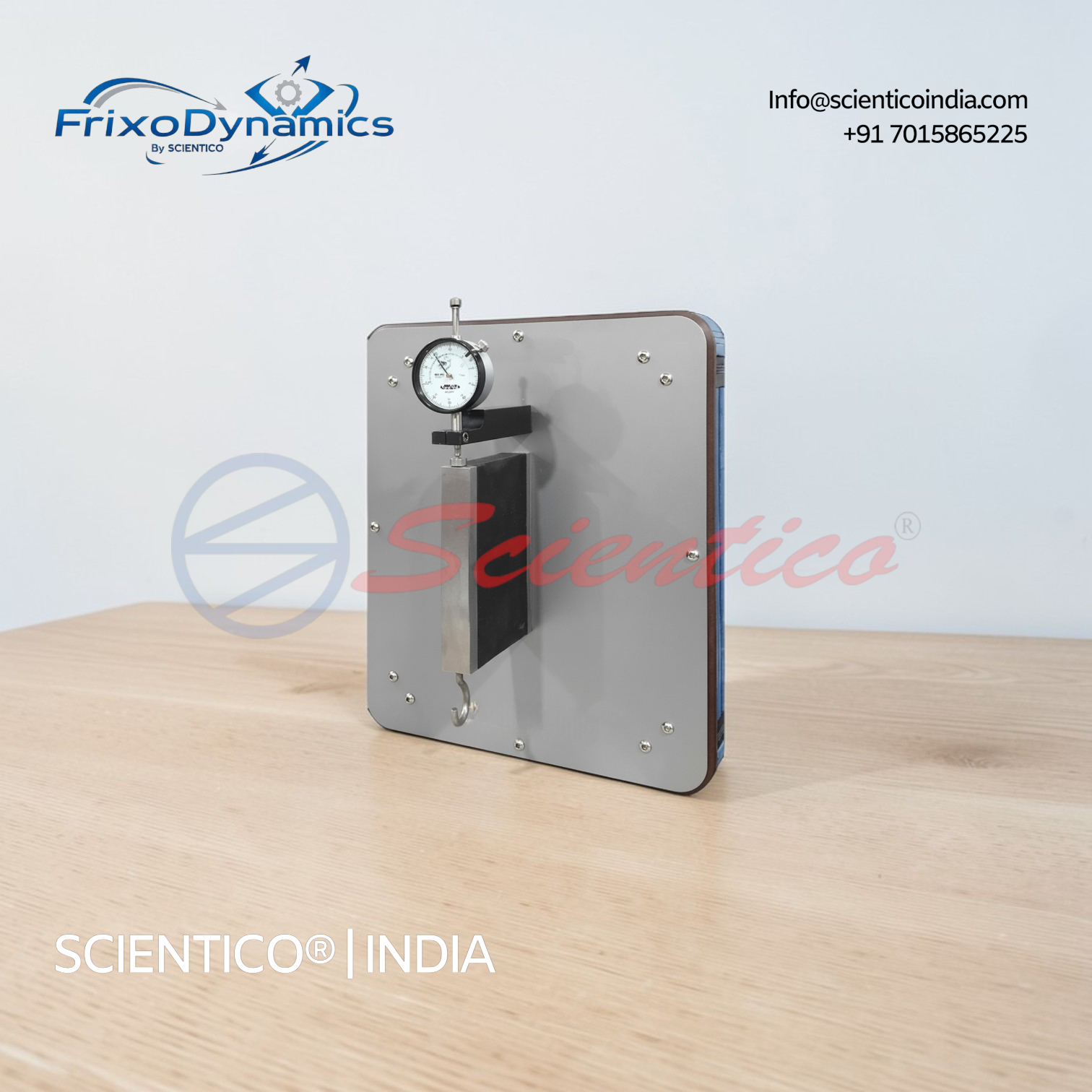
A CE-certified precision laboratory apparatus for engineering experimentation and technical education, manufactured by Scientico India to ISO 9001:2015 standards. Supplied with calibration certificate, operation manual, and complete export documentation. Designed for Forces and Friction laboratories in engineering colleges and technical institutions.
[email protected]
Technical Specifications
| Parameter | Specification |
|---|---|
| Model | FrixoDynamics FX-500 |
| Rubber Block Dimensions | 195 x 100 x 25 mm |
| Dial Gauge Range / Resolution | 20 mm / 0.01 mm |
| Maximum Load Capacity | 9 kg |
| Plate Material | Aluminium Alloy |
| Weight Set Included | 1 x 1 N hanger, 4 x 2 kg, 1 x 1 kg |
| Scope of Delivery | 1 experimental unit, 1 set of weights, 1 instructional manual |
Key Features
Key Features
- Direct shear loading via dead weights with a maximum capacity of 9 kg
- Precision dial gauge (20 mm range, 0.01 mm resolution) for accurate deflection measurement
- Rubber block (195 x 100 x 25 mm) bonded between aluminium alloy plates for repeatable shear testing
- Wall-mounted fixed plate with bolted connection ensures a stable, rigid boundary condition
- Clear mechanical setup allows step-by-step load application and deformation recording
- Demonstrates hysteresis in elastomeric materials, directly applicable to industrial vibration isolation
- Complete weight set and instructional manual included
Applications
- Determination of the variation of shear deflection with applied load
- Calculation of the modulus of rigidity (shear modulus) of a rubber block
- Investigation of the relationship between shear stress and shear strain
- Demonstration of hysteresis behaviour in elastomeric materials under cyclic loading
- Study of vibration isolation principles using rubber as a flexible mounting medium
- Undergraduate and postgraduate laboratory practicals in mechanical engineering and materials science
Construction and System Design
The FX-500 is built around a rubber block of 195 x 100 x 25 mm, bonded on both faces to aluminium alloy plates. The bonding ensures full shear force transfer between the plates and the rubber body without slippage. The fixed plate is attached to a rigid wall or test frame via bolts, providing a stable reference surface. The free plate carries a hook from which calibrated dead weights are suspended.
A dial gauge, mounted on a rigid bracket, contacts the free plate and measures shear deformation with a resolution of 0.01 mm over a 20 mm travel range. This level of precision is sufficient to capture incremental deformation at each loading step. The design is intentionally straightforward, minimising setup time while delivering repeatable and accurate experimental results.
Export and Supply Capability
The SCIENTICO FrixoDynamics FX-500 is available for supply to engineering colleges, technical universities, mechanical engineering departments, research institutions, and industrial training centres. SCIENTICO manufactures and exports laboratory equipment to institutions and distributors across multiple regions. Standard packaging is suitable for international shipment. Bulk orders, customised configurations, and institutional procurement enquiries are welcomed. Please contact SCIENTICO directly for pricing, lead times, and shipping terms.
Standards & Compliance
- Manufactured under ISO 9001:2015 Quality Management System
- CE Marking - European Conformity where applicable
- Supplied with calibration certificate, operation manual, and experiment guide
- 12-month manufacturer's warranty (parts & labour from installation)
Ordering & Delivery
- Incoterms: CIF to destination seaport, FOB Mundra/Nhava Sheva, or Ex-Works Ambala
- Lead time: 3–5 weeks production + sea transit to destination
- Payment: LC (Letter of Credit) or T/T bank transfer against proforma invoice
- Documentation: commercial invoice, packing list, bill of lading, certificate of origin, insurance certificate
Frequently Asked Questions
Q1: What is a rubber shear apparatus used for?
A rubber shear apparatus is used to study the shear deformation of rubber under applied loads. It allows students to measure deflection at each load increment and use those values to calculate the modulus of rigidity and investigate the shear stress versus shear strain relationship.
Q2: What is the modulus of rigidity, and how is it determined using the FX-500?
The modulus of rigidity, also called the shear modulus, is the ratio of shear stress to shear strain in a material. Using the FX-500, students apply known weights to the free plate, measure the resulting deformation with the dial gauge, and calculate stress and strain from the block dimensions. The slope of the resulting load-deformation graph gives the modulus of rigidity.
Q3: Why is rubber used as the shear body in this apparatus?
Rubber produces significant, measurable deformation under relatively small loads, making it practical for laboratory-scale testing. It also displays hysteresis, a difference between the loading and unloading deformation paths, which is a key property in engineering applications such as vibration isolation, engine mounting, and flexible couplings.
Q4: What is hysteresis, and can the FX-500 demonstrate it?
Hysteresis in materials refers to the energy dissipated during a loading and unloading cycle, seen as a difference between the two deformation paths. The FX-500 demonstrates this by recording deflection readings while incrementally loading and then unloading the rubber block. The resulting loop on a load-deformation graph represents the energy absorbed by the rubber.
Q5: What is included in the scope of delivery for the FX-500?
The FX-500 is supplied as a complete kit including: one experimental unit (rubber block bonded between aluminium alloy plates, dial gauge, and mounting bracket), one set of calibrated weights (1 x 1 N hanger, 4 x 2 kg, 1 x 1 kg), and one instructional manual covering experimental procedures and data recording.