Velocity Joint Apparatus | ProDynami - 1284
Product Overview
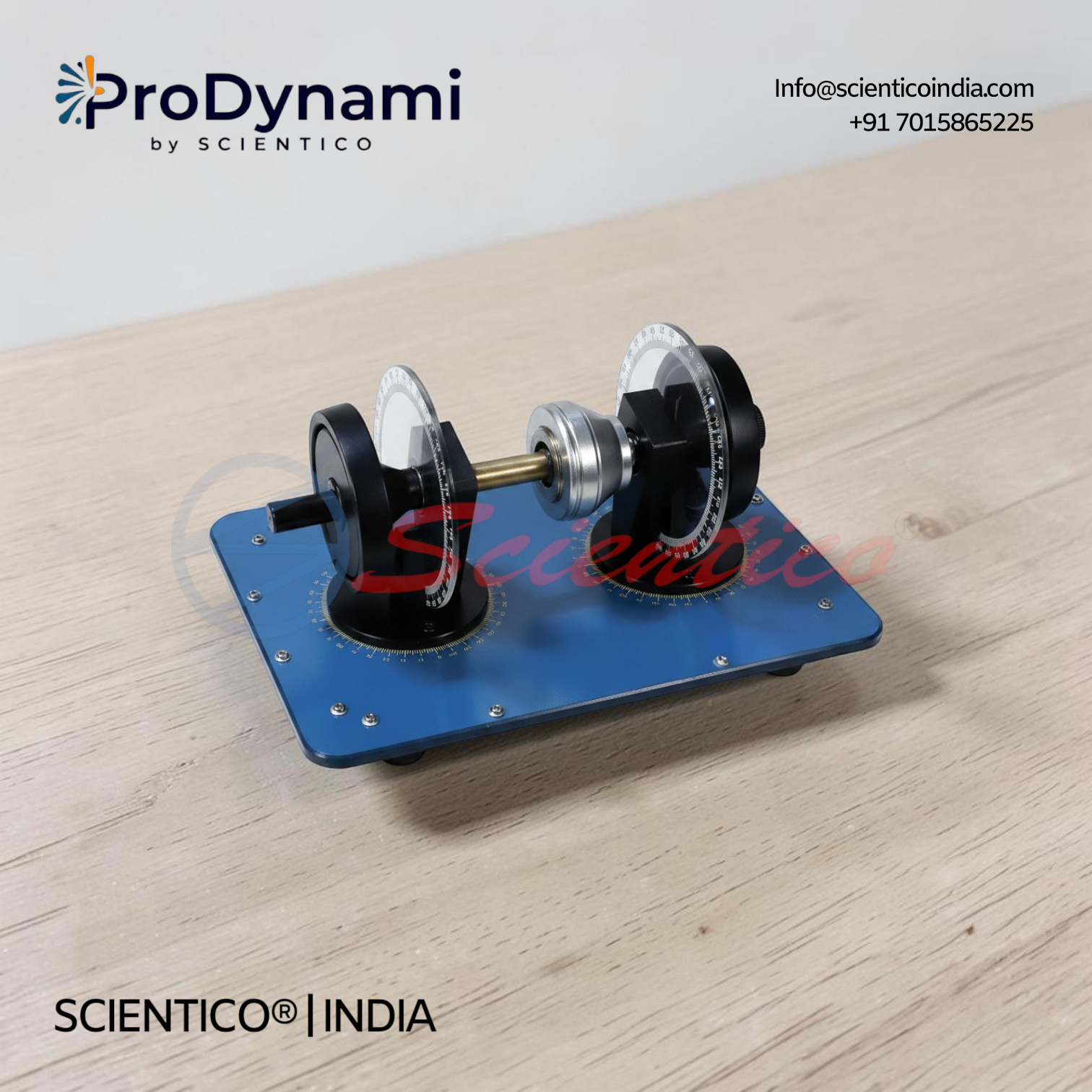
The Velocity Joint Apparatus ProDynami - 1284 demonstrates constant velocity joint operation using two axles with CV joints and angular scales. This Velocity Joint Apparatus features two stainless steel universal joints on ball bearings and three shafts for power transmission. It allows adjustment of joint layout and input angle, with rotary plates measuring output and deflection angles. The apparatus supports precise study of angular difference across rotational positions.
[email protected]
Technical Specifications
Velocity Joint Apparatus ProDynami - 1284, Technical Specifications
| Specification | Detail |
|---|---|
| Layout Adjustment | Adjustment of the layout of the universal joints |
| Angle Measurement | Measure the output angle of rotation and the deflection angle via two rotary plates |
| Angular Difference | Determine the angular difference |
| Input Angle Adjustment | Adjustment of the input angle of the drive universal joint |
Technical Data
Universal Joint
| Parameter | Value |
|---|---|
| Quantity | 2 |
| Diameter | 16mm |
| Standard parts | Stainless steel |
| Material | Stainless steel |
| Bearing type | Ball bearings |
Shaft
| Parameter | Value |
|---|---|
| Quantity | 3 |
Key Features
Key Features
- Universal Joints: 2, standard parts, 16mm diameter, stainless steel, ball bearing mounted
- Shafts: 3, axle configuration
- Layout Adjustment: universal joint layout adjustable
- Angle Measurement: output angle of rotation and deflection angle measured via two rotary plates
- Angular Difference: determinable between input and output
- Input Angle Control: adjustment of the input angle of the drive universal joint
- Angular Scales: fitted at both axle ends and at the base support
- Constant Velocity Demonstration: power transmission at constant velocity across rotational angles, core to this Velocity Joint Apparatus
Construction and Design
The Velocity Joint Apparatus ProDynami - 1284 consists of two axles, each containing a CV joint at one end and an angular scale at the other end. Two universal joints, standard parts made of stainless steel with a diameter of 16mm, are mounted on ball bearings. Three shafts form the drive configuration. The whole mechanism is placed on supports having an angular scale at the bottom. The layout of the universal joints can be adjusted, and the input angle of the drive universal joint can be set. Two rotary plates measure the output angle of rotation and the deflection angle, allowing the angular difference to be determined.
Scope of Delivery
- 1 Experimental unit
- 1 Instruction manual
Standards & Compliance
- Manufactured under ISO 9001:2015 Quality Management System
- CE Marking - European Conformity where applicable
- Supplied with calibration certificate, operation manual, and experiment guide
- 12-month manufacturer's warranty (parts & labour from installation)
Ordering & Delivery
- Incoterms: CIF to destination seaport, FOB Mundra/Nhava Sheva, or Ex-Works Ambala
- Lead time: 3–5 weeks production + sea transit to destination
- Payment: LC (Letter of Credit) or T/T bank transfer against proforma invoice
- Documentation: commercial invoice, packing list, bill of lading, certificate of origin, insurance certificate
Frequently Asked Questions
Q: What is the Velocity Joint Apparatus ProDynami - 1284 used for?
A: It is used to demonstrate the working of constant velocity joints, showing how power is transmitted from a driving shaft to a driven shaft at constant velocity without significant friction or play.
Q: How many universal joints does the apparatus have?
A: The apparatus has 2 universal joints, made of stainless steel with a diameter of 16mm, mounted on ball bearings.
Q: How is the angular difference measured?
A: Two rotary plates measure the output angle of rotation and the deflection angle, allowing the angular difference to be determined.
Q: Can the input angle of the drive universal joint be adjusted?
A: Yes, the input angle of the drive universal joint can be adjusted.
Q: How many shafts are included in the apparatus?
A: The apparatus includes 3 shafts.