Visualization of Flow Fields | FluidoSurge-X 298
Product Overview
A CE-certified precision laboratory apparatus for engineering experimentation and technical education, manufactured by Scientico India to ISO 9001:2015 standards. Supplied with calibration certificate, operation manual, and complete export documentation. Designed for Fluid Mechanics laboratories in engineering colleges and technical institutions.
[email protected]
Technical Specifications
| Parameter | Specification |
|---|---|
| Apparatus Type | Flow field visualization unit |
| Visualization Method | Hydrogen bubble technique |
| Cathode Material | Platinum wire |
| Anode Material | Stainless steel plate |
| Number of Cathodes | 3 |
| Cathode Wire Diameter | 0.2 mm |
| Cathode Lengths | 30 mm, 50 mm, 75 mm |
| Water Channel Volume | Approx. 6 L |
| Experimental Section (L x W x H) | 550 x 150 x 50 mm |
| Illumination | White LEDs on side walls |
| Flow Straightener | Provided |
| Flow Smoothing Medium | Glass spheres |
Pump
| Parameter | Specification |
|---|---|
| Type | Variable speed circulating pump |
| Maximum Flow Rate | 20 L/min |
Bubble Generator
| Parameter | Specification |
|---|---|
| Current Range | 0 to 200 mA |
| Pulse Duration | 8.4 to 1800 ms |
| Pause Duration | 8.4 to 1800 ms |
Key Features
Key Features
-
Visualization of two-dimensional flow fields in water
-
Electrolytic hydrogen bubble generation for fine flow tracing
-
Adjustable bubble generation parameters with display
-
Shallow water channel for low-velocity flow experiments
-
Indirect LED illumination for high-contrast observation
-
Interchangeable models for flow around and through bodies
-
Smooth, low-turbulence flow using straightener and glass spheres
Applications
-
Fluid mechanics laboratory experiments
-
Study of laminar and turbulent flow behavior
-
Visualization of streamline patterns
-
Investigation of flow separation and vortex formation
-
Qualitative analogy of air flow phenomena
Construction & Design Details
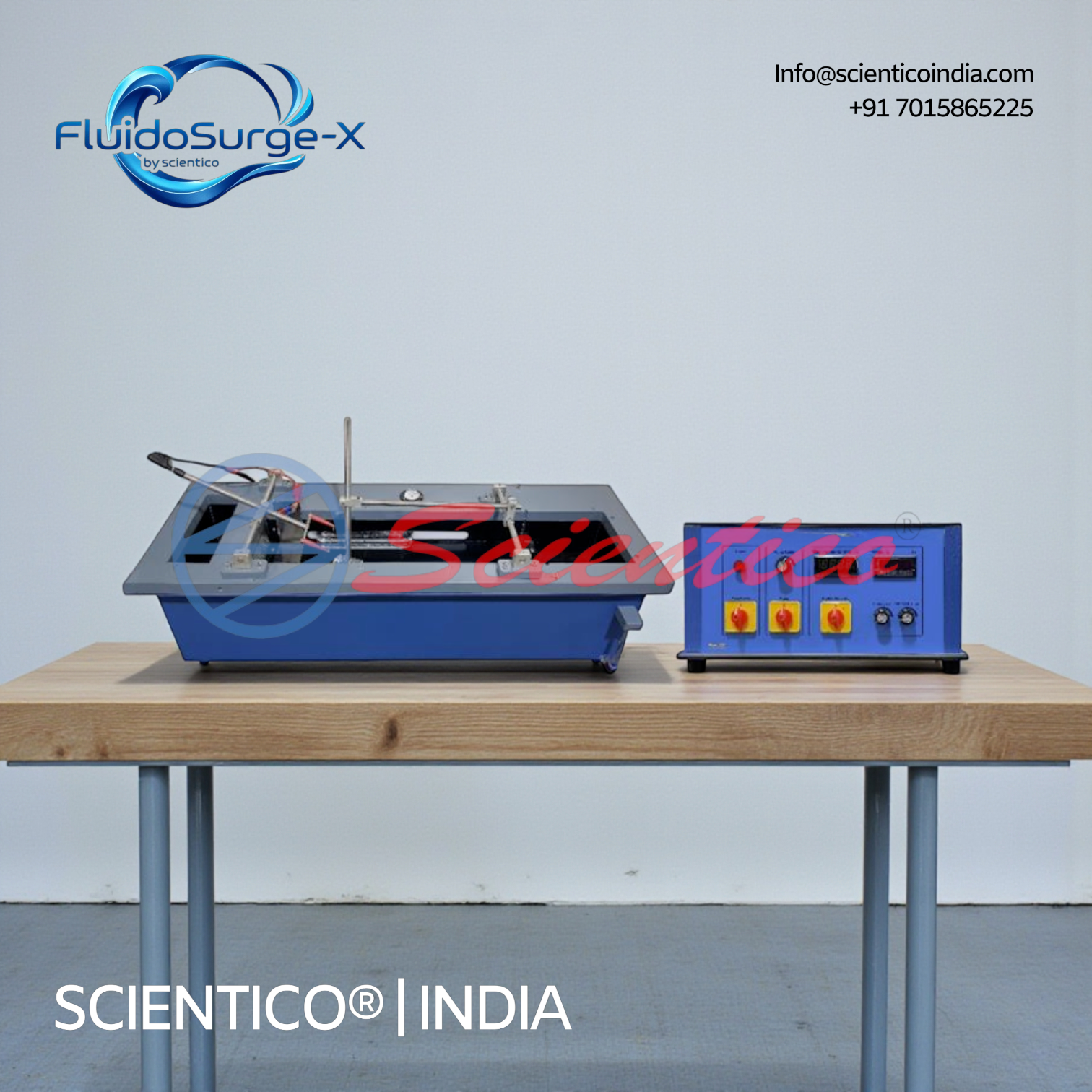
The apparatus consists of a shallow transparent water channel fitted with a variable-speed circulating pump. A flow straightener and glass spheres condition the inlet flow to ensure low turbulence. Hydrogen bubbles are generated at thin platinum wire cathodes using controlled electrolysis, with a stainless steel anode completing the circuit. Indirect white LED lighting along the channel walls enhances contrast, allowing clear visualization of flow structures around interchangeable models.
Experiments
-
Visualization of two-dimensional flow fields
-
Streamline patterns around and through models
-
Observation of flow separation
-
Vortex formation and Kármán vortex street demonstration
-
Qualitative study of velocity distribution in laminar and turbulent flow
-
Analogy between water flow and air flow phenomena
Models Supplied
-
Aerofoil profile
-
Cylinder models of various sizes
-
Rectangle and straight plate
-
Curved plate
-
Models for changes in cross-section
Control and Adjustment
-
Adjustable pump speed for flow velocity control
-
Adjustable electrolysis current
-
Adjustable pulse and pause duration for bubble generation
Standard Scope of Delivery
-
1 experimental unit
-
1 display and control unit
-
3 cathodes with platinum wire
-
1 set of models including drag bodies and cross-section changes
-
1 set of instructional material
Export & Supply Capability
SCIENTICO manufactures the Visualization of Flow Fields FluidoSurge-X 298 for engineering colleges, technical universities, and research laboratories. The apparatus is suitable for domestic and international supply. Export packing, documentation, and electrical configuration are provided as per destination requirements.
Standards & Compliance
- Manufactured under ISO 9001:2015 Quality Management System
- CE Marking - European Conformity where applicable
- Supplied with calibration certificate, operation manual, and experiment guide
- 12-month manufacturer's warranty (parts & labour from installation)
Ordering & Delivery
- Incoterms: CIF to destination seaport, FOB Mundra/Nhava Sheva, or Ex-Works Ambala
- Lead time: 3–5 weeks production + sea transit to destination
- Payment: LC (Letter of Credit) or T/T bank transfer against proforma invoice
- Documentation: commercial invoice, packing list, bill of lading, certificate of origin, insurance certificate
Frequently Asked Questions
Q1. What visualization method is used in FluidoSurge-X 298?
Hydrogen bubbles generated by electrolysis are used as flow tracers.
Q2. What types of flow can be observed?
Laminar flow, turbulent flow, flow separation, and vortex formation can be observed.
Q3. Can air flow phenomena be demonstrated using this apparatus?
Yes. Due to Reynolds number similarity, many air flow phenomena can be qualitatively demonstrated in water.
Q4. How is flow velocity controlled?
Flow velocity is controlled using a variable-speed circulating pump.
Q5. Are different models included for experiments?
Yes. Multiple drag bodies and cross-section models are supplied for varied flow studies.