What this page is for
If you are setting up or re-equipping the skills labs for a GNM (General Nursing and Midwifery) or ANM (Auxiliary Nurse Midwife) programme, you need three things on paper before anyone quotes you: a lab-by-lab equipment list, a defensible quantity against each line, and a note saying which regulatory document each line answers to.
This page gives you the first two in table form and tells you exactly where to source the third. It is written for the person who has to produce the BOQ, the inspection file or the tender annexure, not for a general reader.
One thing to settle at the start. Every quantity in the tables below is an indicative planning figure drawn from how diploma nursing labs are usually built out. It is not a Council norm, it is not an inspection threshold, and you must not paste it into an affiliation file as though it were. Student-to-manikin ratios, bed counts in the demonstration room, floor areas and staffing patterns are all set by the Indian Nursing Council syllabus current at the time you apply, plus your own state nursing council or state registration council rules. Those numbers change. Pull them from the live INC syllabus and your state council circular, and put the document reference next to each quantity in your file.
The companion page for degree-level programmes is the BSc Nursing lab equipment list built around the INC syllabus. If you run both a degree and a diploma programme on one campus, read both, because the sharing decisions between them are where most of the budget is saved or wasted.
GNM and ANM are two different procurement problems
The most common mistake I see is a single equipment list headed “nursing lab” being used for both programmes. It produces two failures at once: the ANM file is padded with items the programme has no business teaching, and the GNM file is short on the midwifery and medical-surgical depth it actually needs.
The scopes are genuinely different. GNM is a longer general nursing programme with a midwifery component, and its practical training spans fundamentals, medical and surgical nursing, child health, mental health, community health and midwifery. ANM is a shorter, community-weighted programme, with the centre of gravity on primary health care, maternal and child health, immunisation support, health education and record keeping at the sub-centre level.
That difference shows up in the lab in a specific way. A GNM skills lab needs a broader instrument and manikin base and a properly built midwifery and obstetrics lab. An ANM skills lab needs a stronger community health and health education setup, with more field-kit and demonstration material and less depth on advanced medical-surgical simulation.
Write the BOQ as three blocks: shared core, GNM-specific, ANM-specific. If the institution runs both programmes, the shared core is bought once and the two specific blocks are bought separately. If you present it any other way, your finance department will ask why the same manikin appears twice, and you will not have a clean answer.
The regulatory frame, and what you can and cannot claim
Diploma nursing programmes sit under the Indian Nursing Council for syllabus and recognition, and under the state nursing council or state registration council for state-level permission and inspection. Programme nomenclature and syllabus structure have been revised at various points, so confirm the current programme title, the current syllabus edition and the current inspection proforma before you finalise anything.
Practical guidance for the file:
- Quote the syllabus edition and date on the cover of your equipment file. An undated list invites the inspector to assume it is old.
- Map each equipment line to a practical or a skill in the syllabus. A line item with no teaching justification is dead weight in the file and dead money in the store room.
- Keep the state council requirement as a separate column. State norms can be stricter than the national syllabus, and the file has to satisfy both.
- Do not copy numeric norms from another college’s file, a coaching website or a supplier catalogue. Including this one. Go to the source document.
The same discipline applies across every regulator we deal with. The habits are set out in the NAAC lab equipment documentation and criteria guide and, on the engineering side, in the NBA accreditation lab documentation guide. The regulator changes, the documentation logic does not.
How diploma nursing labs differ from BSc Nursing labs
Institutions often assume the diploma lab is simply a smaller version of the degree lab. It is not. The differences are structural.
| Dimension | GNM and ANM diploma labs | BSc Nursing labs |
|---|---|---|
| Emphasis | Procedural competence and repetition on core skills, with community weighting in ANM | Procedural competence plus research, biostatistics and broader nursing science exposure |
| Simulation depth | Basic and intermediate task trainers and part-task models carry most of the load | More scope for intermediate and advanced patient simulators where budget allows |
| Science labs | Anatomy and physiology teaching largely model, chart and specimen driven | Same base, usually with more microscopy and biochemistry-facing equipment |
| Nutrition lab | Practical diet planning and demonstration cooking setup | Similar, often with more analytical equipment |
| Computer lab | Basic computing, health records and reporting formats | Same, plus statistics and literature searching for the research component |
| Duplication risk | High if the campus also runs a degree programme and lists items twice | High in the same situation |
If your campus runs both, my advice is blunt: do not build two half-equipped fundamentals labs. Build one properly stocked fundamentals lab with enough stations for the larger batch, timetable it hard, and spend the saving on the midwifery lab, which is the one that is usually under-built.
Fundamentals of Nursing lab
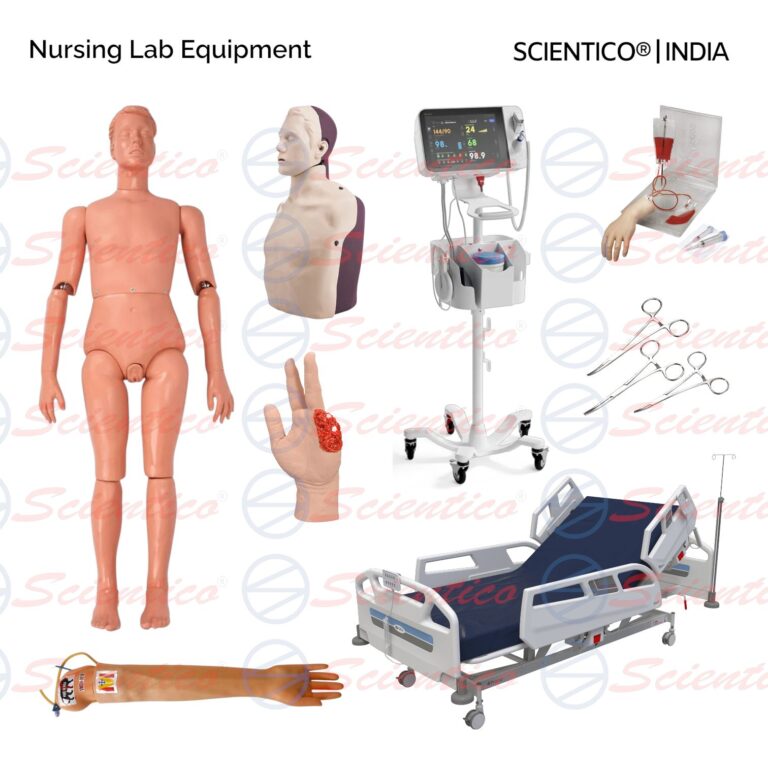
This is the highest-traffic lab in either programme and the one an inspector looks at first. It carries basic nursing skills training for both GNM and ANM, so it belongs in the shared core.
| Equipment | What it demonstrates or trains | Standard or syllabus link | Qty for a typical batch (indicative) |
|---|---|---|---|
| Adult nursing care manikin, full body | Positioning, transfer, hygiene care and general bedside skill practice | Fundamentals of Nursing practicals, confirm unit against the current INC syllabus | 3 to 6 |
| Hospital cot with mattress, bedside locker, over-bed table | Bed-making practice and realistic bedside station setup | Fundamentals of Nursing practicals | 1 set per practice station |
| Injection training arm and injection pad set | Injection technique practice on a training surface | Fundamentals of Nursing practicals | 4 to 8 |
| IV cannulation training arm | Venous access technique practice | Fundamentals of Nursing practicals | 2 to 4 |
| Basic life support training manikin with feedback | Resuscitation skill training and instructor feedback | Emergency and first aid component | 2 to 4 |
| Catheterisation training models, male and female | Urinary catheterisation technique practice | Fundamentals of Nursing practicals | 1 each |
| Wound care and bandaging arm or torso model | Dressing and bandaging technique practice | Fundamentals of Nursing practicals | 2 to 4 |
| Vital signs equipment set: sphygmomanometers, stethoscopes, thermometers, pulse oximeters | Vital sign measurement and recording practice | Fundamentals of Nursing practicals | 1 set per 2 to 4 students |
| Instrument trolley, dressing trolley, IV stand, screens | Procedure area setup and infection-control habit formation | Fundamentals of Nursing practicals | 2 to 4 of each |
| Weighing scale with height rod, examination couch | Anthropometric measurement and examination-station practice | Shared across fundamentals and community lab | 1 to 2 |
| Steel utensil and articles set: kidney trays, bowls, jugs, drums, trays | Consumable handling and procedure tray preparation | Fundamentals of Nursing practicals | As per station count |
| Lockable storage cupboards and instrument racks | Stock control, breakage reduction and inspection-ready storage | Institutional requirement | 3 to 6 |
Storage is the line item people delete first and regret fastest. A skills lab without lockable cupboards loses small instruments continuously, and a half-empty tray at inspection time reads as an unused lab.
Community Health Nursing lab
This is the lab where ANM procurement diverges most from GNM. For ANM it is the primary teaching space, not a secondary one, and it should be resourced accordingly.
| Equipment | What it demonstrates or trains | Standard or syllabus link | Qty for a typical batch (indicative) |
|---|---|---|---|
| Community health nursing bag with contents set | Field visit preparation, bag technique and equipment discipline | Community Health Nursing practicals | 4 to 8 |
| Cold chain demonstration set: vaccine carrier, ice packs, thermometers | Cold chain handling and temperature monitoring practice | Immunisation programme component | 2 to 4 |
| Health education kit: flip charts, flannel board, models, posters | Health education session planning and delivery practice | Health education component | 1 to 2 sets |
| Water testing demonstration kit | Basic water quality awareness for community sanitation teaching | Environmental health component | 1 to 2 |
| Growth chart, MUAC tapes, infant weighing scale, adult weighing scale | Growth monitoring and nutritional status assessment training | Maternal and child health component | 2 to 4 of each |
| Family planning methods demonstration set | Counselling and method-awareness teaching material | Family welfare component | 1 to 2 sets |
| Register and record format set, sub-centre reporting formats | Record keeping, reporting and documentation practice | Community Health Nursing practicals | 1 set per student where possible |
| Sub-centre or village model layout, community mapping material | Area mapping, survey planning and population coverage teaching | Community Health Nursing practicals | 1 per lab |
| First aid and emergency kit for field training | Field-level first aid preparedness training | First aid component | 2 to 4 |
For GNM this lab is still required but can be leaner. For ANM, under-resourcing it is the single clearest signal to an inspector that the programme has been treated as an afterthought.
Midwifery and Obstetrics lab
Shared in name, different in depth. GNM carries a full midwifery component and needs the deeper build. ANM needs the maternal health and normal delivery teaching base.
| Equipment | What it demonstrates or trains | Standard or syllabus link | Qty for a typical batch (indicative) |
|---|---|---|---|
| Advanced childbirth simulator with fetal manikin and placenta | Normal delivery mechanism teaching and midwifery skill practice | Midwifery and Obstetrical Nursing practicals | 1 to 2, GNM priority |
| Basic delivery demonstration model | Entry-level demonstration of the birth process | Midwifery component, both programmes | 1 to 2 |
| Pelvis and fetal skull model set | Pelvic anatomy and fetal skull landmark teaching | Midwifery and Obstetrical Nursing theory and practicals | 2 to 4 sets |
| Stages of pregnancy and fetal development model series | Antenatal teaching and health education demonstration | Maternal health component | 1 series |
| Antenatal abdominal examination model | Abdominal palpation technique training | Midwifery practicals | 1 to 2 |
| Episiotomy and perineal suturing training pad | Suturing technique practice on a training surface | Midwifery practicals, GNM priority | 2 to 4 |
| Labour room furniture: labour table, examination couch, instrument trolley, screens | Realistic labour room station setup | Midwifery practicals | 1 to 2 sets |
| Fetal stethoscope, doppler unit, obstetric instrument set | Fetal monitoring and instrument identification training | Midwifery practicals | 2 to 6 |
| Breast examination and breastfeeding teaching model | Lactation counselling and health education demonstration | Maternal and child health component | 1 to 2 |
| Newborn care manikin with cot, radiant warmer trainer or mock unit | Immediate newborn care station training | Midwifery and child health overlap | 1 to 2 |
Split the budget here explicitly. The advanced childbirth simulator and the suturing trainers are the GNM-weighted lines. The stage-of-pregnancy series, the breastfeeding model and the newborn care station serve both programmes and belong in the shared core.
Child Health Nursing lab
| Equipment | What it demonstrates or trains | Standard or syllabus link | Qty for a typical batch (indicative) |
|---|---|---|---|
| Infant nursing care manikin | Infant handling, positioning and hygiene care practice | Child Health Nursing practicals | 2 to 4 |
| Child nursing care manikin, toddler size | Paediatric care skill practice at a larger body size | Child Health Nursing practicals | 1 to 2 |
| Infant and child resuscitation manikins | Paediatric resuscitation skill training | Emergency component | 1 to 2 each |
| Infant injection and IV training arm or leg | Paediatric injection and access technique practice | Child Health Nursing practicals | 1 to 2 |
| Paediatric cot, incubator trainer or mock unit, phototherapy mock unit | Neonatal care station familiarisation | Child Health Nursing practicals, GNM priority | 1 each |
| Infantometer, infant weighing scale, head circumference tapes | Growth measurement and monitoring practice | Shared with community health lab | 2 to 4 |
| Immunisation schedule charts and demonstration set | Immunisation teaching and counselling material | Immunisation component | 1 to 2 sets |
| Play material and developmental assessment aids | Growth and development teaching | Child Health Nursing theory support | 1 set |
Nutrition and Dietetics lab
Required by both programmes, and consistently the cheapest lab to build well. It is mostly a demonstration kitchen with teaching aids attached.
| Equipment | What it demonstrates or trains | Standard or syllabus link | Qty for a typical batch (indicative) |
|---|---|---|---|
| Demonstration cooking platform with gas or induction points | Therapeutic and normal diet preparation demonstration | Nutrition practicals | 2 to 4 points |
| Weighing balances, measuring sets, kitchen utensil set | Portion measurement and recipe standardisation | Nutrition practicals | 2 to 4 sets |
| Food models and portion size display set | Diet counselling and portion education | Nutrition and health education components | 1 to 2 sets |
| Refrigerator, storage racks, sink and preparation counter | Food storage and hygiene practice | Nutrition practicals | 1 each |
| Diet chart boards, nutritive value charts, food group charts | Diet planning teaching | Nutrition theory support | 1 set |
| Mixer grinder, pressure cooker, basic appliance set | Practical preparation for demonstration classes | Nutrition practicals | 1 to 2 each |
Anatomy and Physiology lab
Model, chart and specimen driven for diploma programmes. Buy fewer, larger, better models rather than many small ones, because a model that cannot be seen from the fourth row is not a teaching aid.
| Equipment | What it demonstrates or trains | Standard or syllabus link | Qty for a typical batch (indicative) |
|---|---|---|---|
| Human skeleton, articulated, with stand | Skeletal system teaching and bone identification | Anatomy and Physiology practicals | 1 to 2 |
| Disarticulated bone set | Individual bone study and handling | Anatomy practicals | 2 to 4 sets |
| Torso model, dissectible, with removable organs | Organ position and body cavity teaching | Anatomy practicals | 1 to 2 |
| System model set: heart, lung, kidney, brain, eye, ear, digestive tract | System-wise structure teaching | Anatomy and Physiology practicals | 1 set |
| Muscular system model or chart series | Muscle group identification | Anatomy practicals | 1 set |
| Compound microscopes with prepared slide sets | Basic tissue and cell structure observation | Anatomy and Physiology practicals | 4 to 10 microscopes |
| Haemoglobinometer, blood grouping demonstration set, ESR and centrifuge units | Basic physiology demonstration under supervision | Physiology practicals | 2 to 6 |
| Anatomy and physiology chart series, laminated | Classroom reinforcement and low-cost coverage of remaining topics | Theory support | 1 full series |
| Laboratory tables, stools, storage cupboards, wash unit | Lab furniture and specimen storage | Institutional requirement | As per room layout |
Computer lab and AV demonstration room
Both are usually assessed as institutional infrastructure rather than as nursing equipment, and both are usually the last thing anyone budgets. Do not leave them to the end.
| Equipment | What it demonstrates or trains | Standard or syllabus link | Qty for a typical batch (indicative) |
|---|---|---|---|
| Desktop computers with basic office and internet access | Computer literacy, health record formats, report preparation | Computer education component | 1 per 1 to 2 students in a lab session |
| Networked printer and scanner | Record printing and document handling practice | Institutional requirement | 1 to 2 |
| UPS or backup power for the lab | Session continuity | Institutional requirement | 1 system |
| Projector with screen, or large display panel | Demonstration classes, procedure videos, case discussion | AV teaching support | 1 per demonstration room |
| Public address unit with mic for the demonstration room | Large-group demonstration audibility | AV teaching support | 1 |
| Demonstration beds with full bedside setup in the AV room | Whole-class procedure demonstration before station practice | Fundamentals and clinical demonstration | 2 to 4 beds |
| Camera or document visualiser for close-up demonstration | Showing small-field technique to a full batch | AV teaching support | 1, optional |
Shared core versus programme-specific: how to structure the BOQ
Here is the split I use when a campus runs both programmes.
Shared core, buy once and timetable: fundamentals lab in full, anatomy and physiology lab in full, nutrition lab in full, computer lab, AV demonstration room, growth monitoring equipment, basic delivery demonstration model, breastfeeding and stages-of-pregnancy teaching models, first aid kits.
GNM-weighted: advanced childbirth simulator, episiotomy and suturing trainers, obstetric instrument sets, neonatal care station equipment, deeper medical-surgical instrument sets, additional adult care manikins for the larger practical load, mental health teaching aids.
ANM-weighted: additional community health nursing bags, cold chain demonstration equipment, expanded health education kit, family welfare demonstration set, sub-centre record and reporting formats in student quantity, field first aid kits, water testing demonstration kit.
Present it in exactly that order in the file. It makes the sharing logic visible to the inspector instead of making it look like padding, and it makes the finance review straightforward.
Specification traps that cost institutions money
Four recurring ones, in the order they usually bite.
Consumables written as capital. Injection pads, suture pads and skin replacements wear out. If you buy the trainer without budgeting replacement parts, the trainer sits unused within a year and shows up as an idle asset. Ask for the replacement part list and part numbers at quotation stage, before the purchase order.
Buying the top-end simulator first. A high-fidelity simulator with no trained faculty and no scenario library is an expensive display item. Build the task-trainer base and the station count first, then add fidelity when the teaching capacity exists to use it.
No spares, no service clause. Write warranty, spares availability and service response into the purchase order text rather than assuming it. The same clause logic applies whether you are buying nursing manikins or a universal testing machine, and it is set out in the tender documents checklist for government colleges.
Storage and layout as an afterthought. Station count drives room size, and room size drives how many students can actually practise per session. Fix the layout before you fix the list.
Procurement route: GeM, tender, or direct quotation
Government and aided institutions usually route through GeM or an e-tender. Private institutions usually buy on comparative quotation. The paperwork differs but the discipline is the same: a clear specification, a named quantity, and a supplier who can document conformity.
If you are buying on GeM, the category mapping and specification-writing habits are covered in the GeM lab equipment procurement guide. If your tender demands a manufacturer’s authorisation, read the MAF requirements for lab equipment tenders before the bid deadline rather than the night before, because a missing MAF is a technical rejection with no appeal.
For a brand-new institution buying every lab at once, sequencing matters more than line-item price. The approach is set out in the first procurement guide for new college lab setup, and the budgeting logic transfers directly to a nursing school even though the examples are engineering. If you are pricing a phased build, the lab equipment cost and budget planning guide covers how to stage it without stranding half a lab.
Health science campuses frequently run allied programmes alongside nursing. If yours does, the B Pharm lab equipment list under PCI norms covers the pharmacy side, and multi-stream institutions with polytechnic or ITI wings will want the complete polytechnic diploma lab equipment list and the trade-wise ITI lab equipment guide in the same procurement plan.
Where Scientico fits
Scientico India has been manufacturing and exporting laboratory and engineering teaching equipment from our own works in Ambala, Haryana since 1993, and we supply to more than 60 countries. We are ISO 9001:2015 certified, and CE conformity documentation is available on applicable models. We are a manufacturer of teaching equipment, not an ISO/IEC 17025 or NABL accredited testing laboratory, and we do not present ourselves as one. If your file needs testing-laboratory accreditation, that is a separate exercise covered in the NABL and ISO 17025 lab accreditation equipment guide.
We currently list 331 products across 19 categories. The nursing side is catalogued under nursing lab equipment, and the broader teaching range is described on the nursing and medical training equipment manufacturer page. Institutions building multiple departments at once also draw from engineering training equipment and pharmacy lab equipment.
We work on a quote basis with no public price list, because quantities, model configuration, packing and destination all move the number. Export orders ship CIF or FOB from Nhava Sheva or Mundra. Catalogues and specification sheets for file preparation are on the downloads page, and buyers outside India can check for local representation through locate a distributor.
Next step
Send us your programme mix, your approved intake and your room layout, and we will return a lab-wise BOQ split into shared core, GNM-weighted and ANM-weighted blocks, with specification text you can paste straight into a tender annexure. Write to us through contact us.
One honest ask
We don't gate anything on this site. You just read the whole thing free. If it was useful, leave your email and two things happen: we send you this page as a plain-text block you can paste into a tender file or an internal email, and we notify you the next time we publish a buyer tool like this one. Nothing else. No drip sequence, no sales calls booked without asking.