Lab equipment dealership and distributorship in India
This page is written for Indian dealers, trading firms and technical suppliers who want to represent a manufacturer of laboratory and engineering teaching equipment in their state or region. If you are outside India and looking at export supply, the page you actually want is our international laboratory equipment distributor programme, and the background reading is how to import lab equipment from India.
Scientico has manufactured engineering and laboratory teaching equipment at its own works in Ambala, Haryana since 1993. We are ISO 9001:2015 certified and provide CE conformity documentation on applicable models. We have supplied to more than 60 countries. The catalogue runs to over 320 products across engineering training equipment plus nursing, pharmacy and medical lab equipment.
We appoint a limited number of dealers in India. We are far more interested in whether you already sell to institutions than in how big your firm is. Please read this page before writing to us. It will save both of us a call.
What a dealership with a manufacturer actually involves
A lot of enquiries arrive assuming a dealership is a brand licence. It is not. A dealership is a working arrangement in which you own the customer relationship in your territory and we own the product.
In practice you do the local work. You find out that a polytechnic is upgrading its hydraulics lab, you meet the head of department or the lab in-charge, you understand what the syllabus requires, you demonstrate, you quote, and you handle the paperwork of the buying process. We sit behind you with drawings, specifications, technical clarifications and, where a tender requires it, a manufacturer authorisation form for lab equipment tenders issued in your name for that specific tender.
Two working models come up in most conversations. In the first, you buy on your own account and resell on your own GST invoice, which suits direct purchases and smaller institutional orders. In the second, we invoice the institution and you are recognised as the appointed channel for that opportunity, which is common where the buyer insists on billing from the manufacturer or where the procurement route requires it. Which model applies depends on the buyer and on the route the purchase takes.
On money, we will be direct with you. We do not publish prices, and that is a deliberate policy, not an oversight. Every quotation is built against a configuration. Dealer commercial terms, payment terms and any credit arrangement are agreed in writing at application review, once we know your firm and the territory it covers. Anyone who publishes a fixed dealer margin on a web page is either selling one product or is not being straight with you.
What we look for in an Indian dealer
The qualification is not complicated. It is mostly about whether you can already reach the buyer and whether you can stand in front of a lab and explain a machine.
| What we look for | What it means in practice | Weight |
|---|---|---|
| Existing institutional customer base | You already sell something to engineering colleges, polytechnics, ITIs, nursing colleges, pharmacy colleges or university departments. Furniture, chemicals, consumables and IT hardware all count. You know the purchase committee, not just the reception desk. | Essential |
| Technical capability to demonstrate | Someone in your firm can set up a test rig, run an experiment in front of faculty and answer a question about the reading. A diploma or degree holder in mechanical, civil, electrical or a related discipline on your staff is usually enough. | Essential |
| Ability to service | You can attend a site for installation, commissioning, calibration support and small repairs without routing every visit through Ambala. Spares handling matters more than sales talk in year two of a relationship. | Essential |
| GST registration and ability to invoice | A registered firm with GSTIN, PAN and a bank account in the firm’s name. Institutions cannot process purchases from an unregistered supplier. | Essential |
| GeM seller registration | An active seller account on the Government e Marketplace, with the category approvals your listing needs. Not mandatory to apply, but it moves an application up the queue because a large share of public institutional buying runs through that route. | Strong advantage |
| Experience with state tenders | You have submitted bids on your state e-procurement portal, handled EMD and bid security formats, and understand what a technical bid evaluation looks like. | Strong advantage |
| Working capital and handling space | Enough capital to fund a demonstration unit or a small stock of fast-moving items, plus covered space to receive a crated machine. We do not set a purchase target on this page. Any stocking arrangement is discussed at application review. | Discussed case by case |
What we do not weigh heavily: the age of your firm or the size of your office. A long list of brands on your letterhead does not count for much either. A two-person firm run by an engineer who has been calling on the same four colleges for six years is often a better dealer than a large trading house with no technical staff.
The institutional market you would be selling into
Almost all of the demand for this equipment is teaching demand. It comes from institutions that must run practical lab sessions against a prescribed syllabus, and it is funded by institutional or state budgets rather than by production requirements.
The main segments are engineering colleges operating under the AICTE framework, state polytechnics running diploma programmes, ITIs, nursing colleges, pharmacy colleges and university engineering departments. Private and government institutions both buy, and they buy in different ways, which is worth understanding before you decide where to spend your time.
Accreditation is a real driver. Institutions pursuing NBA accreditation for their programmes are assessed on laboratory facilities and on the documentation that supports lab outcomes, so an accreditation cycle is often the reason a lab budget appears. Our NBA accreditation lab documentation guide is written for exactly that conversation, and it is a useful thing to send a department head who is preparing for a visit.
On procurement routes, government and government-aided institutions commonly buy through the Government e Marketplace, through their state e-procurement tender portal, or by direct quotation for lower value purchases. State technical education departments and directorates also run centralised modernisation schemes that equip several institutions at once, and those are large but slow. Rules, categories and fees on these portals change, so verify the current position on the portal itself rather than relying on any supplier’s summary, including ours.
For the tender side of the work, three documents on this site do most of the heavy lifting: the laboratory equipment RFQ checklist template for pinning down a requirement before you quote, the tender compliance matrix template for the point-by-point response that technical evaluation actually reads, and the tender documents checklist for government colleges so a bid is not rejected on a missing annexure.
Which categories a dealer can start with
Do not try to carry the whole catalogue. Dealers who succeed pick one or two lab types that match the departments they already visit, learn those properly, and add categories once the first repeat order lands.
| Category | Who buys it | Typical starting items |
|---|---|---|
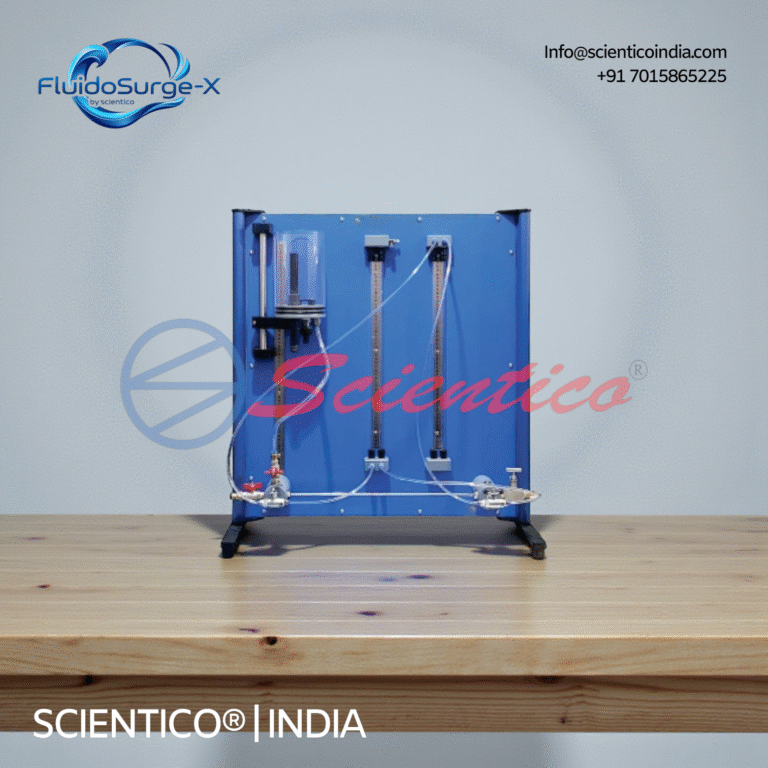
| Fluid mechanics and hydraulics equipment | Mechanical and civil departments, polytechnics | Bench-scale flow apparatus and pump test rigs such as the multi pump test rig apparatus from the FluidoSurge and FluidoSurgeX families |
| Strength of materials lab equipment | Mechanical and civil departments, materials testing labs | Universal hardness tester, torsion testing machine FortiTestX 10, impact testing machine FortiTestX 15 |
| Thermodynamics, heat transfer, refrigeration and air conditioning | Mechanical departments, HVAC and automobile programmes | ThermoFlux heat transfer units and PolarX refrigeration trainers |
| Theory of machines and vibration | Mechanical departments, design and dynamics labs | ProDynami and FrixoDynamics dynamics and friction apparatus |
| Renewable energy training equipment | Electrical, mechanical and energy programmes, new labs funded under modernisation schemes | Solar, wind and energy conversion demonstration units |
| Process engineering, water treatment, automation and control | Chemical, environmental and instrumentation departments | ProZessix, HydraNexis and RVX process and control rigs |
| Nursing lab equipment | Nursing colleges and paramedical institutes | Manikins, skills training models and ward practice items |
| Pharmacy lab equipment | Pharmacy colleges and D.Pharm or B.Pharm programmes | Pharmaceutics, pharmacology and analysis lab instruments |
If you want to see how a full lab is scoped rather than a single machine, work through the mechanical engineering lab equipment list and the civil engineering lab equipment list. Both are laid out the way a department writes a requirement, which makes them the fastest way to turn a syllabus into a quotable list. The wider range sits under engineering training equipment.
How territory is discussed
Territory is agreed in writing at appointment. It is normally a state or a defined group of districts, and in some cases it is a segment within a state, for example nursing and pharmacy institutions only.
We make no territory promise on this page and none in a first conversation, for a simple reason. Some regions already have arrangements in place, and category coverage differs from region to region. If your area is already covered for the categories you asked about, we will tell you plainly instead of stringing you along. Where an area is open, the scope of the appointment and its review basis are settled in the written agreement rather than by email assurance. Any question of exclusivity is settled the same way.
What support we provide
Our side of the arrangement is technical and documentary. Specifically:
- Product documentation. Specifications, general arrangement details, experiment lists and technical write-ups you can build a tender-ready specification sheet from.
- Authorisation letters for tenders. Issued against a named tender when the bid document requires manufacturer authorisation. See the MAF page for what we need from you to issue one.
- Configuration against a syllabus. Send us the department’s lab list, syllabus extract or draft specification and we will map it to models and say plainly which items we make and which we do not.
- Quality documentation. ISO 9001:2015 certification and CE conformity documentation on applicable models, available for bid attachment through our quality certifications page. To be clear, we are a manufacturer with a certified quality management system. We are not an NABL accredited testing laboratory and you should never represent us as one in a bid.
- Product briefing for your engineer. Handover on installation, commissioning and the common faults, so your service visits do not become our phone calls.
What we do not provide: we do not run your sales calls and we do not fund your marketing. We also cannot influence a tender outcome. If a supplier tells you otherwise about a public tender, walk away from that supplier.
Who should not apply
Saying this now is cheaper for both sides than saying it after three meetings. Do not apply if you have never sold to an institution and are hoping a manufacturer’s name will open the door for you, because it will not. Do not apply if what you actually want is a price list to shop against another quotation, because we do not issue one. Do not apply if you need exclusive rights over a whole zone before your first order. And do not apply if your firm cannot raise a GST invoice, because institutional buyers cannot process the purchase.
How the application works
- Write to us with your firm profile: years in trade, GSTIN, the states and districts you cover, the institutions and segments you already sell to, the technical staff on your payroll, and whether you hold GeM seller registration.
- We reply with the categories currently open in your area and any questions we have about your coverage.
- A call, or a meeting at Ambala if you want to see the works and the machines running.
- A written appointment covering territory, categories, commercial terms and the review basis.
- We work your first two or three enquiries jointly so that your team sees how we quote and how a compliance response is put together, including the technical clarification that usually goes with it.
Applications that arrive with the firm profile attached get answered quickly. Applications that say only “interested in dealership” get a form letter asking for the same details, which wastes a week.
Start the conversation
If you sell to Indian engineering colleges, polytechnics, ITIs, nursing colleges or pharmacy colleges and you want to add engineering and laboratory teaching equipment from a manufacturer with its own works, send us your firm profile and the categories you want to carry. Write to [email protected], or use WhatsApp or phone on +91 7015865225, or send the details through the contact page.
One honest ask
We don't gate anything on this site. You just read the whole thing free. If it was useful, leave your email and two things happen: we send you this page as a plain-text block you can paste into a tender file or an internal email, and we notify you the next time we publish a buyer tool like this one. Nothing else. No drip sequence, no sales calls booked without asking.