
Equipment mentioned in this guide
Review the product information, specifications and model before requesting a quotation.
Universal Hardness Tester
The Universal Hardness Tester manufactured by Scientico India combines Brinell, Vickers, and Rockwell hardness testing methods in a single machine. The machine uses interchangeable indenters and a built-in optical measuring system for Brinell/Vickers measurements, with direct-reading digital display for Rockwell hardness.
View product details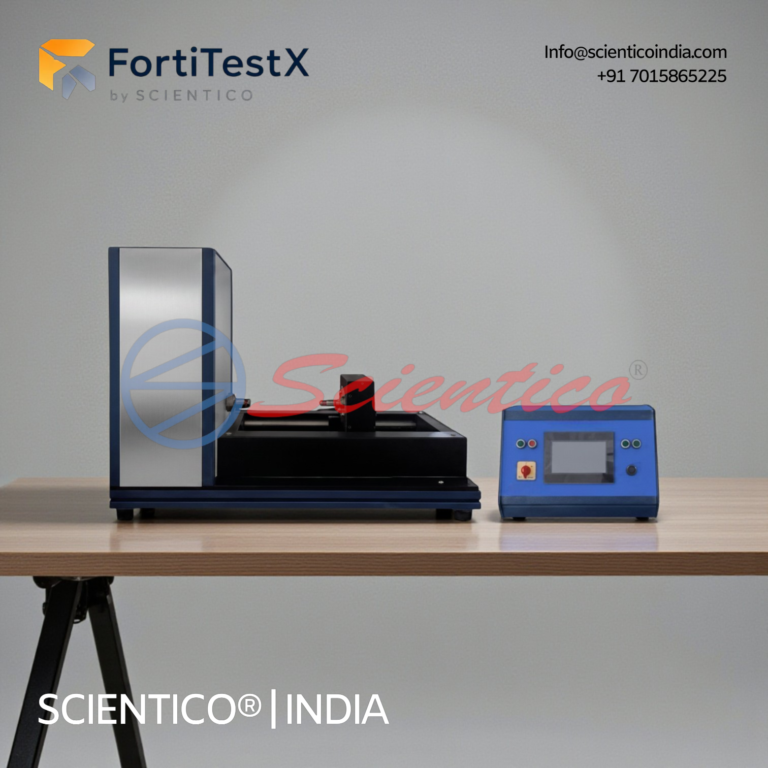
Torsion Testing Machine 300 Nm Motorised | FortiTestX – 10
Torsion Testing Machine FortiTestX 10 is a motorised, benchtop strength of materials lab equipment unit designed for the torsional testing of various material specimens up to fracture. This Torsion Testing Machine applies controlled torque via a worm drive and motor, measuring test torque through a strain gauge and angle of twist through an incremental encoder, with both values displayed on digital readouts in real time. Engineered for undergraduate engineering laboratories, the FortiTestX 10 supports torsional testing of mild steel, aluminium, and brass specimens up to 300 Nm and 300 mm length.
View product details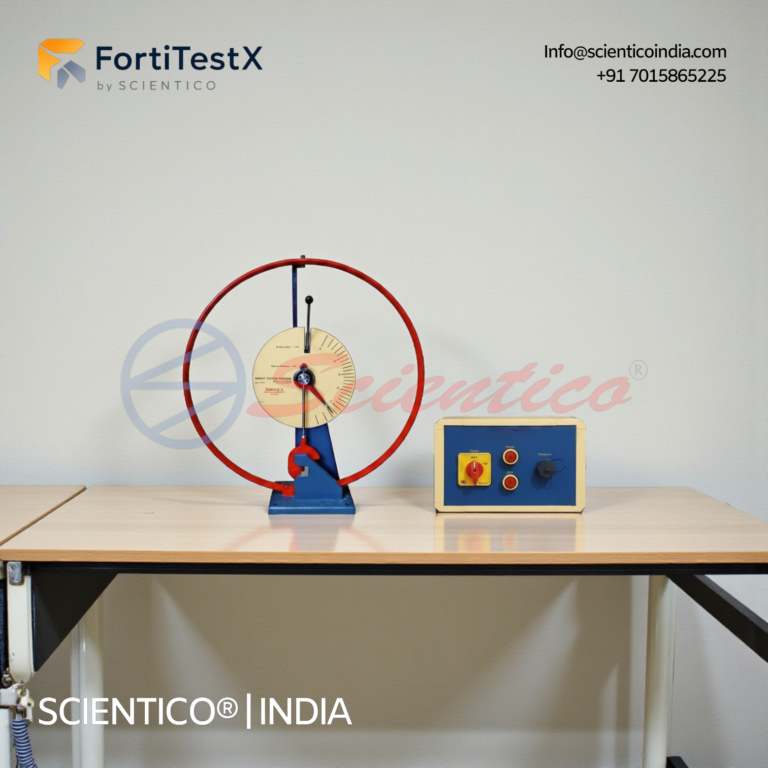
Impact Testing Machine | FortiTestX – 15
Impact Testing Machine FortiTestX 15 is a benchtop strength of materials lab equipment unit designed for notched bar impact bending tests on metallic and non-metallic specimens. This Impact Testing Machine operates on the pendulum principle, delivering a hammer impact speed of 3.8 m/s and a maximum work capacity of 25 Nm, with impact energy read directly from the gauge on a large scale. The FortiTestX 15 supports U, V, and keyhole notch configurations across four specimen materials, making it a complete impact testing machine strength of materials lab equipment unit for undergraduate material testing programmes.
View product details
Multi Pump Test Rig Apparatus | FluidoSurge-X 294
The FluidoSurge X-294 is a multi pump test rig (series and parallel centrifugal pump test rig) that lets students run single, series and parallel pump configurations on one apparatus and compare the resulting head–discharge–efficiency characteristics.
View product detailsWhat our certifications actually prove, and what they do not
Two kinds of people land on this page. The first is a trade buyer, a dealer or an importer, checking whether Scientico is a real manufacturer before sending an enquiry. The second is a bidder assembling a pre-qualification file for a tender, who needs certification evidence in a specific format by a specific date.
Both deserve a straight answer rather than a wall of logos. Here it is.
Scientico is a manufacturer and exporter of laboratory and engineering teaching equipment, working from our own facility in Ambala, Haryana, India since 1993, with supply into 30+ countries. We hold ISO 9001:2015 certification for our quality management system, and we provide CE conformity documentation on applicable models. We are not a testing laboratory and we do not hold laboratory accreditation. Those three sentences are the whole certification position, and the rest of this page explains what each one is worth to you.
ISO 9001:2015 certifies a management system, not a product
This is the single most common misunderstanding in trade enquiries, so it is worth being blunt about it.
ISO 9001:2015 is a standard for a quality management system. A certification body audits how a company runs itself: how customer requirements are captured, how designs are controlled and changes recorded, how suppliers are selected and incoming material checked, how production is documented, how instruments used for inspection are calibrated and traceable, how non-conforming output is handled, how complaints trigger corrective action, and how management reviews the whole loop at defined intervals.
What the auditor does not do is test the machine. There is no ISO 9001 test of a torsion tester’s torque accuracy or a heat transfer bench’s temperature stability. The certificate says the processes around the machine are controlled and repeatable. It says nothing directly about whether any individual unit meets its published specification.
So what does it buy you as a buyer? Practical things:
- There is a documented route from your purchase order to a build record, which means a query about a unit shipped two years ago can be traced rather than guessed at.
- Design changes are controlled, so a repeat order of the same model number is not quietly a different machine.
- Inspection instruments are calibrated on a schedule, which is what makes an in-house test report worth reading at all.
- Complaints are logged and closed through a corrective action process, not absorbed into a WhatsApp thread.
- An external auditor returns on a surveillance cycle, so the system has to survive scrutiny more than once.
That is a real signal about supplier reliability. It is not a product safety mark, and any supplier who presents it as one is either careless or hoping you are.
CE conformity documentation, and why we say “applicable models”
CE marking is a manufacturer’s declaration that a product meets the requirements of the European directives and regulations that apply to it. For our category, that usually means machinery, low voltage, and electromagnetic compatibility requirements, supported by a technical file and a Declaration of Conformity signed by the manufacturer.
Note the wording. CE is declared per product, against the directives that apply to that product. It is not a company-wide badge, and it is not something a factory holds in the abstract. This is why we say CE conformity documentation is available on applicable models rather than claiming every one of our 320+ products carries it. A bench-top mechanical demonstration frame with no powered element does not sit under the same directives as a powered refrigeration and air conditioning trainer or an automation and control panel.
If your tender or your import requirement calls for CE documentation, tell us the model numbers at enquiry stage. We will confirm in writing which of the requested items carry conformity documentation and which do not, before you build a bid around an assumption. That is a shorter and less painful conversation at quotation stage than after award.
Three documents that get confused with each other
Most disputes in tender evaluation come from treating these as interchangeable. They are not.
| Document | Who issues it | What it covers | What it does not prove |
|---|---|---|---|
| ISO 9001:2015 certificate | An accredited certification body, to the manufacturer | The manufacturer’s quality management system, within a stated scope and site address | Product safety, product accuracy, or any individual unit’s performance |
| CE Declaration of Conformity | The manufacturer, on its own responsibility, supported by a technical file | One product or product family against the specific EU directives that apply to it | Anything about products outside that declaration, and it is not a quality system certificate |
| ISO/IEC 17025 accreditation | A national accreditation body, to a testing or calibration laboratory | The technical competence of a laboratory to perform specific tests or calibrations | Nothing about a manufacturer’s factory, and holding it is not the same as being ISO 9001 certified |
Read the third row carefully, because it is where suppliers overreach. ISO/IEC 17025 belongs to laboratories that issue test and calibration results. Scientico is a manufacturer, not an accredited testing laboratory. We are not NABL accredited and we do not represent our in-house test reports as accredited third-party results. When a tender genuinely requires a report from an accredited laboratory, that report has to come from such a laboratory, and we will say so rather than substitute our own paperwork and hope the evaluator does not look.
Being clear about this is not a weakness in a bid. Evaluators who know the difference tend to mark down the supplier who blurred it.
What we can supply with a quotation or for a tender file
On request, and against a specific enquiry with model numbers, we can provide the following as part of a quotation pack or a pre-qualification file:
- A copy of our ISO 9001:2015 certificate showing the certification body, certificate number, scope, site address, and validity dates.
- CE conformity documentation for applicable models, identified by model number.
- A manufacturer’s declaration of origin and manufacturing status, confirming the goods are produced at our own works.
- A manufacturer authorisation form for lab equipment tenders, issued to a named bidder for a named tender reference.
- Technical datasheets, dimensioned drawings where available, and a clause-by-clause response using our laboratory equipment tender compliance matrix template.
- In-house test and inspection records for the supplied unit, described accurately as manufacturer records rather than accredited third-party test reports.
- Packing, marking, and shipping documentation appropriate to CIF or FOB terms from Nhava Sheva or Mundra.
Our standing document set is summarised on the quality certifications page. If you are new to sourcing from India, the sequence of documents through an order is set out in how to import lab equipment from India, and the information we need from you to quote accurately is listed in the laboratory equipment RFQ checklist template.
How an evaluator actually verifies a certificate
If you have never sat on the evaluating side, this is roughly what a competent reviewer does with a PDF certificate, and it is worth knowing because it tells you what a weak certificate looks like.
- Match the legal entity. The name and address on the certificate must match the manufacturer named in the bid and on the authorisation form. A near-match with a different trading name is a query, not a pass.
- Read the scope statement. A certificate scoped to trading activity is not a certificate scoped to manufacture. The scope line is the part most bidders never read and most evaluators read first.
- Check the dates. Issue date, expiry date, and where applicable the current surveillance status. An expired certificate in a bid file is a common and avoidable rejection.
- Identify the certification body and its accreditation. The certificate should name the body and carry an accreditation mark from a recognised accreditation body. Unaccredited certificates exist and are worth less.
- Verify against the issuer’s register. Most certification bodies publish an online directory or offer a verification contact. Serious evaluators check the certificate number there rather than trusting the PDF.
- Separate the document types. A QMS certificate offered in place of a required product conformity document is treated as non-responsive, no matter how impressive the certificate looks.
Send us the certification clauses from your tender document at enquiry stage and we will tell you plainly which we can satisfy with documents and which we cannot. A checklist of what a typical institutional tender asks for is in our lab equipment tender documents checklist for government colleges.
Why this matters more in export tenders than in direct domestic purchase
When a buyer can visit the factory and watch a machine run on the shop floor, certificates are a secondary comfort. The buyer has direct evidence and can rely on it.
Cross-border procurement removes that option. The evaluator has never seen the works and has no way to meet the production team. A pre-shipment visit often will not fit inside the tender timetable either. Documents become the substitute for observation. On top of that, public procurement rules usually require the evaluation to be defensible in writing, which means the evaluator needs a document they can point to when a losing bidder complains.
There is a second, more mundane reason. Certification documents travel with the shipment through customs, inspection agencies, and the buyer’s own goods-inward process. A missing or mismatched document does not just cost a mark in evaluation. It costs time at a port.
This is also why we ask distributor applicants about their local tender activity. Territory terms are agreed at application review rather than published, and the certification support a partner needs varies a great deal by market. If you are exploring representation, start at locate a distributor.
Where certification does not help you, and what to ask instead
An honest page has to include this part.
Neither ISO 9001 nor CE documentation tells you whether a particular apparatus is the right teaching tool for your syllabus, whether the results it produces are stable enough for a lab of thirty students, or whether spares will be available in five years. Certificates screen out unserious suppliers. They do not choose equipment.
For that, ask for the things that actually differentiate: the specification and capacity range of the model, what is included in the standard scope of supply and what is extra, the measurement method and instrumentation fitted, the utilities and floor space required, the manuals and experiment sets provided, and the spare parts position for wearing components.
You can see how we specify at that level across our engineering training equipment range, including fluid mechanics lab equipment, strength of materials testing equipment, and renewable energy training equipment, alongside our nursing lab equipment and pharmacy lab equipment ranges. Individual examples worth reading as specification samples include the universal hardness tester, the torsion testing machine FortiTestX 10, the impact testing machine FortiTestX 15, and the multi pump test rig apparatus FluidoSurgeX 294.
Our product families, FluidoSurge and FluidoSurgeX, FortiTestX, FrixoDynamics, ThermoFlux, ProDynami, ProZessix, HydraNexis, RVX and PolarX, cover fluid mechanics, strength of materials, thermodynamics and heat transfer, theory of machines, refrigeration and air conditioning, renewable energy, process engineering, water treatment, automation and control, and vibration. Departments building a requisition list often start from the mechanical engineering lab equipment list for B.Tech or the civil engineering lab equipment list for B.Tech, and accreditation-driven documentation is covered in our NBA accreditation lab documentation guide.
A note on pricing, because buyers ask
We do not publish prices. That is a deliberate policy, not an oversight. Configuration, quantity, destination port, packing, and the documentation set all move the number, and a public list price would be wrong for almost every enquiry that reaches us. Quotations are issued against a specified requirement on CIF or FOB terms from Nhava Sheva or Mundra.
The same applies to partner terms. We do not publish commercial terms for distributors, and any territory arrangement is agreed at application review.
Talk to us with model numbers in hand
If you are vetting us as a supplier, ask for the certificate and check it properly using the steps above. If you are building a tender file, send the certification clauses and the model list, and we will tell you exactly which documents we can issue and which we cannot. Enquiries reach us at [email protected] and on WhatsApp or phone at +91 7015865225, or you can use the form on our contact page.
One honest ask
We don't gate anything on this site. You just read the whole thing free. If it was useful, leave your email and two things happen: we send you this page as a plain-text block you can paste into a tender file or an internal email, and we notify you the next time we publish a buyer tool like this one. Nothing else. No drip sequence, no sales calls booked without asking.