
Scientico is an India-based manufacturer supplying the Universal Hardness Tester to materials testing labs across Oman. We ship direct from our Ambala factory to dealers and consignees in Muscat, Sohar, Nizwa and Salalah, with CIF quotations in USD and bilingual technical datasheets. Our target market in the Sultanate is the mechanical engineering and metallurgy segment, Military Technological College, technical colleges under MoHERI, and private universities running strength-of-materials programmes. This page tells you exactly how a Universal Hardness Tester purchase from India lands in Oman: pricing logic, port choice, documents, tender fit. See our broader strength of materials category for the full range.
Equipment mentioned in this guide
Review the product information, specifications and model before requesting a quotation.
Universal Hardness Tester
The Universal Hardness Tester manufactured by Scientico India combines Brinell, Vickers, and Rockwell hardness testing methods in a single machine. The machine uses interchangeable indenters and a built-in optical measuring system for Brinell/Vickers measurements, with direct-reading digital display for Rockwell hardness.
View product details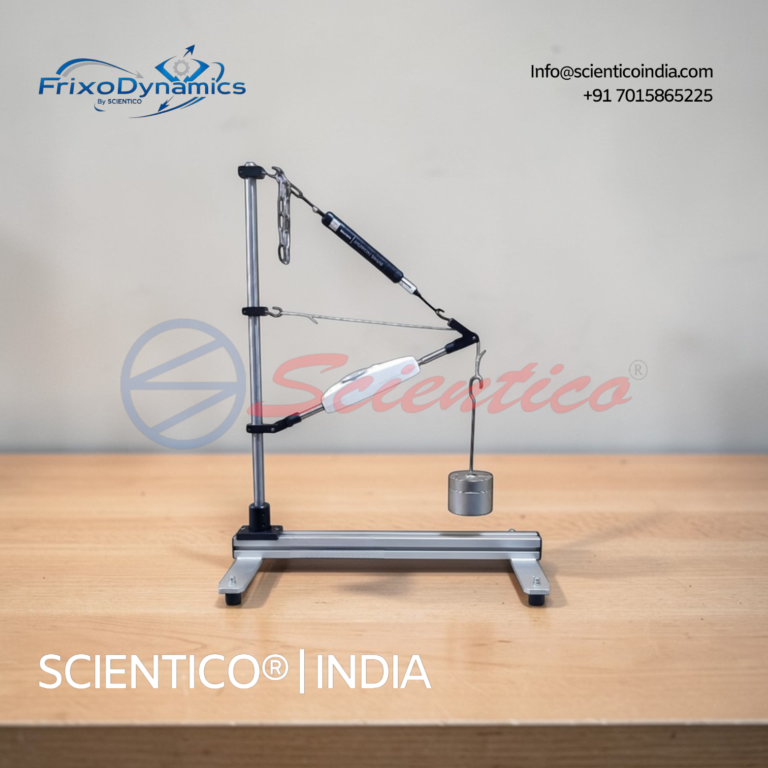
Forces in a Jib Crane Apparatus | FrixoDynamics FX-510
The SCIENTICO FrixoDynamics FX-510 Forces in a Jib Crane Apparatus is a wall-mounted experimental unit designed for the study of force distribution in a two-member jib crane structure. It enables students to measure compressive and tensile forces in the jib and tie members directly using an integrated force gauge and spring balance, and to compare those measured values against theoretical predictions derived from the triangle of forces and polygon of forces methods. The jib inclination and tie angle are adjustable, allowing a range of geometric configurations to be tested. Manufactured by SCIENTICO, the FX-510 is suitable for supply to engineering institutions and distributors worldwide.
View product details
Tablet Hardness Tester Manufacturer India
The Tablet Hardness Tester measures the crushing strength (diametrical compression force) of pharmaceutical tablets, a critical quality control parameter in tablet manufacturing and pharmacy education. It is a standard instrument in pharmacy lab equipment lists prescribed by the Pharmacy Council of India (PCI) for B.Pharm, M.Pharm, and D.Pharm programmes.
View product detailsWhy Oman colleges buy Universal Hardness Tester from India
The Oman higher-education buyer has two workable sources for a Universal Hardness Tester: European brands routed through Dubai dealers, and Indian manufacturers shipping direct. The European route lands at roughly two to three times the price of a comparable Indian unit and rarely includes on-site training. For a teaching lab that needs three or four benches running Rockwell, Brinell and Vickers on the same frame, the maths does not work.
India wins on four points. Price first, obviously. But also: ISO 9001 quality documentation and CE conformity certificates that MoHERI-affiliated procurement committees accept without argument. English-language O&M manuals ready out of the box (Arabic translation on request, most Omani engineering faculty read English fine). And direct factory contact when a technician in Muscat needs an indenter replaced, no three-way call through a European agent.
Scientico has been exporting to 30+ countries since 1993. We already run the GCC lane hard through our UAE supply hub, which means Oman consignments can consolidate through Jebel Ali when Sohar direct calls don’t fit the schedule.
Scientico’s Universal Hardness Tester range for Oman
Our flagship for the Oman market is the Universal Hardness Tester, one frame, three methods, motorised load application. It is the machine most Omani mechanical engineering departments are actually specifying in their BOQs because it collapses three benches into one budget line. For labs that also need destructive testing on rebar and small tensile coupons, we pair it with a Universal Testing Machine from the same strength of materials category. Buyers running a wider materials-testing setup often add a jib crane apparatus from our FrixoDynamics series to cover applied mechanics in the same procurement round.
For Oman specifically, we recommend the motorised load-cell variant over the manual dead-weight version. Reason: the teaching load in MTC and NU-style programmes runs high enough that a manual lever gets abused inside a semester. The motorised unit holds calibration longer and the students learn faster.
Universal Hardness Tester, specifications Oman buyers ask for
These are the specs that show up in every Omani tender BOQ I have quoted against. Nothing exotic, but get any of them wrong and the technical evaluation kicks you out:
- Test methods: Rockwell (A, B, C scales minimum), Brinell (HBW 2.5/187.5 and 5/750 standard), Vickers (HV load range 1–100 kgf typical for teaching units).
- Load application: motorised, closed-loop load cell preferred; dwell time programmable 1–99 seconds.
- Frame capacity: minimum 187.5 kgf, workable up to 3000 kgf on the larger frame variants for structural steel coupons.
- Optical system: integrated digital microscope with camera output, 10x and 20x objectives for Brinell/Vickers diagonal reading.
- Test block set: minimum three calibrated reference blocks with traceable certificates (Oman evaluators check the certificate chain).
- Power: 220V 50Hz single-phase, IEC plug fitted, Oman runs the same standard as India so no conversion needed.
Import process into Oman
Sea freight is the default for a Universal Hardness Tester. The crated weight sits between 400 and 900 kg depending on frame size, so LCL out of Nhava Sheva or Mundra is what we quote 90% of the time. Timings below are typical estimates from my recent shipments, not guarantees:
| Port of entry | Best for | Transit from India |
|---|---|---|
| Port of Sohar | Muscat metro, MTC, industrial belt, primary for project cargo | ~10–14 days LCL, plus 3–5 days customs |
| Port of Salalah | Dhofar University and southern deliveries; transshipment hub | ~7–10 days direct call |
| Jebel Ali → Hatta land border | Consolidated LCL when Sohar direct schedule is thin | ~7–12 days sea + 2 days road |
| Port Sultan Qaboos (Muscat) | Light cargo only; most containers rerouted to Sohar since 2014 | Not recommended for our crate sizes |
My honest recommendation: for anything going to Muscat, MTC or NU campuses, ship to Sohar. For Dhofar University or Salalah College of Technology, ship direct to Salalah, do not route through Sohar and truck 1000 km. For time-critical orders, Jebel Ali plus road across Hatta is faster than waiting for a direct Sohar sailing, especially in Q1 when the schedule is patchy.
Standards and documentation for Oman tenders
Every Oman public-sector procurement, whether through the Etimad successor platform under Ministry of Finance, or directly with an MoHERI-affiliated college, will ask for the same document pack. Get it wrong on submission and you lose a fiscal year.
Mandatory: ISO 9001:2015 manufacturer certificate, CE marking declaration of conformity, and calibration certificates traceable to a recognised national metrology institute (see our ISO 17025 / NABL calibration notes). For the Universal Hardness Tester specifically, evaluators check the test-block certificate chain, do not skip this. Datasheets and O&M manuals in English are sufficient for MoHERI institutions; Arabic translation is appreciated but not typically mandatory for HE tenders. For medical-training procurement routes (OMSB, Sultan Qaboos Comprehensive Cancer Care & Research Centre, DGPA&DC), Arabic is more strongly expected.
One local note: tender BOQs are issued bilingually in Arabic and English (mudakkarah fanniyyah, technical memo, is the phrase you will see). Your local Omani dealer or agent handles the Arabic technical response. We provide everything you need in English, formatted so translation is straightforward.
Related Universal Hardness Tester content
If you are still comparing options, read our detailed Universal Hardness Tester buyer’s guide, it covers spec traps, calibration lifecycle, and price bands in more detail than fits here. For labs building out a full materials department, the Universal Testing Machine guide is the natural next read. Buyers in other GCC and MENA markets can compare our UAE hub and Egypt hub for regional context.
We also serve other export lanes with the same product, see the Nigeria hub and Kenya hub for African market notes if you are procuring for a multi-country programme.
Get a CIF Sohar or Salalah quote
Send your BOQ or spec sheet on WhatsApp and I will return a CIF quotation in USD within 24 hours, Universal Hardness Tester unit price, freight to Sohar or Salalah, insurance, and lead time from PO. If you need a dealer introduction in Muscat we have working relationships already in place. Contact Scientico to start the enquiry.
One honest ask
We don't gate anything on this site. You just read the whole thing free. If it was useful, leave your email and two things happen: we send you this page as a plain-text block you can paste into a tender file or an internal email, and we notify you the next time we publish a buyer tool like this one. Nothing else. No drip sequence, no sales calls booked without asking.