
Plan GNM and ANM nursing laboratory equipment from the programme documents that apply to your institution, the practical skills you teach and the number of learners who need access at the same time. This guide gives procurement teams a way to build and review the equipment schedule. Its examples are planning prompts; they are not an official Indian Nursing Council (INC) list, mandatory quantities, inspection criteria or a guarantee of programme approval.
GNM and ANM should be mapped separately. Some teaching areas and items may be shared, while other activities, training models and consumables may differ by course, syllabus edition and teaching plan. Avoid copying a single combined list into a tender before faculty and the institution’s compliance lead have checked it against current official requirements.
Explore the relevant equipment category
Browse the catalogue category and review individual product specifications for your laboratory requirement.
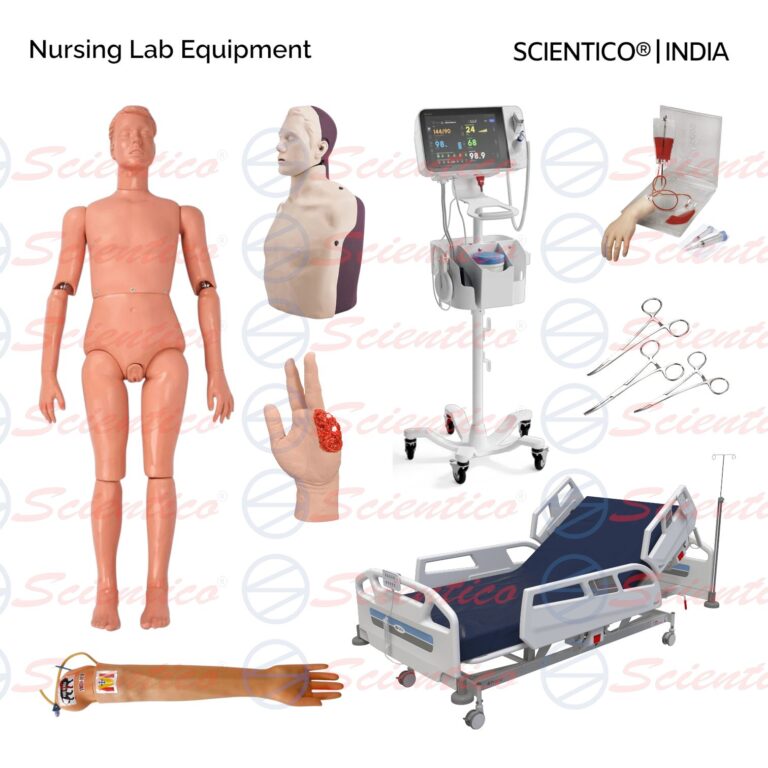
Nursing Lab Equipment
Review the nursing equipment catalogue against the practical skills, teaching groups and laboratory requirements in your approved programme.
Browse categoryStart with the current programme documents
The INC Nursing Programs Guidelines index provides programme-specific guidance and links to minimum-requirement documents. The INC Gazette notifications and publications list provide additional regulations, curriculum notices, corrigenda and syllabus publications. The pages contain documents from different dates and for different purposes, so first confirm the programme, applicable cohort or approval route, document title, publication date and whether a later notice changes it. If applicability remains unclear, confirm it with the relevant authority before using a requirement in an affiliation file or tender.
Keep a source register with the equipment plan. For each requirement, record the official document, edition/date, section or page, the course activity it supports and the person who verified the interpretation. A third-party list—including this guide—cannot substitute for that source check.
Build two schedules, then identify genuine shared use
Create separate GNM and ANM activity maps first. Use the relevant syllabus and faculty teaching plan to identify practical activities, skills and learning resources. Then compare the schedules for equipment that can actually be shared. “Shared” should mean the item is available when each programme needs it, is suitable for the planned teaching activity, and has an agreed timetable, storage and maintenance owner. A line should not be marked shared merely because the item name appears in both schedules.
Where both programmes use the same campus, give every line a unique inventory reference. Record which course uses it, in which session, whether use is simultaneous, and how access will be scheduled. This makes the quantity basis reviewable and prevents the same item from being counted twice—or from being treated as available to two classes at once.
Review the lab areas against teaching activities
The areas below are prompts for faculty review. They do not assert that every item is compulsory or currently available from a particular supplier.
- Fundamentals and nursing skills: identify the activities in the current course documents, then assess which teaching manikins, practice trainers, beds or bedside setups, basic measurement equipment, procedure accessories, storage and replaceable parts support those activities.
- Community health: review planned demonstrations and field-learning activities. Potential teaching aids may include community-visit materials, health-education resources, growth-measurement demonstrations and record-keeping practice materials where the current programme documents and faculty plan call for them.
- Maternal, newborn and midwifery teaching: check the course-specific practical scope before specifying demonstration models or trainers. State whether each item is a teaching aid, what learning activity it supports, and what accessories or consumables are required.
- Child health: map paediatric and newborn teaching activities to suitable demonstration or practice resources, if required by the applicable syllabus and teaching plan.
- Anatomy, physiology and related sciences: assess models, charts, microscopy or demonstration resources against the actual learning activities, existing inventory and room facilities.
- Nutrition and dietetics: have faculty confirm the planned demonstrations and any required teaching equipment, furniture, utilities and safe operating arrangements.
Quantity planning without inventing regulatory ratios
Do not treat a generic “one item per number of students” ratio as an INC rule unless the applicable official document explicitly states that ratio. Develop a local calculation for each line and retain its assumptions. Useful inputs include approved intake, batch and section size, number of simultaneous groups, session length, planned rotation, equipment already in usable condition, consumable life and the academic timetable. Have the academic owner validate access and the procurement owner validate the schedule.
| BOQ field | What to record |
|---|---|
| Programme and source | GNM or ANM; document title, edition/date, section/page and applicable institutional or state reference. |
| Subject and activity | Practical or skill, intended teaching use, academic owner and learner group. |
| Item and performance | Neutral description, function, relevant dimensions or range, materials, interface and acceptable equivalent performance. |
| Quantity basis | Local learner/session calculation, simultaneous use, rotation plan and existing usable inventory. |
| Room and utilities | Space, power, water, drainage, ventilation, connectivity, access or other site prerequisites when relevant. |
| Accessories and upkeep | Included components, consumables, compatible replacement parts, cleaning, storage and maintenance needs. |
| Supplier response | Quoted make/model, line-by-line compliance or deviation, inclusions, exclusions and supporting product literature. |
| Handover | Requested manuals or records, installation/training scope if required, acceptance method and responsible sign-off. |
Compare supplier offers consistently
Issue the same dated schedule and clarification set to each bidder. Ask the supplier to identify the exact offered model against every line, describe how it meets the requested teaching function, and list any deviation, option, accessory, consumable or exclusion. Compare like with like: unit, quantity, configuration, utility needs and handover scope should be visible in each response. Do not infer that a model includes installation, training, a certificate, calibration or a particular warranty unless the written offer says so for that model and order.
Keep regulatory and institutional evidence separate from supplier literature. The college is responsible for confirming applicable approvals and its own academic, staffing, facility and record requirements. An equipment quotation or catalogue does not establish regulatory compliance.
Before issuing a tender or purchase request
- Confirm the GNM and ANM programme documents and applicable dates with the institution’s responsible academic/compliance staff.
- Map proposed equipment to an activity and record the document reference for each line.
- Check existing inventory, condition, location, concurrent use and the timetable before calculating additional quantities.
- Write neutral, measurable specifications tied to the teaching function; identify permitted equivalents and required accessories.
- Separate required items from optional choices, consumables, utilities, furniture, installation, training and other services.
- Ask each supplier for an exact model and a line-by-line response, including exceptions and documents available for the offered configuration.
- Have academic, facilities, procurement and compliance owners sign off their respective parts before release.
Related nursing equipment planning
For degree-programme planning, see the BSc Nursing laboratory equipment planning guide. Review the current listed products in the nursing lab equipment catalogue and the institution-focused nursing colleges equipment page. Product listings are not confirmation of availability, configuration or regulatory suitability; confirm the selected model and scope in writing through the Scientico enquiry page.
Frequently asked questions
Is there one combined official GNM and ANM equipment list?
Do not assume one third-party list is official or applies to both programmes. Start with the current INC documents and applicable authority directions for each course, then map the institution’s teaching activities and equipment schedule to those sources.
Can GNM and ANM share a skills-lab item?
Potentially, if the item is suitable for both planned teaching activities and the timetable makes it available to each learner group. Record ownership, access, storage and maintenance, and avoid double-counting shared inventory.
What quantity should a college put in its BOQ?
Calculate from local intake, group sizes, simultaneous sessions, rotations, usable existing inventory and the teaching plan. Verify any prescribed quantity against the precise official document that applies; this guide does not set a regulatory ratio.
Does buying equipment guarantee programme approval or inspection compliance?
No. The institution must verify all applicable requirements, facilities, staffing, records and implementation with the responsible authorities. A supplier quote or equipment list cannot guarantee an approval or inspection outcome.
What should a supplier quote identify?
Request the exact model, specification response, quantity, included and excluded accessories, consumables or replacement parts, applicable documents, utilities, delivery basis and any installation, training, warranty or acceptance scope required by the tender.
Use this guide as a planning aid. Before tender issue, have the relevant academic and institutional owners verify the current source documents, course mapping, quantities and procurement terms.