
A line item that says “hydrogen training system” leaves too many decisions to the supplier. A PEM electrolyzer, a fuel cell and a complete renewable-hydrogen teaching loop are different purchases. Scientico’s PEM Electrolyzer Trainer RVX-134 is the relevant product when the practical must generate hydrogen by water electrolysis and measure how the system behaves under controlled conditions. Its published record describes a five-cell, 500 W stack, hydrogen production of up to 100 L/h and a stated hydrogen operating-pressure range of 0–20 bar. Those figures describe the listed apparatus; they are not a promise of output under every feed, load or ambient condition. Use the questions below to turn the model into an evaluable institutional RFQ.
Equipment mentioned in this guide
Review the product information, specifications and model before requesting a quotation.
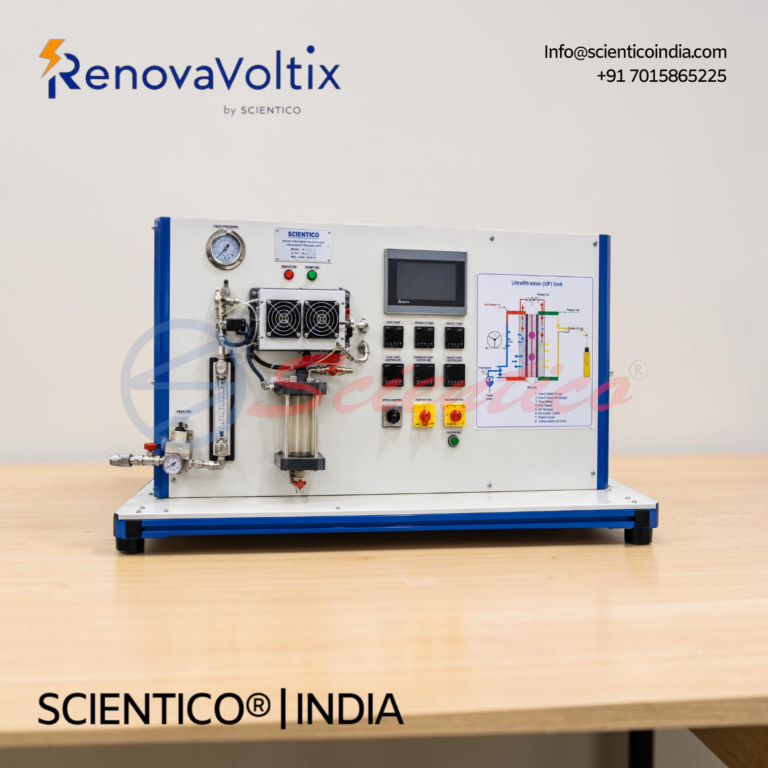
PEM Electrolyzer Trainer | RVX 134
The PEM Electrolyzer Trainer RVX 134 is an educational apparatus for studying proton exchange membrane water electrolysis and hydrogen production from renewable energy sources. This PEM electrolyzer trainer demonstrates efficient clean hydrogen generation using solar, wind, or grid power with comprehensive safety monitoring and hydrogen storage capability.
View product detailsStart with the experiment, then specify the system boundary
Write down what learners must observe: electrolyzer voltage and current, water use, hydrogen production, pressure response, cooling behaviour, or storage and later fuel-cell use. A course that only demonstrates the principle of electrolysis needs a different scope from a lab that will plot output against electrical input and discuss balance-of-plant operation. The green-hydrogen laboratory overview helps map the wider teaching sequence; this RFQ focuses on what must be included with RVX-134 itself.
Ask for a process diagram showing the water source, electrolyzer stack, drying section, gas outlet, pressure controls, cooling loop and any storage connection. Mark the boundary at every connector. If the syllabus requires a fuel cell, hydrogen storage vessel or a solar/wind source, request those as named lines rather than assuming they arrive with the electrolyzer. The product record lists metal-hydride storage cylinders as optional, in 300 L and 600 L capacities. Have the quotation identify whether a storage option is included, its connections and the operating instructions supplied for the selected arrangement.
Compare the power, water and cooling package
The product page describes a constant-current/constant-voltage power supply and an MPPT charge controller that can be used with solar, wind or grid-derived power. It also describes an accumulator battery in the system narrative. That does not establish the rating, local supply connection or battery shipping scope for a specific order. Provide the laboratory’s voltage and frequency, the intended renewable source if any, and the available bench or floor space. Ask Scientico to list the offered power supply, controller, cables, battery or battery exclusion, and protection devices by part and rating.
Water quality is part of the specification, not a small consumable detail. The published RVX-134 record calls for deionized water and describes water-quality detection. Ask for the required water specification, make-up arrangement, initial fill quantity, replacement items and disposal instructions. The same record describes water-cooling and air-cooling options. State which arrangement the room can support, then request its heat-rejection requirements, inlet and outlet connections, coolant or filter schedule, and noise or ventilation information where applicable. Do not infer that a cooling option suits the site solely from a photo of the trainer.
Make hydrogen safety and instrumentation inspectable
The product page lists temperature, pressure and flow monitoring; hydrogen leakage detection by an H2 LEL sensor; water-quality and dry-run protection; gas-port detection; and overpressure relief. An RFQ should ask which of these functions are fitted to the exact offered configuration, where sensors and alarms are located, how the unit stops on a fault, and what operators must do before restarting. Request the current operating manual, site requirements, supervised training plan and a written description of venting, storage and emergency actions. The institution’s responsible engineer should review the proposed room and operating procedure before commissioning.
Separate displayed readings from exportable data. The page offers USB data acquisition and LabVIEW-based software as an option. If students must plot electrical input against hydrogen output, state the variables, sampling interval, file-export format, computer and licence responsibilities, and whether the necessary sensors are included. Ask for a sample data record or screen list. A software logo in a brochure does not define the delivered measurement channels.
Copy-ready RFQ and acceptance checks
“Quote the Scientico RVX-134 PEM electrolyzer trainer, or a technically evaluated equivalent, for [course and number of groups]. Required experiments: [list]. State the offered stack and rated operating envelope; hydrogen output basis; power source and supply; deionized-water requirement; selected cooling method; drying and gas-outlet scope; included and optional storage; every displayed and logged variable; alarms and shutdown actions; room and ventilation requirements; documentation, training and spares. Identify all exclusions and deviations. Destination and installation conditions: [details].” Use the laboratory RFQ checklist to record commercial and handover fields alongside this technical brief.
At acceptance, reconcile the stack, controller, water path, cooling parts, sensors, storage option and manuals with the signed quotation. Agree in advance on a supervised demonstration of start-up, normal measurement, shutdown and a safe alarm test that does not require creating an unsafe fault. Record the measured operating conditions and any untested claim separately. Ask for the maintenance and calibration schedule for the sensors actually supplied, plus replacement routes for water filters, seals and other service items. A training result is only comparable when the test conditions and included equipment are recorded.
For nearby product choices, browse Scientico’s renewable-energy equipment range. To move this model into procurement, request an RVX-134 quotation with the experiment list, power and water available, cooling preference, storage decision, destination and tender date. Ask for a current model-specific inclusion list and site-readiness sheet before the order is approved.
One honest ask
This article and public product information are available to browse without an account. To open a product datasheet, complete the contact form shown with its download link. If this article was useful, leave your email and two things happen: we send you this page as a plain-text block you can paste into a tender file or an internal email, and we notify you the next time we publish a buyer tool like this one. Nothing else. No drip sequence, no sales calls booked without asking.