
🔎 Manufacturer-direct laboratory equipment enquiries - Request a model-specific international quotation →
✓ Established 1993 ✓ Model-Specific Specifications ✓ Manufacturer-Direct Enquiries ✓ International Quotations ✓ Destination-Based Delivery Terms

Ball Mill

Model Solidra - 02

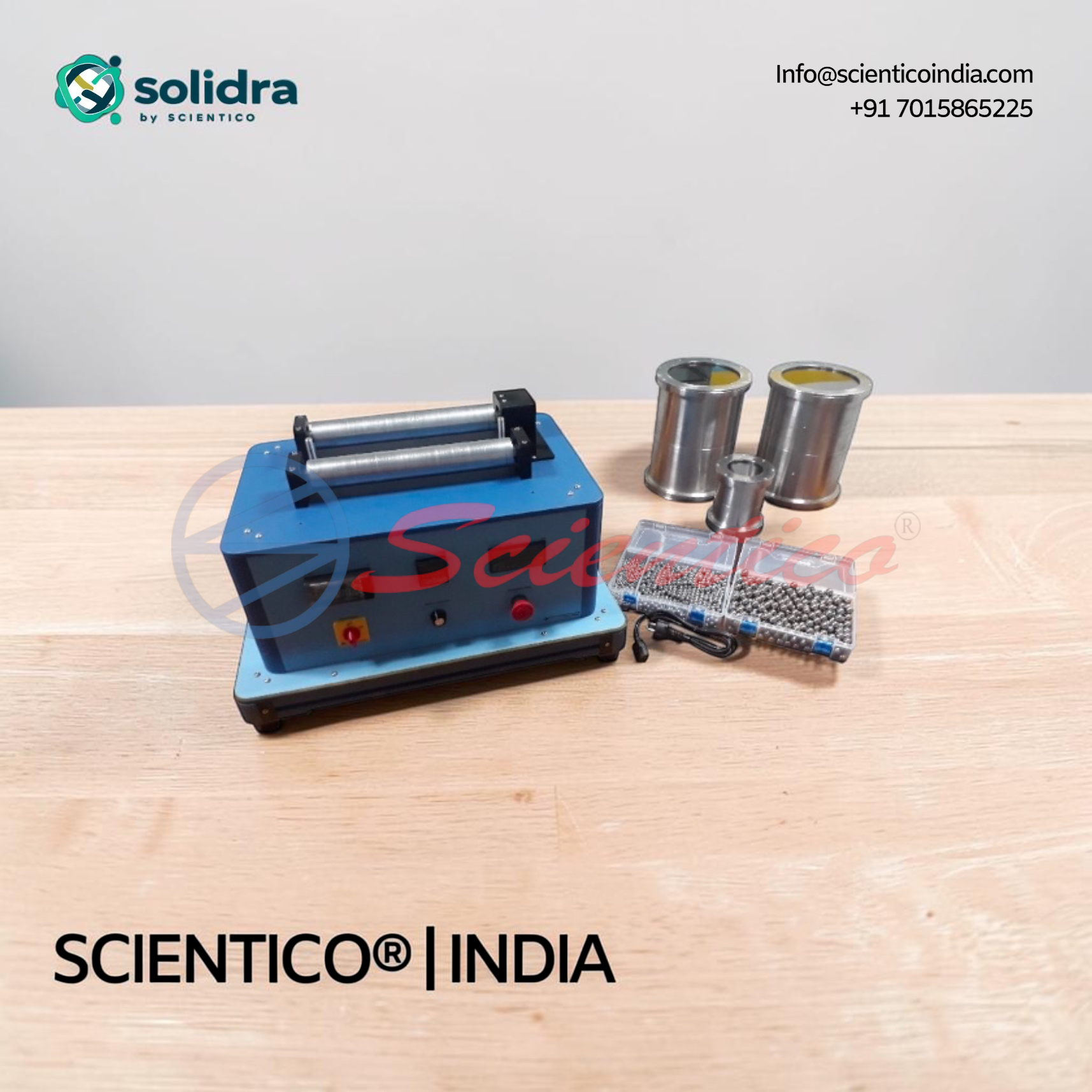
The Ball Mill Solidra – 02 studies solids comminution using two steel-jacketed drums with transparent fronts. This Ball Mill demonstrates cascade and cataract motion at varying rotation speeds, with power consumption displayed digitally. It includes three sets of grinding balls at Ø=5/10/15mm for testing different milling conditions. Adjustable axle spacing accommodates both big and small drum sizes.

The Ball Mill Solidra – 02 is a form of mill with grinding bodies, featuring drums that open at the front for loading material and milling balls. This Ball Mill uses drums mounted on a drive roller and a loose roller with adjustable spacing between the axles. It demonstrates cascade and cataract motion states, observable through transparent drum fronts.

Product Overview

Ball mills are a form of mills with grinding bodies. The drums can be opened at the front and loaded with the material to be milled (limestone is recommended) and the milling balls. The drums are mounted on a drive roller and a loose roller with adjustable spacing between the axles. At low rotation speeds the comminution is affected by the balls rolling over the material (cascade motion).

At higher speeds, some balls are lifted up the wall, become detached and drop down onto the material (cataract motion). Above the critical speed, centrifugal forces ensure that no more comminution takes place. These motion states can be observed through the transparent fronts of the drums on this Ball Mill. In order to compare the theoretical power demand with the actual, the power consumption of the drive motor is indicated on a digital display.

Ball Mill Solidra – 02, Technical Specifications

Specification Detail
Process Comminution of solids with a ball mill
Drums 2, with steel jackets and transparent fronts
Rollers 1 drive roller with adjustable speed, 1 loose roller
Axle Spacing Adjustable to accommodate different drums
Power Measurement Measurement of power consumption

Technical Data

Big Drum

Parameter Value
Capacity 7L approx.

Small Drum

Parameter Value
Capacity 0.7L approx.

Grinding Balls

Parameter Value
Sets 3
Diameter Ø=5/10/15mm

Measuring Ranges

Parameter Value
Power consumption 0~200W
Speed 0~500min⁻¹

Key Features

  • Drums: 2, steel jackets with transparent fronts, capacities 7L (big) and 0.7L (small) approx.
  • Rollers: 1 drive roller with adjustable speed, 1 loose roller
  • Axle Spacing: adjustable to accommodate different drums
  • Grinding Balls: 3 sets, diameters Ø=5/10/15mm
  • Power Measurement: digital display of power consumption, range 0~200W
  • Speed Range: 0~500min⁻¹
  • Motion Observation: cascade and cataract motion visible through transparent drum fronts, core to how this Ball Mill demonstrates comminution
  • Comparative Study: compares theoretical and actual power demand

Experiments

  • Degree of comminution dependent on milling time, rotation speed, ball diameter, ball filling, material to be milled
  • Cascade and cataract motion, critical speed
  • Theoretical and actual power demand

Construction and Design

The Ball Mill Solidra – 02 consists of 2 drums with steel jackets and transparent fronts, with capacities of approximately 7L (big drum) and 0.7L (small drum). The drums open at the front for loading material and milling balls, and are mounted on a drive roller with adjustable speed and a loose roller. Axle spacing between the rollers is adjustable to accommodate different drums. Three sets of grinding balls, with diameters of Ø=5, 10, and 15mm, are used for comminution. Power consumption is measured on a digital display, ranged 0 to 200W, with speed measurable from 0 to 500min⁻¹.

Scope of Delivery

  • 1 experimental module
  • 2 milling drums
  • 3 sets of grinding balls
  • 1 instructional manual

Q: What is the Ball Mill Solidra – 02 used for?
A: It is used to study the comminution of solids, examining the effects of milling time, rotation speed, ball diameter, ball filling, and material type.

Q: What is the difference between cascade and cataract motion?
A: Cascade motion occurs at low rotation speeds, where balls roll over the material. Cataract motion occurs at higher speeds, where balls are lifted up the wall, become detached, and drop onto the material.

Q: What drum sizes are included?
A: A big drum with approximately 7L capacity and a small drum with approximately 0.7L capacity are included.

Q: What grinding ball sizes are available?
A: Three sets of grinding balls are available, with diameters of Ø=5mm, 10mm, and 15mm.

Q: How is power consumption measured?
A: Power consumption is indicated on a digital display, with a measuring range of 0 to 200W, allowing comparison of theoretical and actual power demand.

Need Assistance? We're Here to Help!

Connect with our team for product specifications, pricing, and customized solutions for your institution or project.
Trade enquiries

Distributors, dealers, resellers and bulk buyers

We manufacture Ball Mill | Solidra – 02 at our own works in Ambala, India. Manufacturer-direct, three ways to work with us.

01

Become a distributor, dealer or agent in your territory

Already selling to colleges or hospitals in your market? Add a manufacturer-direct line. Terms reviewed on application.

or message on WhatsApp
02

Wholesale and bulk quotation

Holding a live enquiry? Send the model, quantity, destination and required Incoterm. We will confirm the supplied scope and available export documents.

or message on WhatsApp
03

OEM authorisation letter for a tender

Bidding a tender that requests a manufacturer authorisation form (MAF)? Send the tender reference, deadline and listed equipment so we can confirm what can be issued.

or message on WhatsApp

Full distributor guide OEM and export enquiries

Solid HandlingModel Solidra - 02
🏭
Manufacturer DirectProduct-specific enquiry, not a generic catalogue
🌍
Destination MatchedConfiguration and delivery scope reviewed together
📄
Decision-Ready ReplyApplicable documentation confirmed before ordering
Product-specific enquiry

Get a quotation your team can evaluate

A bare price can hide configuration, accessories, voltage, documentation and delivery assumptions. Send the product and destination now so the quoted scope can be reviewed before a purchase decision.

Avoid the mismatchDo not approve a generic price that leaves supplied scope unclear.
Your product is attachedNo need to retype the model or copy the page URL.
Move toward an approvable quoteAdd the destination; quantity and tender details can follow.

No account is required. Organisation, quantity and tender details are optional. Include the country code so the team can reach you internationally.

1993
Manufacturing Since
Direct
Manufacturer Supply
Quote-based
International Orders
Model
Solidra - 02

Overview

The Ball Mill Solidra - 02 is a form of mill with grinding bodies, featuring drums that open at the front for loading material and milling balls. This Ball Mill uses drums mounted on a drive roller and a loose roller with adjustable spacing between the axles. It demonstrates cascade and cataract motion states, observable through transparent drum fronts.

Product Overview

Ball mills are a form of mills with grinding bodies. The drums can be opened at the front and loaded with the material to be milled (limestone is recommended) and the milling balls. The drums are mounted on a drive roller and a loose roller with adjustable spacing between the axles. At low rotation speeds the comminution is affected by the balls rolling over the material (cascade motion).

At higher speeds, some balls are lifted up the wall, become detached and drop down onto the material (cataract motion). Above the critical speed, centrifugal forces ensure that no more comminution takes place. These motion states can be observed through the transparent fronts of the drums on this Ball Mill. In order to compare the theoretical power demand with the actual, the power consumption of the drive motor is indicated on a digital display.

Key Features

Key Features

  • Drums: 2, steel jackets with transparent fronts, capacities 7L (big) and 0.7L (small) approx.
  • Rollers: 1 drive roller with adjustable speed, 1 loose roller
  • Axle Spacing: adjustable to accommodate different drums
  • Grinding Balls: 3 sets, diameters Ø=5/10/15mm
  • Power Measurement: digital display of power consumption, range 0~200W
  • Speed Range: 0~500min⁻¹
  • Motion Observation: cascade and cataract motion visible through transparent drum fronts, core to how this Ball Mill demonstrates comminution
  • Comparative Study: compares theoretical and actual power demand

Experiments

  • Degree of comminution dependent on milling time, rotation speed, ball diameter, ball filling, material to be milled
  • Cascade and cataract motion, critical speed
  • Theoretical and actual power demand

Construction and Design

The Ball Mill Solidra - 02 consists of 2 drums with steel jackets and transparent fronts, with capacities of approximately 7L (big drum) and 0.7L (small drum). The drums open at the front for loading material and milling balls, and are mounted on a drive roller with adjustable speed and a loose roller. Axle spacing between the rollers is adjustable to accommodate different drums. Three sets of grinding balls, with diameters of Ø=5, 10, and 15mm, are used for comminution. Power consumption is measured on a digital display, ranged 0 to 200W, with speed measurable from 0 to 500min⁻¹.

Scope of Delivery

  • 1 experimental module
  • 2 milling drums
  • 3 sets of grinding balls
  • 1 instructional manual

Specifications

Ball Mill Solidra - 02, Technical Specifications

Specification Detail
Process Comminution of solids with a ball mill
Drums 2, with steel jackets and transparent fronts
Rollers 1 drive roller with adjustable speed, 1 loose roller
Axle Spacing Adjustable to accommodate different drums
Power Measurement Measurement of power consumption

Technical Data

Big Drum

Parameter Value
Capacity 7L approx.

Small Drum

Parameter Value
Capacity 0.7L approx.

Grinding Balls

Parameter Value
Sets 3
Diameter Ø=5/10/15mm

Measuring Ranges

Parameter Value
Power consumption 0~200W
Speed 0~500min⁻¹

Buying Ball Mill: Distributor & Tender Guidance

Ball Mill is the product name procurement teams should use when searching, preparing a BOQ or comparing suppliers. A model reference identifies the proposed configuration; it should not replace the product name or the buyer’s required experiment. This equipment is considered for chemical and process-engineering teaching on separation, mixing, drying, filtration, mass transfer or other unit operations.

What to include in the RFQ

State the product name, quantity, destination, curriculum or tender reference, and process capacity, contact or separation section, feed and collection arrangement, instrumentation, materials of construction, utilities and experiments. This lets the technical team respond against the intended use rather than guess from a model code.

How distributors should quote it

Keep Ball Mill as the BOQ line item. Add the proposed model, included accessories, documentation, packing and delivery basis as separate fields so the end buyer can verify the offer.

How to compare suppliers

Confirm the process flow, measurement points and supplied consumables or accessories for the exact operation required. Record exclusions and alternatives in writing before commercial comparison.

Why Buy From Scientico

🏭

In-House Manufacturer

Designed & built in our Ambala facility since 1993 — not a reseller. Full control over quality & customisation.

✅

Configuration Review

Specifications, documentation and options are confirmed against the selected model.

🌏

International Enquiries

Share your destination and procurement requirements for an export quotation.

📦

Quote-Based Supply

Send the model, quantity and delivery location for a tailored proposal.

🛠

Support Scope

Support and warranty terms are documented in the applicable quotation.

🎓

Built for Teaching

Designed around curriculum experiments with clear, repeatable, hands-on results.

Frequently Asked Questions

Q: What is the Ball Mill Solidra - 02 used for? A: It is used to study the comminution of solids, examining the effects of milling time, rotation speed, ball diameter, ball filling, and material type.

Q: What is the difference between cascade and cataract motion? A: Cascade motion occurs at low rotation speeds, where balls roll over the material. Cataract motion occurs at higher speeds, where balls are lifted up the wall, become detached, and drop onto the material.

Q: What drum sizes are included? A: A big drum with approximately 7L capacity and a small drum with approximately 0.7L capacity are included.

Q: What grinding ball sizes are available? A: Three sets of grinding balls are available, with diameters of Ø=5mm, 10mm, and 15mm.

Q: How is power consumption measured? A: Power consumption is indicated on a digital display, with a measuring range of 0 to 200W, allowing comparison of theoretical and actual power demand.

Related Guides & Resources

In-depth guides from Scientico on Solid Handling lab setup, experiments and procurement.

Ball Mill | Solidra - 02

Related Laboratory Equipment

Explore related apparatus in this equipment range. Request a model-specific international quotation.

Solids Handling Study Unit by Scientico IndiaSolids Handling Study Unit | Solidra-01Liquid/Solid Mixing Unit by Scientico IndiaLiquid/Solid Mixing Unit | Solidra – 03
📄 Download Datasheet

Get the product datasheet

Share your details to open the complete datasheet, then print or save it as a PDF.

Ball Mill | Solidra - 02