
A nursing skills laboratory should be designed around what learners must practise, demonstrate and be assessed on, not around a long mannequin list. Map each competency to a task trainer, anatomical model, patient-care mannequin or simulation system, then define realism, replaceable parts, consumables, cleaning, storage, facilitation and debriefing needs.
Equipment mentioned in this guide
Review the product information, specifications and model before requesting a quotation.
Anatomy Model Manufacturer India
Scientico's Human Anatomy Models are used in nursing colleges, medical colleges, and allied health science institutes for studying human anatomy and physiology without the use of cadavers. The models are anatomically accurate and durable, meeting the laboratory requirements prescribed by the Indian Nursing Council (INC) for B.Sc. Nursing and GNM programmes.
View product details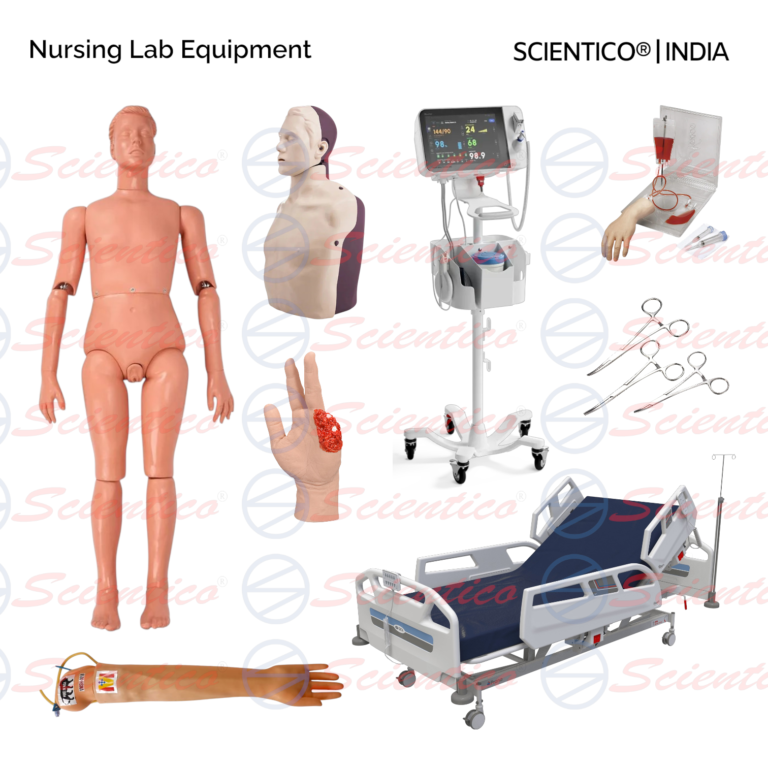
Nursing Lab Equipment | SCIENTICO India
SCIENTICO manufactures a comprehensive range of nursing lab equipment designed for nursing colleges, schools of nursing, and clinical training institutes. Our equipment supports hands-on skill development in patient care, clinical procedures, and healthcare simulation, helping students build practical competence before real-world clinical exposure.
View product detailsBuild the equipment list from competencies
| Competency area | Equipment decision | Evidence to request |
|---|---|---|
| Foundational patient care | Whole-body or part-task equipment for positioning, hygiene, mobility and routine care. | Supported procedures, articulation, replaceable parts, cleaning method, included consumables and learner capacity. |
| Medication and vascular access | Injection and IV task trainers matched to the intended route and practice sequence. | Insertion sites, fluid compatibility, feedback, skin/vein replacement, consumable cost and safe disposal procedure. |
| Airway and resuscitation | CPR or airway trainers selected by required intervention and feedback. | Supported techniques, feedback measures, airway consumables, hygiene, software/licensing and instructor reporting. |
| Maternal and neonatal care | Task trainers or simulators mapped to the exact obstetric or neonatal scenarios. | Scenario coverage, maternal/fetal or neonatal functions, consumables, facilitator controls and debriefing data. |
| Anatomy and examination | Anatomical models and examination trainers matched to the body system and learning outcome. | Structures represented, removable components, labelling, scale, mounting/storage and replacement policy. |
Equipment is only one part of simulation readiness
INACSL’s Healthcare Simulation Standards of Best Practice organise quality simulation around measurable outcomes and objectives, purposeful design, prebriefing, facilitation, debriefing, operations and evaluation. This means procurement must consider the scenario workflow, faculty preparation and operational support as well as the simulator. See the official INACSL standards overview.
A technically advanced simulator can still be a poor fit if the programme lacks the staff time, space, consumables, maintenance plan or debriefing method needed to use it. Conversely, a well-chosen task trainer can be highly effective when it directly supports a measurable competency and repeated deliberate practice.
OSCE and skills-station planning checklist
- Write the observable learner action and expected outcome for each station.
- Define whether the station is practice, formative assessment or summative assessment.
- List equipment, consumables, replacement parts and reset time per learner.
- Specify the realism and feedback necessary for the objective, avoid paying for unrelated features.
- Plan clean/dirty flow, infection-control practice, storage and electrical/network access.
- Record facilitator controls, scenario setup, learner briefing and debriefing requirements.
- Estimate simultaneous learners, station duration and daily utilisation.
- Confirm manuals, training, warranty, technical support and replacement availability.
How to compare supplier or distributor proposals
Ask every bidder to map the offered product to the same competency and procedure list. Record included and optional functions separately. For reusable trainers, compare the cost and availability of skins, veins, pads, airways, fluids, batteries and other replacement items over the expected teaching volume.
Do not infer clinical capability from a product photograph. Request the exact procedures supported, contraindicated uses, cleaning instructions and the supplied parts list. Any claim tied to a particular curriculum, institution or clinical standard must be supported for the offered product rather than applied to the whole category.
Related nursing and medical resources
- Medical training manikins and simulation-equipment guide
- GNM and ANM nursing laboratory equipment list
- Nursing laboratory equipment buyer’s guide
- Nursing laboratory equipment catalogue entry
- Browse nursing laboratory equipment
Frequently asked questions
Should a nursing laboratory begin by choosing a high-fidelity simulator?
No. Begin with competencies, learner numbers, scenario goals and faculty capacity. Select the level of technology needed for those outcomes.
What makes a task trainer suitable for repeated teaching?
It should support the exact procedure, be reset and cleaned safely, have replaceable wear parts and consumables, and fit the intended learner throughput.
What should an OSCE equipment list include?
Include the station objective, trainer or model, consumables, setup/reset items, assessment aids, cleaning requirements and quantity needed for the timetable.
What should an international buyer include in an enquiry?
Send the programme, competency and procedure list, learner numbers, station plan, quantities, destination, electrical/network constraints, training needs and required documents.
Request a competency-matched equipment proposal
Send the competency or skills-station list so the relevant equipment and supplied scope can be reviewed.