
A buyer comparing a Water Hammer Apparatus with a Pipe Surge and Water Hammer Apparatus should first decide which transient-flow measurements the laboratory must support. Similar names can describe different test arrangements. Compare the test sections, pressure measurement, data capture and water-feed requirements shown for the exact model—not the product title alone.
Equipment mentioned in this guide
Review the product information, specifications and model before requesting a quotation.

Water Hammer Apparatus | FluidoSurge-X 250
Supplied to universities and institutions in 30+ countries.
View product details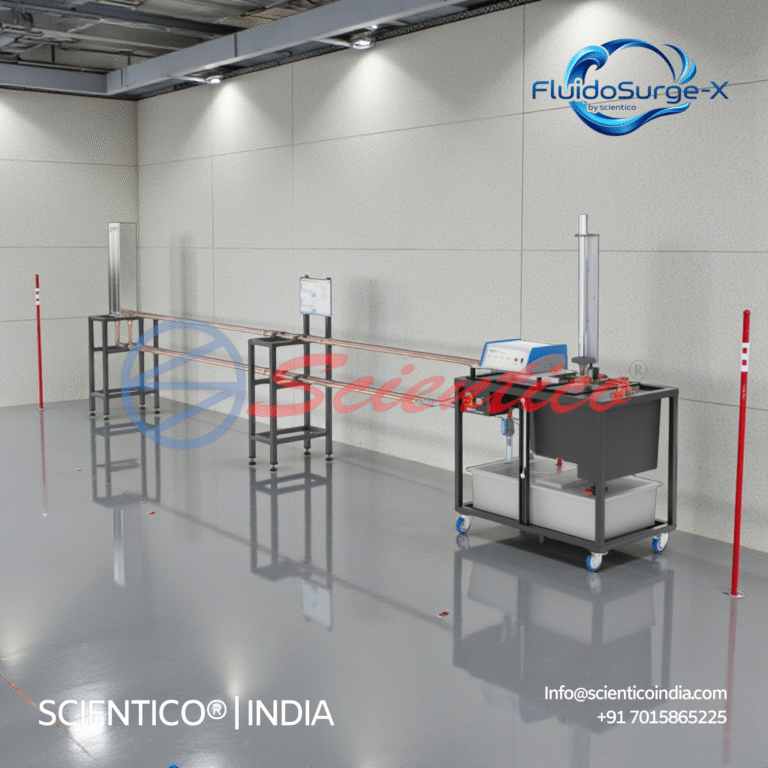
Pipe Surge and Water Hammer Apparatus | FluidoSurge-X 324
The FluidoSurge-X 324 is a dedicated experimental apparatus for studying transient effects of pipe surge and water hammer resulting from gradual or instantaneous changes in fluid velocity. The unit consists of two stainless steel test pipes, one for surge studies and one for water hammer studies, connected to a constant head tank, with a hydraulic bench supplied for water feed and flow measurement.
View product detailsTwo product records, two stated scopes
Scientico’s FluidoSurge-X 250 Water Hammer Apparatus is described for visual study of pressure surges caused by changes in flow. Its product description mentions transparent components, manual generation of transient conditions and different surge-pipe diameters. The product record says it can use a hydraulic bench or laboratory water supply. Treat these as the published description; confirm the supplied pipes, measurement devices and connection details in the current quotation.
The separate Pipe Surge and Water Hammer Apparatus (catalogue model FluidoSurge-X 324) is described with separate pipe-surge and water-hammer sections. Its published description identifies pressure transducers and oscilloscope-based measurements, with optional data-acquisition software. The live URL contains “249” while the product record names model 324; use the current catalogue reference and written offer to confirm the precise SKU before ordering.
Compare by the learning and measurement task
| Question | Water Hammer Apparatus | X 250 | Pipe Surge and Water Hammer | X 324 |
|---|---|---|
| What is the primary fit? | Teaching the water-hammer phenomenon and observing transient pressure behaviour. | Studying both pipe surge and water hammer through separate stated test sections. |
| What measurement path is described? | Visual observation and controlled transient conditions; confirm exact included instruments and recorded variables. | Pressure transducers and oscilloscope measurement are described; confirm channel count, interface and included instruments. |
| What should be checked about data capture? | Ask how readings are observed and recorded for the required practical. | Ask whether the quoted configuration includes the oscilloscope, transducers, software and any computer/interface requirement. The product page describes data-acquisition software as optional. |
| What site setup is needed? | Confirm hydraulic-bench or laboratory-water connection, drainage and required fittings. | Confirm the bench/water-feed arrangement, power, drainage, measurement equipment and operating space against the current datasheet. |
This is a comparison of the currently published product descriptions, not a guarantee that every listed item is included in a particular offer. Product scope can change by configuration; ask the supplier to itemise the delivered set.
When a combined pipe-surge/water-hammer rig may be the closer fit
If the course needs learners to distinguish a surge response from a water-hammer pressure wave, the combined product’s separately described sections and pressure measurement may be relevant. The value is in the measurements your class will actually perform. Confirm whether students need to record a pressure profile, observe a surge level, compare a response to theory, or use software to process and export data. If the outcomes only require an introductory visual demonstration, ask whether the simpler stated arrangement covers the syllabus before specifying instrumentation that may not be needed.
Build a model-specific comparison before requesting a quote
- List each practical and the quantity of student groups that must use it at the same time.
- State which variables students must observe, measure, calculate or export.
- Identify existing equipment: hydraulic bench, data-acquisition hardware, oscilloscope, computer, water supply and drainage.
- Ask for the current datasheet and a line-by-line scope showing test sections, sensors, accessories, software, utilities and exclusions.
- Request the exact model/catalogue reference in the quotation and purchase order; reconcile the reference if the URL, brochure and offer use different numbering.
- Record the institution’s documentation, inspection and acceptance requirements separately from product features.
Questions for the technical evaluation
- Does this offer cover pipe surge, water hammer, or both? Identify each test section.
- Which pressure sensors and measurement/display equipment are included?
- Is the oscilloscope or data-acquisition software optional or included in this price?
- What water, power, drainage, bench and computer connections are required?
- What is the precise model code, supplied scope and documentation for the offered configuration?
For fundamentals, read what water hammer is and why it occurs. For the related hydraulic-ram practical, see the Hydraulic Ram Pump experiment procedure. Browse the Fluid Mechanics range, then send the experiment list and site utilities through the model-specific enquiry route.
Decision rule
Choose by required observations, instrumentation and teaching depth—not by choosing the longest specification sheet. Where two quotes differ, record the difference as included, optional, excluded or requiring confirmation. This keeps the comparison technically meaningful and helps the procurement team evaluate the same scope across suppliers.
One honest ask
We don't gate anything on this site. You just read the whole thing free. If it was useful, leave your email and two things happen: we send you this page as a plain-text block you can paste into a tender file or an internal email, and we notify you the next time we publish a buyer tool like this one. Nothing else. No drip sequence, no sales calls booked without asking.