
The hydraulic ram pump experiment procedure involves supplying water to the pump from a constant-head supply tank, letting the waste (impulse) valve open and close rapidly to create a water hammer pressure surge, and measuring how much water is delivered to a raised tank against a known head. Students record the supply flow, delivered flow, supply head, and delivery head, then calculate efficiency using the Rankine or D’Aubuisson formula. The whole demonstration runs without any external power, which is exactly why it remains a favourite in fluid mechanics labs across engineering colleges and polytechnics.
This guide walks through the working principle, a clean step-by-step lab procedure, the water hammer effect that drives the pump, the performance calculations, and a practical specification checklist for anyone buying a ram pump test rig for a teaching laboratory.
Equipment mentioned in this guide
Review the product information, specifications and model before requesting a quotation.
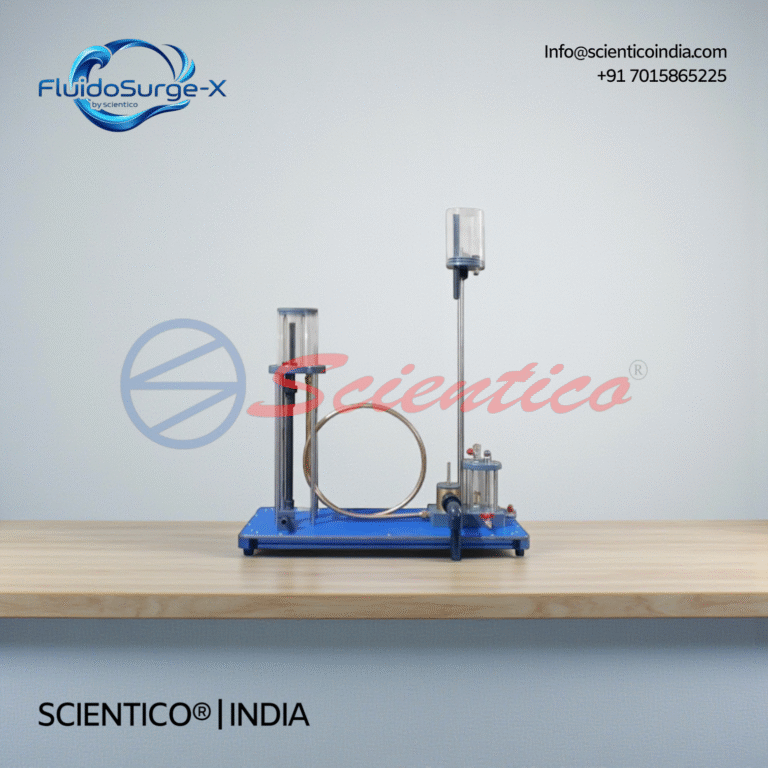
Hydraulic Ram Pump Apparatus | FluidoSurge-X 164
The Hydraulic Ram Pump Apparatus FluidoSurge-X 164 is designed to demonstrate the phenomenon of water hammer and its application in hydraulic ram pumping. It shows how pressure surges in pipelines can be utilized to lift water to a higher elevation without external power. The apparatus enables clear observation of cyclic valve operation and pressure buildup. It is suitable for fluid mechanics and hydraulic machinery laboratory studies.
View product detailsWhat is a hydraulic ram pump and how does it work?
A hydraulic ram (or hydram) is a cyclic pump that uses the energy of a large volume of water falling a small height to lift a smaller volume of water to a much greater height. It needs no motor, no fuel, and no electricity. The energy source is gravity acting on the supply water, and the mechanism that converts that energy into a pressure boost is the water hammer effect.
The pump has a few core parts:
- Drive (supply) pipe: carries water from the supply tank to the pump body under a steady head.
- Waste valve (impulse valve): a spring or weight-loaded valve that periodically slams shut, triggering the pressure surge.
- Delivery valve: a one-way check valve that opens only when pressure inside the body exceeds the delivery head.
- Air vessel (air chamber): cushions the surge, smooths the delivery flow, and protects the system from shock.
- Delivery pipe: carries the lifted water to the raised tank.
The working cycle in four stages
- Water from the supply tank accelerates down the drive pipe and escapes through the open waste valve.
- As velocity builds, the dynamic force lifts and suddenly closes the waste valve.
- The abrupt stop creates a high-pressure water hammer surge that forces the delivery valve open; water is pushed into the air vessel and up the delivery pipe.
- Pressure drops, the delivery valve closes, the waste valve reopens, and the cycle repeats, typically 30 to 100 beats per minute.
Why does the water hammer effect matter in a ram pump?
The water hammer effect is the sudden pressure rise that occurs when a moving column of water is brought to an abrupt halt. When the waste valve snaps shut, the kinetic energy of the water in the drive pipe cannot simply disappear, so it converts into a momentary pressure spike that can be many times the static supply head. That spike is the only thing capable of pushing water above the supply level, without it, the pump would do nothing.
In a teaching context this is the most valuable lesson of the experiment: students see, hear, and measure a phenomenon that engineers usually try to eliminate in pipelines (because it bursts pipes), here being deliberately harnessed to do useful work. The audible “knock” of the waste valve is the water hammer happening in real time. The air vessel is what keeps each surge from damaging the delivery pipe and turns the pulsing flow into a near-steady stream.
What is the step-by-step hydraulic ram pump experiment procedure?
The exact steps vary slightly with rig design, but the standard laboratory procedure is as follows:
- Setup: Fill the supply tank and maintain a constant head over the drive pipe inlet. Note the supply head (H), the vertical distance from supply water level to the pump.
- Prime the pump: Open the supply valve and manually work the waste valve a few times until the pump starts beating on its own.
- Set the delivery head: Record the delivery head (h), the vertical distance from the pump to the delivery tank water level.
- Let it stabilise: Allow the ram to run steadily for a minute so the beat rate becomes regular.
- Measure delivered water (q): Collect the water reaching the delivery tank over a measured time using a measuring tank and stopwatch.
- Measure waste/supply water (Q): Collect the water discharged through the waste valve (or measure total supply) over the same time.
- Repeat: Change the delivery head or waste-valve setting and take several readings to plot performance curves.
- Shut down: Close the supply valve and drain the rig.
Quantities recorded and how efficiency is calculated
| Symbol | Quantity | How it is found |
|---|---|---|
| H | Supply head (m) | Level difference, supply tank to pump |
| h | Delivery head (m) | Level difference, pump to delivery tank |
| q | Water delivered (litre/s) | Measuring tank + stopwatch |
| Q | Supply/waste water (litre/s) | Measuring tank + stopwatch |
| N | Beat rate (beats/min) | Count waste-valve strokes |
Two standard formulas are taught:
- D’Aubuisson efficiency: η = (q × h) / (Q × H), where Q is the total supply water (delivered plus wasted).
- Rankine efficiency: η = (q × (h − H)) / ((Q − q) × H), which is generally considered the more rigorous measure because it credits only the net lift above the supply level.
Both are expressed as a percentage. The Rankine value is always lower than the D’Aubuisson value for the same readings, so students should state clearly which one they have used.
What results and observations should students expect?
A well-run experiment lets students plot delivery head against efficiency and against delivered flow. Typical learning outcomes include:
- As the delivery head increases, delivered flow (q) decreases, the pump lifts less water the higher it has to push.
- Efficiency is low at very low delivery heads, rises to a peak, then falls again at very high heads, giving a characteristic curve.
- Adjusting the waste-valve stroke or spring tension changes the beat rate and shifts the whole performance curve.
- The ratio h/H matters: a ram lifting to a modest multiple of the supply head performs far better than one pushed to extreme heights.
Common sources of error to flag in the report
- Unsteady supply head (the supply tank draining faster than it refills).
- Air leaks at the air vessel reducing the cushioning effect.
- Timing errors in collecting q and Q, use the same time window for both.
- Not letting the beat rate stabilise before taking readings.
What should a college look for when buying a ram pump test rig?
A good teaching rig makes the water hammer cycle visible and the readings repeatable. Use this checklist when comparing apparatus:
| Feature | Why it matters for teaching |
|---|---|
| Transparent air vessel / sight elements | Lets students observe surge cushioning |
| Adjustable waste valve (spring/weight) | Enables varying beat rate as a study variable |
| Integrated supply & measuring tanks | Self-contained recirculating operation in any lab |
| Calibrated piezometers / pressure gauges | Accurate head and pressure readings |
| Corrosion-resistant body and fittings | Long service life with continuous water contact |
| Clear delivery-head adjustment | Easy generation of performance curves |
For laboratories sourcing this category of apparatus, Fluid Mechanics Lab Equipment from Scientico India, an ISO 9001:2015 and model-specific manufacturer in Ambala, India, exporting to 30+ countries since 1993 and GeM-registered, ships with calibration and conformity documentation for institutional procurement and audit needs.
How do buyers in India and abroad request a quote?
Scientico works on a quote basis rather than fixed public pricing, which suits tender, GeM, and export procurement where specifications and quantities differ by institution. Indian polytechnics and universities can request a GeM-compatible quotation, while overseas buyers receive a CIF proforma invoice, typically within 24 hours, covering the equipment and export documentation. Technical queries and quick quotes can also go through WhatsApp at +91-7015865225, where you can share your syllabus requirement or NBA lab specification and get a configuration recommendation.
Whether you are equipping a first-year fluid mechanics lab or expanding a mechanical engineering department, the hydraulic ram pump remains one of the most memorable demonstrations available: it turns a destructive phenomenon into useful work, needs no power, and gives students real numbers to analyse.
Frequently Asked Questions
What is the working principle of a hydraulic ram pump?
It uses the energy of a large volume of water falling a small height (the supply head) to lift a smaller volume to a much greater height. The waste valve closes suddenly, creating a water hammer pressure surge that forces water through the delivery valve and up the delivery pipe. It needs no electricity or fuel.
How is the efficiency of a hydraulic ram pump calculated?
Two formulas are standard. D’Aubuisson efficiency = (q x h) / (Q x H), and Rankine efficiency = (q x (h – H)) / ((Q – q) x H), where q is delivered flow, Q is supply flow, h is delivery head and H is supply head. Rankine is the stricter measure because it credits only the net lift above the supply level.
Why is the water hammer effect important in this experiment?
The water hammer is the sudden pressure rise when the moving water column is stopped by the closing waste valve. That pressure spike is the only force capable of lifting water above the supply level, so it is what makes the pump work. The experiment is a rare chance to harness, rather than prevent, water hammer.
What measurements are taken during the procedure?
Students record the supply head (H), delivery head (h), water delivered to the raised tank (q), supply or waste water (Q), and the beat rate (N). These are collected with a measuring tank and stopwatch over equal time windows, then used in the efficiency formulas.
Does Scientico India publish prices for fluid mechanics lab equipment?
No. Scientico works on a quote basis to suit tender, GeM, and export procurement. Indian institutions can request a GeM-compatible quotation and overseas buyers receive a CIF proforma invoice, typically within 24 hours. Quick quotes are also available via WhatsApp at +91-7015865225.
One honest ask
We don't gate anything on this site. You just read the whole thing free. If it was useful, leave your email and two things happen: we send you this page as a plain-text block you can paste into a tender file or an internal email, and we notify you the next time we publish a buyer tool like this one. Nothing else. No drip sequence, no sales calls booked without asking.