
Both a Free and Forced Vortex Apparatus and a Rotating Tank Vortex Apparatus can support teaching about vortex motion, but they create and measure the flow differently. A laboratory should choose based on the practical, the way students need to generate the vortex, and the measurements the class must record.
Equipment mentioned in this guide
Review the product information, specifications and model before requesting a quotation.
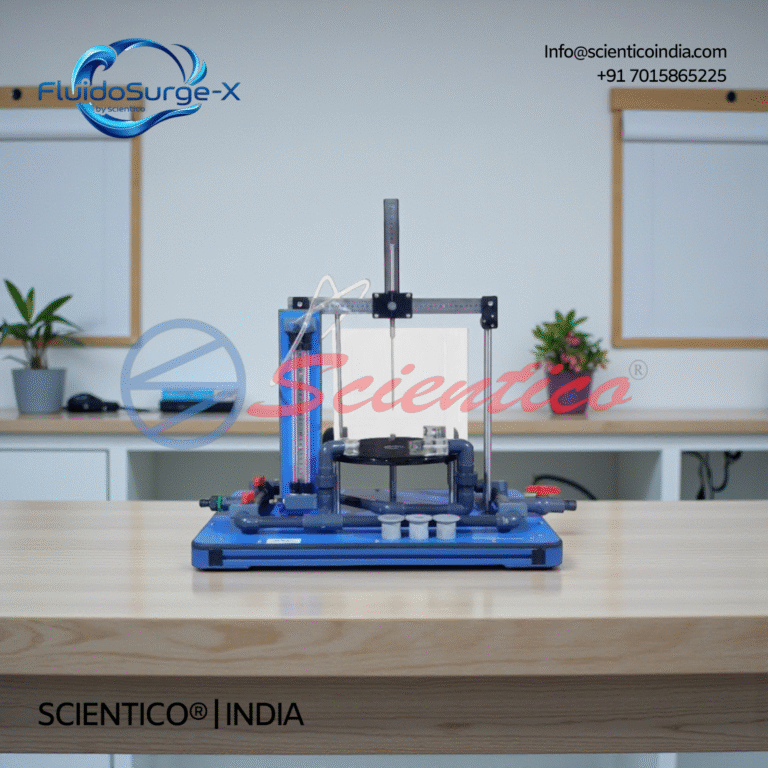
Free and Forced Vortex Apparatus | FluidoSurge-X 140
The Free and Forced Vortex Apparatus FluidoSurge-X 140 is designed for experimental study of vortex motion in fluid mechanics laboratories. It enables generation and measurement of both free and forced vortices under controlled conditions. The apparatus supports surface profile measurement and velocity determination within the vortex. It is intended for academic teaching and experimental verification of vortex flow theory.
View product details
Rotating Tank Vortex Apparatus | FluidoSurge-X 270
The Rotating Tank Vortex Apparatus FluidoSurge-X 270 is a laboratory unit designed to study free and forced vortex motion in rotating fluids. Manufactured by SCIENTICO, the apparatus enables clear visualization and measurement of vortex surface profiles under controlled conditions. It is suitable for instructional use in fluid mechanics laboratories and classroom demonstrations. The system operates using a hydraulic bench or an independent clean water supply.
View product detailsFree and Forced Vortex Apparatus | FluidoSurge-X 140
The published description for FluidoSurge-X 140 identifies a transparent cylindrical vessel used with a hydraulic bench. A free vortex is produced by discharging water through an interchangeable central orifice; students measure the surface profile with a sliding depth scale. For a forced vortex, tangential inlet jets act on a central paddle. The profile is measured with a gauge, and the listed Pitot tube can be used to determine velocity at a point.
This method may suit a practical that compares the surface shapes and flow behaviour produced by central discharge and tangentially driven rotation. Before procurement, ask which orifice sizes, profile-measuring components and Pitot accessories are included in the exact offered set.
Rotating Tank Vortex Apparatus | FluidoSurge-X 270
The FluidoSurge-X 270 product record describes a transparent cylindrical vessel rotated about its vertical axis by a low-voltage variable-speed motor and separate speed-control unit. A traverse probe measures the water-surface profile, while a Pitot tube can be used to examine total-head distribution. The product page describes use with a hydraulic bench or a suitable clean-water supply; confirm the final connection and drainage requirements for your room.
This method is relevant when the teaching brief calls for controlled vessel rotation and observations across a speed range. Ask the technical team to identify the speed-control arrangement, measurement probe, Pitot configuration and any data-recording method included.
Side-by-side selection
| Selection point | FluidoSurge-X 140 | FluidoSurge-X 270 |
|---|---|---|
| How motion is generated | Central outlet for the free-vortex practical; tangential water inlets and paddle for the forced-vortex practical. | Motor rotates the transparent tank; an external speed-control unit adjusts rotational speed. |
| What is measured | Surface profile with a sliding/gauge arrangement; Pitot tube is listed for local velocity measurement. | Surface profile with a traverse probe; Pitot tube is listed for total-head measurement. |
| Water-source planning | Product description identifies hydraulic-bench use; verify the offered connections. | Product description identifies hydraulic-bench or suitable clean-water-supply operation; verify water and drainage details. |
| Best match when | The syllabus requires comparison of free- and forced-vortex methods using outlet flow and tangential paddle input. | The syllabus requires a rotating vessel with controlled speed and profile measurements. |
The table reflects the two current product descriptions, not a guarantee of accessory inclusion. Request the model-specific datasheet and itemised quotation before preparing a BOQ.
What to put in the enquiry
- Which vortex practicals will students perform, and which measurements must they submit?
- Will the class need both free and forced vortex generation, or controlled tank rotation across different speeds?
- What is already available in the laboratory: hydraulic bench, clean water supply, drainage and suitable workspace?
- Which vessel, outlet/orifices, inlets/paddle, motor/controller, traverse gauge and Pitot tube are included?
- What model-specific manual, observation guidance, utilities and exclusions are stated in the offer?
- Does the proposed setup support the planned number of student groups per session?
Keep the tender requirement measurable
A neutral BOQ should state the required vortex experiments, profile measurements, supply method and any specific accessories. Ask each bidder to map its model to those requirements and list optional items separately. Avoid copying a competitor’s dimensions, materials, motor rating or country-of-origin statement into Scientico’s specification unless the selected model’s current datasheet supports them.
For an exact comparison, open the product records for the Free and Forced Vortex Apparatus and the Rotating Tank Vortex Apparatus. Use the product finder by experiment to review other practical-to-product paths, or browse the Fluid Mechanics category. Submit the course requirement and destination through Contact Scientico to request confirmation for a specific configuration.
Summary
The deciding question is whether your students need vortex generation by central discharge and tangential paddle input, or a vessel whose rotation speed is controlled directly. Match that method to the experiment plan, verify instruments and utilities, then compare quotations against the same written scope.
One honest ask
We don't gate anything on this site. You just read the whole thing free. If it was useful, leave your email and two things happen: we send you this page as a plain-text block you can paste into a tender file or an internal email, and we notify you the next time we publish a buyer tool like this one. Nothing else. No drip sequence, no sales calls booked without asking.