🔎 Manufacturer-direct laboratory equipment enquiries - Request a model-specific international quotation →
✓ Established 1993 ✓ Model-Specific Specifications ✓ Manufacturer-Direct Enquiries ✓ International Quotations ✓ Destination-Based Delivery Terms

Forces in Truss Apparatus | FrixoDynamics FX-514

The SCIENTICO Forces in Truss Apparatus is a fully instrumented structural mechanics unit for the experimental measurement of bar forces in single-plane statically determinate trusses. Made by Scientico India, ISO 9001:2015 certified, and supplied with a calibration certificate and operation manual.

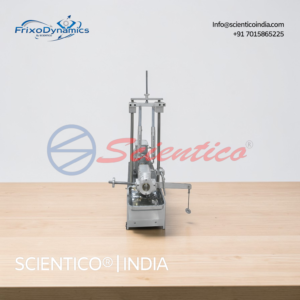
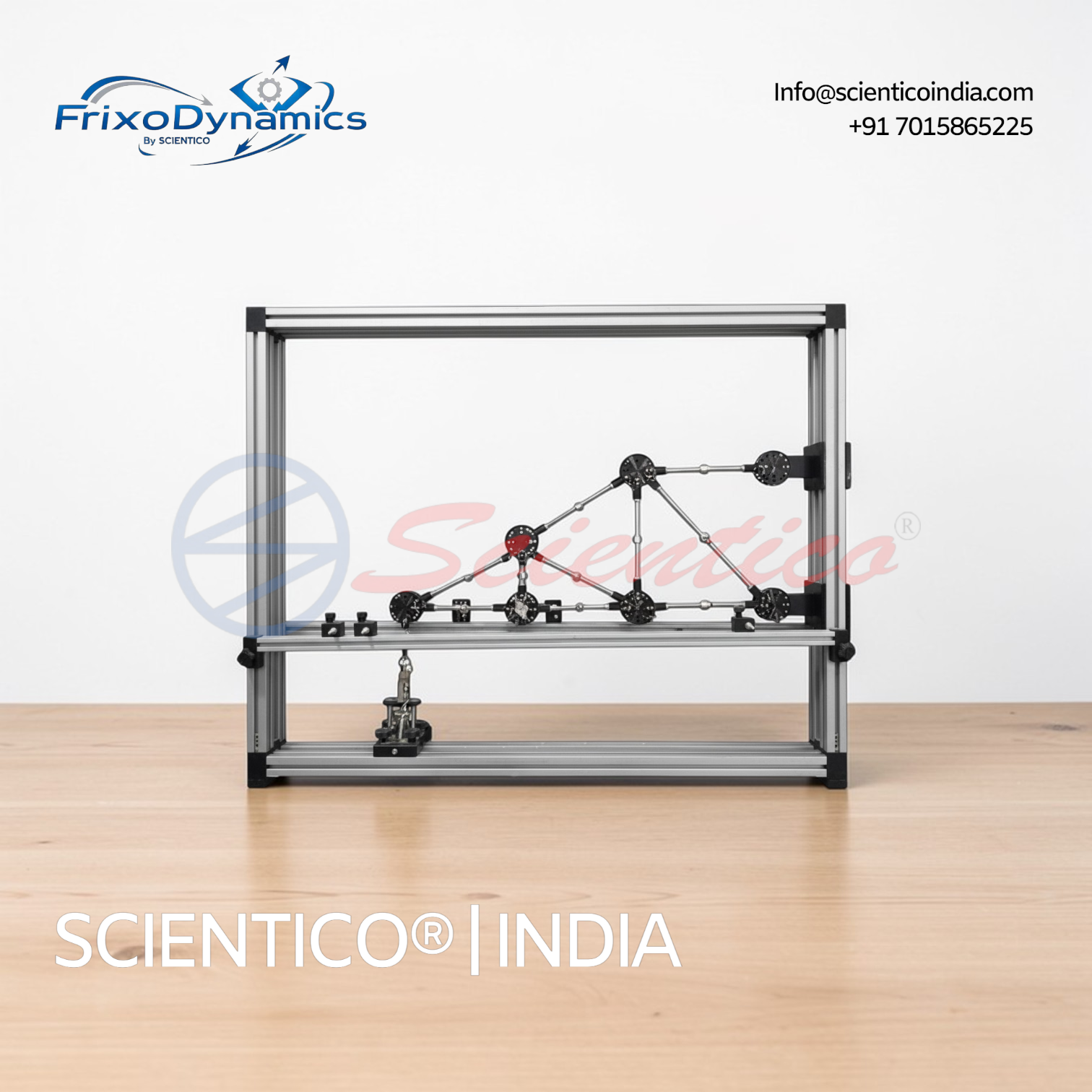
The SCIENTICO FrixoDynamics FX-514 Forces in Truss Apparatus is a fully instrumented structural mechanics unit for the experimental measurement of bar forces in single-plane statically determinate trusses. Bars of six different lengths are connected via pin-jointed node discs, allowing three distinct truss configurations to be assembled within a rigid support frame. Each bar is fitted with a strain gauge load cell, and all force data is acquired simultaneously through a 12-channel measurement amplifier and processed using dedicated DAQ software developed in the National Instruments LabVIEW environment. Results can be compared directly against theoretical values obtained by the method of joints and Ritter’s method of sections. Manufactured by SCIENTICO, the FX-514 is suitable for supply to engineering institutions and distributors worldwide.

Product Overview

A truss is a structural form in which individual straight members, connected only at their ends through pin joints, carry load exclusively as axial tension or compression. Because no moments are transmitted at the nodes, the force in each bar can be determined analytically using equilibrium equations alone, making trusses one of the most tractable structural systems in undergraduate structural analysis. The FX-514 brings this analytical framework into the laboratory, allowing students to physically construct a truss, apply a controlled external force, measure the resulting bar forces instrumentally, and compare those measurements against two established theoretical methods.

The apparatus is assembled in a rigid metallic frame that provides fixed support locations for the truss. Bars are available in six lengths, 150 mm, 259 mm, 300 mm, 397 mm, 424 mm, and 520 mm, and are joined at node discs using pin-install closures that engage quickly and securely without tools. The angular relationships between connected bars, at 30°, 45°, 60°, and 90°, are determined by the choice of bar lengths and node disc positions, with three distinct truss geometries constructible from the standard bar set.

An external force is applied to a selected node disc using the load application device, which incorporates a force gauge with a range of −500 to +500 N and a graduation of 0.01 N. The direction and point of application of this force can be changed by repositioning the device on different node discs, allowing students to investigate how both the magnitude and point of application of the external load affect the distribution of bar forces throughout the truss.

Each bar carries its own strain gauge load cell. All 12 input channels feed simultaneously into the measurement amplifier, and the LabVIEW-based DAQ software acquires, processes, and graphically displays the bar forces in real time. The software supports direct export and comparison of measured values against theoretical calculations, and includes a comprehensive help function. All components are housed in a dedicated storage system and the complete experimental setup is arranged within the frame for clear, orderly use.

Request Specifications & Pricing

model-specific, ISO 9001:2015 compliant. Supplied to universities and institutions in 30+ countries.

WhatsApp: +91 701-586-5225  |  Email: [email protected]

View Quality Certifications  |  FAQ, Shipping, Warranty, Lead Time

Parameter Specification
Model FrixoDynamics FX-514
Bar Lengths 1 x 150 mm, 3 x 259 mm, 7 x 300 mm, 1 x 397 mm, 3 x 424 mm, 1 x 520 mm
Bar Angles 30°, 45°, 60°, 90°
Maximum Bar Force ±500 N per bar
Force Measurement Strain gauge load cell on each bar
Load Application Device Range −500 to +500 N
Load Application Device Graduation 0.01 N
Measurement Amplifier 12 input channels
Node Discs 5 standard node discs, 2 support node discs
Truss Configurations 3 constructible forms
Joint Type Pin joints, frictionless, moment-free
DAQ Software National Instruments LabVIEW environment
Software Compatibility Windows operating system
Storage Dedicated storage system for all components
Scope of Delivery 1 set of bars, 5 node discs, 2 supports with node discs, 1 load application device, 1 set of cables, 1 instructional manual, DAQ software

Key Features

  • Strain gauge load cell on every bar provides simultaneous, independent force measurement across the full truss, no manual repositioning of sensors required
  • 12-channel measurement amplifier acquires all bar forces simultaneously for complete, instantaneous truss force data
  • LabVIEW-based DAQ software displays bar forces graphically, supports data export, and includes a comprehensive help function, compatible with any Windows environment
  • Load application device (−500 to +500 N, 0.01 N graduation) mountable on different node discs for variation of load direction and point of application
  • Six bar lengths and four angular relationships enable construction of three distinct truss geometries within a single apparatus
  • Pin-install node disc closures allow rapid, tool-free bar assembly and reconfiguration
  • Frictionless pin joints transmit no moments, producing ideal truss behaviour directly comparable to analytical methods
  • All components housed in a dedicated storage system and assembled within the support frame for organised, efficient laboratory use
  • Results directly comparable against method of joints and Ritter’s method of sections calculations

Applications

  • Measurement of bar forces in statically determinate single-plane trusses under external loading
  • Investigation of the effect of load direction on bar force distribution
  • Investigation of the effect of load point of application on bar force distribution
  • Comparison of experimental bar force measurements against theoretical values from the method of joints
  • Comparison of experimental results against Ritter’s method of sections
  • Study of tension and compression force distribution across different truss geometries
  • Demonstration of strain gauge load cell principles in structural force measurement
  • Undergraduate and postgraduate laboratory practicals in structural mechanics, statics, and structural analysis

Construction and System Design

The FX-514 support frame is a rigid metallic structure that provides two fixed support locations corresponding to the truss boundary conditions. The frame geometry is fixed, and the truss is assembled within it by selecting the appropriate bar lengths and connecting them at node discs. Each node disc accepts multiple bars simultaneously through its pin-install closure system, locking each bar end securely at the correct angular position. Five standard node discs and two support node discs are provided.

Each bar is a precision-machined steel member with a strain gauge bonded to its surface. The strain gauge converts axial deformation under tension or compression into an electrical signal proportional to the bar force. All gauge signals are routed via the included cable set to the 12-channel measurement amplifier, which conditions and digitises the signals before passing them to the host computer running the LabVIEW DAQ software.

The software displays all bar forces simultaneously in both numerical and graphical format, allowing students to observe the complete force distribution across the truss in real time as the applied load is varied. The load application device is a manually operated mechanism that applies a controlled compressive or tensile force to the selected node disc, with the magnitude read from the integrated force gauge. Repositioning the device to a different node disc, or changing the angle of force application, requires only a few seconds, enabling a wide range of loading scenarios to be explored within a single laboratory session. All components return to the storage system after use, keeping the apparatus organised between sessions.

Export and Supply Capability

The SCIENTICO FrixoDynamics FX-514 is available for supply to engineering colleges, technical universities, civil and mechanical engineering departments, research institutions, and industrial training centres. SCIENTICO manufactures and exports laboratory equipment to institutions and distributors across multiple regions. Standard packaging is suitable for international shipment. Bulk orders, customised configurations, and institutional procurement enquiries are welcomed. Please contact SCIENTICO directly for pricing, lead times, and shipping terms.

Q1: What is the forces in truss apparatus used for?

The FX-514 is used to measure the axial forces, tension and compression, in the individual bars of a single-plane statically determinate truss under an applied external load. Students construct the truss from the provided bars and node discs, apply a known force using the load application device, and record all bar forces simultaneously via strain gauge sensors and the LabVIEW DAQ software. The measured results are then compared against theoretical values from the method of joints and Ritter’s method of sections.

Q2: What is the method of joints and how does the FX-514 support its verification?

The method of joints is an analytical technique for determining bar forces in a statically determinate truss by applying equilibrium equations at each node in sequence. The FX-514 supports its verification by providing measured bar forces for the same truss configuration and loading, allowing students to compare the experimentally recorded force in each bar against the value calculated analytically. The LabVIEW software facilitates direct side-by-side comparison of measured and theoretical data.

Q3: How many truss configurations can be built with the FX-514?

Three distinct truss geometries can be constructed using the provided bar set. The six bar lengths, 150 mm, 259 mm, 300 mm, 397 mm, 424 mm, and 520 mm, in the quantities supplied allow bars to be combined at angles of 30°, 45°, 60°, and 90° to form different planar truss forms within the support frame. The node disc pin-install system allows configurations to be changed quickly between experiments.

Q4: What software is used with the FX-514, and what are its system requirements?

The FX-514 uses DAQ software developed specifically for this apparatus in the National Instruments LabVIEW environment. The software acquires data from all 12 strain gauge channels simultaneously, displays bar forces graphically in real time, and supports data recording and comparison against theoretical values. It includes a comprehensive help function and is compatible with any Windows operating system.

Q5: What is included in the scope of delivery for the FX-514?

The FX-514 is supplied as a complete experimental kit including: one set of bars (1 x 150 mm, 3 x 259 mm, 7 x 300 mm, 1 x 397 mm, 3 x 424 mm, 1 x 520 mm) each with integrated strain gauge load cell; 5 standard node discs; 2 support node discs; 1 load application device (−500 to +500 N, 0.01 N graduation); 1 set of measurement cables; DAQ software (LabVIEW-based, Windows compatible); and 1 instructional manual covering assembly, experimental procedures, and data analysis guidance.

Need Assistance? We're Here to Help!

Connect with our team for product specifications, pricing, and customized solutions for your institution or project.

Trade enquiries

Distributors, dealers, resellers and bulk buyers

We manufacture Forces in Truss Apparatus | FrixoDynamics FX-514 at our own works in Ambala, India. Manufacturer-direct, three ways to work with us.

01

Become a distributor, dealer or agent in your territory

Already selling to colleges or hospitals in your market? Add a manufacturer-direct line. Terms reviewed on application.

or message on WhatsApp
02

Wholesale and bulk quotation

Holding a live enquiry? Send model, quantity, destination port and Incoterm. Proforma back with the full export documentation set listed.

or message on WhatsApp
03

OEM authorisation letter for a tender

Bidding a tender? A missing manufacturer authorisation form (MAF) gets a bid rejected before price is opened. Send the tender reference and closing date.

or message on WhatsApp

Full distributor guide OEM and export enquiries

Forces and FrictionModel FrixoDynamics FX-514
🏭
Manufacturer DirectProduct-specific enquiry, not a generic catalogue
🌍
Destination MatchedConfiguration and delivery scope reviewed together
📄
Decision-Ready ReplyApplicable documentation confirmed before ordering
Product-specific enquiry

Get a quotation your team can evaluate

A bare price can hide configuration, accessories, voltage, documentation and delivery assumptions. Send the product and destination now so the quoted scope can be reviewed before a purchase decision.

Avoid the mismatchDo not approve a generic price that leaves supplied scope unclear.
Your product is attachedNo need to retype the model or copy the page URL.
Move toward an approvable quoteAdd the destination; quantity and tender details can follow.

No account is required. Organisation, quantity and tender details are optional. Include the country code so the team can reach you internationally.

1993
Manufacturing Since
Direct
Manufacturer Supply
Quote-based
International Orders
Model
FrixoDynamics FX-514

Overview

The SCIENTICO FrixoDynamics FX-514 Forces in Truss Apparatus is a fully instrumented structural mechanics unit for the experimental measurement of bar forces in single-plane statically determinate trusses. Bars of six different lengths are connected via pin-jointed node discs, allowing three distinct truss configurations to be assembled within a rigid support frame. Each bar is fitted with a strain gauge load cell, and all force data is acquired simultaneously through a 12-channel measurement amplifier and processed using dedicated DAQ software developed in the National Instruments LabVIEW environment. Results can be compared directly against theoretical values obtained by the method of joints and Ritter's method of sections. Manufactured by SCIENTICO, the FX-514 is suitable for supply to engineering institutions and distributors worldwide.

Product Overview

A truss is a structural form in which individual straight members, connected only at their ends through pin joints, carry load exclusively as axial tension or compression. Because no moments are transmitted at the nodes, the force in each bar can be determined analytically using equilibrium equations alone, making trusses one of the most tractable structural systems in undergraduate structural analysis. The FX-514 brings this analytical framework into the laboratory, allowing students to physically construct a truss, apply a controlled external force, measure the resulting bar forces instrumentally, and compare those measurements against two established theoretical methods.

The apparatus is assembled in a rigid metallic frame that provides fixed support locations for the truss. Bars are available in six lengths, 150 mm, 259 mm, 300 mm, 397 mm, 424 mm, and 520 mm, and are joined at node discs using pin-install closures that engage quickly and securely without tools. The angular relationships between connected bars, at 30°, 45°, 60°, and 90°, are determined by the choice of bar lengths and node disc positions, with three distinct truss geometries constructible from the standard bar set.

An external force is applied to a selected node disc using the load application device, which incorporates a force gauge with a range of −500 to +500 N and a graduation of 0.01 N. The direction and point of application of this force can be changed by repositioning the device on different node discs, allowing students to investigate how both the magnitude and point of application of the external load affect the distribution of bar forces throughout the truss.

Each bar carries its own strain gauge load cell. All 12 input channels feed simultaneously into the measurement amplifier, and the LabVIEW-based DAQ software acquires, processes, and graphically displays the bar forces in real time. The software supports direct export and comparison of measured values against theoretical calculations, and includes a comprehensive help function. All components are housed in a dedicated storage system and the complete experimental setup is arranged within the frame for clear, orderly use.

Key Features

Key Features

  • Strain gauge load cell on every bar provides simultaneous, independent force measurement across the full truss, no manual repositioning of sensors required
  • 12-channel measurement amplifier acquires all bar forces simultaneously for complete, instantaneous truss force data
  • LabVIEW-based DAQ software displays bar forces graphically, supports data export, and includes a comprehensive help function, compatible with any Windows environment
  • Load application device (−500 to +500 N, 0.01 N graduation) mountable on different node discs for variation of load direction and point of application
  • Six bar lengths and four angular relationships enable construction of three distinct truss geometries within a single apparatus
  • Pin-install node disc closures allow rapid, tool-free bar assembly and reconfiguration
  • Frictionless pin joints transmit no moments, producing ideal truss behaviour directly comparable to analytical methods
  • All components housed in a dedicated storage system and assembled within the support frame for organised, efficient laboratory use
  • Results directly comparable against method of joints and Ritter's method of sections calculations

Applications

  • Measurement of bar forces in statically determinate single-plane trusses under external loading
  • Investigation of the effect of load direction on bar force distribution
  • Investigation of the effect of load point of application on bar force distribution
  • Comparison of experimental bar force measurements against theoretical values from the method of joints
  • Comparison of experimental results against Ritter's method of sections
  • Study of tension and compression force distribution across different truss geometries
  • Demonstration of strain gauge load cell principles in structural force measurement
  • Undergraduate and postgraduate laboratory practicals in structural mechanics, statics, and structural analysis

Construction and System Design

The FX-514 support frame is a rigid metallic structure that provides two fixed support locations corresponding to the truss boundary conditions. The frame geometry is fixed, and the truss is assembled within it by selecting the appropriate bar lengths and connecting them at node discs. Each node disc accepts multiple bars simultaneously through its pin-install closure system, locking each bar end securely at the correct angular position. Five standard node discs and two support node discs are provided.

Each bar is a precision-machined steel member with a strain gauge bonded to its surface. The strain gauge converts axial deformation under tension or compression into an electrical signal proportional to the bar force. All gauge signals are routed via the included cable set to the 12-channel measurement amplifier, which conditions and digitises the signals before passing them to the host computer running the LabVIEW DAQ software.

The software displays all bar forces simultaneously in both numerical and graphical format, allowing students to observe the complete force distribution across the truss in real time as the applied load is varied. The load application device is a manually operated mechanism that applies a controlled compressive or tensile force to the selected node disc, with the magnitude read from the integrated force gauge. Repositioning the device to a different node disc, or changing the angle of force application, requires only a few seconds, enabling a wide range of loading scenarios to be explored within a single laboratory session. All components return to the storage system after use, keeping the apparatus organised between sessions.

Export and Supply Capability

The SCIENTICO FrixoDynamics FX-514 is available for supply to engineering colleges, technical universities, civil and mechanical engineering departments, research institutions, and industrial training centres. SCIENTICO manufactures and exports laboratory equipment to institutions and distributors across multiple regions. Standard packaging is suitable for international shipment. Bulk orders, customised configurations, and institutional procurement enquiries are welcomed. Please contact SCIENTICO directly for pricing, lead times, and shipping terms.

Specifications

Parameter Specification
Model FrixoDynamics FX-514
Bar Lengths 1 x 150 mm, 3 x 259 mm, 7 x 300 mm, 1 x 397 mm, 3 x 424 mm, 1 x 520 mm
Bar Angles 30°, 45°, 60°, 90°
Maximum Bar Force ±500 N per bar
Force Measurement Strain gauge load cell on each bar
Load Application Device Range −500 to +500 N
Load Application Device Graduation 0.01 N
Measurement Amplifier 12 input channels
Node Discs 5 standard node discs, 2 support node discs
Truss Configurations 3 constructible forms
Joint Type Pin joints, frictionless, moment-free
DAQ Software National Instruments LabVIEW environment
Software Compatibility Windows operating system
Storage Dedicated storage system for all components
Scope of Delivery 1 set of bars, 5 node discs, 2 supports with node discs, 1 load application device, 1 set of cables, 1 instructional manual, DAQ software

Buying Forces in Truss Apparatus: Distributor & Tender Guidance

Forces in Truss Apparatus is the product name procurement teams should use when searching, preparing a BOQ or comparing suppliers. A model reference identifies the proposed configuration; it should not replace the product name or the buyer’s required experiment. This equipment is considered for engineering-mechanics practicals that demonstrate static, kinetic, belt, cord, bearing or surface friction.

What to include in the RFQ

State the product name, quantity, destination, curriculum or tender reference, and contact materials, load range, angle or speed control, force measurement, accessories and experiment list. This lets the technical team respond against the intended use rather than guess from a model code.

How distributors should quote it

Keep Forces in Truss Apparatus as the BOQ line item. Add the proposed model, included accessories, documentation, packing and delivery basis as separate fields so the end buyer can verify the offer.

How to compare suppliers

Verify the friction modes, specimens and measurement method included with each offered configuration. Record exclusions and alternatives in writing before commercial comparison.

Why Buy From Scientico

🏭

In-House Manufacturer

Designed & built in our Ambala facility since 1993 — not a reseller. Full control over quality & customisation.

✅

Configuration Review

Specifications, documentation and options are confirmed against the selected model.

🌏

International Enquiries

Share your destination and procurement requirements for an export quotation.

📦

Quote-Based Supply

Send the model, quantity and delivery location for a tailored proposal.

🛠

Support Scope

Support and warranty terms are documented in the applicable quotation.

🎓

Built for Teaching

Designed around curriculum experiments with clear, repeatable, hands-on results.

Frequently Asked Questions

Q1: What is the forces in truss apparatus used for?

The FX-514 is used to measure the axial forces, tension and compression, in the individual bars of a single-plane statically determinate truss under an applied external load. Students construct the truss from the provided bars and node discs, apply a known force using the load application device, and record all bar forces simultaneously via strain gauge sensors and the LabVIEW DAQ software. The measured results are then compared against theoretical values from the method of joints and Ritter's method of sections.

Q2: What is the method of joints and how does the FX-514 support its verification?

The method of joints is an analytical technique for determining bar forces in a statically determinate truss by applying equilibrium equations at each node in sequence. The FX-514 supports its verification by providing measured bar forces for the same truss configuration and loading, allowing students to compare the experimentally recorded force in each bar against the value calculated analytically. The LabVIEW software facilitates direct side-by-side comparison of measured and theoretical data.

Q3: How many truss configurations can be built with the FX-514?

Three distinct truss geometries can be constructed using the provided bar set. The six bar lengths, 150 mm, 259 mm, 300 mm, 397 mm, 424 mm, and 520 mm, in the quantities supplied allow bars to be combined at angles of 30°, 45°, 60°, and 90° to form different planar truss forms within the support frame. The node disc pin-install system allows configurations to be changed quickly between experiments.

Q4: What software is used with the FX-514, and what are its system requirements?

The FX-514 uses DAQ software developed specifically for this apparatus in the National Instruments LabVIEW environment. The software acquires data from all 12 strain gauge channels simultaneously, displays bar forces graphically in real time, and supports data recording and comparison against theoretical values. It includes a comprehensive help function and is compatible with any Windows operating system.

Q5: What is included in the scope of delivery for the FX-514?

The FX-514 is supplied as a complete experimental kit including: one set of bars (1 x 150 mm, 3 x 259 mm, 7 x 300 mm, 1 x 397 mm, 3 x 424 mm, 1 x 520 mm) each with integrated strain gauge load cell; 5 standard node discs; 2 support node discs; 1 load application device (−500 to +500 N, 0.01 N graduation); 1 set of measurement cables; DAQ software (LabVIEW-based, Windows compatible); and 1 instructional manual covering assembly, experimental procedures, and data analysis guidance.

Related Guides & Resources

In-depth guides from Scientico on Forces and Friction lab setup, experiments and procurement.

Forces in Truss Apparatus | FrixoDynamics FX-514

Related Laboratory Equipment

Explore related apparatus in this equipment range. Request a model-specific international quotation.

Forces in Simple Bar Structure Apparatus | FrixoDynamics FX-512, Scientico IndiaForces in Simple Bar Structure Apparatus | FrixoDynamics FX-512Friction on Inclined Plane Apparatus | FrixoDynamics FX-509, Scientico IndiaFriction on Inclined Plane Apparatus | FrixoDynamics FX-509Forces in a Jib Crane Apparatus | FrixoDynamics FX-510, Scientico IndiaForces in a Jib Crane Apparatus | FrixoDynamics FX-510Fundamentals of Statics Apparatus | FrixoDynamics FX-513, Scientico IndiaFundamentals of Statics Apparatus | FrixoDynamics FX-513Equilibrium of Parallel Forces Apparatus | FrixoDynamics FX-525, Scientico IndiaEquilibrium of Parallel Forces Apparatus | FrixoDynamics FX-525Gyroscope Apparatus | FrixoDynamics FX-505, Scientico IndiaGyroscope Apparatus | FrixoDynamics FX-505Dry, Rough and Lubricated Friction Apparatus | FrixoDynamics FX-524, Scientico IndiaDry, Rough and Lubricated Friction Apparatus | FrixoDynamics FX-524Journal Bearing Friction Apparatus | FrixoDynamics FX-528, Scientico IndiaJournal Bearing Friction Apparatus | FrixoDynamics FX-528
📄 Download Datasheet

Get the product datasheet

Share your details to open the complete datasheet, then print or save it as a PDF.

Forces in Truss Apparatus | FrixoDynamics FX-514