
Forces and friction lab equipment is a set of mechanical teaching apparatus used to measure and demonstrate the laws of friction, coefficient of friction, and force resolution on surfaces. The core instruments are the inclined plane apparatus, the friction (slider/horizontal) apparatus, and the belt friction apparatus, which together let engineering and physics students verify the relationship between normal force, applied force, and frictional resistance. This guide explains what each instrument does, what to look for when buying, and how it maps to your syllabus and lab safety needs.
Equipment mentioned in this guide
Review the product information, specifications and model before requesting a quotation.
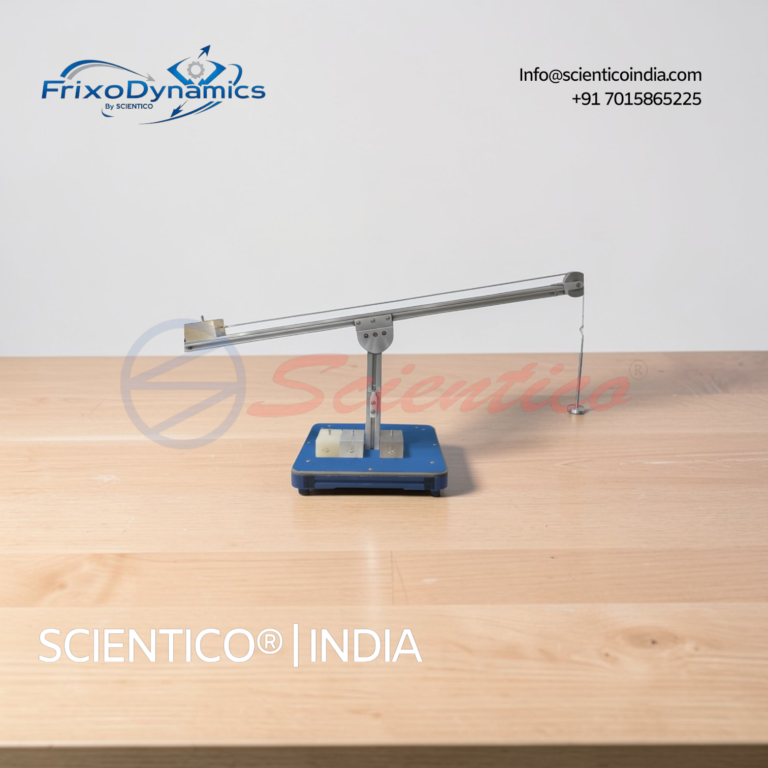
Friction on Inclined Plane Apparatus | FrixoDynamics FX-509
The SCIENTICO FrixoDynamics FX-509 Friction on Inclined Plane Apparatus is a bench-mounted experimental unit for the quantitative determination of static and dynamic friction coefficients across different material pairings. Using an adjustable inclined plane, a ball bearing-mounted deflection pulley, and four material sample blocks, students investigate the transition from static to sliding friction under two distinct experimental methods, angle-based tilting and tensile force loading. The apparatus covers a broad range of fundamental friction experiments and provides direct, measurable results for material comparisons. Manufactured by SCIENTICO, the FX-509 is suitable for supply to engineering institutions and distributors worldwide.
View product detailsWhether you run an applied mechanics lab at a polytechnic, an engineering mechanics course at a university, or a foundation physics lab at a college, these apparatus form the backbone of the “friction and forces” practical block. Below we break down each device, the experiments it supports, and the procurement details Indian and overseas buyers should confirm before raising a purchase order.
What is forces and friction lab equipment used for?
Forces and friction lab equipment lets students experimentally determine the coefficient of static and kinetic friction between two surfaces, study how an inclined plane reduces effort, and observe belt/rope friction as described by the capstan (Euler-Eytelwein) relationship. Instead of only deriving formulas on paper, learners load weights, read spring balances or weight pans, and compare measured values against theory, building intuition for free-body diagrams, equilibrium, and the limiting angle of repose.
The category typically supports practicals such as:
- Finding the coefficient of friction on a horizontal surface using a slider and weight pan.
- Determining the angle of repose and coefficient of friction on an inclined plane.
- Verifying the law of friction (friction is independent of contact area, proportional to normal reaction).
- Studying belt or rope friction and the tension ratio across a pulley or drum.
- Resolving forces and confirming conditions of static equilibrium.
What are the three main types of friction apparatus?
Most syllabi (AICTE/university engineering mechanics, applied physics, and polytechnic diploma courses) rely on three workhorse setups. Here is how they compare.
| Apparatus | What it demonstrates | Typical measured output | Common in |
|---|---|---|---|
| Inclined Plane Apparatus | Force on an inclined surface, mechanical advantage, angle of repose | Coefficient of friction, effort vs. load ratio | Engineering mechanics, applied physics |
| Friction Apparatus (horizontal slider) | Laws of dry friction on a flat surface | Static & kinetic coefficient of friction | Diploma/polytechnic mechanics labs |
| Belt / Rope Friction Apparatus | Friction between belt and pulley/drum, tension ratio | Ratio of tight-side to slack-side tension | Mechanical engineering, machine design intro |
Inclined plane apparatus
An inclined plane apparatus usually consists of a flat, smooth board hinged to a base so the angle can be varied and read on a protractor scale. A roller or slider carries a load while a cord runs over a pulley to a weight pan. By adjusting the angle until motion just begins, students find the angle of repose and calculate the coefficient of friction (μ = tan θ). It is one of the most syllabus-flexible instruments because the same frame teaches force resolution, mechanical advantage, and limiting friction.
Friction apparatus (horizontal)
The horizontal friction apparatus is a flat track or table on which a slider block is pulled by a cord over a pulley connected to a weight pan. Students add weights until the block just slides, recording the limiting (static) friction, then continue to observe kinetic friction. Swapping slider faces or track surfaces lets a single setup demonstrate that μ depends on the material pair, not on the apparent contact area.
Belt friction apparatus
The belt or rope friction apparatus wraps a flexible belt around a fixed or rotating drum. Loads on each end let students measure the tight-side and slack-side tensions and verify the capstan equation, which underpins real-world brakes, conveyor belts, and rope-around-bollard mechanics. This bridges pure physics and machine-design fundamentals.
How do you choose the right friction apparatus for a college lab?
Procurement for a teaching lab is about durability, repeatability, and syllabus fit, not just the lowest quote. Use this checklist when comparing suppliers:
- Syllabus mapping: Confirm the apparatus supports every practical listed in your applied mechanics or physics lab manual, so one purchase covers multiple experiments.
- Build quality: Look for a rigid base, true-flat working surfaces, smooth low-friction pulleys, and corrosion-resistant fittings, student labs see heavy, repeated use.
- Readability: Clear protractor/angle scales and stable weight pans reduce reading error and make results reproducible across batches of students.
- Interchangeable surfaces: Multiple slider/track material pairs let you teach how μ varies, valuable for a richer practical.
- Documentation: Ask for a calibration/conformity statement and a basic experiment/operating manual to support lab accreditation and NBA/NAAC audits.
- Spares and consumables: Cords, weight sets, and pulleys are wear items; confirm they are replaceable.
What should export buyers confirm before ordering?
For institutions outside India, the commercial and compliance details matter as much as the specification. Reputable manufacturers provide internationally recognized quality marks and clear shipping terms.
| Buyer need | What to ask for |
|---|---|
| Quality assurance | ISO 9001:2015 quality management and CE conformity |
| Pricing for tenders | A formal quote / proforma invoice with CIF terms to your port |
| Documentation | Calibration and conformity documents packed with the consignment |
| Lead time clarity | Confirmed dispatch timelines and packaging suited to sea/air freight |
| After-sales | Availability of spares and technical support contact |
Scientico India is an ISO 9001:2015 and model-specific manufacturer and exporter based in Ambala, Haryana, producing engineering, physics, nursing, medical and pharmacy lab equipment since 1993 and supplying institutions across 30+ countries. The company is GeM-registered for Indian government and institutional procurement, and provides a model-specific CIF proforma invoice after technical review of an enquiry, with calibration and conformity documents included. You can explore the full Forces and Friction Lab Equipment category to match apparatus to your lab manual.
How are these experiments typically conducted safely?
Friction practicals are low-hazard, but good lab discipline keeps results reliable and students safe:
- Secure the apparatus base to the bench so it cannot shift when loads are applied.
- Add weights gradually to a hanging pan to avoid sudden jerks and dropped masses on feet.
- Keep working surfaces clean and dry between runs, grease or dust changes μ and skews data.
- Take multiple readings and average them; friction values scatter, and repetition teaches measurement uncertainty.
- Inspect cords and pulleys before each session for fraying or stiffness.
How does this fit into the wider mechanics syllabus?
Forces and friction is usually an early practical block because it cements free-body analysis before students move to trusses, beams, and dynamics. A well-equipped bench in this category pairs naturally with other applied-mechanics apparatus, moment/equilibrium boards, simple machines, and pulley systems, so many colleges buy these instruments together to cover a full semester of practicals. Standardising on one manufacturer also simplifies spares, documentation, and future top-up orders.
For Indian colleges, GeM-registered supply streamlines tender compliance; for overseas universities and training institutes, ISO and CE marks plus a clear CIF quote make budgeting and customs straightforward. Either way, the goal is the same: durable, repeatable apparatus that lets students see the laws of friction, not just read them.
To request a specification sheet or quote for your lab, you can reach a manufacturer directly, Scientico India responds on WhatsApp at +91-7015865225 and issues a model-specific CIF proforma invoice after technical review.
Frequently Asked Questions
What is forces and friction lab equipment?
It is a set of mechanical teaching apparatus, primarily the inclined plane, horizontal friction slider, and belt/rope friction setups, used to measure the coefficient of friction, study force resolution on surfaces, and verify the laws of dry and belt friction in engineering and physics labs.
How do you find the coefficient of friction with an inclined plane apparatus?
You gradually increase the plane’s angle until the loaded slider just begins to move. That angle is the angle of repose, and the coefficient of friction equals its tangent (μ = tan θ). Repeating with different surface pairs and averaging readings improves accuracy.
What is the difference between the inclined plane and belt friction apparatus?
The inclined plane apparatus studies friction and force resolution on a flat tilted surface to find the coefficient of friction. The belt friction apparatus wraps a belt around a drum or pulley to measure the tension ratio between the tight and slack sides, demonstrating capstan friction used in brakes and conveyors.
Does Scientico India export forces and friction lab equipment?
Yes. Scientico India is an ISO 9001:2015 and model-specific manufacturer in Ambala, India, exporting to 30+ countries since 1993. It is GeM-registered, includes calibration and conformity documents, and issues a model-specific CIF proforma invoice after technical review. Enquiries are handled on WhatsApp at +91-7015865225.
What should a college check before buying friction lab apparatus?
Confirm it covers every practical in your lab manual, has a rigid base and smooth pulleys for repeatable results, offers interchangeable surface pairs, and ships with a calibration/conformity statement and operating manual to support lab accreditation audits.
Related simple-machine experiments: Screw Jack, Worm & Worm Wheel, and Single & Double Purchase Winch Crab.
One honest ask
We don't gate anything on this site. You just read the whole thing free. If it was useful, leave your email and two things happen: we send you this page as a plain-text block you can paste into a tender file or an internal email, and we notify you the next time we publish a buyer tool like this one. Nothing else. No drip sequence, no sales calls booked without asking.