
The question I get from every HOD and lab technician who calls me is the same. For a strength-of-materials lab running 30 to 40 students per batch, do I buy a hand-wheel torsion tester or spend the extra 60 to 90k on a motorized one? Short answer. If the lab teaches BTech mechanical and runs 3 to 4 torsion experiments a semester, buy the motorized. If it is a diploma or ITI workshop where the point is that the student feels the torque build up on the hand wheel, the manual is the right tool and the extra money is wasted. One caveat, which I will get to below, depends on whether NBA or ABET reviewers are in your pipeline in the next two years.
This page is a straight buyer’s comparison for a torsion testing machine across the two drive types you will see on any quote from an Indian manufacturer, including us. I am writing this as someone who has specified, inspected, and unboxed both variants in engineering colleges across India and about 20 export markets. No fake balance. Where one wins on the manual vs motorized torsion testing machine question, I say so.
Equipment mentioned in this guide
Review the product information, specifications and model before requesting a quotation.
Universal Hardness Tester
The Universal Hardness Tester manufactured by Scientico India combines Brinell, Vickers, and Rockwell hardness testing methods in a single machine. The machine uses interchangeable indenters and a built-in optical measuring system for Brinell/Vickers measurements, with direct-reading digital display for Rockwell hardness.
View product details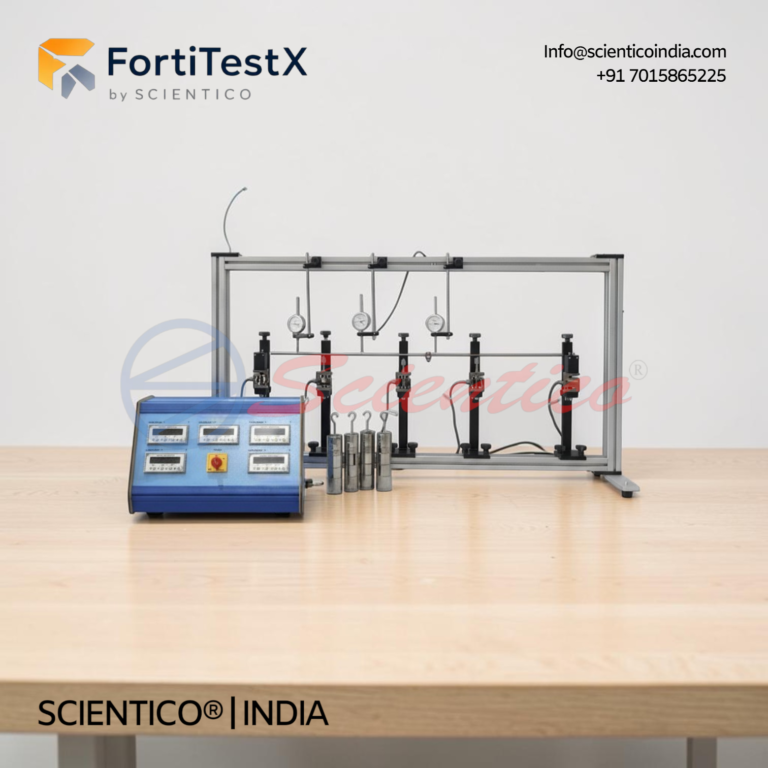
Continuous and Indeterminate Beams Apparatus | FortiTestX 07
The FortiTestX 07 Continuous and Indeterminate Beams Apparatus is an electronically instrumented experimental unit designed for the investigation of beam deflection, support reactions, and elastic line behaviour under statically determinate and indeterminate conditions. It advances beyond dial gauge-based beam testing by incorporating electronic load cells at each support position, providing direct digital measurement of vertical reaction forces and enabling a broader range of structural analysis experiments.
View product detailsThe short answer
For roughly 90% of engineering teaching labs in India, a motorized unit in the 60 to 100 Nm class is the correct buy. You get a repeatable strain rate, a legible digital readout, and a machine that survives fresh second-year students who do not yet know how to feather a hand wheel. The manual variant is cheaper by 30 to 45%, and it is genuinely useful when the syllabus wants tactile feedback of torque build-up. If your accreditation body is looking at data logging and repeatability, do not buy manual just to save 45k. That saving evaporates the first time a reviewer asks for stored test curves.
Head-to-head at a glance
| Parameter | Manual (hand wheel) | Motorized (geared motor + digital) |
|---|---|---|
| Drive | Worm and worm-wheel, hand cranked | Gear motor, typically 0.25 to 0.5 HP, single phase |
| Torque range (teaching class) | Typically 0 to 60 Nm | Typically 0 to 100 Nm, some to 200 Nm |
| Angle measurement | Mechanical protractor, 1 degree least count | Digital encoder, 0.1 degree typical |
| Torque readout | Pendulum dial, 1 to 2 Nm least count | Digital load cell, 0.1 Nm typical |
| Strain rate control | Operator dependent | Set on the panel, usually 1 to 10 rpm |
| Applicable teaching standard | Aligned with IS 1717 style bend/twist demos | Aligned with ASTM E143 modulus of rigidity work |
| Data logging | Hand-plotted on graph sheet | USB or RS232 to lab PC |
| Capital cost tier | Low | Mid to high |
| Bench footprint | ~1200 x 400 mm | ~1500 x 500 mm plus PC |
| Power | None | 230 V, 15 A, single phase |
Working principle differences
Both machines do the same job. They twist a standard specimen, mild steel, brass, or aluminium round bar of 6 or 8 mm gauge, until it yields and then fractures. The difference is how torque is applied and read.
The manual machine uses a worm-and-worm-wheel driven by a hand wheel on one head. The opposite head carries a pendulum-style dial that reads reaction torque. You turn the wheel, watch the pendulum swing, and note the angle of twist on a mechanical protractor. It is a lovely machine to learn on because the student physically feels the yield point. It is not a lovely machine to grade 40 lab reports from, because everyone gets slightly different numbers.
The motorized machine replaces the hand wheel with a gear motor and the pendulum with a strain-gauge load cell. Angle of twist comes off a rotary encoder. The strain rate is set on the panel, so every student’s test proceeds at the same rate and the yield point falls in the same place on the curve. This is what accreditation reviewers want to see.
Torsion testing machine manual motorized specifications teaching lab
Direct answer to the long-tail search. For a teaching lab, specify: torque range 0 to 100 Nm, chuck capacity 3 to 20 mm round or up to 20 mm across flats for hex, distance between chucks adjustable 0 to 500 mm, angle of twist 0 to 360 degrees with 0.1 degree resolution, drive 0.25 HP geared motor at 1 to 10 rpm variable, digital display for torque and angle, USB output for data logging. That specification covers everything a BTech or diploma syllabus requires, and it is well within the price band a private engineering college has already budgeted for a strength-of-materials lab refresh.
Which one for which department
BTech mechanical, production, automobile. Motorized. The syllabus explicitly names modulus of rigidity determination, and that experiment needs a controlled strain rate. A hand wheel introduces enough operator variance that lab reports come out with 15 to 20% scatter, and the external examiner will notice.
Diploma and polytechnic. Manual is defensible. The pedagogical goal at this level is feeling how a material behaves under load, and the hand wheel does that better than a motor. See our notes on lab equipment for polytechnics and TVET for how we structure these bundles.
ITI mechanic fitter. Manual. Full stop. The budget is tight and the point of the exercise is the specimen, not the instrumentation.
Research lab or PhD supervisor. Neither. A teaching-grade torsion machine is not a research instrument. Motorized units at this price band are calibrated to about 1% of full scale. Real research needs ISO 17025 traceable calibration, which is a different animal.
NAAC or NBA cycle in the next 24 months. Motorized, with the data-logging option. Reviewers want to see stored test curves and a calibration certificate.
Common mistakes when picking
Buying too much capacity. A 200 Nm machine sounds impressive on the tender comparison sheet. It will spend its life twisting 6 mm mild steel bars that yield at 15 Nm. You have wasted 40k on capacity you will never use and made the load cell less sensitive at the range you actually operate in.
Skipping the specimen kit. Every quote should include a starter pack of mild steel, brass, and aluminium specimens with their heat-treatment lot numbers. If it does not, the machine sits idle for two months while the workshop tries to source bar stock.
Ignoring the chuck. The self-centering three-jaw chuck is the part that fails first. Ask what the replacement chuck costs and how long the lead time is. On a manual machine this is trivial. On a motorized machine with a bespoke coupling, it can be a six-week wait.
Under-speccing the bench. A motorized unit needs a rigid bench. If you drop it on the same shaky wooden table your universal hardness tester is bolted to, the vibration from the gear motor throws the angle readings by half a degree.
The Scientico recommendation
If you are a private engineering college with a mixed BTech and diploma programme, my pick is the motorized 100 Nm class. For lab bundles I typically pair it with the continuous indeterminate beams apparatus and, for the materials-testing corner, the universal hardness tester. That trio covers the bulk of the strength-of-materials practical syllabus and shares one bench footprint. We manufacture from Ambala, ISO 9001:2015 certified since 1993, documentation reviewed per model for export, shipping to 60 plus countries. See our notes on ISO 9001:2015 for lab equipment if procurement is asking about certification chains.
Cost and delivery framework
Expect ex-works Ambala prices in the following bands for teaching-grade units. Manual, 60 Nm class: roughly INR 85,000 to 1,20,000. Motorized, 100 Nm with digital display and USB: roughly INR 1,60,000 to 2,40,000. The variance is real, and it tracks four things. Load cell sensor grade, chuck quality, whether the panel is a proper industrial enclosure or a plastic hobby box, and whether the calibration certificate is NABL traceable. On export orders we quote FOB Mundra or CIF the customer’s port. Lead time is 3 to 5 weeks for a standard unit, 6 to 8 weeks if you want a customer-branded panel or a bespoke torque range.
Compare notes on our other buyer’s guides before you finalise. The universal hardness tester buyer’s guide and the Brinell vs Vickers vs Rockwell comparison cover the same procurement logic for the hardness bench next to your torsion unit. If you are ready to price a specific configuration, send us the syllabus reference and batch size and I will come back with a firm quote, packing list, and calibration paperwork within 48 hours. WhatsApp works too if you want to talk before you write the tender.
Frequently Asked Questions
Manual vs motorized torsion testing machine: which is better for a BTech lab?
Motorized. BTech syllabi across AICTE-approved colleges include modulus of rigidity determination, which needs a controlled strain rate. A hand wheel introduces enough operator variance that lab reports come out with 15 to 20% scatter. Buy motorized in the 100 Nm class.
What is the price range of a torsion testing machine in India?
Ex-works Ambala, teaching-grade manual units run roughly INR 85,000 to 1,20,000. Motorized 100 Nm units with digital display and USB output run roughly INR 1,60,000 to 2,40,000. Price varies with load cell grade, chuck quality, panel enclosure, and whether the calibration is NABL traceable.
What torque range should I specify for a college lab?
0 to 100 Nm covers every standard specimen in a mechanical engineering syllabus, from 6 mm mild steel to 8 mm brass and aluminium. Higher ranges look impressive on paper but hurt sensitivity at the range you actually operate in.
Do I need a motorized torsion tester for NBA or NAAC accreditation?
Effectively yes. Reviewers want to see stored test curves, controlled strain rate, and a calibration certificate. A hand-wheel machine cannot produce that record. If your next accreditation cycle is within 24 months, buy motorized with the data-logging option.
How long is delivery from Scientico?
Standard units ship in 3 to 5 weeks from Ambala. Custom torque ranges, bespoke panels, or customer-branded units take 6 to 8 weeks. Export orders quote FOB Mundra or CIF your port.
Which standards apply to torsion testing?
For teaching demonstrations, IS 1717 and ASTM E143 are the two references your students should cite in lab reports. ASTM E143 covers modulus of rigidity by torsion. For the machine itself, look for ISO 9001:2015 quality certification from the manufacturer and CE marking if you are importing into an EU-aligned market.
One honest ask
We don't gate anything on this site. You just read the whole thing free. If it was useful, leave your email and two things happen: we send you this page as a plain-text block you can paste into a tender file or an internal email, and we notify you the next time we publish a buyer tool like this one. Nothing else. No drip sequence, no sales calls booked without asking.