
If you are pricing a universal testing machine in India right now, here is the honest picture. Teaching-grade UTMs for diploma and undergraduate labs typically land between INR 3.5 lakh and INR 9 lakh depending on capacity and motorisation. Research-grade servo-hydraulic units for M.Tech and R&D labs typically move from INR 12 lakh into the mid-20s. Industrial QC units with ISO 17025-traceable calibration and closed-loop control sit higher again. The universal testing machine price India buyers see from imported brands is usually 30 to 55 percent above what an Ambala manufacturer like Scientico quotes for the same capacity and standards compliance, because you cut the distributor layer and the import duty stack. Before you accept any quote, check what is driving that number. Compare it against the UTM price benchmarks in our strength-of-materials category.
Scientico has been building this equipment in Ambala since 1993, ships to 30+ countries, and holds ISO 9001:2015 and CE. That combination is what most tender committees ask for first, so it removes one round of back-and-forth on documentation.
Equipment mentioned in this guide
Review the product information, specifications and model before requesting a quotation.
Universal Hardness Tester
The Universal Hardness Tester manufactured by Scientico India combines Brinell, Vickers, and Rockwell hardness testing methods in a single machine. The machine uses interchangeable indenters and a built-in optical measuring system for Brinell/Vickers measurements, with direct-reading digital display for Rockwell hardness.
View product details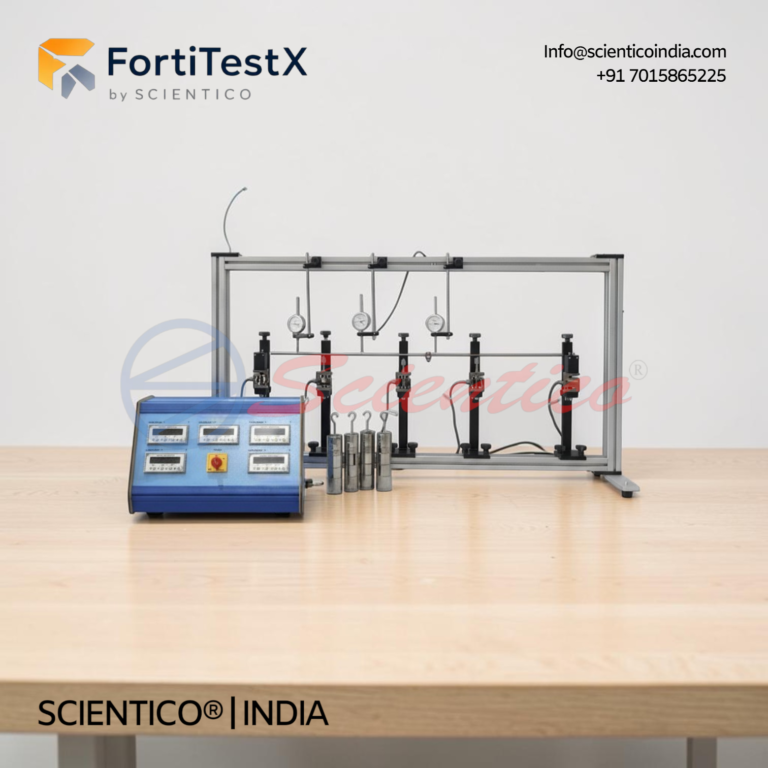
Continuous and Indeterminate Beams Apparatus | FortiTestX 07
The FortiTestX 07 Continuous and Indeterminate Beams Apparatus is an electronically instrumented experimental unit designed for the investigation of beam deflection, support reactions, and elastic line behaviour under statically determinate and indeterminate conditions. It advances beyond dial gauge-based beam testing by incorporating electronic load cells at each support position, providing direct digital measurement of vertical reaction forces and enabling a broader range of structural analysis experiments.
View product details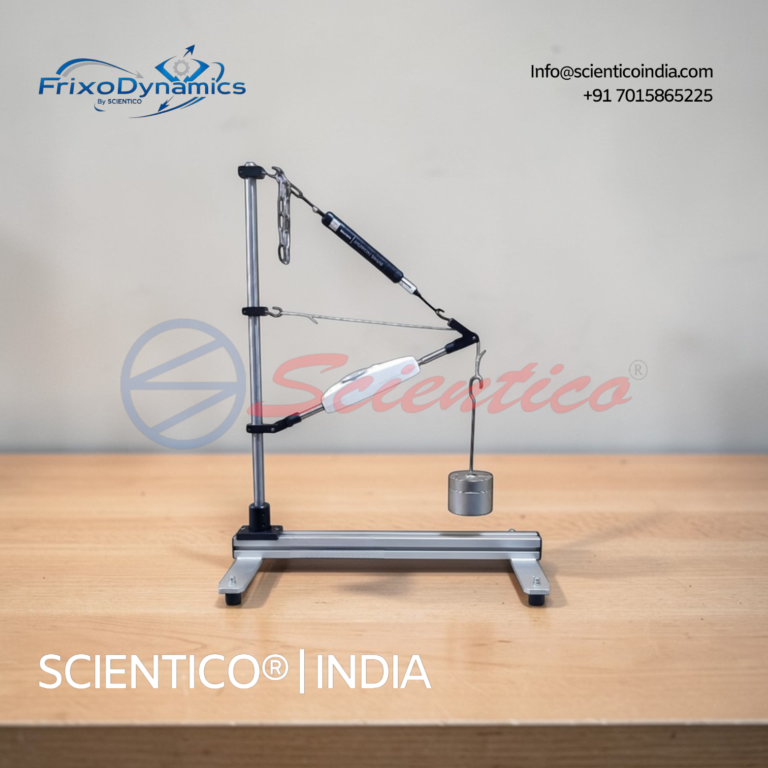
Forces in a Jib Crane Apparatus | FrixoDynamics FX-510
The SCIENTICO FrixoDynamics FX-510 Forces in a Jib Crane Apparatus is a wall-mounted experimental unit designed for the study of force distribution in a two-member jib crane structure. It enables students to measure compressive and tensile forces in the jib and tie members directly using an integrated force gauge and spring balance, and to compare those measured values against theoretical predictions derived from the triangle of forces and polygon of forces methods. The jib inclination and tie angle are adjustable, allowing a range of geometric configurations to be tested. Manufactured by SCIENTICO, the FX-510 is suitable for supply to engineering institutions and distributors worldwide.
View product details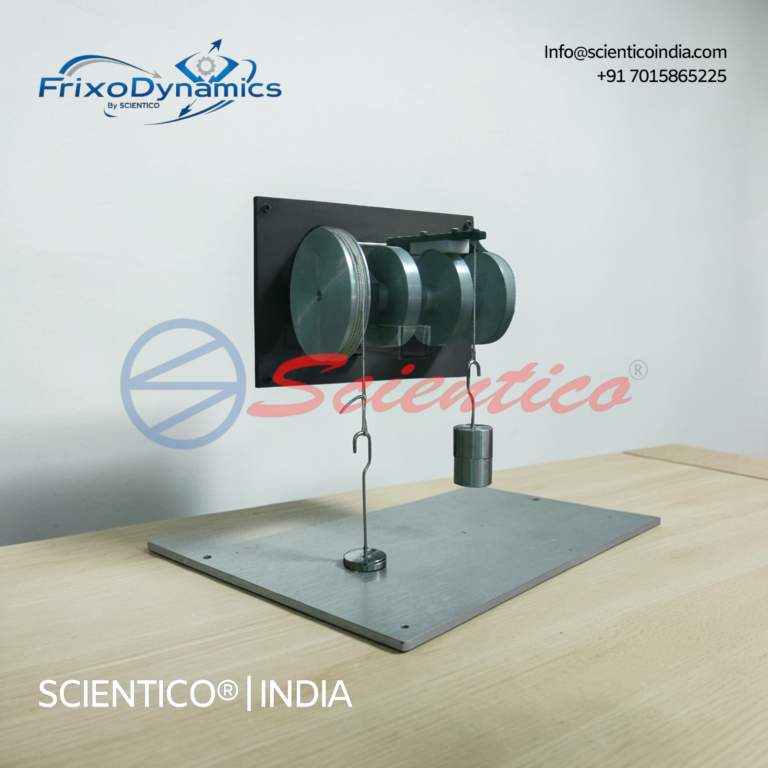
Dry, Rough and Lubricated Friction Apparatus | FrixoDynamics FX-524
The FrixoDynamics FX-524 is a complete friction board apparatus and friction experiment kit for measuring static and kinetic friction across dry, rough and lubricated surfaces, the standard friction experiment in engineering mechanics and physics laboratories.
View product detailsWhat universal testing machine price actually depends on
Six things move the number more than anything else. I have watched buyers argue over brand for weeks and then get surprised by the invoice because they ignored these.
- Capacity (kN). A 40 kN unit and a 400 kN unit share almost no structural parts. The frame, ball-screws or hydraulic cylinder, and load cell all scale up. Do not overspec. If your syllabus tops out at mild-steel rebar tension, 100 kN is enough.
- Accuracy class. Class 1 (±1% of reading) is standard for teaching. Class 0.5 costs noticeably more and is only worth it for research or QC work where you report to a customer.
- Motorisation and control. Hand-operated screw-type is the cheapest. Motorised electro-mechanical is the middle. Servo-hydraulic with closed-loop control is the top tier and often doubles the price.
- Standards compliance. Certification to ISO 9001:2015 and CE is baseline. IS 1500 conformity for hardness attachments, ASTM E8/E9 grip sets, and NABL-traceable calibration each add cost.
- Digital output and software. A basic dial gauge readout is cheap. A load cell with USB data logging and stress-strain plotting software adds INR 40k to 1.2 lakh depending on the licence model.
- Warranty and AMC. A one-year warranty is standard. Extending to three years with an annual preventive-maintenance visit adds real cost but pays back the first time a load cell drifts.
Universal testing machine 40 kN 100 kN 400 kN price India engineering college
These are the three capacities engineering colleges ask for most. Here is how I would think about each.
40 kN: right size for a polytechnic or first-year diploma lab running wire, thin rod, and small specimen tension tests. Compact footprint, single-phase 230 V acceptable, and the cheapest tier. If you only need Young’s modulus demos and basic tension, this is enough.
100 kN: the workhorse for most undergraduate mechanical and civil labs. Handles standard TMT rebar up to 12 mm, mild-steel flats, and compression cubes with the right adapter. Needs three-phase supply on motorised versions. Buy this one if you can only buy one.
400 kN: for structural and civil PG labs, concrete cylinder testing, and any syllabus that touches high-strength steel. Requires a proper floor plinth, three-phase 415 V, and physical space around the frame for specimen handling. Price roughly doubles from 100 kN because the hydraulic power pack, cylinder, and load cell all scale up.
My call: if your NAAC or NBA accreditation cycle is coming, and your budget covers one machine, buy the 100 kN motorised with digital output. It covers 80% of the syllabus. Then add a small 40 kN screw-type unit later if you need bench capacity for wire specimens.
Teaching-grade vs research-grade vs industrial-grade
These labels get thrown around loosely. Here is what actually differs.
Teaching-grade uses Class 1 accuracy, mechanical or basic electronic load measurement, standard grip sets, and factory calibration certificate. Expect 10 to 15 years of service life with reasonable maintenance. This tier fits diploma colleges, polytechnics, and undergraduate engineering labs.
Research-grade uses Class 0.5 accuracy, servo-hydraulic closed-loop control, extensometer inputs, and software that exports raw data. Calibration is NABL-traceable. Service life is longer if maintained, but the electronics stack ages faster than the frame. This tier fits M.Tech departments, IITs and NITs, and CSIR labs.
Industrial-grade adds ISO 17025 calibration scope, redundant safety interlocks, and often a dedicated QC software stack tied to your ERP. Used by steel plants, cement testing houses, and any lab that issues test reports to a paying customer.
The mistake I see: colleges specifying research-grade for a teaching lab because a committee member wanted it, then discovering the department has no one who can operate the software after the vendor training ends. Buy for the person who will actually run the machine.
Landed cost breakdown (CIF vs FOB vs Ex-Works)
For overseas buyers, the Incoterm on the quote changes the number a lot. Read carefully.
Ex-Works Ambala is the lowest quote you will see. It covers the machine at the factory gate. You arrange inland transport to Mundra or Nhava Sheva, export documentation, ocean freight, marine insurance, and destination clearance. Only pick this if your freight forwarder has real India-outbound experience.
FOB Indian port includes inland trucking, export customs, and loading onto the vessel. You pay ocean freight, insurance, and destination charges. This is common when the buyer has a relationship with a specific shipping line.
CIF destination port includes ocean freight and marine insurance up to your port. You still pay destination clearance, terminal handling, and inland delivery on your end. CIF is the popular choice for first-time overseas buyers because it removes the two biggest unknowns (freight rate volatility and insurance).
For most African, Middle East, and Southeast Asian buyers, CIF adds roughly 8 to 14 percent over Ex-Works, depending on destination and container fill.
Why buyers overpay (and how to avoid it)
Five mistakes I see repeatedly.
- Skipping the calibration certificate. If the quote does not mention it, the calibration is factory-internal, not traceable. Ask for it in writing. Cost to add is small; cost to redo later is not.
- Wrong voltage phase. A 100 kN motorised UTM needs three-phase. Confirm with your electrical contractor before you sign the PO. Retrofitting phase converters wastes money.
- No AMC quote at PO stage. The vendor’s leverage is highest before you pay. Get the year-2 and year-3 AMC pricing in the original quote. It stops price creep later.
- Poor freight consolidation. If you are buying a UTM plus a universal hardness tester plus other strength-of-materials equipment, ask for a combined shipment quote. One container is much cheaper than three LCL shipments.
- Buying via a middleman when direct-from-manufacturer is available. Every layer adds 15 to 30 percent. Scientico manufactures in Ambala; there is no reason to buy through a trading house.
How to get an accurate quote (not a range) in 24 hours
To move from a ballpark to a firm number, send a BOQ with six inputs.
- Capacity in kN and required accuracy class.
- Destination port (for overseas) or delivery city (for India).
- Required standards: ISO, CE, IS, ASTM, NABL scope.
- Quantity and any bundled items (grip sets, extensometer, hardness attachments).
- Required delivery date and any tender or NAAC deadline.
- Budget ceiling (yes, share it, it lets the vendor scope realistically).
Send this and expect a written quote inside a working day. Skip any of it and you get a range, not a price.
Scientico’s universal testing machine range
Our primary buyer-ready listing is the universal hardness tester, which pairs naturally with a UTM in most strength-of-materials labs. For the broader strength-of-materials scope, see the category page. If your BOQ includes structural apparatus, the continuous indeterminate beams apparatus and the jib crane forces apparatus are common companion buys for the same syllabus. For friction and tribology labs, look at the friction apparatus.
For comparison reading before you commit, our universal hardness tester buyer’s guide and the Brinell vs Vickers vs Rockwell comparison cover the adjacent hardness question that comes up in most UTM RFQs. If your lab plan is fresh, the engineering college equipment list is a sane starting point.
Get a firm quote
Send your BOQ or share your syllabus and required standards. I will come back with a written quote, delivery timeline, and AMC options inside 24 working hours. Use the WhatsApp button on this site or the contact form to start. Include your destination pincode or port so we can price the landed cost, not just the Ex-Works number.
Frequently Asked Questions
What is the price of a universal testing machine in India?
For teaching-grade units, expect INR 3.5 to 9 lakh depending on capacity (40 to 100 kN) and whether it is motorised. Research-grade servo-hydraulic models start around INR 12 lakh and can cross INR 25 lakh with software and NABL calibration. Industrial-grade QC units sit above that. Direct-from-manufacturer pricing from Ambala is typically 30 to 55 percent below imported-brand quotes for equivalent specs. Send a BOQ for a firm number rather than working from ranges.
How long does delivery take after PO?
For standard 40 to 100 kN teaching-grade UTMs held in configuration, dispatch from Ambala is typically 3 to 5 weeks after payment terms are met. Custom capacities like 400 kN or configurations with special grips, extensometers, or NABL calibration add 2 to 4 weeks. Overseas orders add 2 to 6 weeks of ocean transit depending on destination port. If you have a NAAC or tender deadline, flag it at quote stage so we can prioritise the build slot.
Does the price include calibration and certification?
Factory calibration with an internal certificate is included in the base price. NABL-traceable calibration is available as an add-on and is worth adding if your lab issues test reports or is going for ISO 17025 accreditation. CE marking and ISO 9001:2015 conformity documentation is included in the shipment for all export orders. Ask for these to be listed line-item on the quote so there is no ambiguity.
What capacity should an engineering college buy?
For most undergraduate mechanical and civil labs, 100 kN motorised is the correct answer. It covers standard TMT rebar up to 12 mm, mild-steel tension specimens, and compression cubes with the right adapter. Go to 400 kN only if your PG syllabus includes concrete cylinder testing or high-strength structural steel. A 40 kN bench unit is fine for polytechnic and first-year diploma labs where syllabus tops out at wire and thin rod tension.
Can Scientico ship internationally and what does CIF cover?
Yes, Scientico exports to over 60 countries from Ambala. CIF (Cost, Insurance, Freight) quotes cover the machine, export documentation, ocean freight to your destination port, and marine insurance. It does not cover destination customs clearance, terminal handling charges, or inland delivery from your port to your campus. Share your destination port and pincode with the RFQ so we can quote CIF accurately in one round.
What warranty and AMC options are offered?
Standard warranty is one year from installation covering manufacturing defects on the frame, load cell, and control system. Extended warranty up to three years is available and is worth adding for research-grade units where the electronics stack ages faster than the mechanical parts. Annual AMC with one preventive-maintenance visit and recalibration is priced separately and should be locked in at PO stage rather than negotiated later. For overseas buyers we work through regional service partners.
One honest ask
We don't gate anything on this site. You just read the whole thing free. If it was useful, leave your email and two things happen: we send you this page as a plain-text block you can paste into a tender file or an internal email, and we notify you the next time we publish a buyer tool like this one. Nothing else. No drip sequence, no sales calls booked without asking.