
This is a working reference for anyone writing a Kaplan turbine test rig into a tender or purchase spec. I have put down the parameter ranges I actually see quoted, what each line item means on the shop floor, and the standards your document should cite. If you are procuring for a diploma or degree lab, pair this kaplan turbine test rig specifications page with the broader fluid mechanics lab setup guide before you finalise the BOQ.
A quick note on numbers below. I use ranges, not exact figures, because rig sizing shifts with your available head, floor space, and the syllabus you are teaching. Anyone selling you a “one true spec” for a Kaplan rig either does not build them, or is copying a competitor’s brochure.
Equipment mentioned in this guide
Review the product information, specifications and model before requesting a quotation.
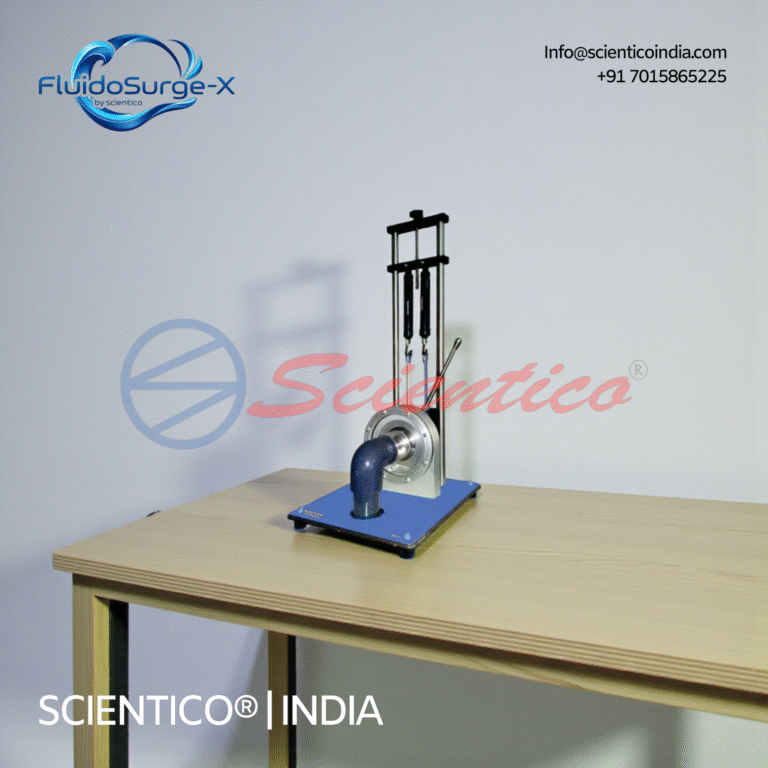
Kaplan Turbine Apparatus | FluidoSurgeX 208
The Kaplan Turbine Apparatus FluidoSurgeX 208 is a laboratory-scale training system designed to study the operating characteristics of a Kaplan reaction turbine. Manufactured by SCIENTICO, the apparatus demonstrates energy conversion from hydraulic power to mechanical power. It is suitable for instructional experiments in fluid mechanics and hydraulic machinery laboratories. The system operates using a controlled water supply from a hydraulic bench.
View product details
Multi Pump Test Rig Apparatus | FluidoSurge-X 294
The FluidoSurge X-294 is a multi pump test rig (series and parallel centrifugal pump test rig) that lets students run single, series and parallel pump configurations on one apparatus and compare the resulting head–discharge–efficiency characteristics.
View product detailsCore specifications for a Kaplan turbine test rig
| Parameter | Typical range | Notes |
|---|---|---|
| Runner diameter | Typically 150 to 250 mm for teaching rigs | Anything under 120 mm gets tip-clearance dominated and readings wander. |
| Runner blades | 3 to 6, adjustable pitch | Pitch adjustment is the whole point of a Kaplan. Fixed-blade units are propeller turbines, not Kaplan. |
| Rated head | Typically 3 to 8 m across the runner | Kaplan is a low-head machine. If a vendor quotes 20 m head, question the classification. |
| Rated discharge | Typically 10 to 25 L/s at rated head | Set by pump selection. Match pump curve to head-discharge point, not peak flow. |
| Shaft power output | Typically 0.5 to 2.5 kW at design point | Usable for rope brake or eddy-current loading in the lab. |
| Runner speed | Typically 800 to 1500 rpm | Non-dimensional speed N11 is what actually matters for characteristic curves. |
| Loading arrangement | Rope brake dynamometer or eddy-current brake | Rope brake is cheaper and honest; eddy-current gives cleaner torque signal for research. |
| Instrumentation | Pressure gauges 0-1 bar and 0-2 bar, digital rpm, digital load cell, orifice or venturi flow meter | Digital load and rpm should read to 0.1 unit resolution minimum. |
| Measurement accuracy | Flow +/- 1 to 2 percent, torque +/- 1 percent, pressure +/- 0.5 percent full scale | Ask for the calibration certificate class, not just the accuracy number. |
| Wetted materials | SS 304 runner and guide vanes, gunmetal or brass bushes, MS powder-coated frame | SS 316 optional if your feed water is aggressive. |
| Power supply | 415 V, 3-phase, 50 Hz, 5 to 7.5 HP pump motor | Confirm your lab has 3-phase before you sign. Single-phase Kaplan rigs are underpowered. |
| Safety | MCB, ELCB/RCCB, emergency stop, guarded couplings, non-return valve on pump discharge | Reject any rig without ELCB. Wet floor + electricity is not negotiable. |
| Standards referenced | IEC 60193 (model acceptance), ISO 9001:2015 (build), CE | See standards section below. |
| Calibration | Traceable to national standard, certificate on delivery | Certificates from an ISO 17025 / NABL calibration lab carry weight in audits. |
| Warranty | Typically 12 months on manufacturing defects, 6 months on instruments | Ask what happens to pump seals and rope brake ropes; these are consumables. |
kaplan turbine test rig specifications, decoding the spec sheet
Head and discharge. The Kaplan sits in the low-head, high-discharge corner of the turbine map. In a college lab you are not simulating a 200 MW barrage; you are showing that as head drops and discharge rises, the reaction turbine still holds efficiency because the blade pitch adjusts. If a vendor quotes head above about 10 m, they have probably repurposed a Francis frame and slapped a propeller runner on it. That is not a Kaplan.
Runner geometry. Three to six blades is the sensible range. Four is the sweet spot I usually recommend for teaching because students can see all the blades clearly during pitch adjustment, and the manufacturing tolerance on four blades is easier to hold than six. Cast SS 304 with hand-finished profiles is standard for this size class. Fabricated sheet-metal blades wobble at speed.
Instrumentation and accuracy. A specification that says “high accuracy digital instruments” is worthless. Insist on a number: percent of reading versus percent of full scale, and the traceability chain. A 0-2 bar gauge with +/- 0.5 percent FS accuracy is +/- 10 mbar across the whole range, which at low head is 3 to 4 percent of your actual reading. Better to spec two gauges, 0-1 and 0-2 bar, and switch between them.
Loading. Rope brake is the classroom workhorse. Two spring balances, a cooling water jacket on the brake drum, and a known drum diameter. Cheap, transparent, and every student sees the torque equation happen. For a research-grade unit I would move to eddy-current with digital torque readout, but you pay a real premium and the pedagogy is thinner.
Flow measurement. An orifice plate with U-tube manometer is fine for teaching Bernoulli and coefficient of discharge alongside the turbine. A venturi is smoother but costlier. Electromagnetic flow meters are lovely and I would not spec one for an undergraduate rig because when it drifts, nobody in the lab can debug it. Related reading: venturi and pitot apparatus and flow measurement apparatus.
Standards the spec sheet should reference
- ISO 9001:2015 for the manufacturer’s quality system.
- CE marking for electrical safety on the control panel.
- IEC 60193 for hydraulic turbine model acceptance testing (cite it even for a teaching rig; it disciplines the vendor).
- IS 15540 for classification of small hydro turbines where relevant.
- ISO 17025 / NABL for the calibration certificates on pressure gauges, load cell, and rpm sensor.
Teaching-grade vs research-grade vs industrial-grade specs
Teaching grade. This is what 90 percent of AICTE, HSBTE, PSBTE, GTU, VTU, and MSBTE labs need. Rope brake loading, analog and digital hybrid instruments, orifice flow, SS 304 wetted parts, powder-coated MS frame. Budget class. Runs a full batch through the experiment in a 2-hour slot.
Research grade. Eddy-current brake with digital torque, electromagnetic or coriolis flow meter, data acquisition to PC with LabVIEW or Python export, servo-driven blade pitch actuator so you can automate characteristic curves. Bigger runner, SS 316 wetted parts, IEC 60193 style calibration. Two to four times the teaching-grade cost.
Industrial grade. Not a lab rig anymore. Model test at 1:10 or better scale for a specific site, with cavitation tunnel, digital blade angle telemetry, and torque calibration traceable to a national hydraulic lab. If this is what you actually need, you are not writing an RFP for a training rig; talk to a hydro OEM.
Common spec-sheet red flags
- “High accuracy” with no number. If accuracy is not stated as percent of reading or percent of FS with a range, it is marketing text. Reject.
- No calibration traceability. A calibration certificate that does not name the reference standard and its cert number is a photocopy of nothing.
- Single-phase power on a 2 kW rig. The motor will trip on inrush and blame the college wiring. Insist on 3-phase 415 V.
- Fixed-pitch blades sold as “Kaplan”. That is a propeller turbine. Different experiment, different curves, wrong classification.
- No non-return valve, no ELCB, no emergency stop. Any one of these missing is grounds to reject on safety, not price.
- Delivery in “2 weeks flat”. A properly built Kaplan rig with cast runner and calibration takes several weeks of production, and sea transit adds more. Fast quotes usually mean stock frames with substituted instruments.
Scientico’s Kaplan turbine test rig, what our spec sheet includes
Our current build is the Kaplan Turbine Apparatus FluidoSurgeX 208. Runner in SS 304 with 4 adjustable blades, rope brake loading, orifice flow measurement, digital rpm and load, MCB plus ELCB on a CE-marked panel, and NABL-traceable calibration on the pressure and load instruments. It sits inside a wider hydraulics range that includes the FluidoSurgeX multi-pump test rig and our hydraulic bench series. Scientico has been building this class of equipment from Ambala since 1993, shipping to 30+ countries, ISO 9001:2015 and CE. For related buying guides, see the turbine test rigs page, the hydraulic bench buyer’s guide, and the renewable energy trainer guide if the lab also covers small hydro.
Send us the shortlisted spec sheet, or a draft BOQ, and I will mark it up against this reference and send back a cleaned version fit for tender submission. Contact us here to start the review.
Frequently Asked Questions
What runner size should I specify for a diploma-level Kaplan turbine test rig?
For HSBTE, PSBTE, MSBTE, and similar diploma programs I would spec a runner in the 150 to 200 mm range with 4 adjustable blades. That size gives visible pitch changes for the class, holds tolerance in casting, and pairs well with a 5 to 7.5 HP pump on standard 3-phase supply.
Is IEC 60193 the right standard to cite for a teaching rig, or is it overkill?
Cite it. IEC 60193 is written for full model acceptance testing, and yes, a teaching rig will not run to that depth. But naming it in the RFP forces vendors to think about calibration discipline, uncertainty budgets, and reporting format. It raises the floor without adding real cost.
What accuracy should the pressure and torque instruments deliver?
For teaching, expect flow accuracy of about 1 to 2 percent, torque of about 1 percent, and pressure of about 0.5 percent of full scale, with certificates traceable to a NABL or equivalent lab. Anything looser and your efficiency curves will not close within acceptable bounds.
How long does a Kaplan turbine test rig actually take to deliver?
Several weeks of production for the runner, guide vanes, calibration, and factory acceptance, plus sea transit if you are outside India. Land delivery within India is faster. Treat any 2-week promise with suspicion.
Should I choose a Kaplan or a Francis turbine rig for my fluid mechanics lab?
If the syllabus asks for a reaction turbine at low head with variable pitch, Kaplan is the right choice. Francis suits medium head and fixed geometry. Most complete labs run both, plus a Pelton for impulse. See the turbine test rigs manufacturer page for the full comparison.
One honest ask
We don't gate anything on this site. You just read the whole thing free. If it was useful, leave your email and two things happen: we send you this page as a plain-text block you can paste into a tender file or an internal email, and we notify you the next time we publish a buyer tool like this one. Nothing else. No drip sequence, no sales calls booked without asking.