
A request for a “BMS trainer” can describe very different teaching packages. One may show cell-voltage signals on a board, while another lets learners compare emulated cells, an actual battery, controlled discharge and protection-board tests. Scientico’s Battery Management System Trainer RVX 121 product record describes the latter path: a 15-channel cell emulator, 48 V 6 Ah lithium iron phosphate battery, 1 kW constant-current discharger and a protection-board test system. A buyer should turn those catalogue descriptions into a precise bill of quantities before comparing prices. The decision is which exercises the institution must deliver, which hardware is included for each exercise and what evidence students need to record.
Equipment mentioned in this guide
Review the product information, specifications and model before requesting a quotation.
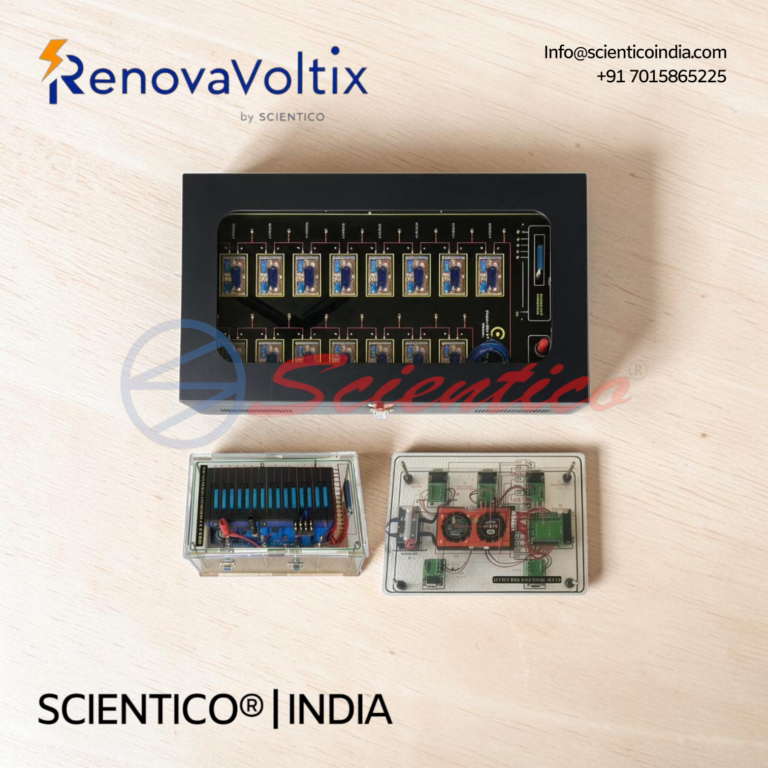
Battery Management System (BMS) Trainer | RVX 121
The Battery Management System (BMS) Trainer RVX 121 is an educational apparatus for studying and testing lithium-ion battery management systems. This BMS trainer features BMS board with PC software and Bluetooth app, lithium battery emulator with individual cell voltage control, 48V lithium battery, battery discharger, and protection board test equipment for comprehensive battery management system training.
View product detailsSeparate learning with an emulator from learning with a real battery
The emulator provides 15 individually adjustable voltage channels. The published range is 1.2–4.9 V per channel, with 2 mV stated accuracy and up to 1000 mA output per channel. This matters when the syllabus asks students to vary simulated cell conditions and observe how a BMS responds, without making every test depend on the state of a physical battery. In the RFQ, identify the exact exercises: setting one channel outside a threshold, observing balance behaviour, comparing channel readings and recording the response. Ask for a current channel diagram, connection schedule and operating procedure so an evaluator can check that the offered interface actually supports those tasks.
The product record also lists a real 48 V, 6 Ah LFP battery with four integrated temperature sensors. That makes the proposed practical different from emulator-only work. Specify whether learners must study battery connection, temperature observation, discharge curves or the transition between emulated and physical test arrangements. Ask the supplier to identify the battery, its connection terminals, protective devices and replacement route in the written offer. The battery description is a published catalogue fact, not a general claim that every battery chemistry or pack design can be tested with the same setup.
Decide what the discharger must demonstrate
The RVX 121 page lists a 1 kW discharger with a 0–20 A constant-current range, 0–100 V voltage measurement and a minimum two-second data-logging interval. The rating describes the instrument; it does not mean a 48 V 6 Ah teaching battery should be run continuously at every possible setting. Have the technical lead define supervised discharge exercises and permissible battery limits first. Then ask for the instrument model, its mains requirement, connection leads, data format and the procedure for stopping a run. Include the intended graph or record in the acceptance plan: for example, current, voltage, elapsed time and any measured temperature at agreed operating conditions.
Check whether the programme needs students to calculate capacity from a controlled run or simply observe the BMS and discharger indications. Those are different assessments. If a computer export is required, state the required file format, interface and licensing question in the RFQ. A display that shows values during operation is not automatically a complete dataset for marking reports. The published page mentions USB data acquisition and PC software; the quotation should identify the installed software version, supported computer environment and what records the supplied package can export.
Specify protection-board tests by function and evidence
The listed protection-board system supports quick and precise test modes. The product page names over-charge, over-discharge, short-circuit and cell-balancing checks, alongside self-consumption and loop-resistance measurements. Translate each required function into an observable practical. For over-voltage or under-voltage work, identify which threshold the class will vary and what indication or logged response counts as evidence. For balancing, state whether the assessment needs channel-level readings or a qualitative indication. For self-consumption or resistance, ask for the offered measurement method, stated range and calibration or verification evidence appropriate to the institution.
Do not merge every published number into a single “maximum BMS current” claim. The page lists a 0–20 A discharger, while the protection-board test system separately describes a high-current module covering 1–120 A. These are different parts of the package with different purposes. Ask the supplier to distinguish their terminals, operating limits, protective measures and supervised test procedures. The same applies to the 15-channel emulator and the page’s statement that some protection-board tests cover one to sixteen cell strings. The current configuration must reconcile the exact supported wiring for each task.
Clarify software, temperature testing and instructor supervision
The product record describes PC-based BMS software and Bluetooth monitoring. It identifies LabVIEW data acquisition as optional. A college that requires automatic logging, a particular software environment or a specified number of simultaneous user seats should list each as a separate line. Request a demonstration of the software functions actually quoted, including connection, live readings, saved records and any export the marking scheme requires. Do not let “software included” hide a distinction between the BMS interface, a mobile display and the optional data-acquisition package.
A hot-air gun and temperature probe are listed for sensor testing. This is a supervised electrical and thermal practical, so the department should define its own safe operating procedure, instructor controls, workspace and emergency arrangements before commissioning. Ask the manufacturer for current instructions covering electrical isolation, battery handling, charging or discharge, hot surfaces and fault simulation. The presence of an emulator does not make every connected exercise risk free, especially when the real battery, discharger and high-current test module are involved.
Make the quotation and acceptance check comparable
An institutional BOQ can name “Battery Management System Trainer, Scientico RVX 121 or technically evaluated equivalent,” then itemise the emulator, BMS board, 48 V 6 Ah LFP battery, discharger, protection-board test system, temperature-test equipment, cables, PC software, manuals and any optional acquisition package. Add quantity, destination, local mains supply, workstation space, required language of documents and tender deadline. Ask every bidder to mark included, optional or excluded for each item. If a component is substituted, request its exact model and a written mapping to the same exercises.
- Cell emulator: Buyer decision: 15-channel voltage exercises and required terminal access; Evidence to request: Channel map, range and demonstration plan.
- Real battery: Buyer decision: 48 V 6 Ah LFP exercises and safe handling; Evidence to request: Battery identification, connections and instructions.
- Discharger: Buyer decision: Constant-current task and records to retain; Evidence to request: Rated instrument, leads and example output.
- Protection tests: Buyer decision: Named faults, balance and measurement tasks; Evidence to request: Test-module schedule and supervised procedures.
- Software: Buyer decision: Included PC/Bluetooth functions versus optional LabVIEW; Evidence to request: Licence, interface, computer and export schedule.
At handover, compare delivered modules and accessories with the signed inclusion list. Agree on a supervised acceptance demonstration that starts with an emulator exercise, verifies the software reading, then checks only the real-battery and protection tasks approved by the institution’s technical lead. Record the supplied manuals, any calibration or conformity documents relevant to the quoted instruments, warranty terms, installation responsibilities and training. A catalogue description does not replace a signed commissioning scope.
The broader renewable-energy trainer buyer’s guide helps plan a department-wide lab. This guide addresses the narrower RVX 121 package once battery-management teaching is in the syllabus. Compare the renewable-energy equipment range if the practical is generation or storage integration rather than protection-board testing.
Request an RVX 121 configuration. Send the required BMS exercises, module count, software needs, destination and tender date. Ask Scientico to return the included hardware, options and site requirements in writing. Request a model-specific quotation.
One honest ask
This article and public product information are available to browse without an account. To open a product datasheet, complete the contact form shown with its download link. If this article was useful, leave your email and two things happen: we send you this page as a plain-text block you can paste into a tender file or an internal email, and we notify you the next time we publish a buyer tool like this one. Nothing else. No drip sequence, no sales calls booked without asking.