
A laboratory equipment tender floated by a government or aided college needs seven core documents: a notice inviting tender, a technical specification sheet, a bill of quantities, pre-qualification and eligibility criteria, the earnest money and performance security clauses, an evaluation matrix, and the general and special conditions of contract. Everything else in the file is annexure. If those seven are drafted properly, the tender survives scrutiny, comparison of bids is straightforward, and the equipment that arrives matches what the syllabus asked for.
This page walks through each document, what belongs inside it, and the supplier-side papers your technical bid should demand. It is the companion to our GeM lab equipment procurement guide, which covers the portal route. Use this one when you are floating an open tender on your own e-procurement portal, or when the item is non-standard enough that a GeM category does not exist for it.
One caution before anything else. Earnest money percentages, tender fee amounts, turnover thresholds and security deposit rates are set by your state finance department, your university statute, or the specific tender conditions your purchase committee approves. They change. Nothing on this page gives you a number to copy. What it gives you is the category, the logic behind it, and the questions to ask your finance officer before you publish.
Equipment mentioned in this guide
Review the product information, specifications and model before requesting a quotation.

Multi Pump Test Rig Apparatus | FluidoSurge-X 294
The FluidoSurge X-294 is a multi pump test rig (series and parallel centrifugal pump test rig) that lets students run single, series and parallel pump configurations on one apparatus and compare the resulting head–discharge–efficiency characteristics.
View product details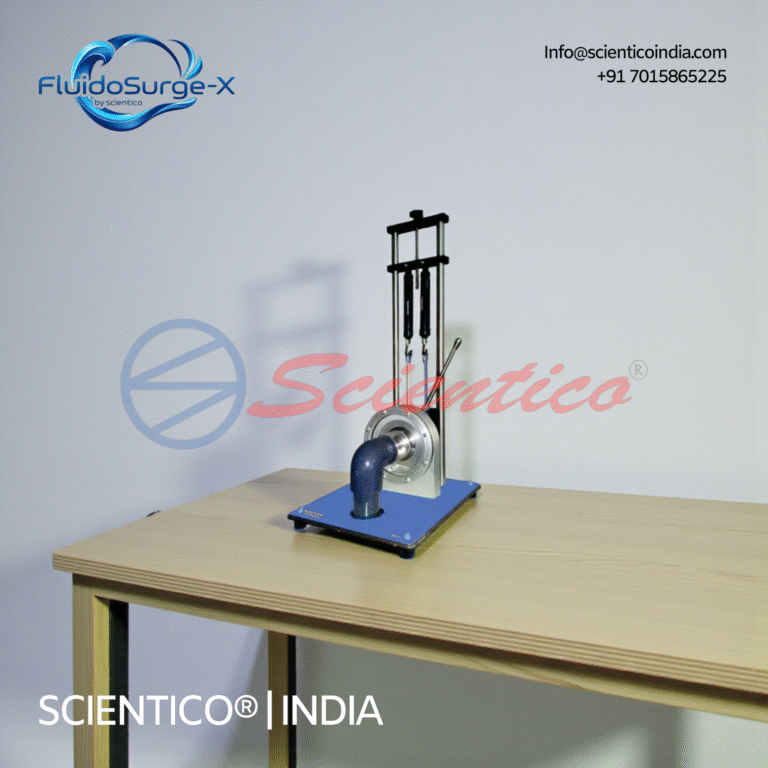
Kaplan Turbine Apparatus | FluidoSurgeX 208
The Kaplan Turbine Apparatus FluidoSurgeX 208 is a laboratory-scale training system designed to study the operating characteristics of a Kaplan reaction turbine. Manufactured by SCIENTICO, the apparatus demonstrates energy conversion from hydraulic power to mechanical power. It is suitable for instructional experiments in fluid mechanics and hydraulic machinery laboratories. The system operates using a controlled water supply from a hydraulic bench.
View product details
Universal Hardness Tester
The Universal Hardness Tester manufactured by Scientico India combines Brinell, Vickers, and Rockwell hardness testing methods in a single machine. The machine uses interchangeable indenters and a built-in optical measuring system for Brinell/Vickers measurements, with direct-reading digital display for Rockwell hardness.
View product details
Torsion Testing Machine 300 Nm Motorised | FortiTestX – 10
Torsion Testing Machine FortiTestX 10 is a motorised, benchtop strength of materials lab equipment unit designed for the torsional testing of various material specimens up to fracture. This Torsion Testing Machine applies controlled torque via a worm drive and motor, measuring test torque through a strain gauge and angle of twist through an incremental encoder, with both values displayed on digital readouts in real time. Engineered for undergraduate engineering laboratories, the FortiTestX 10 supports torsional testing of mild steel, aluminium, and brass specimens up to 300 Nm and 300 mm length.
View product details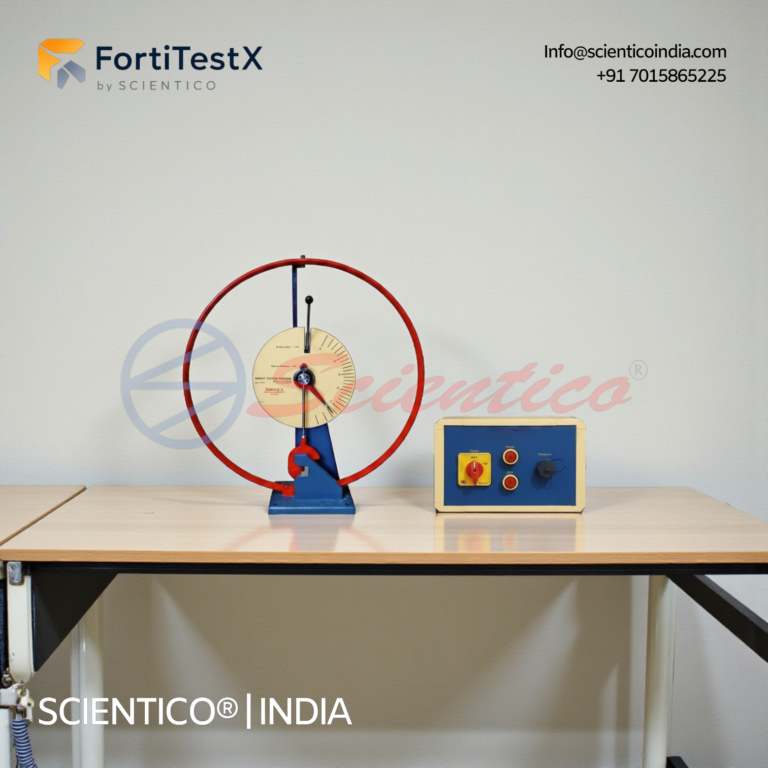
Impact Testing Machine | FortiTestX – 15
Impact Testing Machine FortiTestX 15 is a benchtop strength of materials lab equipment unit designed for notched bar impact bending tests on metallic and non-metallic specimens. This Impact Testing Machine operates on the pendulum principle, delivering a hammer impact speed of 3.8 m/s and a maximum work capacity of 25 Nm, with impact energy read directly from the gauge on a large scale. The FortiTestX 15 supports U, V, and keyhole notch configurations across four specimen materials, making it a complete impact testing machine strength of materials lab equipment unit for undergraduate material testing programmes.
View product details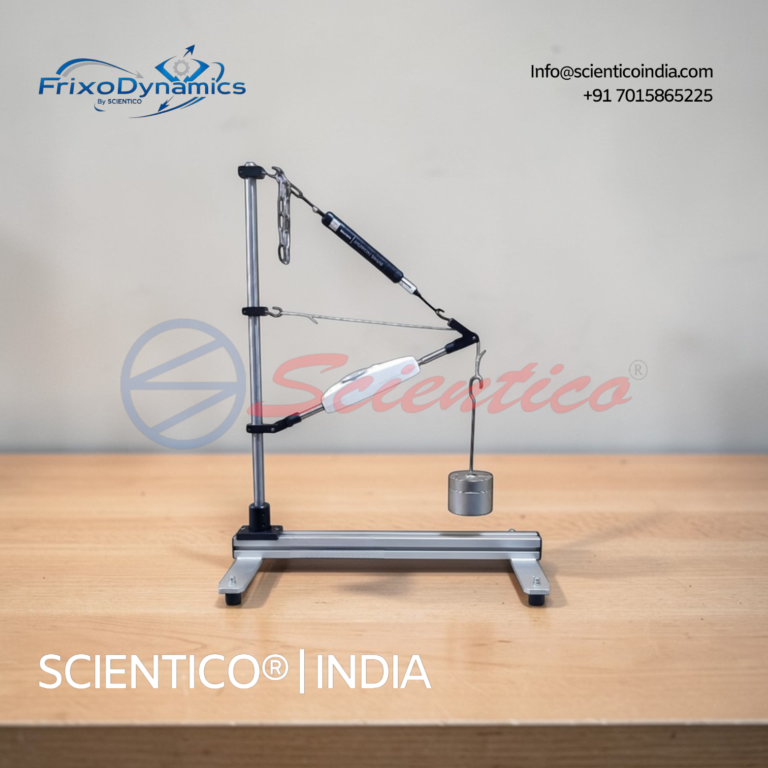
Forces in a Jib Crane Apparatus | FrixoDynamics FX-510
The SCIENTICO FrixoDynamics FX-510 Forces in a Jib Crane Apparatus is a wall-mounted experimental unit designed for the study of force distribution in a two-member jib crane structure. It enables students to measure compressive and tensile forces in the jib and tie members directly using an integrated force gauge and spring balance, and to compare those measured values against theoretical predictions derived from the triangle of forces and polygon of forces methods. The jib inclination and tie angle are adjustable, allowing a range of geometric configurations to be tested. Manufactured by SCIENTICO, the FX-510 is suitable for supply to engineering institutions and distributors worldwide.
View product detailsThe tender file at a glance
Here is the full document set, what each one actually does, and who in the college should own it.
| Document | What it does | Who should draft it |
|---|---|---|
| Notice Inviting Tender (NIT) | Public announcement: scope, dates, portal, contact, bid validity | Purchase or stores section |
| Technical specification sheet | Defines exactly what each item must do and measure | Lab in-charge and HOD |
| Bill of Quantities (BOQ) | Item-wise quantity structure that bidders price against | HOD with stores |
| Eligibility and pre-qualification criteria | Filters out bidders who cannot deliver or support | Purchase committee |
| EMD and performance security clauses | Financial commitment from the bidder and the awarded vendor | Finance officer |
| Evaluation matrix | How technical and financial bids are scored and compared | Purchase committee |
| General and special conditions of contract | Delivery, installation, training, warranty, penalty, arbitration | Administration with legal input |
| Site and installation annexure | Room dimensions, power phase, drainage, exhaust, foundation | Lab in-charge with estates |
| Integrity pact and undertakings | Non-blacklisting, no conflict of interest, acceptance of terms | Purchase section |
| Price bid format | Blank rate schedule, submitted separately from the technical bid | Purchase section |
The technical specification sheet
This is the document that decides whether the tender produces good equipment or a cheap approximation of it. Everything else is procedure. This one is engineering.
Write each specification as a measurable parameter with a range, not as a brand name and not as a wish. “Torsion testing machine, capacity 0 to 100 Nm, digital torque and angle display, chuck accepting specimens of 6 to 12 mm diameter, supplied with test specimens in mild steel, brass and cast iron” is a specification. “High quality torsion testing machine as per standard” is not, and any bidder can meet it with anything.
Four things belong in every item specification:
- Function and measured output. What the student must be able to observe, record and plot at the end of the practical.
- Range, capacity and accuracy. Stated as numbers with tolerances, because this is what separates a teaching-grade instrument from a demonstration toy.
- Construction and utilities. Frame material, bench or floor mounting, power supply phase and rating, water or drain requirement, footprint.
- Deliverables with the machine. Test specimens, spares, tool kit, experiment manual, calibration certificate, installation and on-site training.
Where a national or international standard genuinely governs the test, cite it. Hardness testing, impact testing and tensile testing all have well established test method standards, and quoting the relevant IS or ASTM code in the specification protects you. Where you are not certain of the code number, write “conforming to the relevant IS code for the test method” rather than guessing. A wrong code number in a published tender invites a technical objection, and technical objections restart your calendar.
The last mandatory line in every specification block should be the equivalence clause: “Equivalent or superior models will be considered, subject to bidder submitting a parameter-by-parameter comparison statement.” Without it, a specification tight enough to be useful can be challenged as restrictive. With it, you keep the tightness and shift the burden of proof onto the bidder.
Structuring the BOQ so bids are comparable
The BOQ is where most colleges lose the ability to compare quotes. If item descriptions are loose, three bidders will each price a different machine and the lowest number will win on paper while losing on delivery.
Give every line a unique item code, a one-line description that references the full specification annexure by page, a unit, a quantity, and blank columns for rate and amount. Keep consumables, spares and the annual maintenance contract as separate line groups so they do not distort the comparison of the capital items.
Quantities are a syllabus question, not a budget question. Decide how many experiments run in parallel, how many students share one setup, and how many lab sessions the timetable allows per week. Only then does a number exist. The table below shows the pattern that most engineering departments settle on for a 60-student batch split into rotating groups, and it is a starting point for your own timetable arithmetic rather than a norm imposed by anyone.
| Lab | Equipment | What it demonstrates | Typical qty for 60-student batch |
|---|---|---|---|
| Fluid mechanics | Multi-pump test rig, FluidoSurgeX | Pump characteristic curves, series and parallel pump operation | 1 rig, batch rotates in groups of 15 |
| Fluid mechanics | Kaplan turbine apparatus | Axial flow turbine performance, head against power output | 1 |
| Strength of materials | Universal hardness tester | Brinell, Rockwell and Vickers hardness on the same specimen set | 1 |
| Strength of materials | Torsion testing machine, FortiTestX | Modulus of rigidity, shear failure in ductile against brittle material | 1 |
| Strength of materials | Impact testing machine, FortiTestX | Izod and Charpy energy absorption, notch sensitivity | 1 |
| Theory of machines | Forces in a jib crane apparatus, FrixoDynamics | Force resolution in a pin-jointed frame against analytical values | 2, since the setup is compact and rotation is fast |
| Thermodynamics | Heat transfer test bench, ThermoFlux family | Conduction, convection and radiation coefficients | 1 per mode of heat transfer taught |
| Refrigeration and air conditioning | Vapour compression refrigeration test rig | COP calculation, pressure-enthalpy plotting from live readings | 1 |
| Renewable energy | Solar thermal trainer, RVX | Collector efficiency, insolation against useful heat gain | 1 |
| Process engineering | Analytical process control trainer, ProZessix | Level, flow and pressure loop behaviour, controller tuning response | 1 |
| Nursing | Advanced patient care manikin, IV arm trainer | Positioning, catheterisation, cannulation practice | 1 manikin per 10 students in the practical group |
| Pharmacy | Disintegration and dissolution test apparatus | Release profile of solid dosage forms | 1 of each, 2 if two batches run concurrently |
If you are equipping a department from zero rather than adding to an existing lab, the sequencing question comes before the quantity question, and our first procurement guide for new engineering colleges deals with that order. For budget banding across a full department, the engineering lab equipment cost and budget guide is the better starting point. Discipline-specific lists live in the electrical engineering lab equipment list, the soil mechanics lab equipment list, the B.Sc Nursing lab equipment list and the B.Pharm lab equipment list.
Eligibility and pre-qualification criteria
Pre-qualification exists to keep out bidders who can quote but cannot deliver, install, or support for the next decade. Write it as a checklist of documents, each one either present or absent, with no interpretation required from the evaluating committee.
The categories worth including:
- Legal existence. Registration certificate, GST registration, PAN, and for a manufacturer, the factory or Udyam registration.
- Financial standing. Audited statements for the last three financial years and an average annual turnover threshold. Your finance officer sets the threshold, usually as a multiple of the estimated tender value.
- Experience. A minimum number of similar supplies to educational or government institutions in recent years, evidenced by purchase orders or completion certificates.
- Technical capacity. Manufacturing facility, in-house design capability, and named service engineers with contact details and locations.
- Standing. A self-declaration of non-blacklisting by any government body, university or public sector undertaking.
Two criteria are worth adding for laboratory equipment specifically, because they are what separates a manufacturer from a trading intermediary. First, the after-sales response commitment: a stated maximum response time in days for a service call, with a penalty attached. Second, spares availability: a written undertaking that spares will be supplied for a defined number of years after installation. A trading house cannot honestly sign the second one.
EMD, performance security and the money instruments
Four financial instruments usually appear in a laboratory equipment tender, and confusing them is common.
Tender fee or document cost is a non-refundable charge for the tender document. On most e-procurement portals it is nominal or waived.
Earnest money deposit (EMD) is submitted with the bid and refunded to unsuccessful bidders after award. Its purpose is to stop frivolous bidding and to stop a winning bidder from walking away. It is normally a percentage of the estimated tender value, and the percentage is fixed by your state or institutional purchase rules, not by any national constant. Micro and small enterprises and startups often qualify for exemption on production of the relevant registration certificate, so your NIT should state the exemption clause explicitly rather than leaving it to be argued later.
Performance security or performance bank guarantee is furnished by the successful bidder after award and held through the warranty period. It is your remedy if the supplier delivers, invoices, and then disappears. Specify the acceptable form, usually a bank guarantee from a scheduled commercial bank, and specify the validity period as warranty period plus a claim margin.
Security deposit or retention is sometimes held instead of, or alongside, a bank guarantee. If you use both, say clearly which one is released when, because ambiguity here produces the longest email chains in the entire procurement.
Confirm every rate and every exemption with your finance officer against the current state financial rules before publishing. Rates set in a previous cycle get copied forward into new tenders more often than anyone admits.
The evaluation matrix
Decide the evaluation method before the bids arrive, publish it in the tender, and do not change it afterwards. Three methods are in common use.
Lowest evaluated bid (L1) among technically qualified bidders. Technical bids are opened first and marked qualified or disqualified against the specification. Only qualified bidders have their price bids opened, and the lowest wins. This is the default for standard, well specified equipment, and it works when your specification sheet is genuinely tight.
Quality and cost based selection. Technical bids are scored out of a stated total, price is scored separately, and a published weighting produces the composite. Use this when a technically superior offering is worth paying for, for example on a process control trainer where the quality of the software and the experiment manual varies enormously between suppliers.
Two-envelope with a technical threshold. A hybrid: bidders must clear a minimum technical score before price is considered, and then L1 applies among those who cleared. My view is that this is the most defensible method for laboratory equipment, because it lets you set a quality floor without ever having to justify a subjective weighting to an auditor.
Whichever method you pick, publish the technical scoring sheet with the tender. A scoring sheet the bidders have seen in advance is a scoring sheet you can defend.
Supplier documents to demand in the technical bid
This is the section that separates a serious tender from a formality. Demand these, and demand them as attachments to the technical bid rather than as promises to be produced later.
| Document | What it proves | How to word the demand |
|---|---|---|
| ISO 9001:2015 certificate | A documented, audited quality management system at the manufacturing site | Valid certificate with scope covering the manufacture of the tendered items, plus accreditation body details |
| CE declaration of conformity | The manufacturer’s declaration against the applicable European directives | Model-specific declaration listing the directives and harmonised standards applied |
| Calibration certificate with traceability | That the instrument’s readings mean something | Certificate from a NABL accredited laboratory, traceable to national standards, issued for the serial number supplied |
| OEM authorisation letter | That the bidder can actually supply and support that brand | On OEM letterhead, tender-specific, naming the tender reference number and the bidder |
| Past supply record | That similar institutions have taken delivery and accepted the equipment | Purchase orders or completion certificates for similar items, with the client’s contact for verification |
| Test or inspection report | That the specific model was tested, not just the product family | Factory test report or third-party inspection report for the offered model |
| Compliance statement | That the bidder has read the specification | Parameter-by-parameter table: your specification, offered value, deviation, page reference in the catalogue |
| Warranty and AMC terms | What happens in year two and year five | Warranty duration, what it covers, exclusions, AMC rate quoted separately in the price bid |
| Experiment manual sample | That the equipment is teaching-ready | Sample manual for at least one offered item, showing theory, procedure, observation table and calculation |
The compliance statement is the single highest-value document on that list. It converts a fifty-page catalogue into a one-page comparison your committee can evaluate in an afternoon, and it makes a bidder who is offering something different declare it in writing.
Two of these deserve their own reading, because the terms get used loosely in Indian tender documents. Our reference pages on ISO 9001:2015 for lab equipment and CE marking for lab equipment explain what each certificate does and does not cover, and the quality certifications page carries Scientico’s own current documents for anyone who needs them attached to a bid.
How this file feeds accreditation
Tender documents are procurement records first, but they become accreditation evidence the moment a visiting team asks how the lab was equipped. A well built tender file answers three questions an NBA or NAAC team will raise, without anybody having to reconstruct anything from memory.
The first is whether equipment matches the curriculum. Your specification sheet, written experiment by experiment against syllabus outcomes, is the answer. The second is whether procurement followed due process. The NIT, the evaluation matrix, the comparative statement and the purchase committee minutes are the answer, and they need to be in one folder rather than three departments. The third is whether the equipment is maintained and calibrated. The calibration certificates you demanded in the technical bid become the first entries in your maintenance register, which is why our page on the lab equipment maintenance and calibration schedule pairs with this one.
For the wider documentation set that an accreditation visit expects, including lab manuals, utilisation registers and outcome mapping, work through the NBA accreditation lab documentation guide. Verify current criteria and thresholds against the official handbook for your accreditation cycle. Those numbers are revised, and no third-party page should be your source for them.
What most colleges get wrong
The mistake I see most often is a specification copied from a supplier’s catalogue without removing the brand-specific phrasing. It happens with good intentions, usually because a helpful vendor offered to “help draft the specs”. The result is a tender that either gets challenged as restrictive, or gets quoted by a single bidder at a price nobody can compare. Take the technical parameters from any catalogue you like, then rewrite them in your own words as ranges.
Second: quantities set by budget rather than by timetable. A department decides it can afford four units, so four goes into the BOQ. Nobody asks how many students can be at a setup at once, or how many sessions the lab has per week. Do the arithmetic in the other direction: students per batch, students per group, groups per session, sessions per week, experiments in the syllabus. The number falls out of that.
Third: installation and site conditions left out of the tender. Three-phase supply, water and drainage, exhaust for a diesel engine test bed, floor loading for a heavy testing machine, ceiling height for a vertical rig. When these are not in the tender, they become a dispute after delivery, and equipment sits in a crate for a semester while the college and the supplier argue about who pays for the electrical work.
Fourth: no acceptance test defined. The tender should state exactly what has to happen before the equipment is accepted and payment is released. Run the experiment, record the readings, compare them to the specified accuracy, sign the installation report, train the staff. Without a written acceptance test, “delivered” and “working” quietly become the same word.
Fifth, and the most expensive one: warranty and AMC not quoted at bid stage. If the AMC rate is negotiated after award, you are negotiating with a supplier who knows you have no alternative. Ask for years three, four and five in the price bid, and evaluate the total.
Send us your BOQ
If you are drafting a tender now and want the technical annexure checked against what is actually manufacturable and quotable, send it across. Scientico has manufactured laboratory training equipment in Ambala since 1993 and supplies to institutions in more than 60 countries, and specification review is something we do routinely for departments preparing tenders. Send your syllabus, your draft BOQ, or just a list of experiments, and you will get a configured quotation with model-wise specifications you can compare against any other bid. Pricing is quote-based because configurations vary, so there is no list to work from. Send your requirement here and we will come back with a structured response.
One honest ask
We don't gate anything on this site. You just read the whole thing free. If it was useful, leave your email and two things happen: we send you this page as a plain-text block you can paste into a tender file or an internal email, and we notify you the next time we publish a buyer tool like this one. Nothing else. No drip sequence, no sales calls booked without asking.