
EQUIPMENT SELECTION GUIDE
Choose the distillation column by the separation task, not by the catalogue photo
A distillation teaching purchase fails most often because the buyer ordered “a distillation column” instead of a defined separation task. Batch rectification, continuous rectification and multifunction training columns answer different curriculum questions: batch work teaches reflux and cut management on a changing mixture; continuous work teaches steady-state feed, reflux and product-draw control; a multifunction column teaches both by reconfiguration. This guide turns a syllabus into a comparable quotation.
Four decisions before any model is shortlisted
1. Batch or continuous operation
Batch rectification suits experiments where students charge a mixture, run the column and observe how top composition changes with reflux and cut strategy. Continuous rectification suits steady-state teaching: constant feed, controlled reflux, measured bottom and top products. If the syllabus names both, a multifunction column with interchangeable columns may avoid a duplicate purchase.
2. Column configuration and internals
Ask what the students must see and change: number of trays or packing type, column material for visibility, whether columns are interchangeable between experiments, and how reflux ratio is set. A column whose internals cannot be changed locks the laboratory into one experiment family.
3. Measurement and control
List the measurements the curriculum requires: top and bottom temperatures, reflux ratio, feed rate, reboiler power, vacuum level where relevant. Confirm which sensors are included per column and which are optional, because sensor count differs between models.
4. Working fluid and safety boundary
Teaching columns are designed for specific working fluids. State the mixture your curriculum uses and confirm suitability, materials compatibility and any ventilation or drainage assumptions in writing. Never assume a column offered for one solvent family is approved for another.
The three Scientico column families compared
| Requirement | Batch column (OperatiX-04) | Continuous column (OperatiX-06) | Multifunction column (OperatiX-05) |
|---|---|---|---|
| Process taught | Batch rectification with different column types | Continuous rectification with different column types | Distillation with different interchangeable columns |
| Column configuration | Column set per experiment | Interchangeable columns | Interchangeable columns |
| Reflux ratio | Adjusted using valves | Adjusted using valves | Adjusted using valves |
| Evaporator | Electrically heated, infinitely variable | Electrically heated, infinitely variable | Electrically heated, infinitely variable |
| Tanks | Feed and top product tanks | Feed, bottom and top product tanks | Feed, bottom and top product tanks |
| Bottom-product heat exchange | Not part of the published record | Cooling/heating via feed preheating | Cooling/heating via feed preheating |
| Top product condensing | Coiled condenser and phase separation | Condenser and phase separation tank | Condenser and phase separation tank |
| Vacuum mode | Possible with vacuum pump | Possible using vacuum pump | Possible with vacuum pump |
| Tank materials | Glass and stainless steel | Glass and stainless steel | Glass and stainless steel |
| Temperature sensors | Different sensors per column | Per published record | Per published record |
Every cell above is taken from the current live product records on 12 September 2026. Where a record does not state a value, the table says so instead of estimating. Confirm the complete offered configuration, sensor list and accessories in the quotation.
Verified Scientico product records
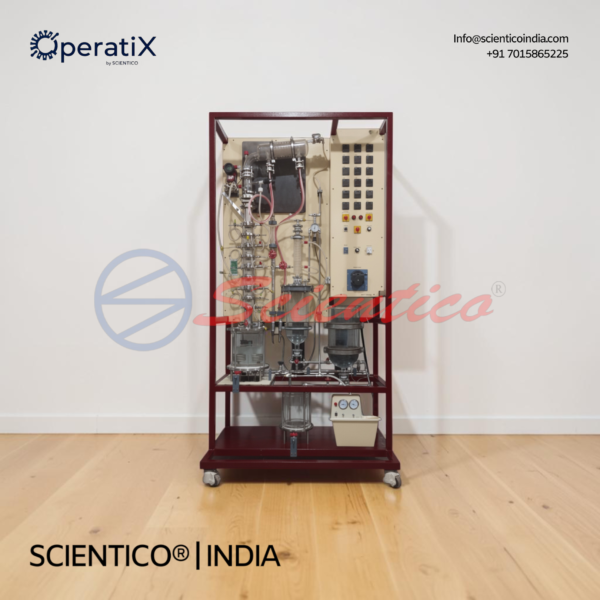 VERIFIED SCIENTICO PRODUCT PATHBatch Distillation Column Apparatus | OperatiX – 04
Open the current product record, then confirm the offered column configuration, instrumentation, tanks, utilities and supplied accessories in the quotation.
Review the product →
 VERIFIED SCIENTICO PRODUCT PATHContinuous Distillation Column Apparatus | OperatiX – 06
Open the current product record, then confirm the offered column configuration, instrumentation, tanks, utilities and supplied accessories in the quotation.
Review the product →
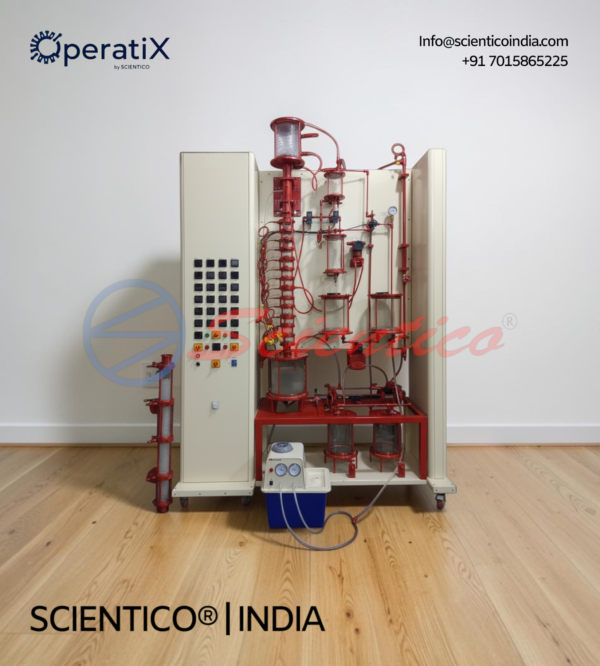 VERIFIED SCIENTICO PRODUCT PATHMultifunction Distillation Column | OperatiX – 05
Open the current product record, then confirm the offered column configuration, instrumentation, tanks, utilities and supplied accessories in the quotation.
Review the product →
For the underlying theory and procedure, use the distillation column experiment guide. For laboratory-wide planning across separation, water-treatment and process-control families, use the pilot-plant procurement guide and the unit operations selection guide.
Utilities and installation questions to settle before the order
Electrical and services
Confirm the electrical supply available in the laboratory and the evaporator heater requirement in the offered configuration, the cooling-water arrangement for the condensers, and whether a vacuum pump is included or optional where vacuum operation is planned.
Space, drainage and ventilation
Columns, tanks and separation tanks need bench height clearance and service access. Confirm the installed footprint, floor drainage expectations for the working fluid used, and the ventilation assessment your institution applies to the mixtures students will run.
Copy-ready RFQ brief
We are selecting distillation teaching equipment for [institution and department]. Separation tasks required: [batch / continuous / both, mixtures and working fluids]. Experiments and measurements required: [reflux ratio, top/bottom temperatures, feed rate, composition method, vacuum work]. Student group size and weekly throughput: [details]. Please identify the exact offered model and column configuration, included sensors per column, tanks and materials, condenser arrangement, vacuum capability, electrical and cooling requirements, supplied accessories, manuals and experiment documentation. Mark every deviation, exclusion and optional item, and state installation, training, acceptance, warranty and spares responsibility for delivery to [destination].
Questions buyers ask before ordering a distillation column
Should we buy a batch column, a continuous column or both?
Decide from the syllabus. If students must manage charge, cut and reflux on a changing mixture, batch teaching matters. If they must hold steady state and balance feed, reflux and draws, continuous teaching matters. A multifunction column with interchangeable columns can cover both families where the budget requires one unit.
Which measurements should the column include?
At minimum, the measurements your experiments assess: top and bottom temperatures, reflux ratio setting, feed and product flows where applicable, and reboiler power. Confirm the included sensor list per column in the quotation rather than assuming all sensors are standard.
Can the column run under vacuum?
The published records for all three columns state vacuum operation is possible with a vacuum pump. Confirm whether the pump is included or optional and any additional glassware or safety requirements in the offered configuration.
What working fluids can we run?
State your curriculum mixtures in the enquiry and require written confirmation of materials compatibility and any ventilation or drainage assumptions. Do not run fluids that the offered configuration has not been confirmed for.
How do we compare two suppliers’ columns fairly?
Compare mode of operation, column internals and interchangeability, included instrumentation, tanks and materials, condenser arrangement, utilities, supplied accessories, documentation and acceptance support line by line, using the same requirement list for both offers.
Scope note: this guide describes selection decisions and the published facts of the named Scientico records. It does not state prices, delivery times, certification status or third-party approvals. Model-specific confirmation happens in the written quotation.