
A materials-testing laboratory needs separate equipment for separate failure modes and measurements. A universal testing machine, hardness tester, impact machine and fatigue machine do not substitute for one another. Start with the specimen, loading mode, property to be determined and applicable teaching or test method; then select capacity, fixtures, measurement and data requirements.
Equipment mentioned in this guide
Review the product information, specifications and model before requesting a quotation.
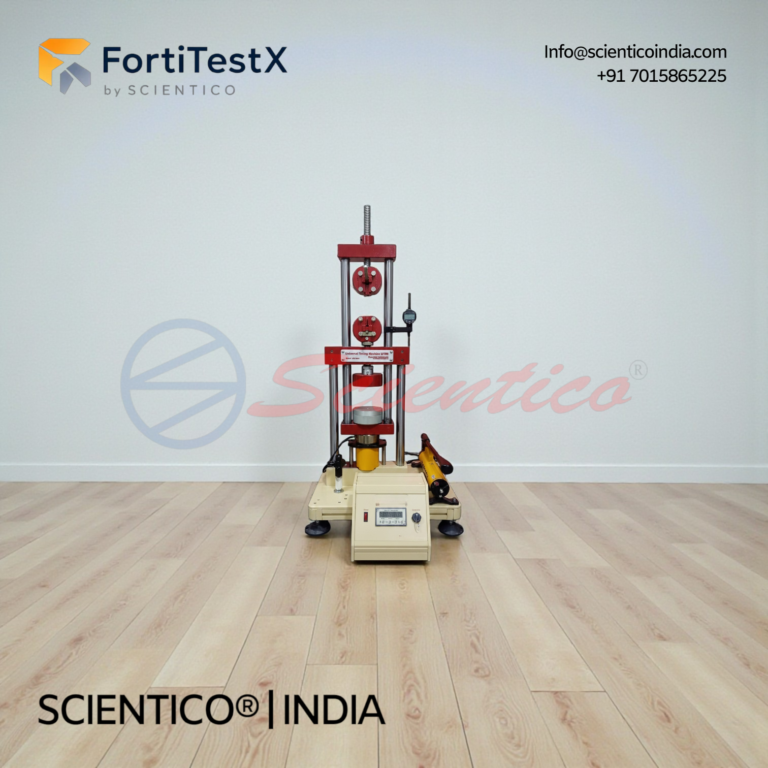
Universal Testing Machine 30kN | FortiTestX – 16
Universal Testing Machine 30kN FortiTestX 16 is a benchtop strength of materials lab equipment unit designed for tensile, compressive, bending, and elongation testing of metallic and non-metallic specimens using a hand-operated hydraulic system requiring no external power supply. This Universal Testing Machine 30kN generates test forces up to 30 kN through a hydraulic system, displaying load on a large dynamometer gauge with trailing pointer and measuring elongation via a dial gauge with 0.01 mm graduation. The FortiTestX 16 accepts a comprehensive range of standard and optional accessories for shear, cupping, spring, and Brinell hardness testing, making it a complete universal testing machine 30kN strength of materials lab equipment unit for undergraduate engineering and materials science programmes.
View product details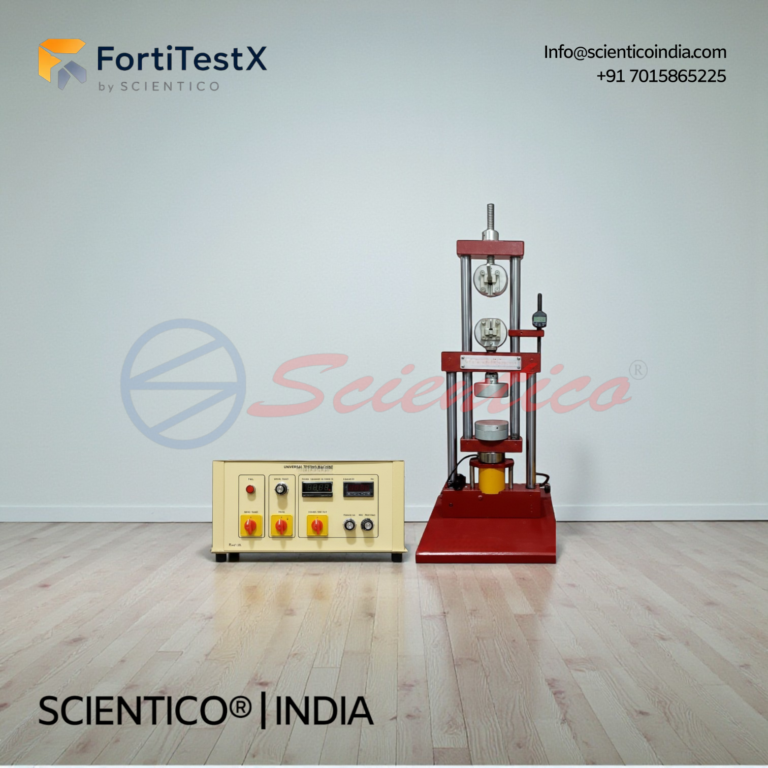
Universal Testing Machine 50kN | FortiTestX – 40
Universal Testing Machine 50kN FortiTestX 40 is a vertical benchtop strength of materials lab equipment unit designed for compressive and tensile testing of materials, parts, and structures using a hydraulically operated or servo ball screw-based loading system. This Universal Testing Machine 50kN generates test forces up to 50 kN across a maximum stroke of 150 mm, measuring force via full bridge strain gauges and displacement via a linear potentiometer, with both values displayed on dedicated digital displays. The FortiTestX 40 accepts a comprehensive range of standard and optional accessories for bending, shear, deep draw, spring, Brinell hardness, and additional tensile configurations, making it a complete universal testing machine 50kN strength of materials lab equipment unit for undergraduate and industrially focused engineering programmes.
View product details
Universal Hardness Tester
The Universal Hardness Tester manufactured by Scientico India combines Brinell, Vickers, and Rockwell hardness testing methods in a single machine. The machine uses interchangeable indenters and a built-in optical measuring system for Brinell/Vickers measurements, with direct-reading digital display for Rockwell hardness.
View product details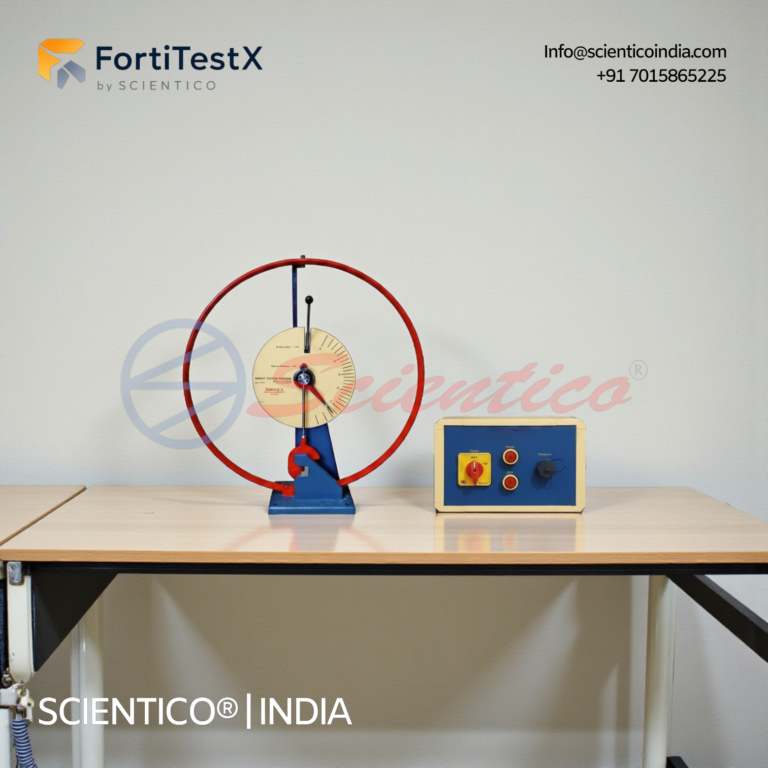
Impact Testing Machine | FortiTestX – 15
Impact Testing Machine FortiTestX 15 is a benchtop strength of materials lab equipment unit designed for notched bar impact bending tests on metallic and non-metallic specimens. This Impact Testing Machine operates on the pendulum principle, delivering a hammer impact speed of 3.8 m/s and a maximum work capacity of 25 Nm, with impact energy read directly from the gauge on a large scale. The FortiTestX 15 supports U, V, and keyhole notch configurations across four specimen materials, making it a complete impact testing machine strength of materials lab equipment unit for undergraduate material testing programmes.
View product details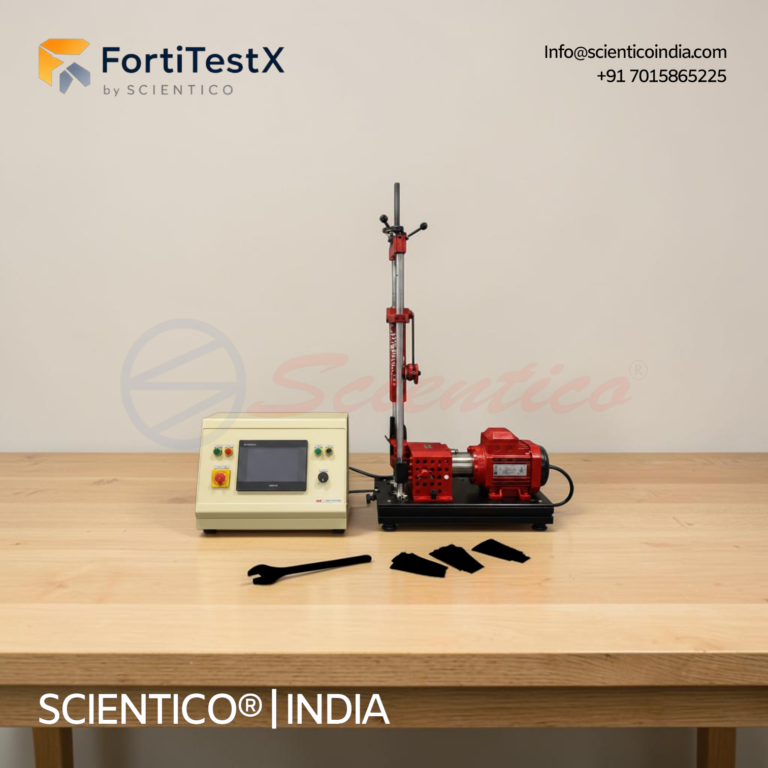
Fatigue Testing Machine | FortiTestX – 22
Fatigue Testing Machine FortiTestX 22 is a benchtop strength of materials lab equipment unit designed for fatigue strength testing of cylindrical metal specimens under cyclic bending load using a rotating cantilever configuration. This Fatigue Testing Machine clamps a revolving metal test bar at one end, applies a controlled point force via a spring balance and moveable plain bearing, and subjects the specimen to a sinusoidal bending stress cycle until fracture, with automatic shutdown triggered by a stop switch integrated into the bearing. The FortiTestX 22 includes an 8-digit electronic load cycle and revolutions counter with contactless inductive speed sensor, making it a complete fatigue testing machine strength of materials lab equipment unit for undergraduate materials testing and failure analysis programmes.
View product detailsMatch the learning outcome to the equipment
| Required outcome | Relevant catalogue route | Key RFQ evidence |
|---|---|---|
| Tensile or compression behaviour under controlled loading | Universal Testing Machine 30 kN and Universal Testing Machine 50 kN | Capacity, loading method, grips/fixtures, specimen range, extension measurement, display/data method and guarding. |
| Indentation hardness using the required method | Universal Hardness Tester | Requested hardness method, test-force range, indenter, optical or depth measurement, specimen limits and reference blocks. |
| Energy absorbed during a notched impact test | Impact Testing Machine | Charpy/Izod requirement, energy range, specimen/notch geometry, supports, striker and safety enclosure. |
| Response to repeated or cyclic loading | Fatigue Testing Machine | Loading mode, stress or load range, speed/frequency, specimen geometry, cycle counting and failure detection. |
Why the test method comes before the machine
For tensile testing, ASTM explains that results can include yield strength, tensile strength, elongation and reduction of area, while specimen geometry and units affect how the method is applied. A buyer should therefore name the teaching method or required standard and specimen before accepting a “universal” machine description. See the official ASTM E8/E8M scope.
The same principle applies to hardness, impact and fatigue. A catalogue noun does not define the indenter, test force, striker, energy, fixture, loading cycle or result format. Those details belong in the compliance matrix and model-specific quotation.
Selection sequence for faculty and procurement teams
- List the properties or failure behaviours students must observe or calculate.
- Define specimen material, shape, size and preparation.
- Name the required test method or state that the equipment is for educational demonstration only.
- Select capacity and operating range with enough margin for the intended specimen, without overspecifying unusable capacity.
- List every grip, fixture, indenter, anvil, support, striker and reference item required.
- Specify load, displacement, extension, depth, energy, speed or cycle measurements.
- State guarding, emergency-stop and safe-access expectations.
- Confirm power, footprint, foundation, environment and handling needs.
- Ask for manuals, experiment worksheets and order-specific documentation.
How to compare two materials-testing quotations
Use one row per measurable requirement. Mark each response as compliant, alternative, excluded or clarification required. Do not give full credit for copying the tender sentence: the bidder should identify the offered model and the datasheet or drawing that supports the response. Options must be separated from included scope.
For a teaching laboratory, also compare how students obtain and record results. A machine may meet a nominal capacity yet fail the educational need if the relevant reading, specimen fixture or experiment documentation is absent.
Related guides
- Universal testing machine buying guide
- Brinell, Rockwell and Vickers hardness selection
- Brinell versus Vickers method comparison
- Column buckling experiment
- Browse strength-of-materials equipment
Frequently asked questions
Is the highest-capacity UTM always the best choice?
No. Capacity must suit the specimen and expected load while preserving usable measurement resolution and the correct fixtures.
Can one hardness tester perform every hardness method?
Not automatically. Confirm the offered methods, force ranges, indenters, measurement system, specimen constraints and included reference items.
Can an impact machine replace a fatigue machine?
No. Impact testing measures response to a sudden blow; fatigue testing studies repeated or cyclic loading over many cycles.
What should a distributor include in the offer?
State the standard product name, proposed model, capacity, fixtures, measurement method, safety scope, utilities, documents, installation, warranty and every deviation.
Request a comparable equipment proposal
Send the specimen, test method and equipment list so the proposed models and included fixtures can be reviewed.