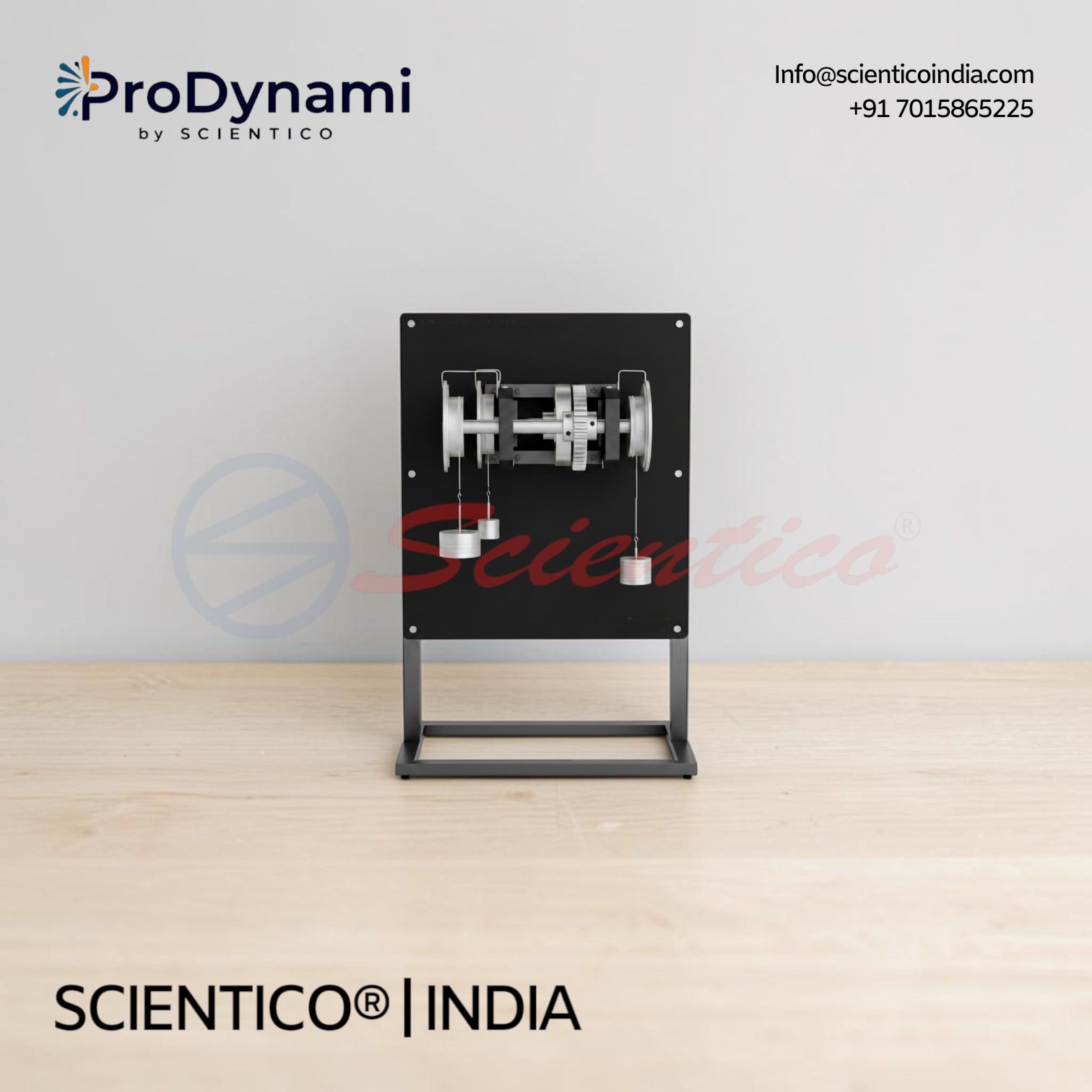
Differential-Crownwheel & Pinion | ProDynami – 1366
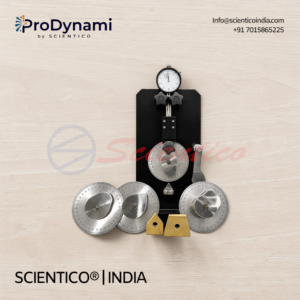
The Differential-Crownwheel & Pinion ProDynami – 1366 demonstrates differential mechanism behavior using an input pinion, crown-wheel, sun gears, and planetary gears. This Differential-Crownwheel and Pinion apparatus shows how drive wheels rotate at different speeds during turns while maintaining torque distribution. It features an aluminum profile frame with wall-mounting brackets and protractor-fitted pulleys for speed and torque ratio verification. Required weight sets support hands-on efficiency and gear ratio experiments.
The Differential-Crownwheel & Pinion ProDynami – 1366 demonstrates the action of a differential when a vehicle takes a curve and the external wheel must travel a greater distance than the internal wheel. This Differential-Crownwheel and Pinion apparatus shows how the crown-wheel and pinion elements enable independent motion between shafts while allowing coupling between both parts. It simulates the differential mechanism that lets drive wheels rotate at different speeds.
Product Overview
When a vehicle takes a curve, the external wheel must travel a greater distance than the internal wheel. The shaft is divided to enable the wheels of a same shaft to have different speeds, guaranteeing the coupling of both parts with the differential. It is difficult for many students to visualize the action of a differential when used to provide a drive from the gearbox to each shaft, allowing at the same time an independent motion between the shafts. This Differential-Crownwheel and Pinion unit has been designed to demonstrate the action of the elements of a differential: the crown-wheel and the pinion.
The unit simulates a differential mechanism. The function of the differential mechanism is to enable the drive wheels to rotate at different speeds, regardless of whether they are the front or rear wheels. When the vehicle is travelling in a straight line, the differential must behave as if it were rigid and make both wheels rotate at the same speed. This means that in this situation the sun gears do not spin around their own axis; in other words, they act as wedges to transmit the motion of the crown. Therefore, the differential allows torque to be provided to either both wheels or only one wheel. When both wheels have the same load, the differential supplies the same torque to both of them, but when one of them supports a greater load than the other, then motion is distributed uniformly.
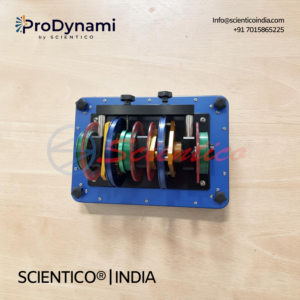
The input pinion transfers the power to the crown. That motion of the crown drives the sun gears, and they, rotating together with the crownwheel, transfer the power to the planetary gears. The planetary gears at the same time transfer the power to the output shafts, allowing them to rotate at the same or different speed.
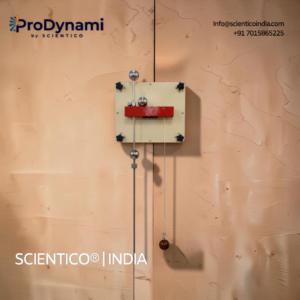
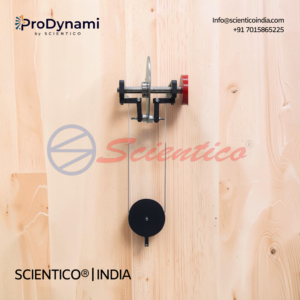
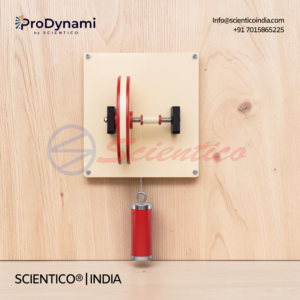
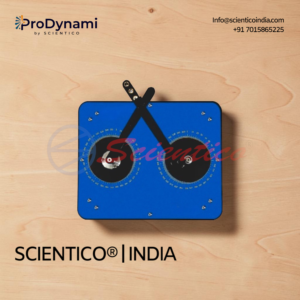
The unit is mounted on a frame consisting of aluminum profiles with a panel made of painted steel with legs that enable it to be located on an appropriate surface. It also includes brackets that allow the unit to be hung on a wall. Gears are distributed on different shafts (input shaft, right output shaft, and left output shaft), which are mounted on ball bearings that allow low inertia and a decrease of the losses due to friction. Both the input shaft and the output shafts have pulleys equipped with protractors, enabling the student to determine and verify the torque and speed ratios on this Differential-Crownwheel and Pinion apparatus. They are made of aluminum and their radius is 40mm.
Differential-Crownwheel & Pinion ProDynami – 1366, Technical Specifications
| Specification | Detail |
|---|---|
| Components | An input pinion, a crown-wheel, three gears named sun gears, two gears coupled to the shafts of the wheels named planetary gears, three pulleys with protractor |
| Frame | Aluminum profiles with panel made of painted steel, with legs and wall-mounting brackets |
| Shaft Mounting | Ball bearings, for low inertia and reduced friction losses |
| Pulleys | Aluminum, radius 40mm, equipped with protractors |
Technical Data
Differential Group
| Parameter | Value |
|---|---|
| Input pinion | Z = 21 |
| Crown-wheel | Z = 63 |
| Sun gears | 3, Z = 16 |
| Planetary gears | 2, Z = 32 |
Key Features
- Components: input pinion, crown-wheel, 3 sun gears, 2 planetary gears, 3 pulleys with protractor
- Gear Counts: input pinion Z=21, crown-wheel Z=63, sun gears Z=16 (x3), planetary gears Z=32 (x2)
- Frame: aluminum profiles with painted steel panel, floor legs and wall-mounting brackets
- Shaft Configuration: input shaft, right output shaft, and left output shaft, all ball bearing mounted
- Pulleys: aluminum, 40mm radius, fitted with protractors for torque and speed ratio verification
- Mounting Flexibility: can be located on a surface or hung on a wall
- Differential Behavior: demonstrates torque distribution across straight-line and curved travel, central to this Differential-Crownwheel and Pinion apparatus
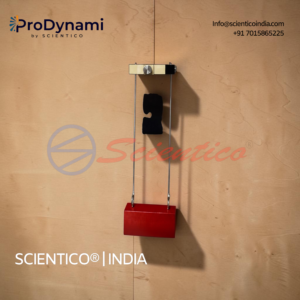
- Required Accessory: 3 sets of weights, “B” type, needed for certain practices
Experiments
- Determination of the input and output speed ratio and the torque distribution
- Study of the efficiency
- Study of the use of a differential as a simple transmission system
- Visualization and demonstration of the behaviour of a differential when used as a means to provide a drive
- Verification of the gear ratio
Construction and Design
The Differential-Crownwheel & Pinion ProDynami – 1366 includes an input pinion (Z=21), a crown-wheel (Z=63), three sun gears (Z=16), and two planetary gears (Z=32). The input pinion transfers power to the crown, whose motion drives the sun gears; these, rotating together with the crownwheel, transfer power to the planetary gears, which in turn transfer power to the output shafts. The unit is mounted on a frame of aluminum profiles with a painted steel panel, fitted with legs for surface placement and brackets for wall mounting. Gears are distributed across the input shaft, right output shaft, and left output shaft, all mounted on ball bearings for low inertia and reduced friction losses. Both the input shaft and output shafts carry aluminum pulleys, 40mm in radius, equipped with protractors to determine and verify torque and speed ratios.
Q: What is the Differential-Crownwheel & Pinion ProDynami – 1366 used for?
A: It is used to demonstrate the action of a differential mechanism, including the crown-wheel and pinion, showing how drive wheels rotate at different speeds during turns.
Q: What are the gear counts in the differential group?
A: The differential group includes an input pinion (Z=21), a crown-wheel (Z=63), three sun gears (Z=16 each), and two planetary gears (Z=32 each).
Q: How is the apparatus mounted?
A: The unit can be placed on an appropriate surface using its frame legs, or hung on a wall using included brackets.
Q: How are torque and speed ratios measured?
A: Both the input shaft and output shafts have aluminum pulleys, 40mm in radius, equipped with protractors to determine and verify torque and speed ratios.
Q: What accessories are needed for certain experiments?
A: 3 sets of weights, “B” type, are required to carry out some of the practices with this unit.
Need Assistance? We're Here to Help!
Connect with our team for product specifications, pricing, and customized solutions for your institution or project.