Geneva Mechanism Apparatus | ProDynami – 1292
The Geneva Mechanism Apparatus ProDynami – 1292 demonstrates the Geneva drive, converting continuous rotation into intermittent rotary motion. This Geneva Mechanism apparatus features a six-slot driven wheel advancing 60° per rotation, with an anodised aluminium drive disc mounted on ball bearings. A scale on the drive disc allows exact input angle measurement. The unit sits on an HDF base with rubber feet for laboratory table use.
The Geneva Mechanism Apparatus ProDynami – 1292 demonstrates the Geneva drive, or Maltese cross, a gear mechanism that translates continuous rotation into intermittent rotary motion. This Geneva Mechanism apparatus uses a rotating drive wheel with a pin that reaches into a slot of the driven wheel, advancing it by one step. A raised circular blocking disc locks the driven wheel in position between steps.
Product Overview
The Geneva drive or Maltese cross is a gear mechanism that translates a continuous rotation into an intermittent rotary motion. The rotating drive wheel has a pin that reaches into a slot of the driven wheel, advancing it by one step. The drive wheel also has a raised circular blocking disc that locks the driven wheel in position between steps.
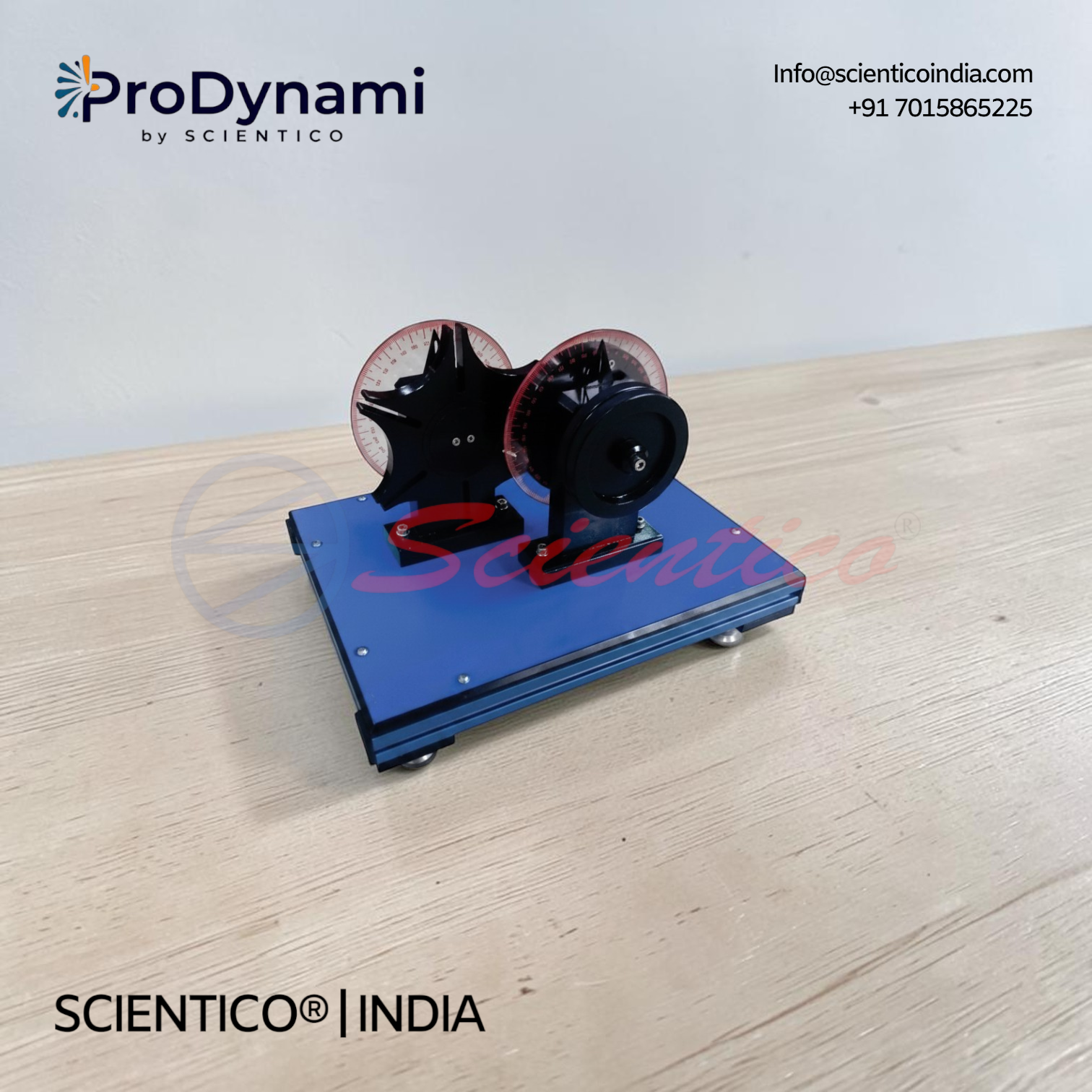
In this apparatus, the driven wheel has six slots and thus advances for each rotation of the drive wheel by one step of 60°. An anodised aluminium disc is mounted on ball bearings as a driver. The disc has a scale so that the input angle can be exactly measured. The crank pin is used for the movement of the driven wheel. The driven wheel is made of black anodised aluminum. All components are fitted to an HDF base fitted with rubber feet. This Geneva Mechanism apparatus is placed on the laboratory table for the experiment.
Geneva Mechanism Apparatus ProDynami – 1292, Technical Specifications
| Specification | Detail |
|---|---|
| Mechanism Type | Geneva drive (Maltese cross), translates continuous rotation into intermittent rotary motion |
| Driven Wheel Slots | 6, advancing 60° per rotation of the drive wheel |
| Drive Disc | Anodised aluminium, mounted on ball bearings, with angle measurement scale |
| Driven Wheel Material | Black anodised aluminum |
| Base | HDF, fitted with rubber feet |
| Setup | Placed on the laboratory table for the experiment |
Key Features
- Mechanism Type: Geneva drive (Maltese cross)
- Motion Conversion: continuous rotation to intermittent rotary motion
- Driven Wheel Slots: 6, each advance step is 60°
- Drive Wheel: anodised aluminium disc, ball bearing mounted
- Angle Measurement: scale on the drive disc for exact input angle measurement
- Driven Wheel Material: black anodised aluminum
- Locking Mechanism: raised circular blocking disc locks the driven wheel between steps
- Base Construction: HDF fitted with rubber feet
- Demonstration Setup: placed on laboratory table, illustrating the Geneva Mechanism principle directly
Construction and Design
The Geneva Mechanism Apparatus ProDynami – 1292 consists of a rotating drive wheel with a pin that reaches into a slot of the driven wheel, advancing it by one step. A raised circular blocking disc on the drive wheel locks the driven wheel in position between steps. The driven wheel has six slots and advances 60° per rotation of the drive wheel. An anodised aluminium disc, mounted on ball bearings, serves as the driver and includes a scale for exact input angle measurement. The crank pin is used for the movement of the driven wheel, which is made of black anodised aluminum. All components are fitted to an HDF base equipped with rubber feet, allowing the unit to be placed directly on the laboratory table for the experiment.
Scope of Delivery
- 1 Experimental unit
- 1 Instruction manual
Q: What is the Geneva Mechanism Apparatus ProDynami – 1292 used for?
A: It is used to demonstrate the Geneva drive, or Maltese cross, which translates continuous rotation into intermittent rotary motion.
Q: How many slots does the driven wheel have?
A: The driven wheel has six slots, advancing by one step of 60° for each rotation of the drive wheel.
Q: What materials are used for the drive and driven wheels?
A: The drive disc is made of anodised aluminium, and the driven wheel is made of black anodised aluminum.
Q: How is the input angle measured?
A: The drive disc has a scale that allows the input angle to be exactly measured.
Q: What is the base of the apparatus made of?
A: The base is made of HDF and is fitted with rubber feet, allowing the unit to be placed on a laboratory table.
Need Assistance? We're Here to Help!
Connect with our team for product specifications, pricing, and customized solutions for your institution or project.