
“Motor trainer” is too loose a BOQ line for a practical electrical-machines course. A synchronous servo motor and a reluctance motor can both support speed, torque, voltage and current observations, yet they demonstrate different operating principles and may need different control and load arrangements. Scientico lists a Synchronous Servo Motor Trainer EL 1018 and a Reluctance Motor Trainer EL 1022. Their public records give nominal ratings, but they do not specify a complete instrumented workstation. This guide helps a department choose the experiment first and request the missing system details before approving either model or an equivalent.
Equipment mentioned in this guide
Review the product information, specifications and model before requesting a quotation.
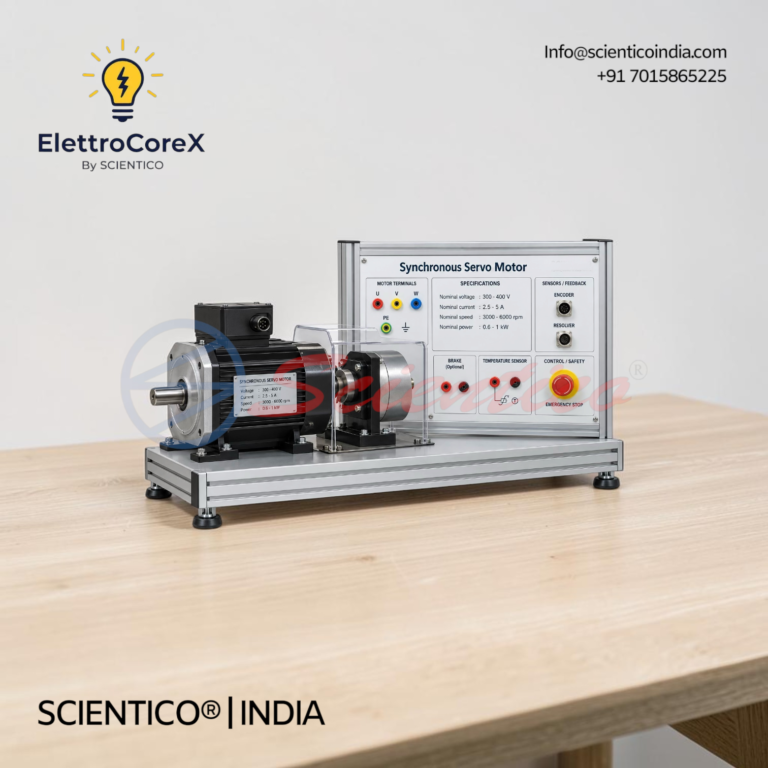
Synchronous Servo Motor Trainer | EL 1018
The Synchronous Servo Motor Trainer EL 1018 is a laboratory unit for studying synchronous servo motor operation. It is rated 300 to 400 V nominal voltage, 2.5 to 5 A nominal current, 3000 to 6000 rpm nominal speed, and 0.6 to 1 kW nominal power.
View product details
Reluctance Motor Trainer | EL 1022
The Reluctance Motor Trainer EL 1022 is a laboratory unit for studying reluctance motor operation. It is rated 400/230 V, 50 Hz, 1.4/2.4 A nominal current, 1500 to 3000 rpm nominal speed, and 0.25 to 1 kW nominal power.
View product detailsSeparate the two learning outcomes
The EL 1018 is described for synchronous servo motor operation and precision-motion study. The EL 1022 is described for reluctance motor operation. Both records mention speed-and-torque characteristics and voltage-and-current relationship study, but that shared wording should not erase the machine distinction. Ask the course leader to list the principles students must explain, the variables they must change, and the graph or calculation they must submit. If the syllabus is specifically about synchronous servo control, specify the control, feedback and load conditions needed to demonstrate it. If it is about reluctance motor behaviour, identify the starting, running and load observations required. A procurement committee should not substitute one machine for the other on a matching power band alone.
Write one assessment sheet for each practical. It can name the circuit or system diagram students must interpret, the readings to record at each operating point, the safe sequence for changing load or speed, and the shutdown condition. Send that sheet with the RFQ. The supplier can then state which observations the base trainer supports and which require a controller, dynamometer, encoder, meter or interface. The product pages list only the trainers in their scope of delivery; do not assume a sensor, computer, software licence, power supply or bench is included unless the quotation expressly names it.
Use the catalogue ratings correctly
The EL 1018 page lists 300–400 V nominal voltage, 2.5–5 A nominal current, 3000–6000 rpm nominal speed and 0.6–1 kW nominal power. The EL 1022 page lists 400/230 V at 50 Hz, 1.4/2.4 A nominal current, 1500–3000 rpm nominal speed and 0.25–1 kW nominal power. These are published ranges or ratings for catalogue identification. They do not tell you the delivered motor’s exact nameplate values, control range under load, permissible duty, required site supply, protection settings or accuracy of any measured characteristic. Ask for a current datasheet and nameplate schedule for the offered unit, and state the supply available in the laboratory.
For EL 1022, ask the supplier to explain the 400/230 V and 1.4/2.4 A pairing in the offered connection and how students will see or measure the operating state safely. For EL 1018, ask whether the offered setup includes the controller and feedback arrangement needed for the proposed precision-motion exercise. Do not infer a closed-loop servo demonstration merely from “servo” in the product name. If a bid proposes either unit as a complete motor-control station, it should show a wiring and instrumentation diagram that links the named trainer to each controller, load, indicator, emergency-stop device and connection lead. The current product records alone do not settle those inclusions.
Specify a complete and safe experiment station
Before seeking prices, inventory what the lab already owns. Note the voltage and phase of available supply, bench space, protective earthing, local isolation, approved meters, load apparatus and compatible control modules. Identify whether a student will adjust a set point, vary mechanical load, observe steady-state values or log a dynamic response. A speed–torque plot needs measured speed and torque over an agreed range; a voltage–current exercise needs accessible, protected measurement points and an approved meter. If the lab lacks any of these, request them as separately priced lines rather than quietly assuming the trainer contains them.
Ask the supplier to document guards over rotating parts, cable routing, overload and emergency-stop arrangements for the offered assembly. The public pages provide nominal electrical and mechanical data but no detailed safety circuit. Have the instructor or electrical safety officer approve the practical sequence and the maximum operating condition used with students. For each measurement, ask whether it is read from a built-in display, a supplied accessory or an existing laboratory instrument. This distinction is essential for both cost comparison and acceptance: two quotations can name the same motor yet deliver different teaching capability.
Make integration and documentation bid requirements
A clear BOQ has separate equipment, integration and documentation schedules. The equipment schedule names the chosen motor trainer and exact proposed model, the power and control modules, mechanical load, sensing, meters, leads and mounting. The integration schedule says who connects and commissions the station, what the institution provides, and how the offered machine interfaces with existing modules. The documentation schedule requests the current wiring diagram, operating limits, sample experiment sheets, maintenance instructions and spares list. Ask for all deviations in writing. If the supplier offers an alternate load or control scheme, it should show how the same student observations will be produced.
Do not merge the two machines into one vague “servo/reluctance motor training kit” line. If the curriculum requires both machine principles, ask for two identifiable trainer lines and a shared-accessory schedule that states which components genuinely serve both. If only one machine is required, preserve the intended practical in the line description and evaluate equivalents against that outcome. This prevents a cheaper single motor with no compatible measurements from winning on headline price while leaving the course experiment unworkable. A multi-station teaching room should also state the number of simultaneous student groups and whether instruments are shared or duplicated.
Plan a supervised acceptance demonstration
Acceptance should begin with delivered model, nameplate, wiring, controller and accessories checked against the approved quotation. The supplier should demonstrate protective earth and isolation checks according to the institution’s procedure, then operate the motor in its stated range under a supervised test plan. At least one speed, current and load observation should be recorded with the specified instruments. If the contract includes a characteristic curve or feedback exercise, demonstrate one complete data set and show how students reproduce it. Avoid requiring the machine to reach every upper catalogue figure during a classroom acceptance; use conditions agreed from the current manual and offered configuration.
Ask the instructor to follow the student worksheet during commissioning. If a cable, sensor, drive parameter, load fixture or software permission is missing, it will become visible before the station is handed over. Record measured values as evidence, not as an invented universal pass threshold. Keep calibration or verification certificates, electrical drawings and training records alongside the equipment handover. Confirm warranty, spares and support scope in the quotation, because a motor practical depends on repeatable setup across many classes rather than one successful demonstration.
The electronics and electrical product range lists adjacent power, load and measurement products that may be relevant to a complete station; each accessory still needs a compatibility check. The existing laboratory equipment BOQ guide explains broader tender structure. This page owns the narrower decision between the EL 1018 synchronous servo and EL 1022 reluctance trainer, together with the instrumentation needed to make their stated experiments assessable.
Request the model and station scope together
Send Scientico the specific experiment sheet, chosen motor principle, number of stations, existing electrical supply and instruments, required load and measurements, destination, quantity and tender deadline. Ask for the exact EL 1018 or EL 1022 configuration, station diagram, included and excluded accessories, commissioning plan, manuals and written deviations. If both models are needed, request a clear shared-accessory schedule and a separate price for each station. Request a motor-trainer quotation that answers the practical, rather than a single unqualified price.
One honest ask
This article and public product information are available to browse without an account. To open a product datasheet, complete the contact form shown with its download link. If this article was useful, leave your email and two things happen: we send you this page as a plain-text block you can paste into a tender file or an internal email, and we notify you the next time we publish a buyer tool like this one. Nothing else. No drip sequence, no sales calls booked without asking.