
A useful process-control trainer request names the practical exercises and the evidence a supplier must provide for each one. “PID trainer” alone could mean a compact multi-variable teaching board, an analytical process trainer with water-quality measurements, a dedicated cascade-control rig or a larger DCS teaching platform. UAE engineering colleges and technical institutes can use this worksheet to compare those scopes without assuming that every model, accessory or service is interchangeable. It is a model-selection and request-for-quotation guide; the current tender document and the supplier’s written offer control the final purchase.
Equipment mentioned in this guide
Review the product information, specifications and model before requesting a quotation.

Process Control Trainer (4 in 1) | NexuMation-50
The Process Control Trainer (4 in 1) NexuMation-50 is a complete educational platform for studying level, pressure, temperature and flow control. This Process Control Trainer combines a pressurized vessel, sensors, actuators and PID control circuits on a single training board for automation and control technology education.
View product details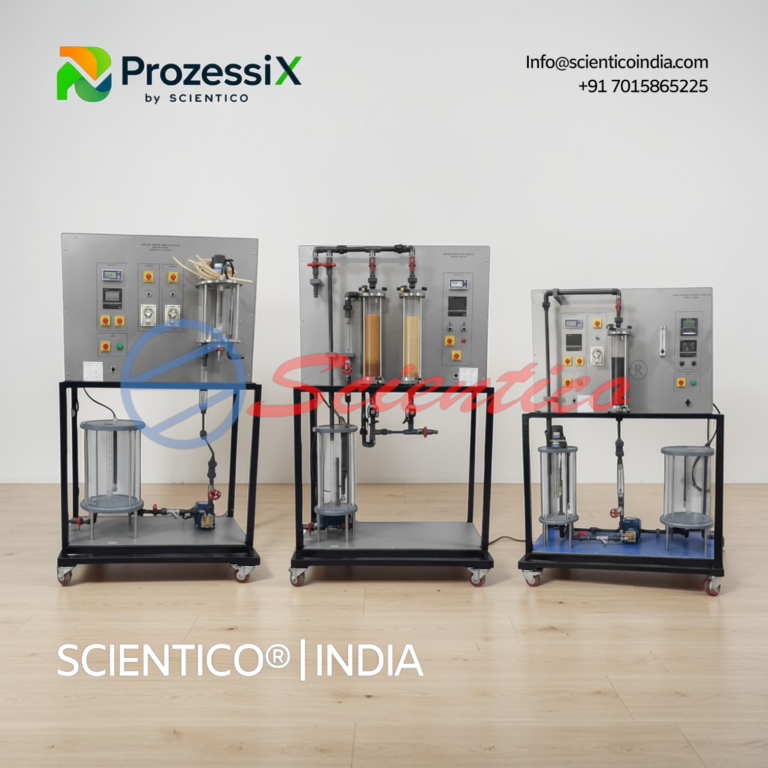
Analytical Process Control Trainer | ProzessiX PX-04
The Prozessix PX-04 is an analytical process control trainer for instrumentation and process engineering laboratories, giving students hands-on PID loop tuning across flow, level, temperature and pressure processes on a single bench.
View product details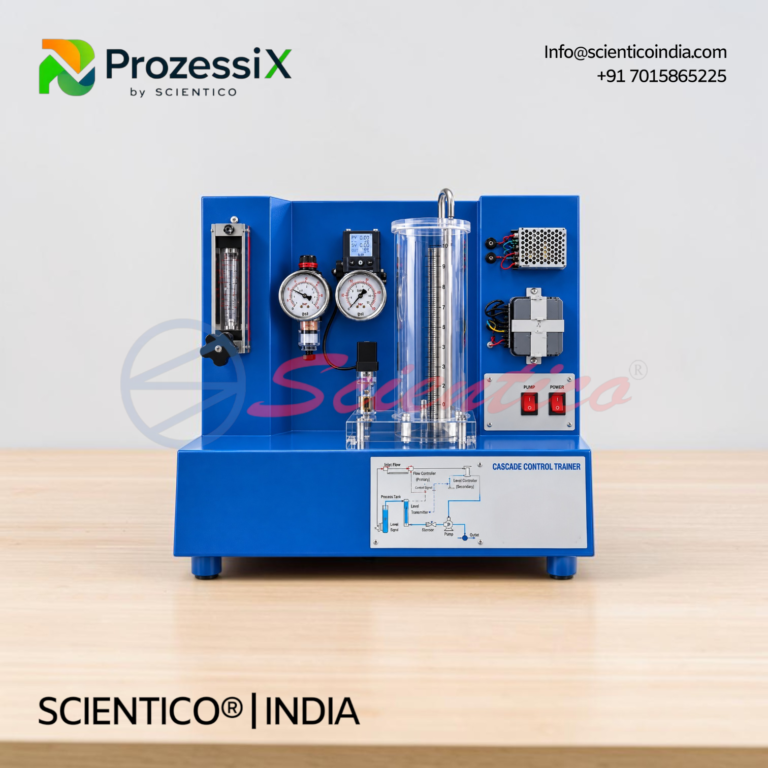
Cascade Control Trainer | Prozessi PX 18
The Cascade Control Trainer Prozessi PX 18 is designed to teach advanced process control methods used in industrial applications. This Cascade Control Trainer allows students to configure and study flow, level and cascade control experiments with water circulation, transmitters, an orifice meter, a pneumatic control valve and data acquisition.
View product details
Universal Process Control Trainer | Prozessi PX 29
The Universal Process Control Trainer Prozessi PX 29 demonstrates industry-standard process control using DCS, SCADA and advanced control techniques. This Universal Process Control Trainer integrates temperature, flow, level and pressure control with pneumatic and electric actuation on a single configurable platform.
View product details
Universal Process Control Trainer | Prozessi PX 29A
The Universal Process Control Trainer Prozessi PX 29A is a modular industrial process control training system for PLC programming, SCADA, process instrumentation, and advanced process control. This universal process control trainer integrates temperature, flow, level, and pressure processes on one platform.
View product details
Universal Process Control Trainer | Prozessi PX 29B
The Universal Process Control Trainer Prozessi PX 29B is a modular process control training system for PLC programming, SCADA, process instrumentation, and marine engineering process control. This universal process control trainer uses a Honeywell HC900 process controller and integrates temperature, flow, level, and pressure processes.
View product detailsDefine the practicals before naming a model
Start with the department’s assessed experiments. List the process variables students must measure and control: level, flow, temperature and pressure are common, but analytical measurements such as pH or conductivity call for a different setup. Then state whether students must tune a single PID loop, compare interacting loops, configure cascade control, or work with DCS and supervisory software. Add the expected outputs: live readings, trends, data export, observations, calculations and a report. This makes a supplier response testable against the curriculum rather than a generic statement that the rig “supports process control.”
For example, a course teaching the four familiar variables could evaluate Scientico’s Process Control Trainer (4 in 1) | NexuMation-50. Its live product page describes level, pressure, temperature and flow control on one training board with a pressurised vessel, sensors, actuators and PID circuits. The published table lists an approximately 5-litre vessel, approximately 20-litre water tank, 200 W heater and 10 L/min circulation pump. Those entries are catalogue references for an RFQ, not a substitute for the current datasheet or an agreed installation schedule.
If the course includes pH, conductivity, ORP or dissolved oxygen alongside PID work, inspect the Analytical Process Control Trainer | ProzessiX PX-04. Its page describes those analytical measurements and lists a universal process controller, a 0–14 pH sensor range, 20-litre sump tank, 5-litre process tank and two peristaltic metering pumps. Ask which sensors, dosing items, fluids and measurement ranges form part of the offered configuration. The word “analytical” should not be read as a promise of every possible water-quality test.
Match advanced control tasks to the right rig
A practical dedicated to nested loops deserves its own scope line. The Cascade Control Trainer | Prozessi PX 18 is described for flow, level and cascade-control experiments with water circulation, transmitters, an orifice meter, a pneumatic control valve and data acquisition. Its page lists an NI USB-6001 data-acquisition device with four analogue inputs and two analogue outputs. Ask for the current loop diagram, the signals students can access, the supplied software, and an acceptance demonstration of the specific cascade exercise your course requires.
For a programme that explicitly teaches DCS architecture, the Universal Process Control Trainer | Prozessi PX 29 is a separate conversation. Its product page describes a Honeywell HC900 controller with eight control loops and exercises including single-loop, cascade, feedforward, ratio and MIMO control. It lists temperature, flow, level and pressure transmitters, pneumatic control valves, a compressor, a diaphragm pump, and Hybrid Control Designer and SCADA software. That breadth is relevant only if the curriculum, supervision and lab utilities can use it. Ask for an exact experiment list and current system architecture rather than purchasing on the label “universal.”
These four records span different teaching jobs. A larger list of features is not automatically a better fit for an introductory class. The existing process-control lab equipment guide explains the wider family of PID trainers. Use it for curriculum planning, then use the model pages and this RFQ worksheet to specify the exact apparatus and offered scope.
Put the requested evidence beside each tender line
A procurement schedule should ask for a line-by-line response. For each experiment, request the proposed model, measured and controlled variables, sensors and ranges, controller type, actuator or valve, utility needs, data output, included test accessories and acceptance method. Put “included,” “optional,” “alternative” or “not offered” beside each component. This prevents a quote for one trainer from appearing equivalent to a quote for another when software, sensors or pumps are outside the base package.
Ask for a current manufacturer datasheet and a configuration drawing that identifies the exact offered unit. Request the electrical supply, water or air requirements, footprint, connections and any site-preparation obligations in writing. The catalogue pages contain model-specific figures, but a teaching lab must also know whether the room can support the proposed rig. For a PX 29 enquiry, for instance, confirm space and the compressor’s site requirements against the current installation document. For a PX 04 enquiry, confirm dosing and sensor consumables, handling and cleaning instructions, and what the supplier expects the institution to provide.
Record the documents the buyer actually requires: operating manual, experiment manual, wiring or piping diagrams, calibration or verification evidence for specified instruments, training scope, warranty terms and spare-parts list. Do not assume a standard certificate or service package applies to every model. If a tender names a particular conformity document, ask the supplier to identify its issuer, scope and model coverage. Ask how the offered configuration will be demonstrated at receipt and who signs the acceptance record. A supplier can then state exceptions before the bid deadline rather than after delivery.
Keep UAE tender eligibility separate from technical suitability
Technical model matching and procurement eligibility are two different checks. For a UAE federal government opportunity, the UAE Ministry of Finance supplier-registration service says suppliers use the Digital Procurement Platform to register and, once qualified, participate in federal tenders. It lists a foreign-supplier route and says required information and documents depend on supplier type. This official description should prompt a bidder to check the current platform and the exact tender conditions. It does not establish that Scientico, a local distributor or any particular bidder is registered or eligible.
For a university, emirate-level authority or private institution, follow that buyer’s actual procurement notice and approved supplier procedure. Do not copy federal-platform requirements into every UAE RFQ. If the institution needs a local contracting party, installation provider, manufacturer authorisation or import documentation, make that a named tender line and obtain a written response. The existing UAE equipment supplier page provides the broader country route; this article stays focused on selecting process-control trainers and producing a comparable technical offer.
Specify the delivery city and destination address, requested delivery basis, packaging and unloading responsibility, and any installation or training services to be priced separately. Ask who will arrange import clearance and local services. A statement that a supplier exports to the UAE is not proof of local stock, a UAE office, local certification or an approved service partner. Procurement teams should evaluate those claims only when supported by current documents for the specific bid.
Use a concise RFQ schedule
Copy this structure into the institution’s own form or tender schedule: (1) department, course and assessed practicals; (2) quantity and simultaneous student groups; (3) required variables and control methods; (4) proposed model or models and permitted alternatives; (5) sensor, controller, valve, pump, tank and software inclusions; (6) utilities and site dimensions; (7) manuals, verification records, training, warranty and spare parts; (8) delivery city, service responsibilities, bid deadline and acceptance tests. Ask each supplier to mark deviations and optional prices against these same headings.
The resulting comparison should answer a practical question: can students perform the named exercises on the offered configuration, and can the institution receive, operate and maintain it under the written terms? Request a process-control trainer quotation and include the UAE destination and your experiment schedule in the enquiry. The product team can then respond against a defined model and scope instead of guessing from a general equipment list.
One honest ask
This article and public product information are available to browse without an account. To open a product datasheet, complete the contact form shown with its download link. If this article was useful, leave your email and two things happen: we send you this page as a plain-text block you can paste into a tender file or an internal email, and we notify you the next time we publish a buyer tool like this one. Nothing else. No drip sequence, no sales calls booked without asking.