
Process control lab equipment consists of bench-scale or floor-mounted trainers that let students study and tune the four core controlled variables of industrial automation: temperature, flow, level and pressure. Each trainer pairs a real physical process (a heated vessel, a flow loop, a level tank or a pressurised chamber) with a sensor, a final control element such as a control valve, and a PID controller, so learners can apply set points, watch the loop respond, and tune proportional, integral and derivative action against live data. For engineering colleges, polytechnics and instrumentation labs in India and abroad, these rigs are the practical foundation of any process instrumentation or control systems course.
This guide explains what each type of trainer does, how to read the specifications that matter, and what to check before you raise a purchase request or request a quotation.
Equipment mentioned in this guide
Review the product information, specifications and model before requesting a quotation.
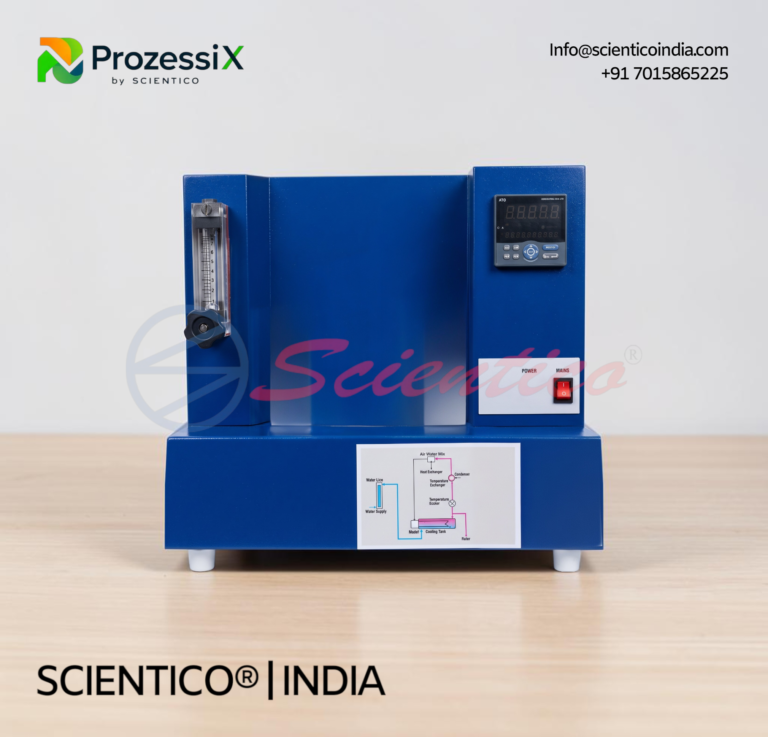
Temperature Control Trainer | Prozessi PX 14
The Temperature Control Trainer, Prozessi PX 14, is designed for understanding basic temperature control principles through a complete process setup. This Temperature Control Trainer allows students to study open loop and closed loop control, tuning methods, and SCADA based monitoring.
View product details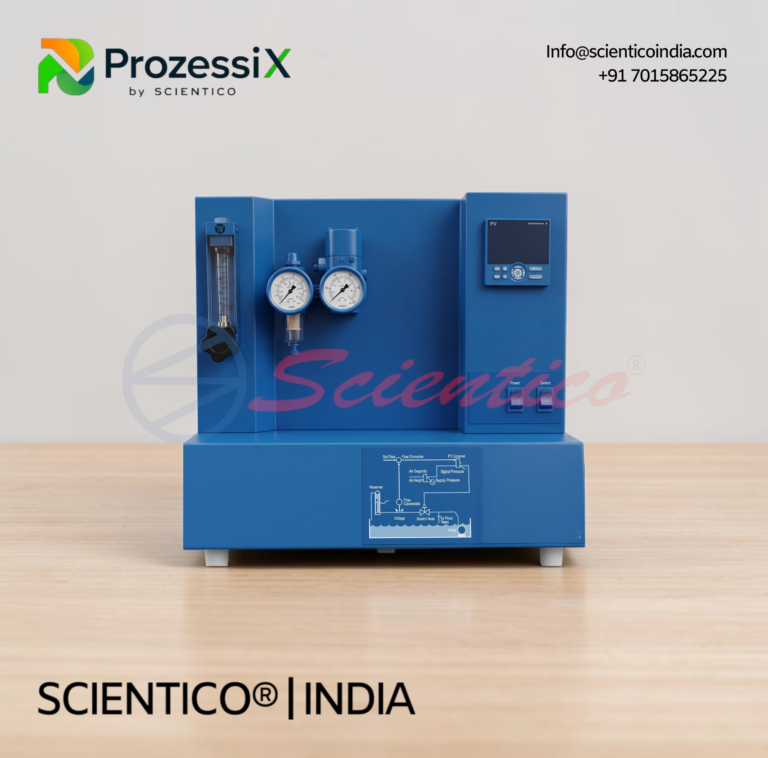
Flow Control Trainer | Prozessi PX 15
The Flow Control Trainer, Prozessi PX 15, is designed for understanding the basic principles of flow control using a complete pneumatic and electronic control loop. This Flow Control Trainer allows students to study open loop and closed loop control, tuning methods, and SCADA based monitoring of water flow.
View product details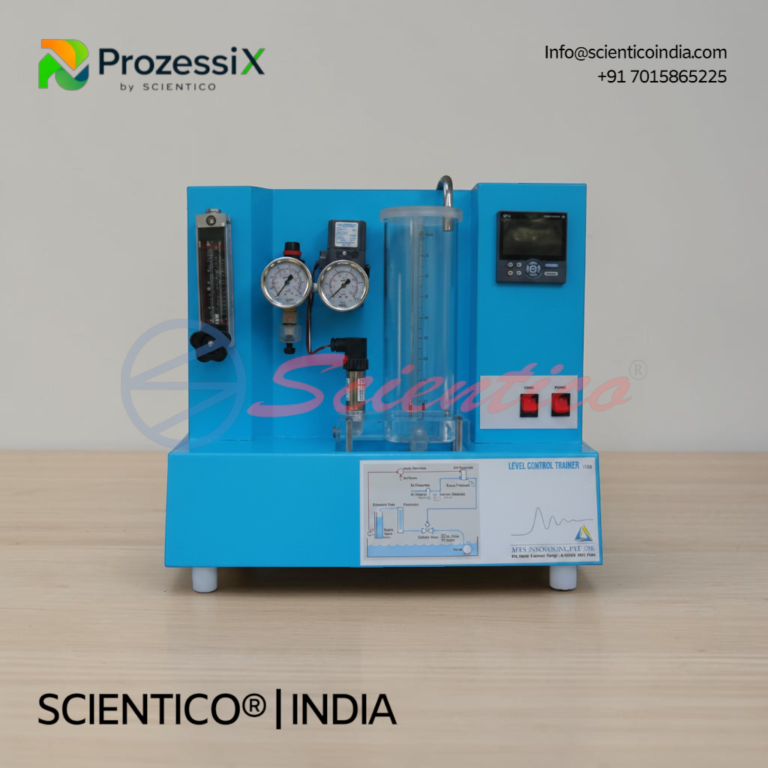
Level Control Trainer | Prozessi PX 16
The Level Control Trainer, Prozessi PX 16, is designed for understanding the basic principles of level control using a transparent process tank and pneumatic control valve. This Level Control Trainer allows students to study open loop and closed loop control, tuning methods, and SCADA based monitoring of liquid level.
View product details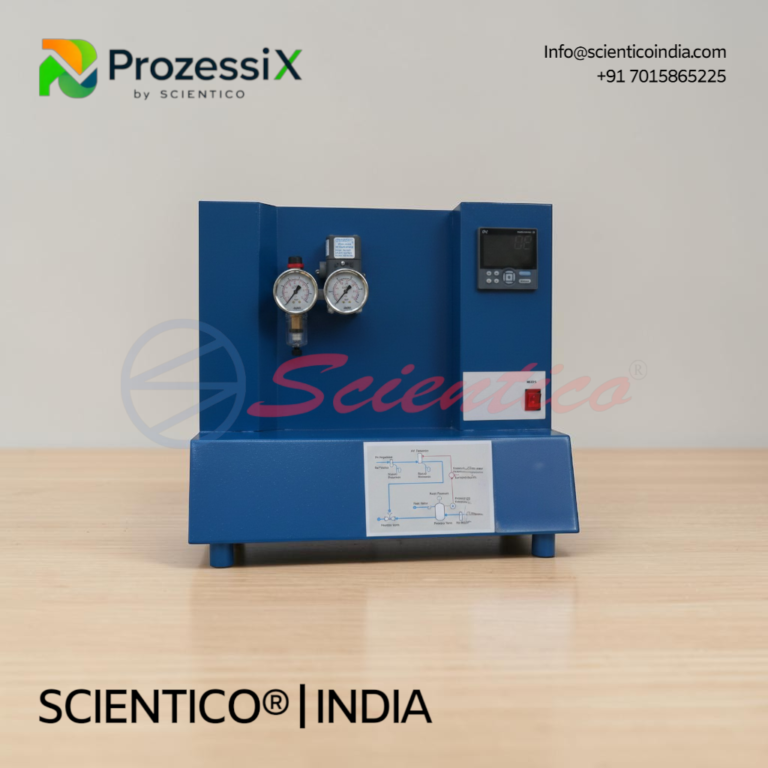
Pressure Control Trainer | Prozessi PX 17
The Pressure Control Trainer, Prozessi PX 17 , is designed for understanding the basic principles of pressure control using a pressure vessel and pneumatic control valve. This pressure control trainer allows students to study open loop and closed loop control, tuning methods, and SCADA based monitoring of pressure.
View product details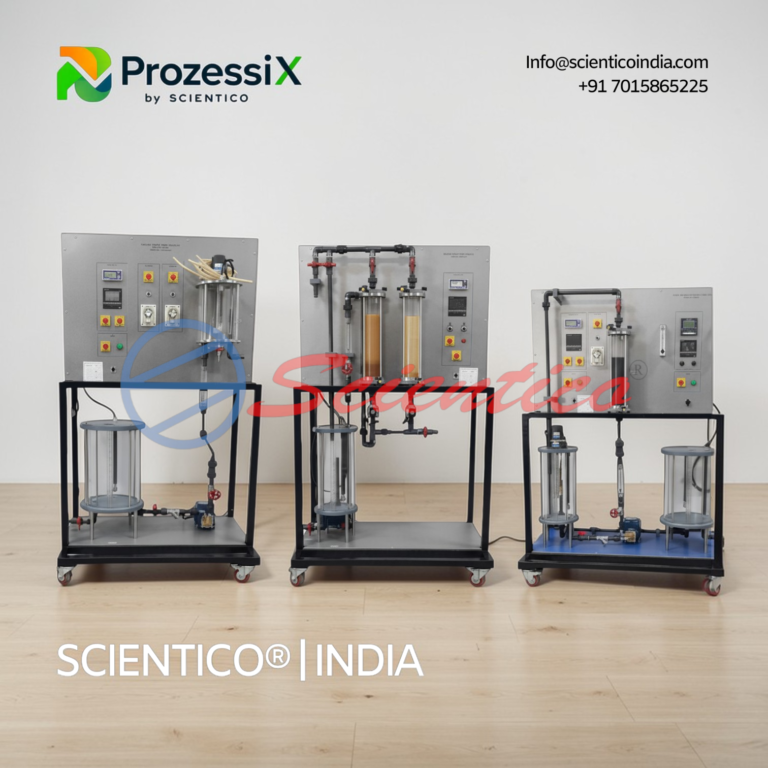
Analytical Process Control Trainer | ProzessiX PX-04
The Prozessix PX-04 is an analytical process control trainer for instrumentation and process engineering laboratories, giving students hands-on PID loop tuning across flow, level, temperature and pressure processes on a single bench.
View product details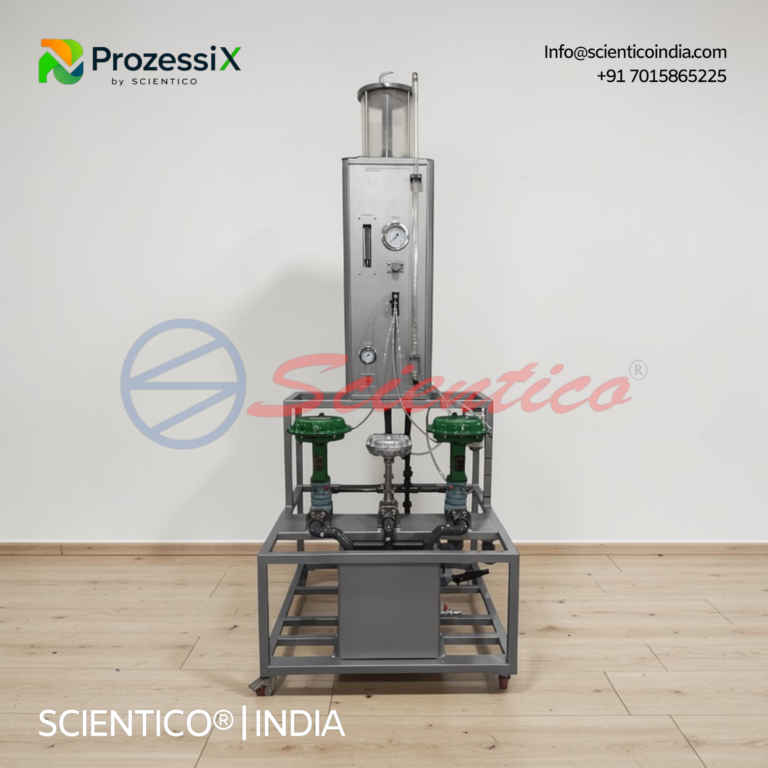
Control Valve Characteristics Training Panel | ProzessiX PX-06
The Control Valve Characteristics Training Panel – ProzessiX PX-06 is a laboratory training system designed to study the behavior and performance characteristics of pneumatic control valves used in industrial process control systems. Manufactured by SCIENTICO, this system is part of the ProzessiX series developed for process engineering and instrumentation education.
View product detailsWhat is process control lab equipment used for?
Process control trainers turn abstract control theory into something a student can see, hear and adjust. Instead of only solving transfer functions on paper, learners connect a sensor, send its signal to a controller, drive an actuator, and observe how the process variable settles toward the set point. The equipment is used to teach:
- The behaviour of first-order and higher-order processes, dead time and lag.
- On/off (two-position) control versus continuous PID control.
- Manual tuning methods such as Ziegler–Nichols and trial-and-error tuning.
- The role of the 4–20 mA current loop as the industry-standard analog signal.
- Cascade, ratio and feed-forward strategies on more advanced rigs.
These skills map directly to roles in chemical, pharmaceutical, power, water-treatment and manufacturing plants, which is why process control is a required outcome in most instrumentation, chemical and electronics engineering curricula.
What are the four main types of PID trainers?
Most process engineering labs are built around four single-loop trainers, often supplemented by multi-process or computer-controlled units. Each isolates one controlled variable so students master one loop at a time.
Temperature control trainer
A heater warms a fluid or metal block while a sensor (typically an RTD such as Pt100 or a thermocouple) feeds the temperature back to the controller. Because thermal systems have large lag, they are ideal for teaching integral action and overshoot. Students study how a slow process responds to step changes and how derivative action damps oscillation.
Flow control trainer
A pump circulates water through a loop fitted with a flow sensor (rotameter, electromagnetic or differential-pressure type) and a control valve. Flow is a fast, noisy process, which makes it excellent for demonstrating why derivative action is usually minimised and why filtering matters.
Level control trainer
Liquid level in a transparent tank is held at a set point by modulating inflow or outflow. Because the tank is integrating by nature, level trainers are a clear way to teach the relationship between valve position, capacity and settling time. The visible water column makes the control action obvious to a full class.
Pressure control trainer
Air or liquid pressure in a closed chamber is regulated using a pressure transmitter and a control valve or proportional regulator. Pressure loops are fast and tightly coupled, useful for studying stability margins and quick-acting PID response.
How do these trainers compare?
The table below summarises the typical sensing, actuation and teaching focus of each loop. Exact components and ranges vary by configuration and by what the institution specifies.
| Trainer | Controlled variable | Typical sensor | Final control element | Process speed | Key teaching point |
|---|---|---|---|---|---|
| Temperature | Temperature | RTD (Pt100) / thermocouple | Heater (SCR/relay) | Slow (large lag) | Integral action, overshoot |
| Flow | Volumetric flow | Rotameter / DP / magnetic | Control valve + pump | Fast, noisy | Noise, derivative caution |
| Level | Liquid level | DP / capacitive / float | Control valve | Integrating | Capacity vs settling time |
| Pressure | Pressure | Pressure transmitter | Control valve / regulator | Fast | Stability, quick PID |
What specifications should a buyer check?
When you evaluate process control lab equipment, the headline name (for example “level control trainer”) tells you little. Ask for the detailed specification and confirm these points before purchase:
- Signal standard: Industrial-grade rigs use the 4–20 mA loop so students learn the same signalling used in plants. Confirm sensor output and controller input ranges.
- Controller type: A digital PID controller with adjustable P, I and D and auto/manual transfer is standard. Some labs prefer a PC/SCADA interface for data logging and tuning graphs; others want a standalone microprocessor controller for robustness.
- Mounting and footprint: Bench-top units suit shared lab benches; floor-mounted MS or stainless frames suit dedicated process labs. Check the table or floor space available.
- Wetted materials: For flow, level and pressure rigs, confirm tanks and piping (acrylic, SS304, etc.) and that the pump and valve are rated for continuous student use.
- Power supply: Confirm it matches your country’s mains voltage and frequency, which is essential for export orders.
- Documentation: Insist on an instruction/experiment manual listing the experiments the rig supports, plus a calibration and conformity certificate.
- Spares and consumables: Sensors, valves and seals are wear items. Ask about spare availability and lead time.
Why does the 4–20 mA loop matter?
The 4–20 mA current loop is the most common analog signalling method in industrial instrumentation because current does not degrade over long cable runs and a reading of 0 mA clearly indicates a broken wire. Training on equipment that uses this standard means graduates arrive job-ready, already familiar with the signal they will wire and troubleshoot in the field.
How do you choose the right trainer for your lab?
Start from your syllabus and lab outcomes, then match equipment to them rather than buying the longest catalogue. A focused approach:
- Match the curriculum: List the experiments your university or AICTE/affiliating body expects, then confirm each trainer’s manual covers them.
- Plan for class size: One rig per batch of students keeps lab sessions productive. Decide how many of each loop you need.
- Decide standalone vs. computer-interfaced: Data-logging rigs are excellent for plotting response curves and report writing; standalone rigs are simpler to maintain.
- Think about durability: Student labs are high-traffic. Sturdy frames, quality pumps and accessible wiring reduce downtime.
- Budget for the full set: Many labs phase purchases, adding cascade, ratio or multi-process trainers once the four single loops are in place.
You can browse a full range of these rigs under Process Engineering Lab Equipment to see typical configurations before you request a specification sheet.
Why buy from an ISO and model-specific manufacturer?
Buying directly from a manufacturer rather than a reseller gives you control over specification, configuration and after-sales spares. Scientico India is an ISO 9001:2015 and model-specific manufacturer and exporter based in Ambala, Haryana, building engineering, nursing, medical and pharmacy lab equipment since 1993 and exporting to more than 60 countries. Being GeM-registered makes procurement straightforward for Indian government institutions, and every dispatch can include calibration and conformity documentation so your lab’s audit and inspection records stay complete. For export buyers, a CIF proforma invoice is typically provided within 24 hours of an enquiry.
What to send when you request a quote
To get an accurate, fast quotation, include:
- The trainers you need (temperature, flow, level, pressure or a combined set) and quantities.
- Standalone or PC/SCADA-interfaced preference.
- Your mains voltage and frequency, and the destination port or city for export.
- Any syllabus or experiment list the rig must satisfy.
You can share these details over WhatsApp at +91-7015865225 to receive a specification and quotation, including a CIF proforma invoice for export orders.
Key takeaways
Process control lab equipment teaches the four pillars of industrial automation through hands-on PID tuning. Choose trainers that use the 4–20 mA standard, match your syllabus, suit your lab space and power supply, and come with proper manuals and calibration documents. Buying from an ISO and model-specific manufacturer keeps specification, quality and spares in one accountable place, whether you are equipping a polytechnic in India or a university lab overseas.
Frequently Asked Questions
What is process control lab equipment?
It is a set of trainers that lets students study industrial control of temperature, flow, level and pressure. Each rig pairs a real process with a sensor, a control valve or heater, and a PID controller so learners can apply set points and tune the loop against live data.
What are PID trainers used to teach?
PID trainers teach how proportional, integral and derivative control act on a process variable. Students learn on/off versus continuous control, manual tuning methods such as Ziegler-Nichols, the 4-20 mA signal loop, and how process speed and lag affect stability and overshoot.
What is the difference between flow, level, temperature and pressure trainers?
They isolate different controlled variables. Temperature loops are slow with large lag, flow loops are fast and noisy, level loops behave as integrating processes, and pressure loops are fast and tightly coupled. Each highlights a different aspect of PID tuning and stability.
Why should the equipment use a 4-20 mA signal?
The 4-20 mA current loop is the industrial standard because current does not degrade over long cables and a 0 mA reading flags a broken wire. Training on this standard makes graduates job-ready for plant instrumentation work.
How do I get a price and proforma invoice from Scientico India?
Pricing is quote-based. Share your required trainers, quantities, standalone or PC-interfaced preference, mains voltage and destination via WhatsApp at +91-7015865225. Export buyers typically receive a model-specific CIF proforma invoice after technical review, with calibration and conformity documents included on dispatch.
How to specify a process control trainer for a laboratory or tender
A useful process control RFQ begins with the variable to be controlled and the behaviour students must observe. “PID trainer” is not a complete specification: a temperature loop, a liquid-flow loop, a pressure loop and a level loop have different process dynamics, sensors, actuators, utilities and safety considerations. Before comparing quotations, identify the loop, the teaching exercises and the measurements that must be available to the student.
For a single-loop trainer, ask the supplier to state the process vessel or test section, measured variable, transmitter or sensor type, final control element, controller interface, signal standards, data acquisition arrangement and included experiment material. For a multi-loop or process-plant trainer, request the same information for every loop and explain whether loops can be operated independently, in cascade or as interacting processes. This gives a distributor or tender evaluator a technical basis for comparison instead of relying on a similar product name.
Match the trainer to the learning outcome
| Teaching objective | Information to request | Useful evidence |
|---|---|---|
| Understand open-loop and closed-loop response | How the set point and disturbance are introduced; which process values can be observed and recorded | Experiment list, screen view or sample response plot |
| Compare proportional, integral and derivative action | Available controller modes, adjustable parameters and method used to record overshoot, settling time and steady-state error | Controller specification and experiment manual contents |
| Study a real process variable | Process range, sensor/transmitter, final control element, working medium and operating limits | Model-specific datasheet and piping or functional diagram |
| Introduce disturbances | Which load or flow disturbances are available and whether they are manual or software controlled | Experiment procedure or supplied-scope schedule |
| Teach industrial instrumentation | Signal type, terminals, I/P or P/I conversion, calibration access and compatibility with external instruments | Connection diagram and included accessory list |
| Collect and analyse data | Variables logged, sampling controls, export format, software/licence requirements and computer interface | Software description and licence scope in the quotation |
Questions distributors should resolve before requesting a price
- Which loop is required? State temperature, flow, level, pressure or a combined process. If the tender uses a reference model, attach the underlying functional specification as well as the model name.
- Which experiments are mandatory? Preserve the buyer’s syllabus wording and identify exercises that require data logging, controller tuning, disturbances, cascade control or external instrumentation.
- What will the institution provide? Confirm electrical supply and the availability of water, drainage, compressed air, ventilation, a computer or network access where relevant.
- What must be included? Separate the main trainer, sensors, transmitters, control valve or other actuator, controller, software, cables, manuals, consumables and optional accessories.
- How many student groups will work at once? Quantity should follow the laboratory timetable and group size rather than a default one-unit assumption.
- Which documents are part of evaluation? List the model-specific datasheet, experiment manual contents, drawings, software information and order documents the buyer actually requires.
Compare process control equipment by function, not by catalogue wording
Two trainers can share the same generic name and still offer different teaching scope. Compare the complete signal path: the process creates a measurable condition; the sensor or transmitter converts it to a signal; the controller calculates an output; and the final control element changes the process. A quotation should make each part visible and state whether it is included in the base configuration.
Pay particular attention to range and signal compatibility. The fact that two units both mention a control valve or transmitter does not mean they can be substituted without checking operating range, input/output signal, power requirement and connection method. If an external PLC, controller or instrument must be supplied locally, that exclusion should appear in the written scope rather than being discovered during installation.
Relevant process-control configurations
- Temperature Control Trainer for requests centred on thermal-process response and temperature-loop control.
- Flow Control Trainer for liquid-flow measurement, control action and response studies.
- Level Control Trainer for tank-level dynamics, set-point response and disturbance behaviour.
- Pressure Control Trainer for pressure-loop instrumentation and control exercises.
- Analytical Process Control Trainer where the required curriculum involves analytical measurement within a controlled process.
- Control Valve Characteristics Training Panel when valve behaviour and final-control-element characteristics are part of the syllabus.
- I/P and P/I Converter Trainer for instrument-signal conversion and pneumatic/electrical interface study.
- Process Plant Trainer for a broader integrated-process requirement. Confirm each included loop and experiment rather than assuming coverage from the name.
A quotation-ready process control RFQ
Send one controlled schedule containing the product or process required, mandatory experiments, quantities, destination, utilities, controller preference, signal standards, software requirement, documentation list and bid deadline. Ask each supplier to identify the exact proposed model, offered values, included scope, optional items and every deviation. For public procurement, keep the buyer’s clause numbering and record the supporting datasheet or drawing page beside each response.
If the requirement covers a complete automation or process laboratory, include the syllabus and number of simultaneous student groups. Scientico can map the exercises to relevant catalogue products for review; the final configuration, scope, documents and commercial terms are confirmed in the written quotation.
Send a distributor or tender enquiry Browse process engineering equipment
One honest ask
We don't gate anything on this site. You just read the whole thing free. If it was useful, leave your email and two things happen: we send you this page as a plain-text block you can paste into a tender file or an internal email, and we notify you the next time we publish a buyer tool like this one. Nothing else. No drip sequence, no sales calls booked without asking.