
An equipment list that says only “cavitation apparatus” leaves a major installation question unanswered: where will the controlled water flow come from? Scientico’s Cavitations Apparatus FluidoSurge-X 184 is described as a transparent Venturi test section on a plate for use with a hydraulic bench or laboratory water supply. The published unit has pressure observations upstream, at the throat and downstream. A procurement team should therefore evaluate the test section, pressure measurement and site water circuit together. This guide is for a department that has chosen cavitation as a practical and needs a quotation that can be installed, demonstrated and assessed.
Equipment mentioned in this guide
Review the product information, specifications and model before requesting a quotation.
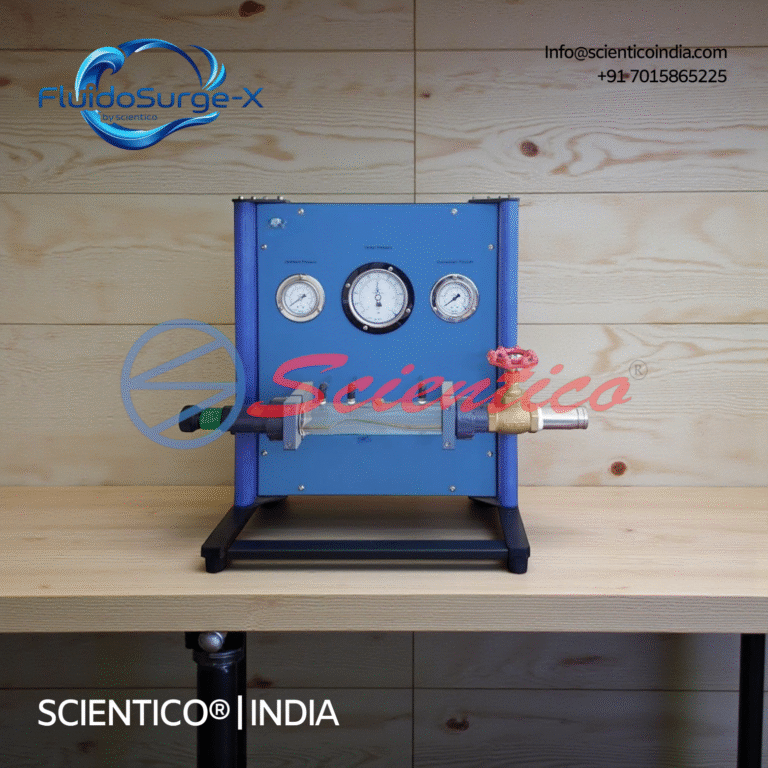
Cavitations Apparatus | FluidoSurge-X 184
The Cavitations Apparatus FluidoSurge-X 184 is designed to demonstrate the formation and effects of cavitation in flowing liquids. It enables clear visualization of vapor bubble formation and collapse within a Venturi section. The apparatus supports controlled variation of flow rate and pressure to reach cavitation conditions. It is suitable for fluid mechanics laboratory instruction and experimental analysis.
View product details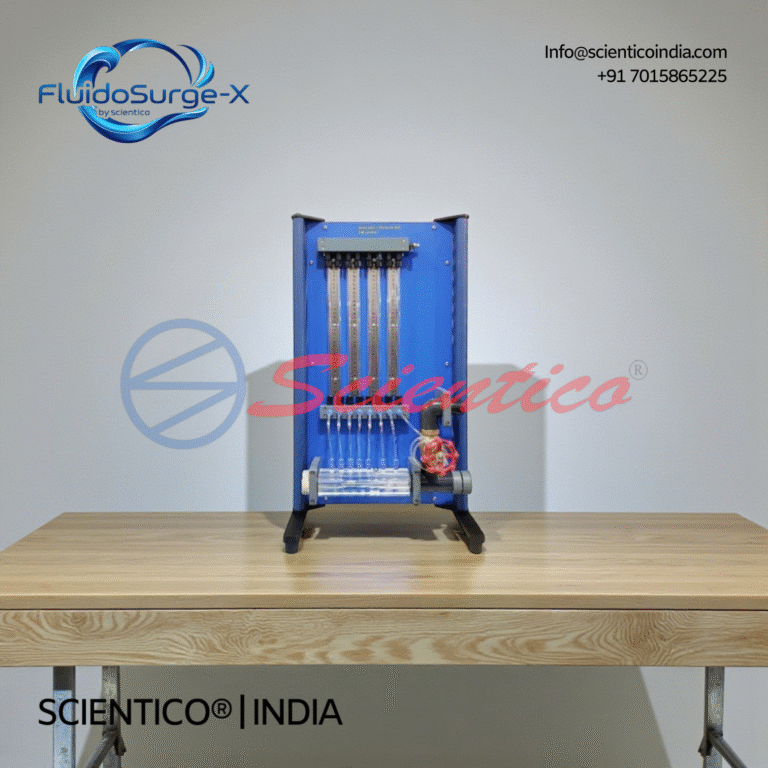
Bernoulli’s Theorem Apparatus | FluidoSurge-X 120
The Bernoulli's Theorem Apparatus FluidoSurge-X 120 is designed for experimental verification of Bernoulli’s principle in fluid mechanics laboratories. It enables detailed study of pressure, velocity, and energy variations along a converging and diverging duct. The apparatus uses a transparent Venturi test section with multiple pressure tapping points. It is intended for structured academic experiments and analytical comparison with theoretical flow behavior.
View product detailsState the learning outcome before naming hardware
In the Venturi, increasing water velocity at the throat reduces static pressure; sufficiently low pressure can produce visible vapour bubbles, which collapse after pressure recovery. The catalogue describes using changes in flow rate and static pressure to observe cavitation onset, intensity and suppression. Decide what students must do with those observations. A basic demonstration may ask them to identify the first visible bubbles and describe the change as flow is varied. A more analytical practical may require simultaneous readings at three points, a flow-rate record and a comparison of the observed pressure change with the course’s fluid-mechanics treatment.
Write the expected student record into the specification: valve setting or flow condition, upstream pressure, throat pressure, downstream pressure, visible state and the action used to reduce cavitation. That makes an acceptance test possible. The product page also mentions study of air release from dissolved gases at low pressure. In a teaching session, bubbles from dissolved gas and vapour cavitation can be confused; ask the instructor to define the distinction and request the supplier’s operating guidance for the proposed water circuit. Avoid promising that every visible bubble proves a specific pressure condition without measurement.
Check the hydraulic bench and water connections first
The published FluidoSurge-X 184 mounts on a plate with feet for a hydraulic bench. It also lists operation from a hydraulic bench or laboratory water connection. Neither phrase establishes that an existing bench in your laboratory has the needed flow, fittings, head range or return arrangement. Send the supplier the bench make, model, available pump information, outlet and return fittings, hose size, maximum available flow and a photograph or drawing of the working surface. Ask for written compatibility with the proposed apparatus and a connection diagram. If there is no bench, ask for a complete water-supply and drainage proposal as a distinct priced line.
Consider how water will return after passing through the Venturi and where the operator will stand to see the throat and gauges. Confirm hose length, couplings, valves, drain path, splash control and bench stability in the offered setup. If the room uses a mains connection rather than a recirculating bench, include the available supply conditions and the institution’s water-use restrictions. The apparatus can only support a repeatable class if students can set and observe conditions within the agreed water circuit; a generic statement that a “water source is available” is not enough.
Match the three gauges to the practical
The product record lists an upstream pressure gauge with a 0–4 bar range, a throat vacuum gauge with a −1 to 1 bar range, and a downstream pressure gauge with a 0–4 bar range. Their locations are central to the experiment. Ask for a current drawing showing all pressure tappings, lines and gauge positions. Check that the scale, units and graduation allow students to read the changes expected in the agreed operating range. A printed range alone does not establish the resolution, accuracy or the actual pressure that will occur on your bench, so request the current gauge specifications and any calibration or verification record required by the tender.
The listed transparent acrylic Venturi enables visual observation. Ask how it is supported, how the gauges are protected, how trapped air is handled and how the test section is cleaned without damaging the acrylic. The page describes an upstream control valve and a restriction on downstream valve closure intended to protect instrumentation. Request an explanation of the valve sequence and operating limits in the current manual. The acceptance procedure should follow the manufacturer’s instructions; it should never rely on deliberately closing a downstream line beyond its permitted position to create a dramatic effect.
Keep this apparatus distinct from neighbouring experiments
A Bernoulli apparatus and a cavitation apparatus may both use a transparent Venturi, but they are bought for different assessed outcomes. The Bernoulli’s Theorem Apparatus FluidoSurge-X 120 page describes eight static pressure points and a movable total-head probe for pressure and energy variation along a converging and diverging duct. The FluidoSurge-X 184 record focuses on inducing and observing cavitation with three pressure locations. If the syllabus requires station-by-station pressure distribution, do not assume the cavitation unit provides eight tappings. If it requires visible cavitation onset and suppression, do not assume a general Venturi flow measurement unit will reproduce that exercise. Name the desired practical rather than selecting solely by the shape of the test section.
The conceptual article on cavitation causes and effects can prepare students for the phenomenon. This purchasing guide has a different job: turning the teaching outcome into a testable apparatus, utility and gauge schedule. The wider fluid-mechanics range may be useful when a department needs adjacent Venturi, pump or pressure-loss experiments.
Put the apparatus, bench and acceptance evidence on separate lines
A comparable BOQ can begin: “Cavitations Apparatus, Scientico FluidoSurge-X 184 or technically evaluated equivalent, with transparent acrylic Venturi, three pressure measurement positions, upstream flow control, bench mounting, connecting hoses and current operating instructions.” Follow with a distinct line for the hydraulic bench or approved laboratory water connection. State whether the bench is existing, separately purchased or to be supplied as a matched package. Include quantity, destination, voltage and frequency for any powered bench, the required training and installation responsibilities, and the tender deadline.
- Test section: Specify: Transparent Venturi for onset and suppression observation; Ask for: Current drawing and material schedule.
- Pressure: Specify: Upstream, throat and downstream readings; Ask for: Gauge ranges, units and verification records.
- Flow control: Specify: Required adjustment and protective valve limits; Ask for: Valve sequence and operating instructions.
- Water circuit: Specify: Existing bench or separate matched supply; Ask for: Connection drawing, hoses, flow and return scope.
- Handover: Specify: Demonstration, documents and service; Ask for: Signed acceptance checklist and exclusions.
Before acceptance, check the delivered plate, Venturi, fittings and gauges against the signed offer. Have the responsible technician inspect the water connection and any leaks, then run a supervised demonstration at approved settings. Record the three readings and the observed change as the operator varies the flow within the written instructions. Confirm that the gauges return appropriately and that the setup can be shut down and drained safely. Ask for the current manual, accessory list, warranty terms and any calibration documentation promised in the quotation. A website statement that documentation is available is not the same as a delivered set of documents.
For a complete fluid-mechanics room, the fluid-mechanics lab setup guide helps place this unit among other practicals. Once the cavitation experiment is selected, the FluidoSurge-X 184 RFQ should settle the bench, gauges and demonstration scope explicitly.
Request the FluidoSurge-X 184 bench configuration. Send your hydraulic-bench details or water-service plan, required observations, quantity, destination and tender date. Ask Scientico for a connection schedule, included gauges and documented acceptance scope. Request a model-specific quotation.
One honest ask
This article and public product information are available to browse without an account. To open a product datasheet, complete the contact form shown with its download link. If this article was useful, leave your email and two things happen: we send you this page as a plain-text block you can paste into a tender file or an internal email, and we notify you the next time we publish a buyer tool like this one. Nothing else. No drip sequence, no sales calls booked without asking.