
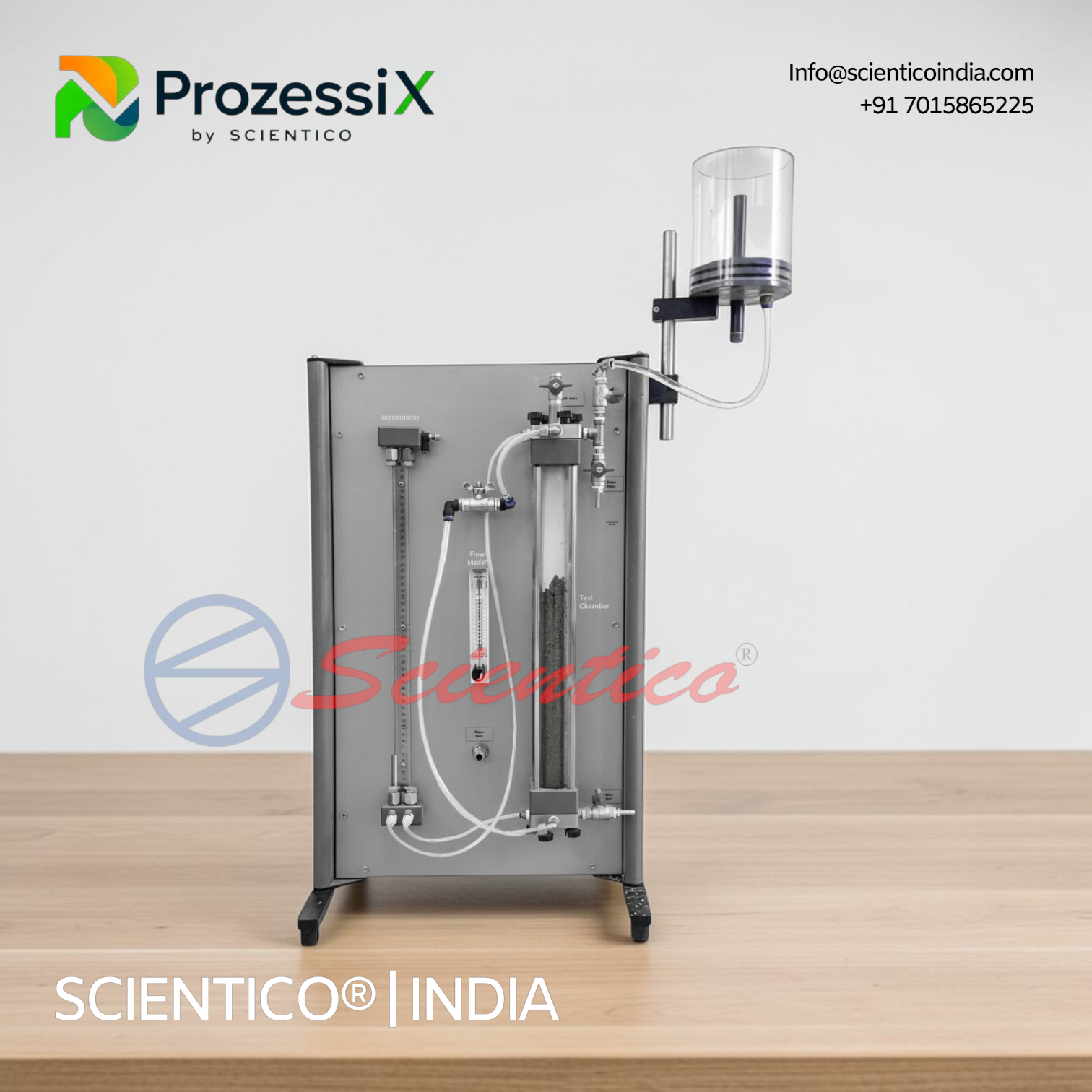
Flow Through Particle Layers Trainer | ProzessiX PX-02
The Flow Through Particle Layers Trainer is a laboratory-scale process engineering equipment designed to study flow behavior through fixed and fluidized beds. Made by Scientico India, ISO 9001:2015 certified, and supplied with a calibration certificate and operation manual.
The Flow Through Particle Layers Trainer is a laboratory-scale process engineering equipment designed to study flow behavior through fixed and fluidized beds. It enables controlled experimentation on pressure loss, fluidization velocity, and permeability of bulk solids subjected to liquid flow. Manufactured by SCIENTICO under the ProzessiX series, Model PX-02 is developed for engineering colleges, technical universities, pilot plants, and industrial training centers requiring hands-on understanding of bed hydrodynamics and solid–fluid interaction.
Product Overview
Flow through particle layers is a fundamental concept in chemical and process engineering. Fixed beds and fluidized beds are widely used in reactors, separation systems, and filtration units. This trainer allows detailed investigation of the fluid mechanics associated with liquid flow through packed and fluidized granular media.
The system consists of a vertical glass test tube mounted over a sintered metal filter medium, which supports the bulk solid. Water is supplied from a laboratory connection and can be introduced either from the top (downward flow) to study fixed beds or from the bottom (upward flow) to investigate fluidized beds.
At low velocities in upward flow mode, water passes through the fixed bed without disturbing the particles. When the flow velocity reaches the fluidization velocity, the bed begins to expand and behave as a fluidized bed. The expansion tank positioned above the test tube accommodates overflow and stabilizes discharge. Flow rate is controlled using a valve and indicated by a flow meter. Two inverted U-tube manometers with different measuring ranges allow measurement of pressure loss across the bed. Selection between manometers is performed via valves.
This pilot plant system enables verification of Darcy’s law and the Carman-Kozeny equation while providing visual observation of the fluidization process.
Request Specifications & Pricing
model-specific, ISO 9001:2015 compliant. Supplied to universities and institutions in 30+ countries.
WhatsApp: +91 701-586-5225 | Email: [email protected]
View Quality Certifications | FAQ, Shipping, Warranty, Lead Time
| Parameter | Specification |
|---|---|
| Model | ProzessiX PX-02 |
| Process | Flow through fixed and fluidized beds |
| Test Tube Length | 480 mm |
| Test Tube Inside Diameter | Approx. 44 mm |
| Test Tube Material | Glass |
| Filter Medium Thickness | 2 mm |
| Filter Medium Material | Sintered metal |
| Expansion Tank Capacity | Approx. 2500 mL |
| Expansion Tank Material | PVC |
| Flow Rate Range | Up to 60 L/h |
| Tube Manometer Range | 0 to 500 mm WC |
| Steel Rule Range | 0 to 1000 mm |
| Flow Control | Valve with flow meter |
| Pressure Measurement | Inverted U-tube manometers |
| Flow Direction | Upward (fluidized bed), Downward (fixed bed) |
| Scope of Delivery | 1 Experimental module, 1 Instruction manual |
Key Features
- Investigation of liquid flow through fixed and fluidized particle beds
- Transparent glass test tube for clear visualization of bed behavior
- Sintered metal filter medium for uniform support and distribution
- Upward and downward flow configurations using quick modification
- Flow meter with control valve for precise adjustment
- Two inverted U-tube manometers for pressure loss measurement
- Direct observation of bed expansion and fluidization
- Steel rule for measurement of fixed or fluidized bed height
- Suitable for verification of Darcy’s law and Carman-Kozeny equation
Applications
- Chemical engineering laboratory studies on packed and fluidized beds
- Reactor hydrodynamics demonstrations
- Verification of pressure drop correlations in process engineering
- Determination of fluidization velocity
- Study of influence of particle size, bed height, and flow rate on pressure loss
- Training modules for solid–fluid interaction and separation processes
Construction & System Design
The Flow Through Particle Layers Trainer is built around a vertical glass test tube that allows direct observation of particle behavior. The sintered metal filter plate at the base supports the bulk solid and ensures uniform flow distribution.
The test tube is removable, allowing easy filling with different granular materials for comparative studies. The system supports both upward and downward flow configurations, enabling investigation of both fixed bed and fluidized bed regimes.
An expansion tank made of PVC is installed above the test section to stabilize the outflow during operation. Flow rate is regulated through a control valve and indicated via a flow meter. Two inverted U-tube manometers with selectable measuring ranges allow accurate determination of pressure drop across the bed.
The system is designed for repeated laboratory use, providing durability, operational flexibility, and clear experimental visibility. Its compact configuration makes it suitable for laboratory benches and pilot-scale instructional environments.
Export & Supply Capability
The ProzessiX PX-02 Flow Through Particle Layers Trainer is manufactured by SCIENTICO for supply to domestic and international institutions. The unit is suitable for export to engineering colleges, universities, R&D laboratories, and industrial training centers.
Standard supply includes the experimental module and a detailed instruction manual. The equipment is prepared for secure packaging and international transportation. Documentation support for installation and academic experimentation is provided to meet institutional procurement requirements.
Q1. What is the purpose of the Flow Through Particle Layers Trainer?
The trainer is used to study flow behavior, pressure loss, and fluidization phenomena in fixed and fluidized beds under liquid flow conditions.
Q2. How does the system differentiate between fixed and fluidized beds?
In downward flow mode, the bed remains fixed. In upward flow mode, increasing flow velocity eventually reaches the fluidization velocity, causing the particles to suspend and form a fluidized bed.
Q3. What is fluidization velocity?
Fluidization velocity is the minimum upward flow velocity at which the drag force of the fluid balances the weight of the particles, causing the bed to expand and behave like a fluid.
Q4. How is pressure loss measured in this system?
Pressure loss is measured using inverted U-tube manometers connected across the test section. Two different measuring ranges are available for accurate readings.
Q5. What equations can be verified using this equipment?
The system allows verification of Darcy’s law for flow through porous media and the Carman-Kozeny equation for packed bed pressure drop.
Q6. Can different particle sizes be tested?
Yes. Since the test tube is removable and refillable, different bulk solids and particle sizes can be used to study their influence on pressure drop and fluidization behavior.
Need Assistance? We're Here to Help!
Connect with our team for product specifications, pricing, and customized solutions for your institution or project.