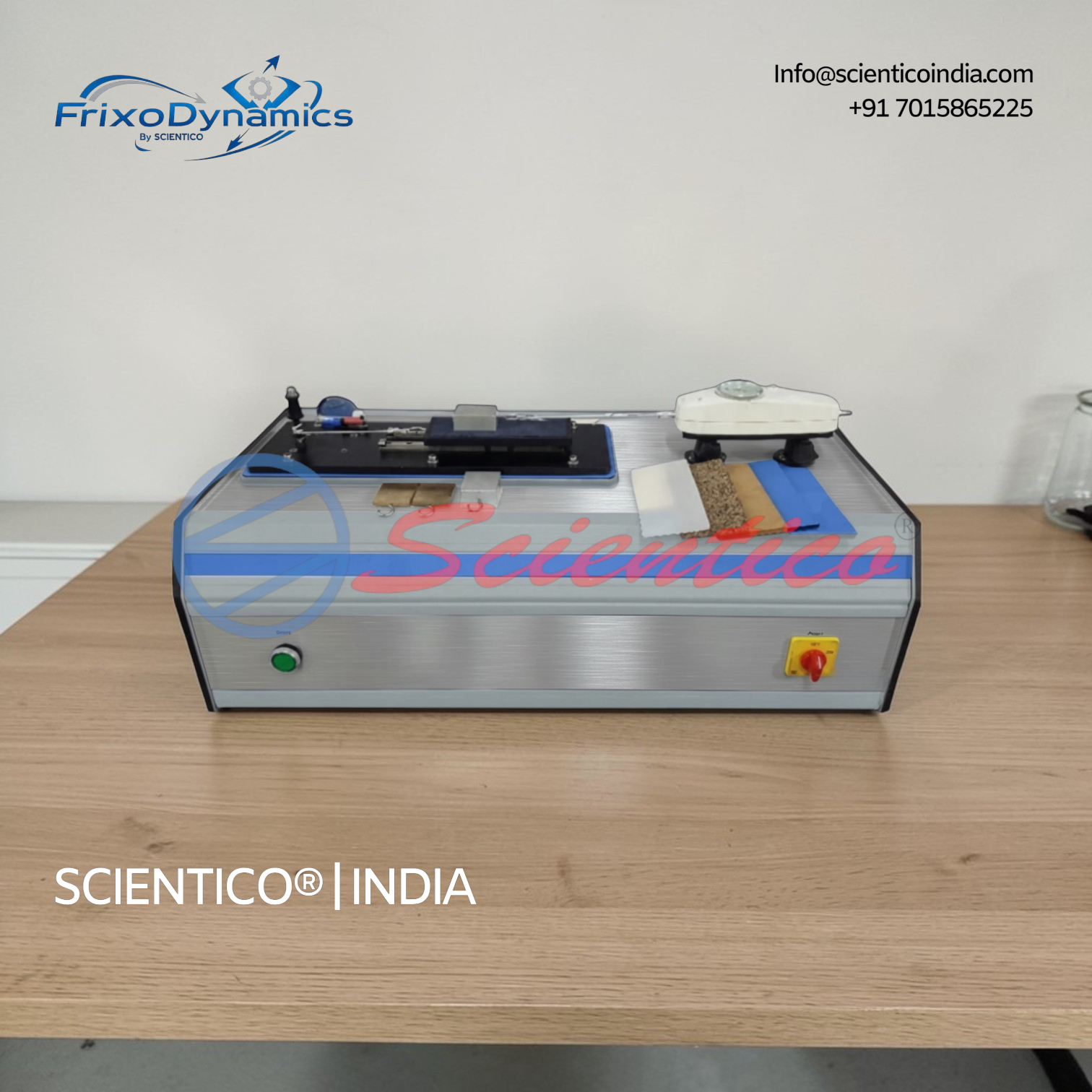
Dry Friction Apparatus | FrixoDynamics FX-527
The SCIENTICO Dry Friction Apparatus is a motorised experimental unit for the systematic investigation of static and dynamic friction between solid bodies under controlled conditions. Made by Scientico India, ISO 9001:2015 certified, and supplied with a calibration certificate and operation manual.
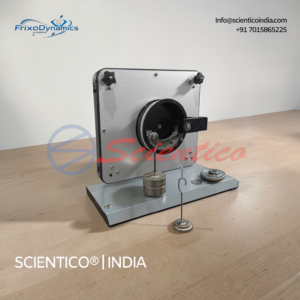
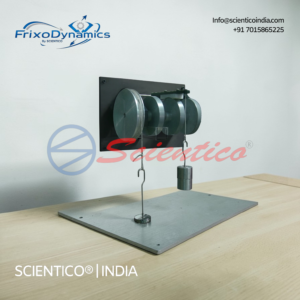
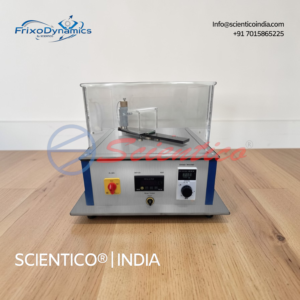
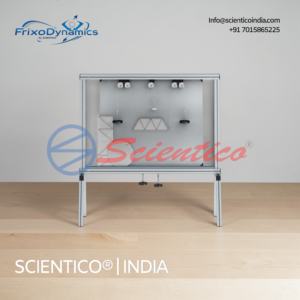
The SCIENTICO FrixoDynamics FX-527 Dry Friction Apparatus is a motorised experimental unit for the systematic investigation of static and dynamic friction between solid bodies under controlled conditions. A synchronous motor drives a carriage at two selectable constant velocities, drawing the support friction surface beneath a stationary friction body connected to a height-adjustable force gauge. Four friction bodies, in two materials and two surface finishes, and multiple interchangeable support surfaces allow the effects of normal force, sliding velocity, material pairing, surface properties, and contact area to be investigated independently. The force gauge is designed to compensate for stick-slip effects, providing a stable mean friction force reading throughout each test. Manufactured by SCIENTICO, the FX-527 is suitable for supply to engineering institutions and distributors worldwide.
Product Overview
Friction between solid bodies in contact is one of the most practically significant topics in engineering mechanics. Static friction must be sufficient to maintain components in fixed relative positions, as in parking brakes, self-locking threads, and frictional couplings. Dynamic friction must be minimised in relative motion applications such as bearings, guideways, and cutting tools. Understanding the variables that govern friction magnitude, normal force, sliding velocity, material pairing, surface roughness, and contact area, is therefore essential for competent mechanical engineering design.
The FX-527 addresses this need through a clearly structured series of experiments covering each of these variables individually. The apparatus operates on the principle that the friction force on a stationary body is most accurately measured when the contact surface moves beneath it at a constant, controlled velocity, eliminating the dynamic effects of accelerating mass that arise if the friction body itself is pulled. A synchronous motor drives the support friction surface carriage at two fixed velocities, 23.5 cm/min and 47 cm/min, selected via a graduated cable drum. The constant, regulated drive speed ensures that the measured friction force at each velocity is a true steady-state dynamic friction value, not a transient result influenced by acceleration.
The friction body is held stationary and connected to the force measuring unit by a cord. The force measuring unit, a force gauge with a range of 0–10 N and a graduation of 0.05 N, is mounted on a height-adjustable bracket. The height adjustment ensures that the line of action of the friction force at the contact surface and the line of action of the tensile force in the cord to the gauge are parallel at all times, eliminating any moment component that would otherwise introduce error into the force reading. The gauge is also designed to damp stick-slip effects, displaying a stable mean friction force rather than a spiking instantaneous value.
Four friction bodies are provided: smooth aluminium, rough aluminium, smooth brass, and rough brass. The aluminium bodies are 20 mm high and the brass bodies 5 mm high, providing two different contact heights as well as two distinct material pairings. Support friction surfaces of four different surface types are available, allowing any combination of friction body and support surface to be tested. Normal force is varied by adding 0.5 N calibrated weights to the friction body, and the effect of contact area can be investigated by comparing results from different friction body orientations or material pairs.
Request Specifications & Pricing
model-specific, ISO 9001:2015 compliant. Supplied to universities and institutions in 30+ countries.
WhatsApp: +91 701-586-5225 | Email: [email protected]
View Quality Certifications | FAQ, Shipping, Warranty, Lead Time
| Parameter | Specification |
|---|---|
| Model | FrixoDynamics FX-527 |
| Support Friction Surface Dimensions (L x W x H) | Approx. 175 x 80 x 6 mm |
| Friction Body Dimensions (L x W) | Approx. 50 x 40 mm |
| Friction Body Materials | Aluminium (smooth and rough, h = 20 mm), Brass (smooth and rough, h = 5 mm) |
| Number of Friction Bodies | 4 |
| Support Surfaces | Multiple, 4 different surface types |
| Drive Motor | Synchronous motor, 100 rpm |
| Driving Velocities | 23.5 cm/min and 47 cm/min |
| Velocity Selection | Graduated cable drum |
| Force Gauge Range | 0 – 10 N |
| Force Gauge Graduation | 0.05 N |
| Force Gauge Mounting | Height-adjustable |
| Weights | 10 x 0.5 N |
| Scope of Delivery | 1 experimental unit, 4 friction bodies, 1 set of weights, multiple support surfaces |
Key Features
- Synchronous motor at two fixed drive velocities (23.5 cm/min and 47 cm/min) ensures constant, controlled sliding speed for accurate steady-state dynamic friction measurement
- Four friction bodies, smooth and rough aluminium, smooth and rough brass, provide two material pairings and two surface finish conditions for systematic comparison
- Multiple interchangeable support friction surfaces (four different surface types) allow friction body and support surface combinations to be varied independently
- Height-adjustable force gauge mounting ensures parallelism of friction force and tensile force lines of action at all times, eliminating moment-induced measurement error
- Force gauge (0–10 N, 0.05 N graduation) designed to compensate for stick-slip effects, displaying a stable mean friction force
- Normal force varied by adding 10 x 0.5 N calibrated weights to the friction body for incremental normal force experiments
- Static friction observable at the onset of carriage motion before steady-state dynamic friction is established
- Compact, self-contained motorised unit, requires only a standard power connection
Applications
- Determination of the coefficient of static friction at the onset of sliding for different material and surface pairings
- Determination of the coefficient of dynamic friction at two constant sliding velocities
- Investigation of the effect of normal force on friction force for a given material and surface pairing
- Investigation of the effect of sliding velocity on dynamic friction coefficient
- Comparison of friction behaviour across aluminium and brass friction bodies on different support surfaces
- Study of the influence of surface roughness on friction coefficient for the same material pairing
- Investigation of the effect of contact area on friction force using different friction body configurations
- Undergraduate laboratory practicals in tribology, applied mechanics, mechanical engineering design, and engineering physics
Construction and System Design
The FX-527 is built on a rigid base that houses the synchronous motor, cable pulley drive system, and carriage track. The support friction surface is mounted in a carriage that travels along the track at the motor-driven speed selected by the graduated cable drum. The cable drum offers two winding diameters, producing the two selectable drive velocities of 23.5 cm/min and 47 cm/min from the single fixed motor speed of 100 rpm.
The friction body sits on the moving support surface and is connected by a horizontal cord to the force gauge mounted on the height-adjustable bracket beside the track. The bracket height is set so that the cord runs horizontally and parallel to the support surface, ensuring that the measured tensile force in the cord directly equals the horizontal friction force acting on the friction body, with no vertical component introduced by a misaligned cord angle. The force gauge is mounted on a compliant suspension within its housing, which absorbs the rapid force fluctuations associated with stick-slip behaviour and presents a smoothed mean value on the graduated scale.
The four friction bodies are machined to consistent plan dimensions of approximately 50 x 40 mm, ensuring that contact area comparisons between material pairings are made on a consistent geometric basis. The smooth and rough surface finishes on each material are produced to defined specifications, providing repeatable surface conditions across all test specimens. The interchangeable support friction surfaces are placed in the carriage before each test and are changed between experiments to vary the support surface condition independently of the friction body selection. Normal force is adjusted by stacking 0.5 N weights directly onto the upper face of the friction body.
Export and Supply Capability
The SCIENTICO FrixoDynamics FX-527 is available for supply to engineering colleges, technical universities, mechanical engineering departments, research institutions, and industrial training centres. SCIENTICO manufactures and exports laboratory equipment to institutions and distributors across multiple regions. Standard packaging is suitable for international shipment. Bulk orders, customised configurations, and institutional procurement enquiries are welcomed. Please contact SCIENTICO directly for pricing, lead times, and shipping terms.
Q1: What is the dry friction apparatus used for in engineering education?
The FX-527 is used to investigate the factors governing dry friction between solid bodies in contact, specifically the effects of normal force, sliding velocity, material pairing, surface roughness, and contact area on the friction force and coefficient of friction. A motorised carriage drives the support surface at two constant velocities beneath a stationary friction body connected to a precision force gauge, allowing both static and dynamic friction to be measured under controlled and repeatable conditions.
Q2: What is the difference between static and dynamic friction, and how does the FX-527 measure both?
Static friction is the resistance to the onset of relative motion between two bodies in contact, it must be overcome before sliding begins. Dynamic friction is the resistance to continued relative motion once sliding has started, and is generally lower than the peak static friction value. The FX-527 captures static friction at the moment the carriage begins to move and the friction body cord first tenses to the maximum before sliding commences. Dynamic friction is then the steady-state force gauge reading as the carriage moves at constant speed beneath the friction body.
Q3: Why is the force gauge mounting height-adjustable on the FX-527?
The height adjustment ensures that the cord connecting the friction body to the force gauge runs horizontally and parallel to the support friction surface at all times, regardless of the friction body height. If the cord were angled, either upward or downward, the measured tensile force would include a vertical component that does not correspond to the friction force, introducing systematic measurement error. By adjusting the gauge height to match the friction body height, the lines of action of the friction force and the cord tensile force are kept parallel, ensuring accurate force measurement.
Q4: How does the FX-527 handle stick-slip effects in the friction force measurement?
Stick-slip is a phenomenon in which the friction force fluctuates rapidly between a high static peak and a lower dynamic value as the surfaces alternately adhere and slide. The force gauge in the FX-527 is designed with a compliant internal suspension that absorbs these rapid fluctuations, displaying a smoothed mean friction force value rather than the instantaneous spiking that would otherwise make the reading difficult to record accurately. This design gives a stable, representative dynamic friction force reading suitable for coefficient of friction calculations.
Q5: What is included in the scope of delivery for the FX-527?
The FX-527 is supplied as a complete experimental kit including: one motorised dry friction experimental unit with synchronous motor, graduated cable drum, carriage track, support friction surface carriage, and height-adjustable force gauge (0–10 N, 0.05 N graduation); four friction bodies (smooth aluminium h = 20 mm, rough aluminium h = 20 mm, smooth brass h = 5 mm, rough brass h = 5 mm); multiple interchangeable support friction surfaces covering four different surface types; and one set of calibrated weights (10 x 0.5 N).
Need Assistance? We're Here to Help!
Connect with our team for product specifications, pricing, and customized solutions for your institution or project.