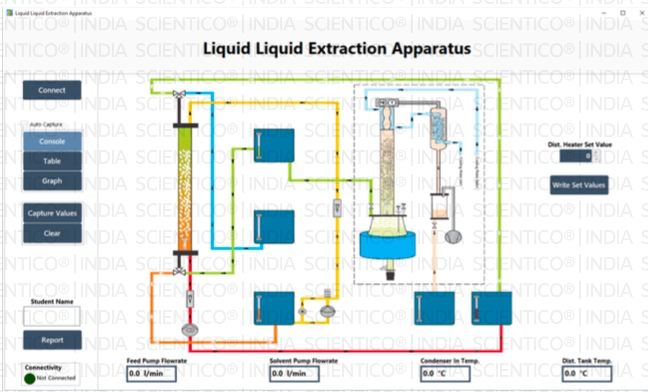
Liquid/Liquid Extraction Apparatus | OperatiX – 11
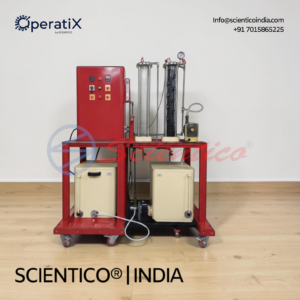
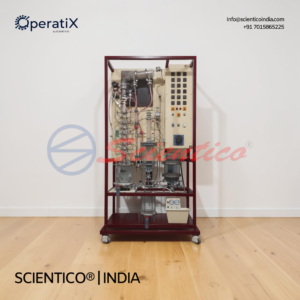
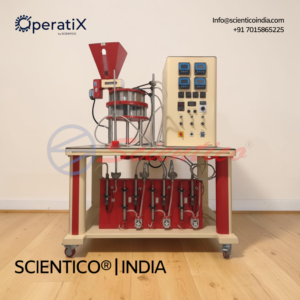
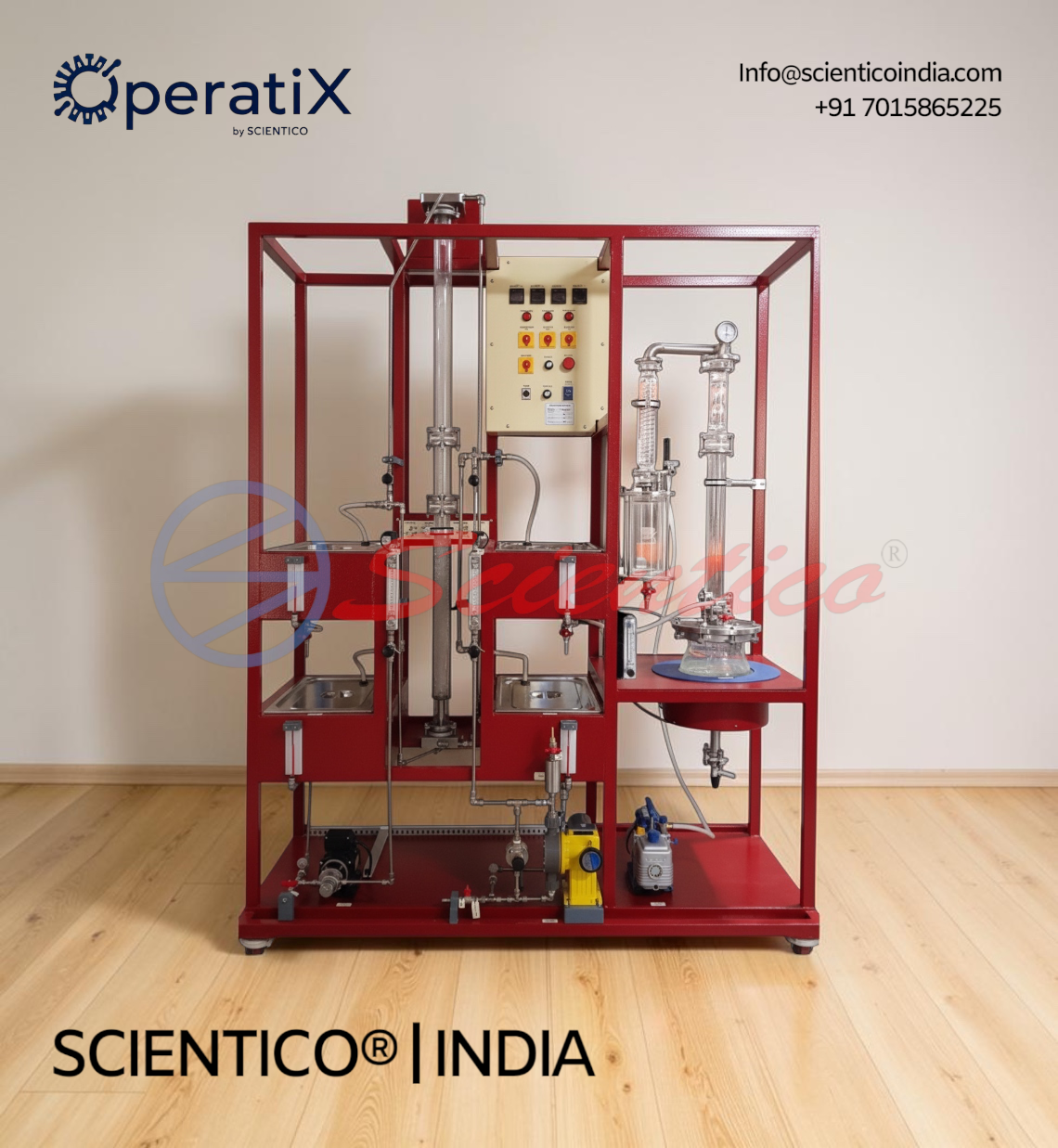
The Liquid/Liquid Extraction Apparatus OperatiX – 11 demonstrates liquid-liquid extraction in counterflow operation with distillation for extract enrichment. This Liquid/Liquid Extraction Apparatus features a glass extraction column, a distillation unit with condenser, and PID-controlled heating. It supports continuous or discontinuous process modes and vacuum operation during distillation. Optional DAQ software enables measurement and calculation of results.
The Liquid/Liquid Extraction Apparatus OperatiX – 11 demonstrates the separation of two liquid mixes to be separated. This Liquid/Liquid Extraction Apparatus pumps the liquid mixture from a feed tank to the base of the extraction column, where it flows counter-current to the solvent pumped into the top. It can be run as a continuous or discontinuous process using two three-way valves.
Product Overview
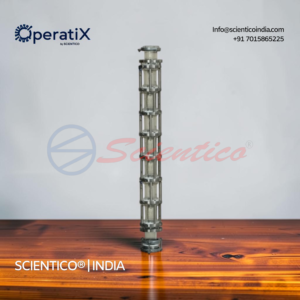
The separation of two liquid mixes to be separated is demonstrated by the liquid/liquid extraction device. A pump transfers the liquid mixture to be separated from the feed tank to the base of the extraction column. There, it flows against the flow in the direction of the solvent, which is pumped into the top of the extraction column.
The mixture that needs to be separated consists of a carrier liquid and a transitional substance. Because the solvent and the carrier liquid are insoluble in one another, a phase boundary forms in the column. Two valves can be used to examine and modify this. Inside the column, the transition component moves from the carrier liquid into the solvent. The trainer can be run as a continuous or discontinuous process using two three-way valves.
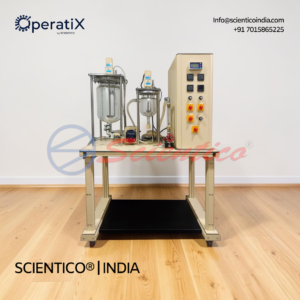
The enrichment of the transition component in the extract is made easier by a distillation unit. This consists of a packed column and a distillation bridge with a condenser in a heated round-bottomed flask. At the top of the column, the enriched extract exits and is collected in a tank. A sensor measures the temperature at the bottom, which is then digitally displayed and controlled by a PID controller. Additionally, the temperature at the distillation column’s top is gauged. The transition component, which collects at the bottom of the unit and can be extracted as a product, has the solvent removed using distillation. The solvent that has been separated is gathered in a tank and can be used again for extraction.
Rapeseed oil is suggested as the carrier liquid, ethanol as the transition element, and water as the solvent for a ternary material system. Density measurements are used to determine the concentrations of extract, top, and bottom products in this ternary material system. A conductivity meter is included for alternative ternary material systems, extending the flexibility of this Liquid/Liquid Extraction Apparatus.
Liquid/Liquid Extraction Apparatus OperatiX – 11, Technical Specifications
| Specification | Detail |
|---|---|
| Process Mode | Liquid-liquid extraction in counterflow operation with distillation for extract enrichment |
| Phase Boundary Control | 2 valves for fine-tuning the phase boundary |
| Vacuum Measurement | Pressure gauge to measure the vacuum pressure |
| Fluid Delivery | 2 pumps for feed and solvent delivery |
| Process Switching | 2 three-way valves for continuous or discontinuous operation |
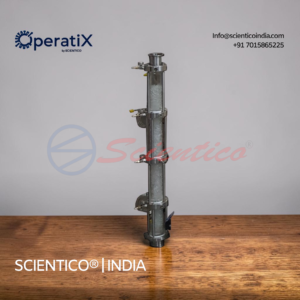
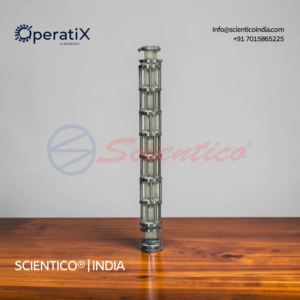
| Extraction Column | Glass, in two parts |
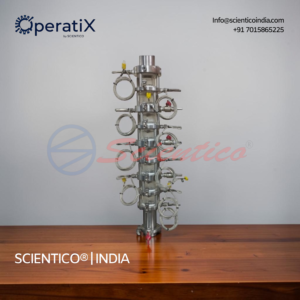
| Distillation Column | With condenser |
| Temperature Control | PID control of electrical heating |
| Vacuum Operation | Possible during distillation to reduce evaporation temperature |
| Tank Material | Stainless steel for feed, solvent, raffinate and extract; glass for top product tank (distillation) |
| Heat Transfer Aid | Raschig rings used in extraction and distillation columns |
Technical Data
Columns
Extraction (Liquid-Liquid)
| Parameter | Value |
|---|---|
| Diameter | 40mm |
| Height | 1000mm |
Distillation Unit
| Parameter | Value |
|---|---|
| Diameter | 50mm |
| Height | 400mm |
| Bottom heater power output | 1.2kW |
Tanks
| Parameter | Value |
|---|---|
| Feed and raffinate | approx. 20L each |
| Solvent and extract | approx. 20L each |
| Top product (distillation) | 2.5L |
| Bottom tank (distillation) | approx. 5L |
Feed Pump
| Parameter | Value |
|---|---|
| Max. flow rate | 1000ml/min |
| Max. head | 40m |
Solvent Pump
| Parameter | Value |
|---|---|
| Max. flow rate | 2000ml/min |
| Max. head | 10m |
Vacuum Pump
| Parameter | Value |
|---|---|
| Type | Water circulation |
| Vacuum ports | 2 |
| Final vacuum | approx. 200mbar |
Measuring Ranges
| Parameter | Value |
|---|---|
| Temperature | 2x 0~400°C |
| Flow rate | 2x 0.2~1.5l/min |
| Pressure | -1~1bar |
| Conductivity | 0~200mS/cm |
Key Features
- Extraction Column: glass, two parts, 40mm diameter, 1000mm height
- Distillation Column: 50mm diameter, 400mm height, with condenser
- Process Modes: continuous or discontinuous, using two three-way valves
- Phase Boundary Control: 2 valves for fine-tuning
- Fluid Delivery: feed pump (1000ml/min, 40m head) and solvent pump (2000ml/min, 10m head)
- Vacuum Operation: possible during distillation to reduce evaporation temperature, water circulation vacuum pump
- Temperature Control: PID control of electrical heating, bottom heater rated 1.2kW
- Tank Materials: stainless steel tanks for feed, solvent, raffinate, and extract; glass top product tank
- Heat Transfer Enhancement: Raschig rings in extraction and distillation columns
- Ternary System Support: rapeseed oil, ethanol, and water suggested; conductivity meter included for alternative systems, part of this Liquid/Liquid Extraction Apparatus
- Software: optional DAQ software for measurement and calculation
Experiments
- Extraction of a component from a two-component liquid mixture into a solvent
- Separation of a liquid mixture by liquid-liquid extraction in counter flow operation
- Operation in either continuous or discontinuous process mode is possible
- Adjustment and observation of phase boundary possible
- Distillation enrichment of transition component in extract
- Separation processes are evaluated using concentration measurements and mass balances
- The effect of several experimental alternatives on separation processes
Construction and Design
The Liquid/Liquid Extraction Apparatus OperatiX – 11 is built around a glass extraction column in two parts, 40mm in diameter and 1000mm in height. A distillation unit is fitted with a packed column and a distillation bridge with a condenser in a heated round-bottomed flask, 50mm in diameter and 400mm in height. Two pumps handle fluid delivery: a feed pump rated at 1000ml/min with a 40m head, and a solvent pump rated at 2000ml/min with a 10m head. Two three-way valves allow switching between continuous and discontinuous operation. Two valves fine-tune the phase boundary within the extraction column. A water circulation vacuum pump with 2 vacuum ports supports vacuum operation during distillation, reaching a final vacuum of approximately 200mbar. PID control governs electrical heating, with a bottom heater power output of 1.2kW. Stainless steel tanks hold feed, solvent, raffinate, and extract, each approximately 20L, while the top product tank for distillation is made of glass at 2.5L capacity. A bottom tank for distillation holds approximately 5L. Raschig rings increase heat transfer surface area in the extraction and distillation columns.
Software
Software OperatiX – 11 (optional). DAQ software specially designed in National Instrument™, LABVIEW™ environment to measure and calculate the results of the apparatus. The software is optional; a set of electronic sensors is included when the software is used. The software can be run in any Windows™ environment.
Scope of Delivery
- 1 Experimental unit
- 1 Instruction manual
Q: What is the Liquid/Liquid Extraction Apparatus OperatiX – 11 used for?
A: It is used to demonstrate the separation of two liquid mixes through liquid-liquid extraction in counterflow operation, with distillation for extract enrichment.
Q: What carrier liquid, transition element, and solvent are suggested for the ternary system?
A: Rapeseed oil is suggested as the carrier liquid, ethanol as the transition element, and water as the solvent.
Q: Can the system operate under vacuum?
A: Yes, vacuum operation is possible during distillation to reduce the evaporation temperature, using a water circulation vacuum pump with a final vacuum of approximately 200mbar.
Q: Is data acquisition software available with this system?
A: Yes, Software OperatiX – 11 is available as an optional add-on, designed in National Instrument™ LABVIEW™ environment, and can run in any Windows™ environment.
Q: How is concentration measured in the ternary material system?
A: Density measurements are used to determine the concentrations of extract, top, and bottom products. A conductivity meter is included for alternative ternary material systems.
Need Assistance? We're Here to Help!
Connect with our team for product specifications, pricing, and customized solutions for your institution or project.