
BSc Nursing lab equipment should be planned from the practical activities, learner groups, room layout and current programme documents used by the institution. This guide gives a subject-wise planning framework, shows how to turn a curriculum into a buyer-ready schedule, and lists the supplier details to verify before a purchase or tender. The examples are planning prompts; they are not an Indian Nursing Council (INC) mandated equipment list, quantity schedule or inspection threshold.
Start with the official source documents applicable to your institution and programme. The INC maintains a Nursing Programs Guidelines page with programme guidance and minimum-requirement documents. Its Gazette notifications include the revised B.Sc. (Nursing) regulations and curriculum and a later corrigendum. Check the publication date and any later notice before finalizing an equipment schedule; a supplier article or old college list cannot replace the official material.
Explore the relevant equipment category
Browse the catalogue category and review individual product specifications for your laboratory requirement.
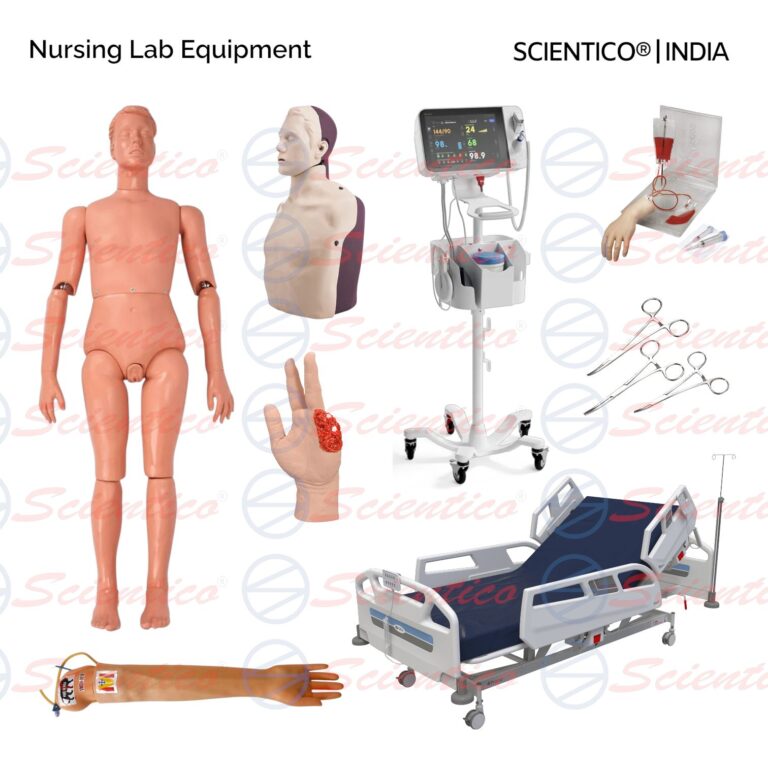
Nursing Lab Equipment
Review the nursing equipment catalogue against the practical skills, teaching groups and laboratory requirements in your approved programme.
Browse categoryWhat belongs in a BSc Nursing lab equipment list?
There is no safe one-size-fits-all list to copy into every BSc Nursing tender. The final schedule depends on the current syllabus, approved intake, practical timetable, class sizes, simultaneous groups, teaching method, existing usable equipment, facilities available in the clinical setting and state-level requirements. A useful list connects each proposed item to a learning activity and states how students will access it.
Fundamentals of Nursing and nursing skills practice
Review the practical skills your faculty plans to teach and identify the training equipment that supports them. Depending on the approved curriculum and institutional plan, discussion may include a nursing-care manikin, bed and bedside furniture, vital-signs training equipment, injection and intravenous practice trainers, catheterization models, wound-care practice models, dressing trolley, screens and storage. These are examples to assess against the actual syllabus, not a statement that each is compulsory or that a fixed number is prescribed.
For each skill station, record the activity, learner group size, how many students can practise at once, consumables or replacement parts, cleaning method, storage, supervision and acceptance check. Where a trainer is shared between sessions, put the rotation plan beside the quantity so reviewers can assess access rather than infer it from the inventory.
Community health, maternal health and child health
Build separate planning lines for activities that belong to community health, maternal and newborn care, and child health. Depending on the syllabus and teaching plan, example categories may include community-visit teaching aids, growth-measurement demonstrations, family-health education materials, obstetric or antenatal teaching models, childbirth demonstration trainers, newborn-care teaching models and paediatric nursing practice trainers. Verify each activity and model type with the faculty responsible for that subject. The syllabus, not a vendor list, determines which teaching activity is relevant.
For each line, distinguish a teaching model or simulator from clinical equipment used on patients. State the intended learning use clearly and do not imply that an educational trainer is suitable for patient care. If a model has replaceable skin, pads or other consumables, list those separately with compatible part identifiers and confirm availability and cost in the quotation.
Anatomy, physiology, nutrition and shared teaching spaces
Map the planned topics to suitable visual or measurement aids. Potential categories for faculty review include anatomical models, charts, prepared slide sets, microscopes or physiology-demonstration apparatus, nutrition teaching materials, storage and general laboratory furniture. The required configuration depends on the practical curriculum, existing inventory and number of learners who use the space concurrently. Shared items should appear once in a campus equipment schedule with the programmes and timetable that will use them, instead of being duplicated across multiple BOQs.
How to convert the syllabus into a defensible BOQ
- Record the source. Write the programme, syllabus or regulation title, edition/date, applicable correction and the institution or state document being used. Save the official file with the planning record.
- Map the activity. Identify the subject, unit, practical or skill and intended learning outcome. A proposed item without a teaching purpose should be reviewed before it enters the BOQ.
- Check current inventory. Record existing make/model, quantity, working condition, location, accessories, age and whether the equipment is already committed to another class or programme.
- Calculate access from the timetable. Note approved intake, section size, groups working at once, session duration and rotation. Derive quantities from this local plan; do not copy illustrative numbers or another college's ratio as an INC rule.
- Define the function, not a preferred brand. State the required function, dimensions or operating range, material, interfaces, accessories, power/utility needs, consumables and acceptance checks that are necessary for the learning activity.
- Separate base supply and options. Ask vendors to state what is included, excluded or optional, including stands, manuals, software, models, replacement parts and training. Record deviations next to the relevant BOQ line.
- Confirm the procurement and handover terms. Capture delivery destination, packing, installation or training responsibilities if required, warranty wording, applicable documents, acceptance method and the person responsible for sign-off.
BSc Nursing equipment schedule template
A common response format makes supplier evaluation easier and creates a traceable record for later use. Adapt these fields to the institution's tender or procurement system.
| Schedule field | What to record |
|---|---|
| Programme and source | Programme, document title, edition/date, relevant section and any applicable state or institutional document. |
| Subject and activity | Course, practical/skill, intended learning use and the faculty owner. |
| Equipment description | Neutral item name, essential function, specification, range or materials and permitted equivalent performance. |
| Access and quantity basis | Approved intake, session groups, simultaneous users, rotation and existing usable items. |
| Accessories and recurring needs | Included accessories, consumables, replaceable parts, storage and compatible identifiers. |
| Room and utilities | Space, power, water/drainage, ventilation, connectivity, lifting/access or preparation requirements, where relevant. |
| Supplier response | Quoted make/model, quantity, inclusions/exclusions, deviations, supporting literature and unresolved clarification. |
| Handover and acceptance | Inspection or demonstration criteria, manuals and records requested, responsible recipient and sign-off process. |
Documents and regulatory checks: avoid assumptions
Equipment planning helps organize a teaching space; it does not itself establish programme recognition, suitability or accreditation. Refer to the current INC requirements and any applicable state authority directions for the institution's actual situation. Do not describe a supplier's product list as an official INC list, promise that a purchase will pass an inspection, or copy old quantities without checking their source and date.
Ask the supplier to identify documents available for the exact offered model and configuration. Depending on the product and tender, the institution may request product literature, operating and maintenance instructions, scope of supply, utility requirements, warranty terms, applicable conformity records, calibration information for measuring instruments, installation or commissioning records and a spares list. The supplier should confirm what applies and what is actually included in the written offer.
How to compare nursing lab equipment suppliers
Give each supplier the same BOQ revision and request a line-by-line response. Compare whether the offered model performs the stated teaching function, whether requested accessories are included, whether the quantity and unit are clear, and whether deviations are explicit. Check replacement-part compatibility for models that use consumables. Record delivery, installation, training, warranty, documentation and acceptance responsibilities in the commercial response rather than assuming they are standard.
For any tender, have the institution's procurement and academic teams confirm the required technical equivalence, bid documents, eligibility, evaluation method and approval route. Keep supplier documentation separate from regulatory evidence owned by the college. A product catalogue is evidence about the offered product; it is not proof that the institution satisfies every regulatory criterion.
Where to continue planning
For the official source trail, begin at the INC's programme guideline index and check the relevant Gazette notifications. The INC's publications page lists syllabus publications; confirm that the document you use is the one applicable to your programme and date.
For related institutional procurement, see the GNM and ANM equipment planning guide for diploma-programme differences, the published nursing lab equipment catalogue for current listed products, and the nursing colleges equipment page for the broader institutional route. To ask whether a specific model or item is currently available, send the schedule through Scientico's enquiry page. Each line and its scope should be confirmed in writing.
Frequently asked questions
Is there one official BSc Nursing lab equipment list that every college can copy?
Do not assume a supplier or third-party checklist is the official list. Start with current INC programme guidelines, regulations and syllabus material, plus applicable state and institutional directions. Map every equipment line to the source and activity that supports it.
Does an equipment list guarantee INC inspection compliance?
No. An equipment schedule is a planning and procurement aid. The institution must independently confirm the applicable official requirements and its own implementation, records and facilities.
How should we calculate quantities?
Use your approved intake, group sizes, simultaneous sessions, timetable, activity design and usable existing inventory. State the calculation basis so academic and procurement reviewers can assess it. Avoid treating generic quantities as regulatory norms.
What should a supplier quote include?
Ask for an exact model, specification response, quantity, accessories, exclusions, requested documents, consumables or compatible replacements, warranty, delivery basis and any installation or training scope. The written offer should identify unresolved requirements.
Before release of a BOQ or tender: have academic staff check the curriculum mapping, the institution's compliance lead check official sources, and procurement staff verify neutral specifications and comparable supplier responses.