
If you are kitting out a Fluid Mechanics lab for a BTech Mechanical Engineering programme, the fluid mechanics bench sits at the centre of the room, not at the edge. Every other apparatus in that lab (venturi, orifice, notch, pipe friction, impact of jet) depends on it for measured flow and calibrated head. I have specified hydraulic benches for BTech Mechanical Engineering labs in three states, and the ones that survive a decade of student use share the same handful of design choices. Get those choices wrong and you will be re-buying inside four batches of students.
The reason this bench matters more for BTech than for a diploma programme is simple: your students are expected to reproduce a Reynolds number, not just “observe” flow. That means you need repeatable flow between roughly 0 and 0.5 L/s at heads a student can actually read off a manometer without a fight. A cheap unit will give you neither.
Equipment mentioned in this guide
Review the product information, specifications and model before requesting a quotation.

Multi Pump Test Rig Apparatus | FluidoSurge-X 294
The FluidoSurge X-294 is a multi pump test rig (series and parallel centrifugal pump test rig) that lets students run single, series and parallel pump configurations on one apparatus and compare the resulting head–discharge–efficiency characteristics.
View product details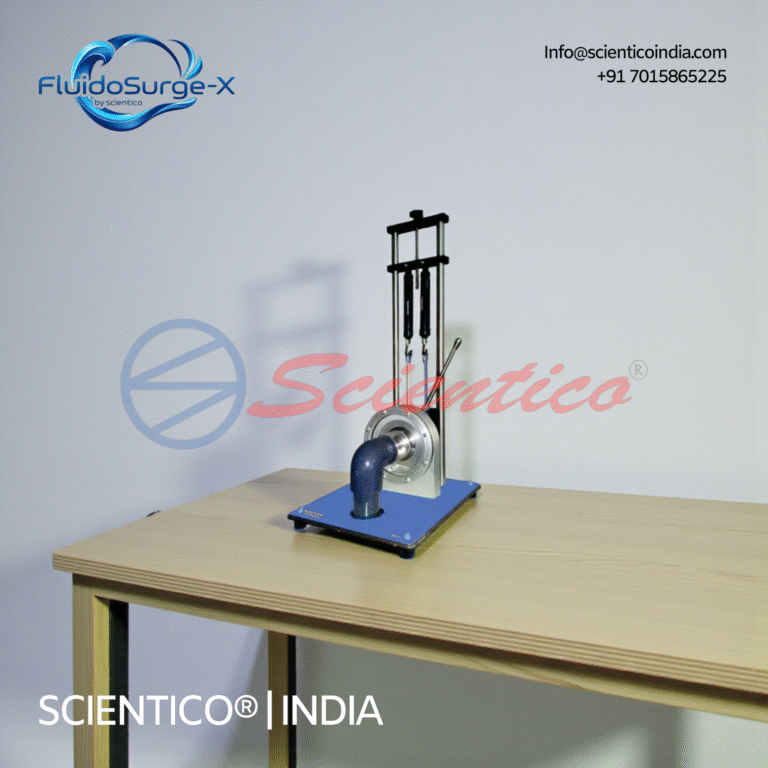
Kaplan Turbine Apparatus | FluidoSurgeX 208
The Kaplan Turbine Apparatus FluidoSurgeX 208 is a laboratory-scale training system designed to study the operating characteristics of a Kaplan reaction turbine. Manufactured by SCIENTICO, the apparatus demonstrates energy conversion from hydraulic power to mechanical power. It is suitable for instructional experiments in fluid mechanics and hydraulic machinery laboratories. The system operates using a controlled water supply from a hydraulic bench.
View product details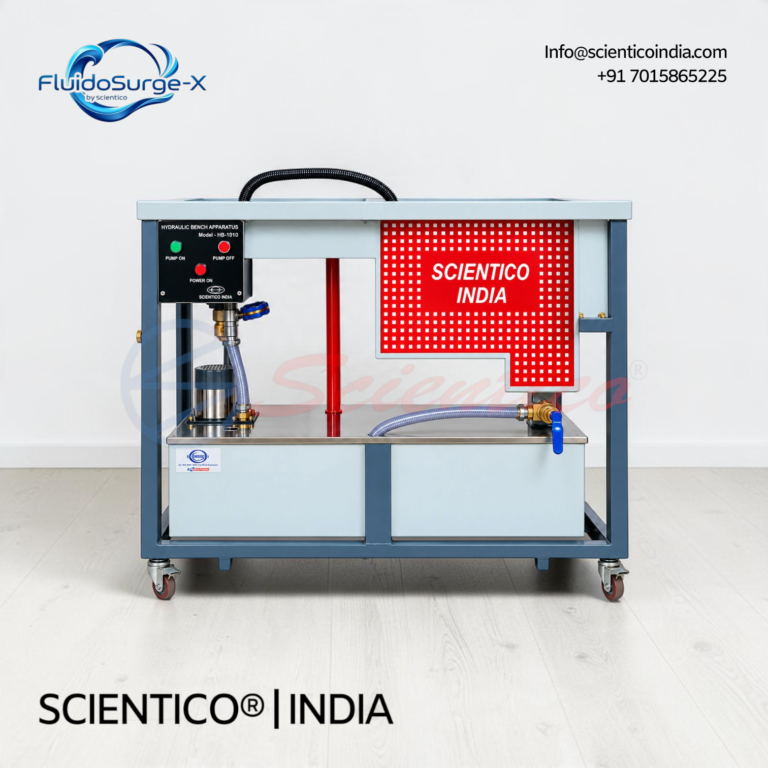
Hydraulic Bench Apparatus | FluidoSurgeX 101
The SCIENTICO FluidoSurgeX 101 Hydraulic Bench Apparatus is a basic supply and measurement unit used in fluid mechanics laboratories. It enables the circulation, measurement, and collection of water for a wide range of experimental modules.The system operates on a closed-loop water circuit consisting of a storage tank, centrifugal pump, and an elevated measuring tank. Volumetric flow rates are determined using stepped measuring tanks and a calibrated measuring beaker, supported by manual stopwatch timing.An integrated work surface with a built-in flume allows experiments involving weirs while ensuring safe placement of accessories and controlled collection of return water.
View product details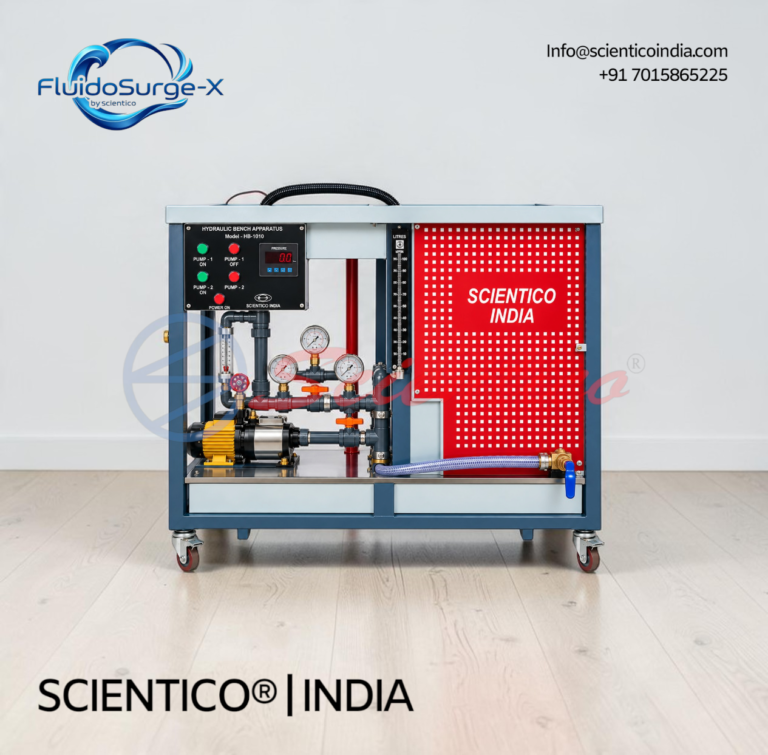
Hydraulic Bench with Series and Parallel Pumps | FluidoSurgeX 104
The Hydraulic Bench with Series and Parallel Pumps FluidoSurgeX 104 by SCIENTICO is designed for detailed study of centrifugal pump performance in fluid mechanics laboratories.The system enables operation of two centrifugal pumps in single, series, or parallel configurations within a closed water circuit.It supports volumetric flow measurement, pressure monitoring, and weir experiments on an integrated work surface.The apparatus is intended for structured academic instruction and practical laboratory experimentation.
View product details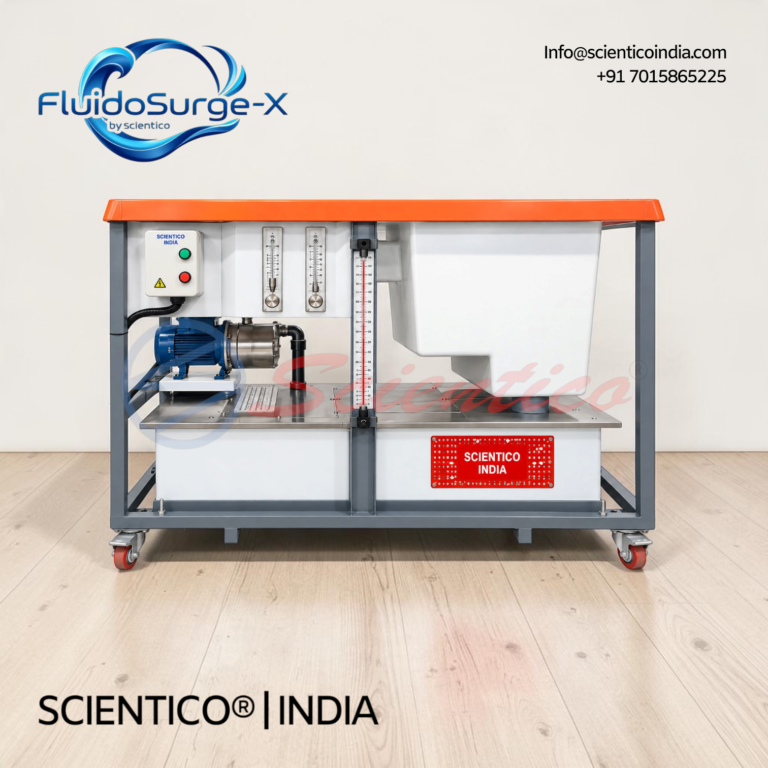
Hydraulic Bench Apparatus with Flowmeter | FluidoSurgeX 105
The Hydraulic Bench Apparatus with Flowmeter FluidoSurgeX 105 by SCIENTICO is designed for fundamental fluid mechanics laboratory experiments.It provides a closed water circuit for supplying experimental units and measuring volumetric flow rates.The system combines stepped volumetric measurement with direct flow indication using flowmeters.It is suitable for structured teaching and routine laboratory experimentation.
View product detailsBTech Mechanical Engineering syllabus, where the hydraulic bench fits
Across AICTE model curricula and most autonomous BTech Mechanical Engineering schemes, the hydraulic bench underpins the Fluid Mechanics practical paper in Semester 3 or 4, and again inside Fluid Machinery in Semester 5. Typical experiments the bench must feed are: Bernoulli’s apparatus, venturimeter and orificemeter coefficient of discharge, V-notch and rectangular-notch calibration, friction loss in pipes, minor losses in fittings, impact of jet, and metacentric height. That is 10 to 14 practicals depending on the affiliating university, and roughly 30 to 45 contact-hours per student per semester.
For NBA-accredited programmes, the CO/PO mapping usually forces you to demonstrate quantitative uncertainty, not just qualitative demonstration. Practically, that means the bench must produce steady flow long enough for a student pair to take three timed readings without the head drifting. Undersized sumps and weak pumps will fail this quietly and you will only find out at accreditation.
Specifications that matter for BTech Mechanical Engineering
- Pump duty: Look for a centrifugal pump delivering roughly 60 to 90 L/min at 10 to 15 m head. Anything below that and your pipe-friction experiment collapses at higher Reynolds numbers.
- Sump and measuring tank: Sump around 150 to 250 L, measuring tank around 40 to 60 L with a two-step gauge (0 to 5 L quick, then 0 to 40 L for higher flows). Undersized tanks force students to stopwatch in 4 seconds, which destroys accuracy.
- Structure: Stainless steel work-surface, powder-coated MS frame. Painted MS surfaces rust inside two monsoons in a Delhi or Chennai lab. Do not compromise here.
- Flow control: Bypass valve plus a fine-throttle delivery valve. A single gate valve is not enough for BTech-grade experiments.
- Standards conformity: ISO 9001:2015 manufacturing and CE-marked electricals at minimum. For central-government tenders and NAAC, this is table stakes.
- Manometer interface: Quick-connect couplings to the piezometer/manometer bank. Threaded connections eat 20 minutes of every practical.
Common mistakes BTech Mechanical Engineering colleges make when buying a hydraulic bench
1. Buying on price alone against a two-line tender spec. I have seen “hydraulic bench, one number” tenders that let a vendor supply a plastic-sump unit with a 0.25 HP pump. It technically clears the PO. It cannot run the pipe-friction practical past 20,000 Reynolds. Write the pump head, tank volumes, and steel grade into the spec.
2. Ignoring the drain and floor slope. The bench needs a floor drain within 2 metres and a 15 to 20 mm slope, otherwise the sump backflows every time a student overfills. Civil work, not equipment, but this kills more benches than pump failure.
3. Forgetting the ancillary experiments. A bench alone is not a lab. You need the notch tank, orifice apparatus, and pipe-friction rig sized to the bench’s flow envelope. Buy them together from one manufacturer so the connections match.
4. Skipping the electrical schedule. Single-phase 230 V, 15 A dedicated line. If your college gives it a shared 5 A socket, the pump will trip mid-experiment and students will blame the equipment.
5. Not budgeting for spares. Mechanical seal, capacitor, one spare impeller. Order at commissioning. Sourcing these after two years, when the vendor has moved SKUs, is a six-week outage.
How the Scientico hydraulic bench fits BTech Mechanical Engineering
For a BTech Mechanical Engineering department, I usually recommend the FluidoSurgeX multi-pump test rig / hydraulic bench as the anchor unit, because it handles both the Fluid Mechanics practicals and doubles as a pump-characteristics rig for the Semester 5 Fluid Machinery paper. That is one CapEx line covering two years of curriculum. Pair it with the Kaplan turbine apparatus if your syllabus includes low-head turbines, and you have covered the machinery half of the lab too. For the ancillary spread, my hydraulic bench buyer’s guide and the complete fluid mechanics lab setup guide lay out the full BOM.
Compliance: NBA, NAAC, AICTE requirements
NBA Tier-1 evaluators look at three things in the fluid lab: whether the CO/PO mapping is actually demonstrable on the equipment, whether calibration records exist, and whether safety compliance (earthing, MCB, emergency stop) is documented. A hydraulic bench that ships with an ISO 9001:2015 manufacturer certificate, a CE conformity declaration for the pump-motor assembly, and a calibration certificate for the measuring tank clears all three in one shot. Keep those documents in the lab file, not in the store-keeper’s cupboard.
For AICTE Mandatory Disclosure and NAAC criteria 4.1, the equipment audit trail matters as much as the equipment. Ask the vendor upfront for the invoice, the test certificate, and the operator manual as PDFs. Scientico ships all three by default because we have been manufacturing since 1993 and export to 30+ countries where documentation is a customs requirement, not an afterthought. If you also run programmes for nursing or pharmacy departments, the same discipline applies, and the INC nursing lab guide and PCI pharmacy guide mirror this thinking.
Ordering and delivery for BTech Mechanical Engineering labs
A BTech Mechanical Engineering hydraulic bench from our Ambala factory typically needs several weeks of production once the PO is confirmed, because the tank, frame, and pump assembly are built to order rather than pulled off a shelf. Domestic road transport within India adds a further 5 to 10 working days depending on the state. For international orders (we ship to engineering colleges across Africa, the Gulf, and Southeast Asia), sea freight on FOB Nhava Sheva or CIF destination adds several weeks on top, so if your semester starts in July, place the order by March. Air freight is possible on smaller SKUs but rarely economic on a full hydraulic bench because of volumetric weight.
On Incoterms, my honest view: EXW works only if your buyer has a customs broker they trust. Most colleges are better off on CIF or DAP because it removes the freight-forwarding headache. You will pay 8 to 12% more, but you save the procurement officer two weeks of chasing. Compare the trade-offs in the multi-pump test rig buyer’s guide before you finalise the tender.
Commissioning is included on domestic orders within India. For overseas orders, we send installation videos and offer remote commissioning on a scheduled call. A technician visit is quotable but rarely necessary because the bench is a single-unit skid.
Ready to spec your Fluid Mechanics lab? WhatsApp our BTech Mechanical Engineering desk on the number listed on our contact page, or send the tender document and we will return a line-item quote within two working days. If you are still comparing options, start with the hydraulic bench price guide and shortlist from there.
Frequently Asked Questions
What pump capacity should a hydraulic bench have for a BTech Mechanical Engineering lab?
For BTech-level experiments you want roughly 60 to 90 L/min at 10 to 15 m head. Anything smaller cannot push the pipe-friction rig into turbulent flow, so students cannot verify the Darcy-Weisbach equation properly. A 0.5 to 1 HP single-phase centrifugal pump on a dedicated 15 A line is the practical sweet spot.
How many experiments can one hydraulic bench support?
A properly-spec’d bench supports 10 to 14 practicals across Fluid Mechanics and Fluid Machinery, including Bernoulli, venturimeter, orificemeter, notches, pipe friction, minor losses, impact of jet, and pump characteristics. Plan one bench per 8 to 10 students so a two-hour practical actually finishes on time.
Does a BTech Mechanical Engineering hydraulic bench need CE marking if it is used only in India?
CE is not legally mandatory for domestic use in India, but NBA and NAAC evaluators treat CE plus ISO 9001:2015 as evidence of build quality. For central-government funded procurement (RUSA, TEQIP successor schemes) the tender usually asks for both, so it is easier to buy CE-marked from day one than to justify its absence later.
What is the realistic lead time for delivery to a BTech Mechanical Engineering college?
From our Ambala factory, expect several weeks of build time after PO confirmation, plus 5 to 10 working days road transport within India. If your semester begins in July, place the order by March or April to allow buffer for commissioning and student induction before the first practical.
Should we buy the hydraulic bench and ancillary apparatus from the same vendor?
Yes, and it is not a small point. Single-vendor procurement means the tank outlets, quick-connects, and manometer fittings all match, and one AMC covers the whole set. Mixed-vendor labs typically lose the first two weeks of every semester to adapter fittings and mismatched thread standards.
One honest ask
We don't gate anything on this site. You just read the whole thing free. If it was useful, leave your email and two things happen: we send you this page as a plain-text block you can paste into a tender file or an internal email, and we notify you the next time we publish a buyer tool like this one. Nothing else. No drip sequence, no sales calls booked without asking.