
This is a working guide to setup solar PV training lab India college, the kind of lab a diploma or B.Tech EEE/ME department actually runs, not a brochure fantasy. I am writing for the lab-in-charge, the HOD who signs the indent, and the procurement officer who has to justify every line item. If you are shopping the wider category, start on our renewable energy training equipment range and come back here for the setup logic. A well specced solar PV trainer lab is not expensive. A badly specced one is, because you rebuild it in year three.
Equipment mentioned in this guide
Review the product information, specifications and model before requesting a quotation.
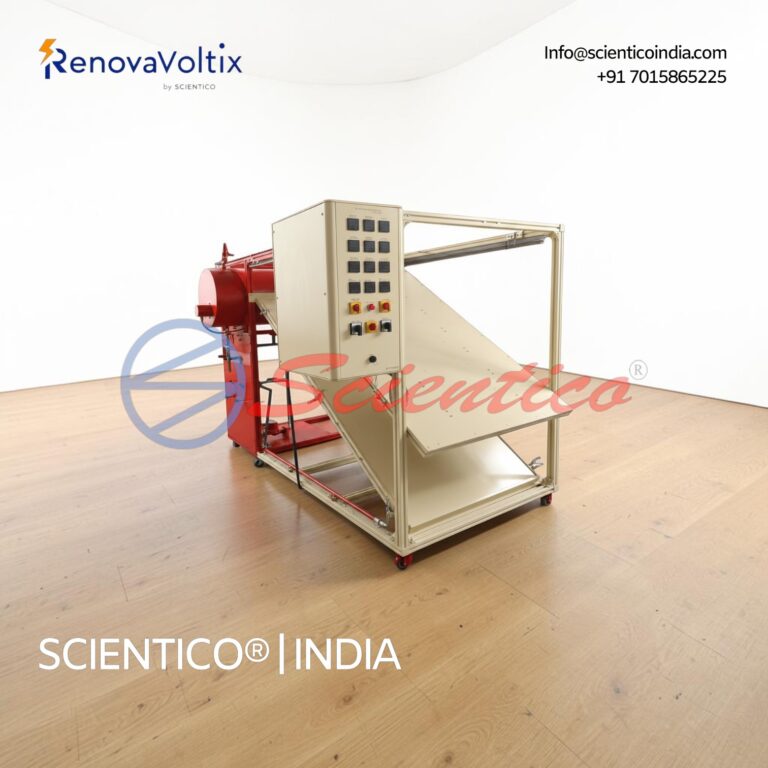
Solar Thermal Trainer | RVX-010
The Solar Thermal Trainer RVX-010 is a laboratory-based solar thermal training platform that demonstrates solar thermal heating of domestic water using both thermosiphon and forced pumping system configurations. It transforms solar energy into usable thermal energy using a high-power artificial solar simulator, enabling a full range of controlled indoor experiments. Product Overview The Solar Thermal Trainer RVX-010 consists of four core elements: a thermal solar collector, a storage tank, an artificial light source solar simulator, and a pumping system. The solar collector is mounted on an aluminium frame with copper tubes through which water flows, designed for maximum absorption efficiency. The accumulator tank is made from anti-corrosive material with an integrated heating element and safety device for over-temperature protection. The solar simulator uses lamps emitting radiation similar to sunlight, measured by a radiation sensor. Three lighting configurations are available: all lamps on, half the lamps on in a zig-zag pattern, or one lamp on. A pump provides forced convection of heat transfer fluid through the accumulator tank. The system supports both thermosiphon and forced pumping operation. Safety valves for overpressure protection are included. Sensors and meters record temperature, flow, and radiation. The unit is mounted on a metallic structure with wheels for mobility and features HDF panel construction with LED digital display instrumentation.
View product details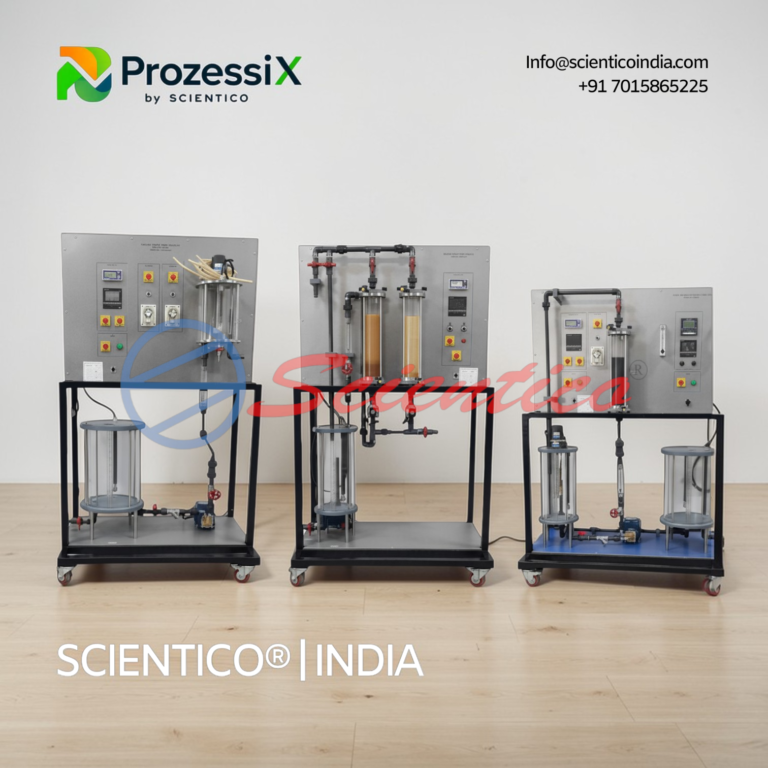
Analytical Process Control Trainer | ProzessiX PX-04
The Prozessix PX-04 is an analytical process control trainer for instrumentation and process engineering laboratories, giving students hands-on PID loop tuning across flow, level, temperature and pressure processes on a single bench.
View product details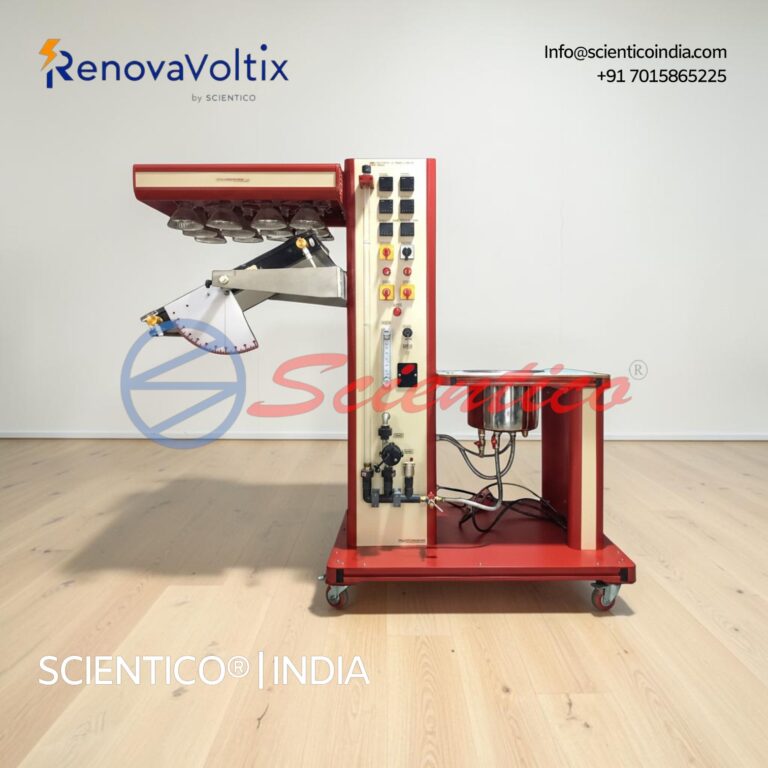
Solar Thermal Energy Training System | RVX-009
The Solar Thermal Energy Training System RVX-009 is a laboratory-based solar thermal training platform that demonstrates the conversion of solar energy into usable thermal energy for domestic water heating. It includes a solar panel for simultaneous light-to-electrical energy conversion, making it a dual-function solar energy training system. Product Overview The Solar Thermal Energy Training System RVX-009 demonstrates solar thermal heating of domestic water in an illustrative laboratory setup. A lighting unit simulates natural solar radiation and enables a range of controlled indoor experiments. Light is converted into heat in an absorber and transferred to a heat transfer fluid. A pump conveys the heat transfer fluid through a hot water tank fitted with an integrated tube coil heat exchanger. A solar panel is included to simultaneously convert light energy into electrical energy and charge a battery. The system supports study of various angles of incidence and different illuminance levels. The pre-installed absorber with selective coating can be replaced with a blackened absorber for comparative measurements of collector losses. External heat consumers can be connected to the tank via two connectors. Sensors detect collector inlet temperature, collector outlet temperature, ambient air temperature, tank temperature, and illuminance. Measured values are displayed on the device and can be transferred to a PC via USB or Ethernet when the DAQ option is selected.
View product details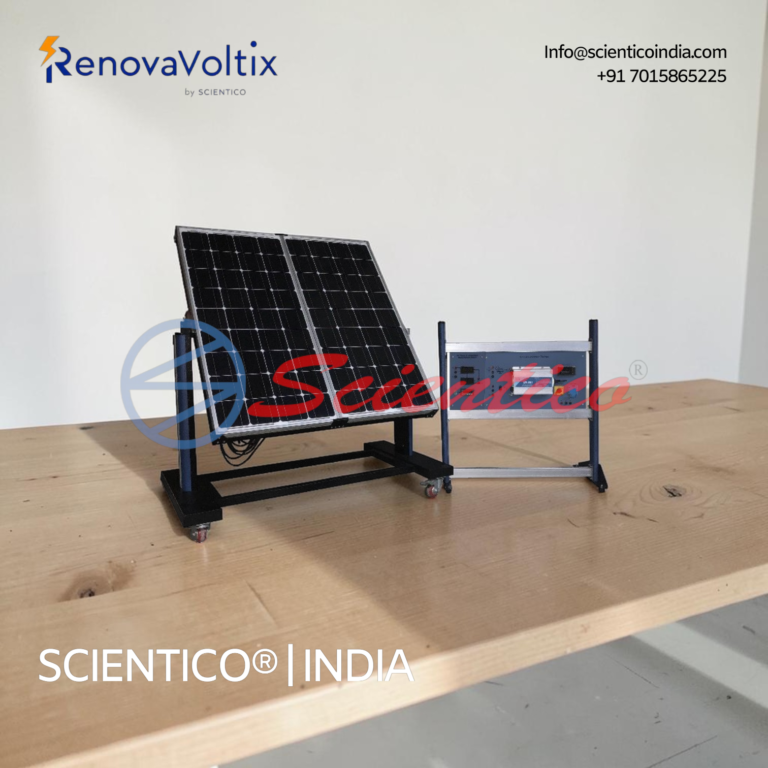
Outdoor Solar Energy Training System | RVX-002
The Outdoor Solar Energy Training System RVX-002 is a field-ready solar power experimental platform designed to demonstrate the complete cycle of solar energy utilisation, from photovoltaic generation through battery storage to load delivery. As a purpose-built solar energy trainer, the RVX-002 enables hands-on investigation of how solar PV modules transform solar power into usable electrical energy across real outdoor conditions.
View product detailsWhat you need before you start
Do not raise a purchase order until these five things are settled. I have watched too many labs arrive on a Tata Ace and sit in a corridor for a month because the room was not ready.
- Room: 30 to 40 sqm minimum for a 15-student batch. South or south-west facing terrace access within 20 m for the outdoor PV array.
- Power: 3-phase 415 V, dedicated 32 A MCB, proper earthing (below 1 ohm), and a separate 6 A UPS line for the DAQ PC.
- Equipment mix: at least one indoor lamp-source solar PV trainer, one outdoor mono and poly panel pair, an MPPT charge controller module, a battery bank stand, and a grid-tie inverter demo.
- Budget approval: get the full BOM sanctioned in one go. Splitting across two financial years always breaks DAQ-to-panel matching later.
- Standards reference: keep printed copies of IEC 61215, IEC 61730 and the current MNRE testing note in the lab, plus your college’s AICTE/NBA scheme document. NBA peer teams ask for these first.
Step-by-step: solar PV trainer commissioning
Follow the order below. Skipping the site survey to save a day is the single most common reason a solar PV trainer lab underperforms after installation.
- Site survey and shading study. Walk the terrace at 10 am, 12 noon and 3 pm on a clear day. Any water tank, parapet or neighbouring tower that throws a shadow on the proposed array footprint disqualifies that spot. Move the array, not the schedule.
- Structural approval for the array. Get a one-page load certificate from your civil department for the mounting structure. Typical dead load for a 2 kWp teaching array is 40 to 60 kg per panel including MS structure. Cheap to do now, expensive to retrofit.
- Cable routing from terrace to lab. Use UV-resistant 4 sqmm DC cable in a dedicated GI conduit. Keep the run under 25 m to hold voltage drop below 3 percent. Label positive red, negative black, at both ends. Do not share the conduit with AC lines.
- Indoor trainer bench placement. Place the indoor solar PV trainer bench against a wall with a 1 m clearance behind for cabling and a 1.2 m aisle in front. Group two trainers per bay so a batch of 15 works in three sub-groups.
- DC safety chain. Fit a lockable DC isolator within 1 m of the array, a second DC isolator at the lab entry point, and SPDs (surge protection) on both ends. This is what NBA and any serious safety audit look for first.
- MPPT and battery bank commissioning. Charge the battery bank to full using grid power before the first PV connection, then let the MPPT take over. Log open-circuit voltage and short-circuit current of every string on day one and paste the sheet inside the panel cover. This becomes the reference for every future experiment.
- Grid-tie inverter demo. Keep the grid-tie demo on a separate isolation transformer with a manual changeover. Students should be able to see the anti-islanding trip in under 2 seconds when the AC side is opened. If your unit trips slower than that, call the supplier before signing acceptance.
- DAQ and software validation. Run the supplied software against a known load bank. IV curve, PV curve, efficiency, fill factor and temperature coefficient must all be exportable to CSV. If the software only shows pretty gauges, it is a toy, not a trainer.
- Standard operating procedure (SOP) lamination. Write a one-page SOP for start-up, experiment and shutdown. Laminate it and screw it to the bench. Faculty rotate every two years, the SOP is what keeps the lab alive.
- User acceptance and handover. Do not sign the acceptance certificate on the same day as delivery. Run one full lab session with real students, then sign. Suppliers respect this and it protects your NBA file.
Common mistakes and pitfalls
- Buying only an indoor lamp trainer. Halogen or LED source trainers are fine for IV curve theory, but students need real sunlight data for their project reports. Always pair indoor with a small outdoor array.
- Undersized battery bank. A 12 V 26 Ah battery discharges too fast to demonstrate a full charge-discharge cycle in a 2-hour lab. Expect to specify 48 V, 40 to 60 Ah for a proper cycle demo.
- Skipping earthing tests. If your earth pit reads above 1 ohm, the MPPT and inverter will throw ground-fault alarms randomly. Test earthing with a proper 4-pole earth tester before installation, not after.
- No spares indent. Fuses, MC4 connectors, DC cable glands and one spare charge controller should be part of the original PO. Ordering spares later at retail typically costs 3x the original allocation.
- Ignoring dust. An unwashed panel loses 15 to 25 percent output within a month in most Indian cities. Put panel cleaning in the lab attendant’s weekly checklist from day one.
Standards and compliance
Two layers of standards apply. The equipment itself should ship with an ISO 9001:2015 quality declaration from the manufacturer and a CE marking on the electrical panels. For the PV modules, ask for IEC 61215 (design qualification) and IEC 61730 (safety) test certificates from a NABL or equivalent lab. If your college is chasing NBA Tier-1 or planning to send calibration samples externally, keep the ISO 17025 NABL calibration pathway in mind for your DAQ instruments. AICTE model curricula list renewable energy as a core lab for EEE, ME and civil, so build for the strictest of those three.
The Scientico angle
Scientico has been building teaching-grade renewable energy equipment out of Ambala since 1993, exporting to 30+ countries under ISO 9001:2015 and CE. For a diploma or B.Tech solar PV trainer lab I usually pair two units. The Solar Thermal Trainer RVX-010 gives students the thermal side of solar (flat plate, evacuated tube, storage) which examiners increasingly ask about alongside PV. For process instrumentation students who need to see PV data logged and controlled, the Analytical Process Control Trainer ProZessiX PX-04 plugs neatly into the same DAQ workflow. Pricing sits in the teaching-grade range, lead time is typically several weeks of production, and sea transit adds weeks for export orders. Ambala dispatch means domestic delivery is faster and installation support is available in-person, which is the real reason most colleges pick us over an import.
Related reading
- Renewable energy trainer buyers guide India
- Thermodynamics lab equipment buyers guide India
- Lab equipment for engineering colleges
- Lab equipment for polytechnics and TVET
- Lab equipment for research labs
Ready to move? Send your room dimensions, batch size and budget bracket to our team through the contact page and I will come back with a specced BOM, layout drawing and delivery plan for your solar PV trainer lab. No hard sell, just a real quote.
Frequently Asked Questions
How much floor space is needed for a solar PV training lab in an Indian college?
Plan for 30 to 40 sqm indoor for a batch of 15 students, plus roughly 15 to 20 sqm of unshaded south or south-west facing terrace within 20 m of the lab for the outdoor PV array. Keep 1.2 m aisles between benches for safe movement during experiments.
What power supply does a solar PV trainer lab require?
A 3-phase 415 V feed with a dedicated 32 A MCB, an earth pit reading below 1 ohm, and a separate 6 A UPS-backed circuit for the DAQ PC and grid-tie inverter controller. Do not share this circuit with AC laboratory equipment.
Do I need both indoor and outdoor solar PV trainers?
Yes. Indoor lamp-source trainers give repeatable IV curves for classroom theory regardless of weather. Outdoor mono and poly panels give real irradiance data for student projects and NBA lab-outcome evidence. Buying only one type will limit your syllabus coverage.
Which standards should the solar PV lab equipment comply with?
Trainer panels and control cabinets should carry ISO 9001:2015 manufacturer QA and CE electrical marking. PV modules should have IEC 61215 design qualification and IEC 61730 safety certificates from a NABL or equivalent lab. If DAQ instruments will be used for external calibration work, plan for ISO 17025 NABL scope.
How long does it take to commission a solar PV trainer lab end to end?
From signed PO to acceptance certificate expect several weeks of production, one to two weeks of dispatch, and roughly 3 to 5 working days of on-site installation and commissioning for a standard indoor plus outdoor setup. Site readiness (room, power, terrace structure) is what usually delays the timeline, not the equipment.
One honest ask
We don't gate anything on this site. You just read the whole thing free. If it was useful, leave your email and two things happen: we send you this page as a plain-text block you can paste into a tender file or an internal email, and we notify you the next time we publish a buyer tool like this one. Nothing else. No drip sequence, no sales calls booked without asking.