
This page is a working spec reference I hand to procurement teams and faculty writing an RFP for a fluid mechanics teaching rig. It covers the ranges I actually see quoted, what each line on the sheet means once the crate is opened, and where vendors quietly cut corners. If you also want context on price bands and shortlisting logic, read it alongside the multi-pump test rig buyers guide. Focus keyword: multi-pump test rig specifications, written for people who have to defend the wording in a tender file.
A note on numbers before we start. I keep specs as ranges, not fake decimals, because pump curves, motor ratings and instrument classes vary across suppliers and across your own electrical supply. A spec sheet that gives you three-decimal accuracy on a teaching rig is either overpromising or copying a research-grade datasheet. Neither is safe for a diploma lab.
Equipment mentioned in this guide
Review the product information, specifications and model before requesting a quotation.
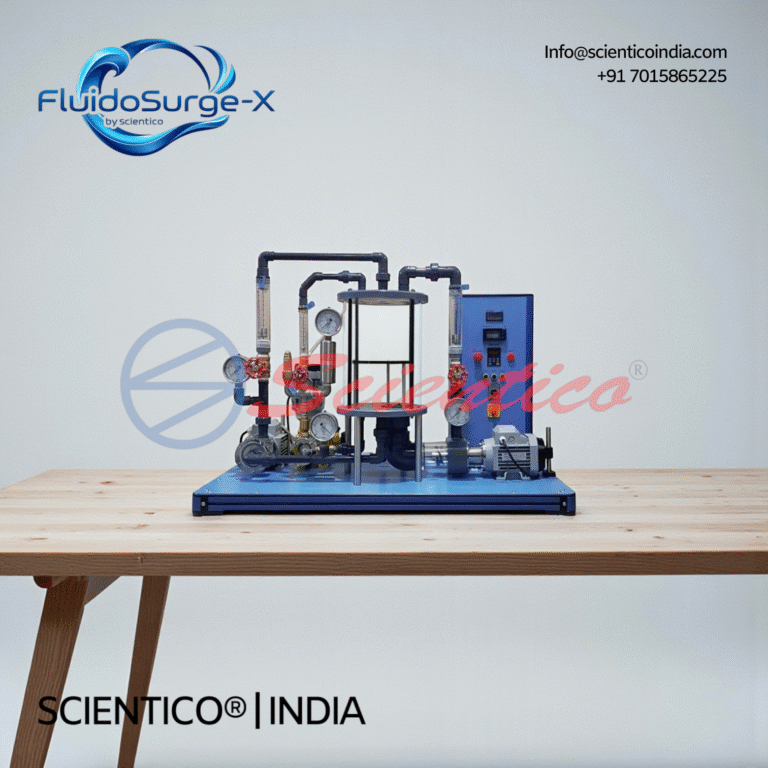
Multi Pump Test Rig Apparatus | FluidoSurge-X 294
The FluidoSurge X-294 is a multi pump test rig (series and parallel centrifugal pump test rig) that lets students run single, series and parallel pump configurations on one apparatus and compare the resulting head–discharge–efficiency characteristics.
View product details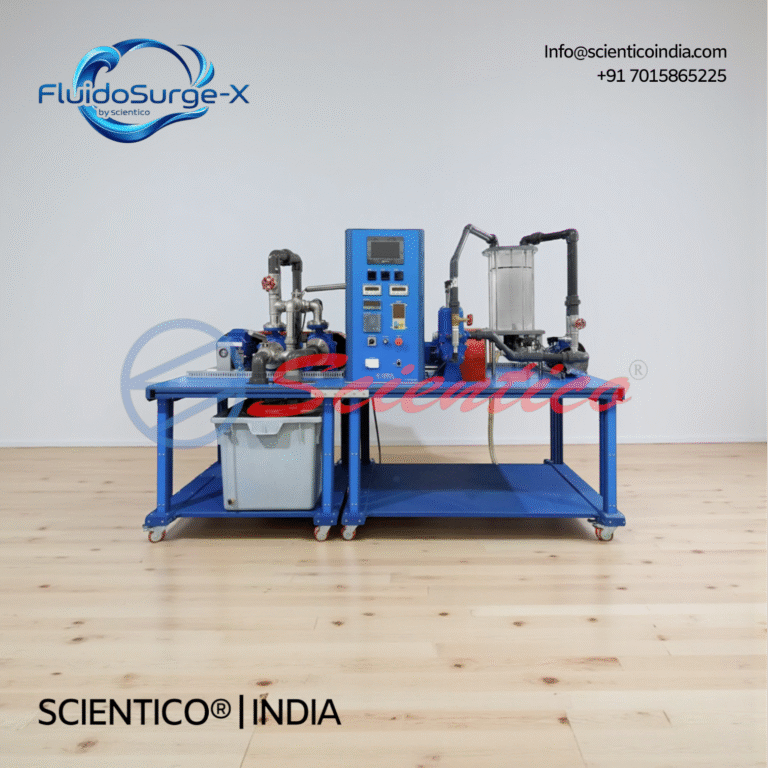
Multi Pump Test Rig with 4 Pumps | FluidoSurge-X 345
The Multi Pump Test Rig with 4 Pumps FluidoSurge-X 345 is an advanced laboratory system designed for detailed study of pump operating characteristics. Manufactured by SCIENTICO, this fully instrumented bench enables experimental analysis of centrifugal, side channel, and positive displacement pumps under controlled conditions.
View product details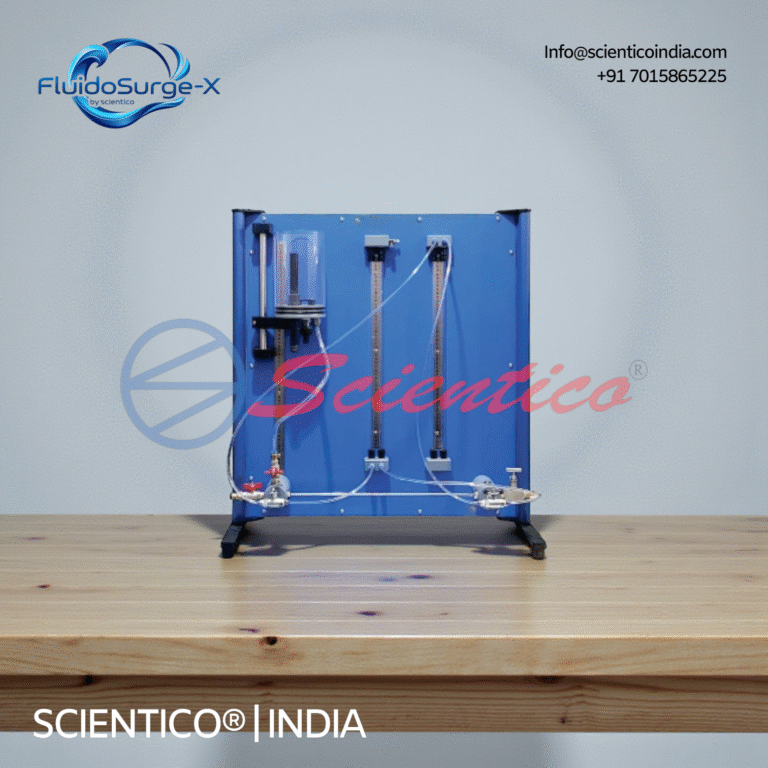
Pipe Friction Apparatus | FluidoSurge-X 168
The Pipe Friction Apparatus FluidoSurge-X 168 is designed for experimental determination of friction losses in pipe flow. It enables study of both laminar and turbulent flow regimes under controlled conditions. The apparatus allows measurement of head loss and determination of critical Reynolds number. It is suitable for fluid mechanics laboratory instruction and experimental analysis.
View product detailsCore specifications for a multi-pump test rig
Use this table as a starting skeleton. Adjust the ranges to your syllabus (BTEUP, MSBTE, GTU, VTU, AKTU, PSBTE, HSBTE all differ slightly on what they want measured) and to your utility supply.
| Parameter | Typical range | Notes for the RFP |
|---|---|---|
| Pump configuration | 2 to 3 centrifugal pumps, series and parallel selectable | State whether identical pumps are mandatory. Identical pumps make the theory cleaner for series/parallel comparison. |
| Motor rating per pump | Typically 0.5 to 1.5 kW, 3-phase preferred | Single-phase is fine for a small ITI setup; polytechnics and engineering colleges should ask for 3-phase, 415 V, 50 Hz. |
| Discharge range | Typically 0 to 200 to 400 LPM at pump outlet | Ask for the head-vs-discharge curve, not just a single duty point. |
| Head range | Typically 5 to 25 m per pump | Combined series head roughly doubles for identical pumps at low flow. That is a teachable moment; verify the rig shows it. |
| Flow measurement | Rotameter and/or measuring tank with piezometer | Measuring tank with stopwatch is the reference. Rotameter is convenience; ask its class (typically 1.6 or 2.5). |
| Pressure measurement | Suction vacuum gauge and delivery pressure gauge, dial type, class 1.0 | Digital transmitters are optional; if quoted, ask for accuracy in percent of span, not percent of reading. |
| Electrical measurement | Energy meter or voltmeter + ammeter + wattmeter per pump line | Needed for input power and overall efficiency. A single common meter is a red flag on a multi-pump rig. |
| Piping and fittings | GI or SS 304 for wetted lines, PVC allowed for return lines | SS 304 costs more, lasts longer, and matters in humid coastal labs. |
| Sump tank | Typically 150 to 300 litres, MS with epoxy or SS 304 | Ask for a drain valve at the lowest point. Cleaning is a real maintenance line item. |
| Safety | MCB per motor, overload relay, emergency stop, IP54 panel | ELCB/RCCB on the incoming line is not optional for a student-run lab. |
| Standards referenced | ISO 9001:2015 for the maker; IS 1828 or equivalent for pump testing where applicable | Calibration traceability should be stated. See the standards section below. |
| Warranty | Typically 12 months on the rig, pump warranty pass-through from OEM | Pump OEM name should appear on the quote (Kirloskar, CRI, Crompton and similar). |
multi-pump test rig specifications, decoding the spec sheet
The single most misread line is discharge range. A vendor will quote the pump’s maximum free-discharge, which happens at zero head. In a real experiment you throttle the delivery valve to build head, and discharge drops along the pump curve. If your syllabus expects students to plot H vs Q, ask for at least six operating points on the supplied curve, not a single number.
Head calculation for series and parallel is where most rigs earn their keep. For two identical pumps in series at the same flow, ideal head roughly doubles; in parallel at the same head, flow roughly doubles. Real rigs show departures from that ideal because of pipe losses between pumps and check-valve pressure drop. That departure is the teaching point. If a vendor’s demo video shows a perfect 2x, either the pumps are oversized for the piping or the readings are staged.
Efficiency needs both hydraulic power out and electrical power in. Hydraulic power in watts is roughly rho times g times Q times H, with Q in cubic metres per second and H in metres. Electrical power comes from the wattmeter, not from V times I on a single-phase assumption. If a rig only ships with voltmeter and ammeter, students will compute apparent power and call it efficiency. That is a wrong lesson baked into the hardware.
Measuring tank sizing is worth checking against your class size. A 40-litre collecting tank with a 200 LPM pump fills in 12 seconds, which is too fast for a group of students to time reliably. Ask for a tank that gives at least 30 to 60 seconds fill time at mid-range flow, or accept that the rotameter becomes the primary instrument and the tank is only for calibration.
Cavitation demonstration is optional on a teaching rig but a nice-to-have for engineering colleges. It usually needs a throttling valve on the suction line and a vacuum gauge with adequate range. If the RFP wants it, say so explicitly; retrofitting the suction throttle later is messy.
Standards the spec sheet should reference
- ISO 9001:2015 for the manufacturer’s quality system.
- CE marking where the buyer intends to export or where the institution’s policy requires it.
- ISO 17025 / NABL calibration traceability for any gauge or transmitter listed as calibrated.
- IS 1828 or equivalent pump acceptance standard where applicable to the pump OEM.
Standards on a quote do not mean the rig is certified end-to-end; they mean the maker and the individual instruments are traceable. That is what a tender committee actually needs to defend the purchase in audit.
Teaching-grade vs research-grade vs industrial-grade specs
Teaching-grade, which is what most polytechnic and engineering diploma labs buy, uses class 1.0 or 1.6 gauges, rotameters, MS or SS sump, and manual valves. Accuracy is around plus-minus 2 to 3 percent on the derived efficiency, which is more than enough to teach the curve shapes.
Research-grade adds calibrated pressure transmitters (0.25 percent class), turbine or electromagnetic flow meters, VFD control on at least one motor, and DAQ logging. Overall uncertainty budget drops to around 1 percent. Cost typically doubles or more. For most B.Tech labs this is overkill; for M.Tech project work or centres of excellence it earns its price.
Industrial-grade rigs are IEC 60193 style acceptance benches used by pump OEMs. Ignore them for teaching. If a vendor tries to sell you one wrapped as a teaching rig, the quote will be several times what it should be.
Common spec-sheet red flags
- Accuracy stated as a single number with no reference (percent of reading? span? full scale?). Reject and ask for restatement.
- No calibration certificate promised for the pressure gauges and flow meter. On a teaching rig you should still get factory calibration records with instrument serial numbers.
- Single common energy meter for two or three pumps. You cannot compute per-pump efficiency from that.
- Wrong electrical spec: single-phase 230 V motors quoted for a lab that only has 3-phase 415 V, or vice versa. Confirm your supply before floating the RFP.
- No named pump OEM. Generic “high quality centrifugal pump” is a warranty problem waiting to happen.
- Delivery promised in an unrealistic short window. Custom-built rigs need several weeks of production, and sea or road transit adds more; anyone promising a week is either holding old stock or lying.
Scientico’s multi-pump test rig, what our spec sheet includes
Our current build is the FluidoSurgeX multi-pump test rig, built at our Ambala facility. It has been shipped to labs in 30+ countries since 1993, is made under an ISO 9001:2015 system, and ships with CE documentation where the buyer needs it. The spec sheet gives per-pump wattmeter readings, series and parallel valve routing, an SS 304 wetted line option, and a measuring tank sized for a class group rather than for a single operator. Related pieces buyers usually spec at the same time are the hydraulic bench, pipe friction apparatus and single centrifugal pump rig. If you are building the whole lab in one purchase, the complete fluid mechanics lab setup guide is the right starting point.
Ready to hand over your draft RFP for review, or want a spec sheet cut to your syllabus and utility supply? Send it across through the contact page and I will mark it up with the ranges and clauses I would defend in a tender committee.
Frequently Asked Questions
What is the typical discharge range for a teaching multi-pump test rig?
Typically 0 to 200 to 400 LPM per pump at the outlet, with the actual operating flow set by throttling the delivery valve. Ask for the full head-vs-discharge curve, not a single duty point, so students can plot H vs Q properly.
Should I ask for single-phase or 3-phase motors?
For ITI and small vocational labs single-phase 230 V is workable. For polytechnics and engineering colleges I recommend 3-phase 415 V, 50 Hz motors because efficiency is better and the wattmeter measurement matches what industry uses. Confirm your lab’s utility supply before writing the RFP.
What accuracy should the pressure gauges have?
Class 1.0 dial gauges are standard on teaching rigs and give roughly plus-minus 1 percent of full scale. Reject any spec that just says ‘high accuracy’ without stating the class or whether the tolerance is on reading, span or full scale.
Do I need calibration certificates for a teaching rig?
Yes. Even at teaching grade you should get factory calibration records with the instrument serial numbers on the pressure gauges and flow meter. For research-grade rigs insist on ISO 17025 or NABL traceable calibration.
How long does production and delivery usually take?
Custom-built rigs need several weeks of production. Sea transit for export orders adds more, road transit within India is faster. Treat any promise of a one-week delivery on a custom rig as a red flag; it usually means old stock or overstated commitments.
One honest ask
We don't gate anything on this site. You just read the whole thing free. If it was useful, leave your email and two things happen: we send you this page as a plain-text block you can paste into a tender file or an internal email, and we notify you the next time we publish a buyer tool like this one. Nothing else. No drip sequence, no sales calls booked without asking.