
This Fluid Mechanics sub-range covers laboratory test rigs used to characterise the performance of centrifugal and reciprocating pumps. The rigs let students plot head-versus-discharge (H-Q) curves at constant speed, derive characteristic curves at variable speed, study series and parallel combinations of two identical pumps, and record the pressure-volume indicator diagram of a reciprocating pump. Scientico manufactures these rigs at its Ambala, India works and exports them worldwide under CIF terms.
Equipment mentioned in this guide
Review the product information, specifications and model before requesting a quotation.
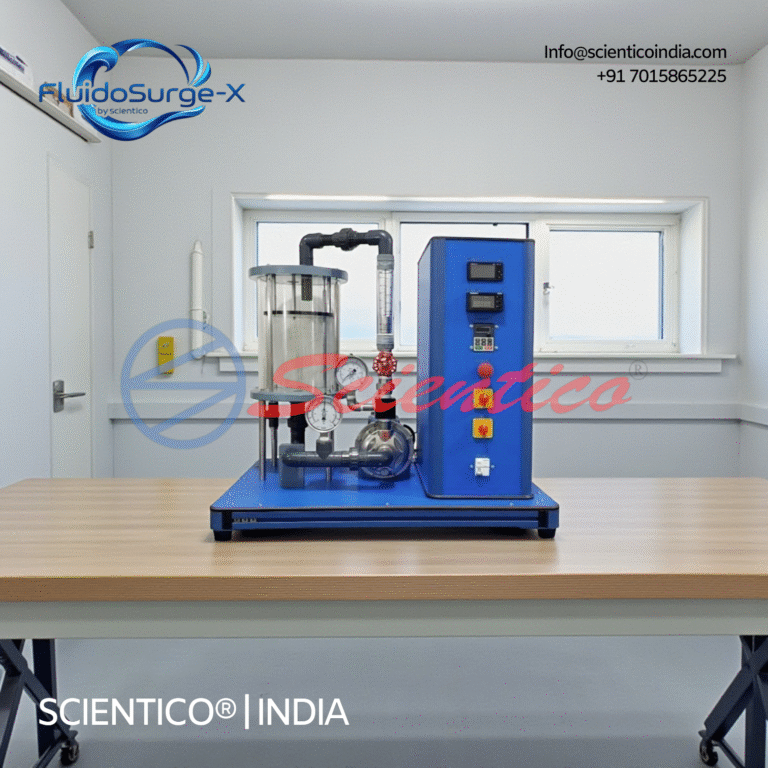
Centrifugal Pump | FluidoSurge-X 188
The Centrifugal Pump FluidoSurge-X 188 is designed for instructional demonstration and experimental study of centrifugal pump performance. It enables controlled investigation of pump characteristics under variable speed and head conditions. The apparatus integrates measurement of flow rate, pressure, and rotational speed. It is suitable for fluid mechanics and hydraulic machinery laboratories.
View product detailsProducts in this range
- FluidoSurge-C 100 Single-Stage Centrifugal Pump Test Rig, closed-loop rig with sump, delivery and suction gauges, orifice-meter flow measurement, and energy-meter input power reading.
- FluidoSurge-C 200 Variable-Speed Centrifugal Pump Test Rig, VFD-driven motor for constant-head and constant-discharge characteristic families.
- FluidoSurge-CP 300 Series/Parallel Twin-Pump Test Rig, two identical centrifugal pumps with change-over valves for individual, series and parallel operation.
- FluidoSurge-MS 400 Multi-Stage Centrifugal Pump Test Rig, 2- and 3-stage operation on the same skid for stage-wise head build-up study.
- FluidoSurge-R 500 Reciprocating Pump Test Rig, single-cylinder pump with mechanical indicator and air vessel for slip and indicator-diagram experiments.
- FluidoSurge-RD 600 Double-Acting Reciprocating Pump Test Rig, for comparison of single- and double-acting delivery and coefficient of discharge.
- FluidoSurge-GP 700 Gear Pump Test Rig, positive-displacement rig for volumetric efficiency versus delivery pressure.
- FluidoSurge-JP 800 Jet Pump Test Rig, nozzle-throat-diffuser assembly for jet-pump efficiency characteristics.
Typical experiments demonstrated
- H-Q performance curve at constant speed, throttle the delivery valve in steps, record suction and delivery pressure, discharge and input power; plot head, power and overall efficiency against discharge.
- Characteristic curves at variable speed, vary motor speed with the VFD, capture families of H-Q, P-Q and eta-Q curves and verify the affinity laws H proportional to N squared and Q proportional to N.
- Pumps in series, open the inter-connecting valve so pump-2 takes delivery from pump-1; confirm that heads add for the same discharge.
- Pumps in parallel, feed a common delivery header from both pumps; confirm that discharges add for the same head.
- Reciprocating pump slip and coefficient of discharge, measure theoretical discharge from bore, stroke and rpm, compare with actual discharge collected in the measuring tank, and compute percentage slip.
- Indicator diagram of a reciprocating pump, take a mechanical indicator card, calculate indicated power and compare with shaft input to obtain mechanical efficiency.
Key specifications you should ask for
| Parameter | Typical range |
|---|---|
| Pump rated head | 15 to 30 m of water |
| Pump rated discharge | 50 to 400 LPM |
| Motor rating | 0.5 to 3.0 HP, single or three phase |
| Supply voltage | 230 V / 50 Hz single phase or 415 V / 50 Hz three phase (other voltages built to order) |
| Speed control (variable-speed models) | VFD, 0 to 3000 rpm approx. |
| Flow measurement | Calibrated collecting tank with piezometer, plus orifice or venturi meter |
| Pressure gauges | Bourdon-type: compound gauge on suction, pressure gauge on delivery |
| Sump tank capacity | 150 to 300 litres, MS with anti-corrosive coating or SS 304 |
| Piping | GI or SS with union joints and gate/ball control valves |
| Frame | MS square-tube skid on levelling feet |
| Overall footprint | 1500 to 2200 mm L x 700 to 900 mm W x 1200 mm H (indicative) |
Confirm the exact model card at enquiry stage; ranges above are indicative of the class and are tailored to each order.
Applications
These rigs are specified in fluid mechanics and hydraulic machines laboratories for:
- BTech Mechanical Engineering, Fluid Mechanics and Hydraulic Machines lab.
- BTech Civil Engineering, Fluid Mechanics and Hydraulics lab.
- BTech Chemical / Agricultural Engineering, unit operations and farm-power labs.
- Diploma in Mechanical / Civil Engineering, polytechnic hydraulics lab.
- ITI trades in pump operation and maintenance.
- Vocational and short-course training centres for pump technicians.
Standards & compliance
Scientico is an ISO 9001:2015 quality-management-system certified manufacturer and its equipment carries the CE mark for export. Pump test procedures on these rigs follow the general framework of IS 9137 and ISO 9906 (rotodynamic pumps hydraulic performance acceptance tests) at classroom level, and reciprocating pump testing follows the conventions used in standard hydraulics textbooks. Electrical construction uses BIS-marked motors, MCB protection and earthed metal frames; instrumentation is factory-calibrated before dispatch and a calibration certificate is issued with each rig.
Ordering & delivery
Rigs are quoted on CIF terms to the nearest suitable seaport; buyers may also request FOB Nhava Sheva / Mundra or Ex-Works Ambala. Standard sea-freight ports served include Jebel Ali, Dar es Salaam, Mombasa, Lagos (Apapa), Durban, Colombo, Chittagong, Port Klang, Jakarta and Guayaquil, among others. Indicative production lead time is 3 to 6 weeks from advance payment, depending on model, voltage variant and current order book; transit time is quoted separately by the freight forwarder. Each rig ships in a seaworthy plywood crate with a bilingual instruction manual, experiment write-ups, wiring diagram and packing list. Installation is by the buyer’s technician using the supplied manual; remote commissioning support is provided by email, WhatsApp and video call.
For a specification-matched quotation, share your intended experiments, three-phase or single-phase supply, and delivery port; a CIF offer is returned by email or WhatsApp.
See all Fluid Mechanics products →
Frequently Asked Questions
What is the difference between a performance curve and a characteristic curve of a centrifugal pump?
A performance curve is taken at one constant speed and plots head, power and efficiency against discharge. A characteristic curve is a family of such curves at different speeds, from which the affinity laws (H proportional to N squared, Q proportional to N) can be verified.
How is discharge measured on Scientico's centrifugal pump test rigs?
Discharge is measured by a calibrated collecting tank fitted with a piezometer and stopwatch (primary reference), and cross-checked with an orifice-meter or venturi-meter installed on the delivery line. This gives students both volumetric and differential-pressure methods.
Why do pumps in series add heads while pumps in parallel add discharges?
In series the delivery of one pump becomes the suction of the next, so at a common flow the pressure rises stack. In parallel both pumps feed a common header at the same head, so their individual discharges combine at that head.
What is slip in a reciprocating pump and can it be negative?
Slip is the percentage difference between theoretical discharge (from bore, stroke and rpm) and actual discharge. It is usually positive due to leakage, but can be negative in long suction pipes where inertia keeps liquid flowing into the cylinder after the delivery valve opens.
Do the rigs come with a three-phase supply option for export orders?
Yes. Rigs can be built for 230 V / 50 Hz single phase or 415 V / 50 Hz three phase as standard, and other voltage / frequency combinations (for example 220 V / 60 Hz or 380 V / 60 Hz) are built to order. Confirm your site supply at enquiry stage.
What is the typical lead time and shipping arrangement?
Indicative production lead time is 3 to 6 weeks from advance payment, subject to the current order book. Rigs are quoted CIF to the buyer’s nearest seaport by default; FOB Indian port or Ex-Works Ambala are also available on request.
One honest ask
We don't gate anything on this site. You just read the whole thing free. If it was useful, leave your email and two things happen: we send you this page as a plain-text block you can paste into a tender file or an internal email, and we notify you the next time we publish a buyer tool like this one. Nothing else. No drip sequence, no sales calls booked without asking.