
Every fluid mechanics lab I have kitted out in the last fifteen years ends up asking the same question. Do we buy a venturi rig, an orifice rig, or both? The honest TL;DR is this. If your students only ever run one flow measurement experiment and you care about a clean coefficient of discharge story, buy the orifice. If you want the textbook Bernoulli demo, low permanent head loss, and a rig that survives a decade of rough handling, buy the venturi. Caveat before we go further: most engineering colleges eventually need both, so the real question is usually sequencing, not either or.
Equipment mentioned in this guide
Review the product information, specifications and model before requesting a quotation.
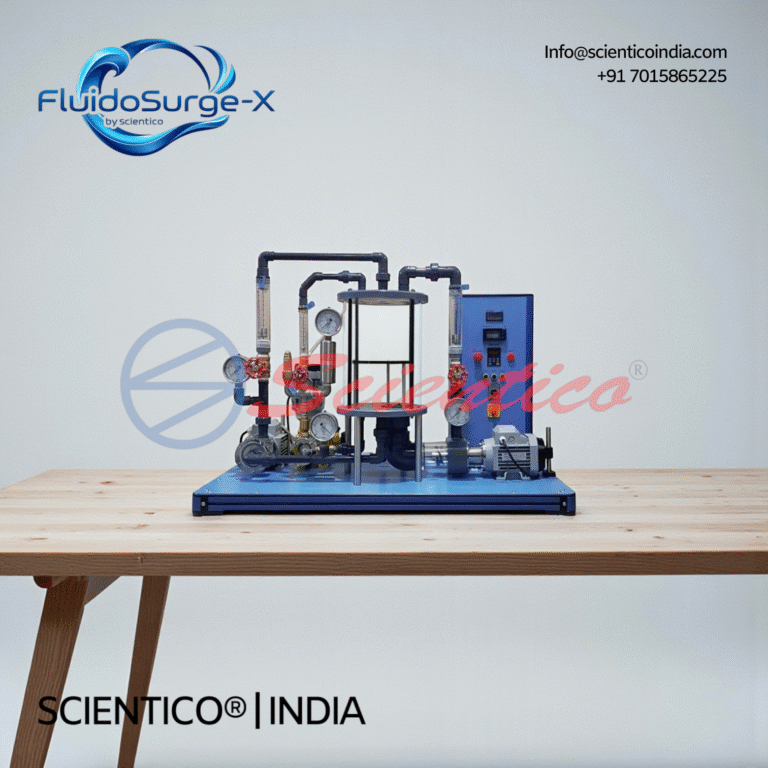
Multi Pump Test Rig Apparatus | FluidoSurge-X 294
The FluidoSurge X-294 is a multi pump test rig (series and parallel centrifugal pump test rig) that lets students run single, series and parallel pump configurations on one apparatus and compare the resulting head–discharge–efficiency characteristics.
View product details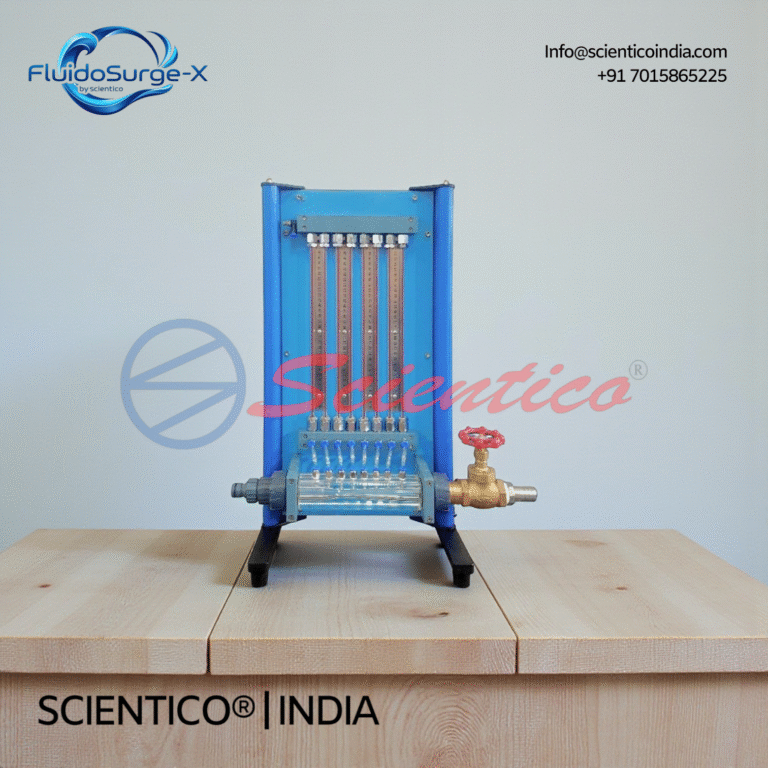
Venturi Meter Apparatus | FluidoSurge-X 176
The Venturi Meter Apparatus FluidoSurge-X 176 is designed for experimental determination of flow rate in pipes using a Venturi tube. It enables measurement of static pressure distribution along a horizontal Venturi section. The apparatus supports analysis of pressure drop and pressure recovery characteristics. It is intended for fluid mechanics laboratory instruction and experimental verification.
View product details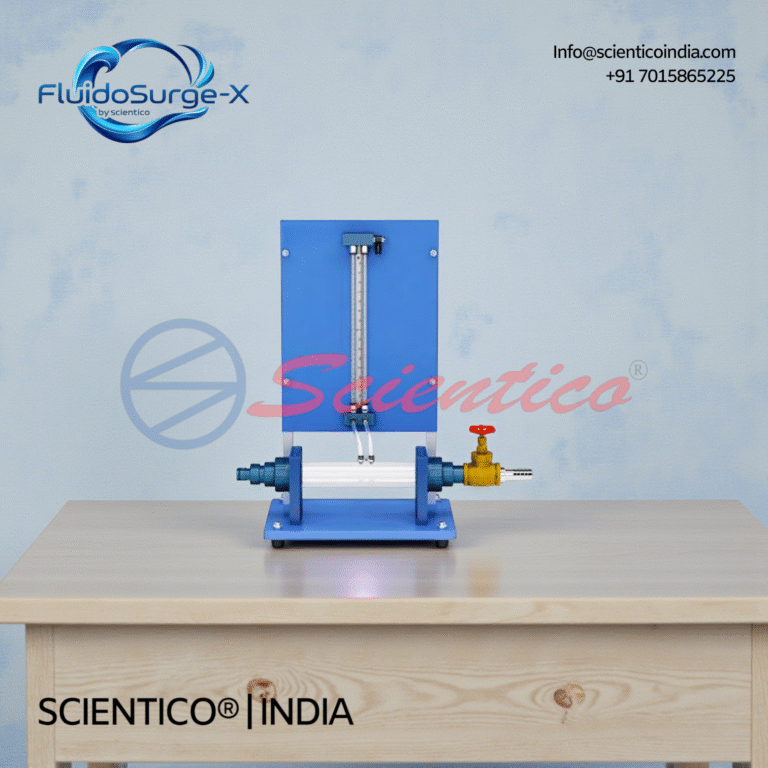
Orifice Flowmeter | FluidoSurge-X 232
The Orifice Flowmeter FluidoSurge-X 232 is a laboratory apparatus designed to demonstrate and study flow measurement using the differential pressure principle. Manufactured by SCIENTICO, the unit enables experimental verification of Bernoulli’s principle and the continuity law. It is intended for instructional use in fluid mechanics and hydraulics laboratories. The apparatus operates in conjunction with a hydraulic bench or laboratory water supply.
View product details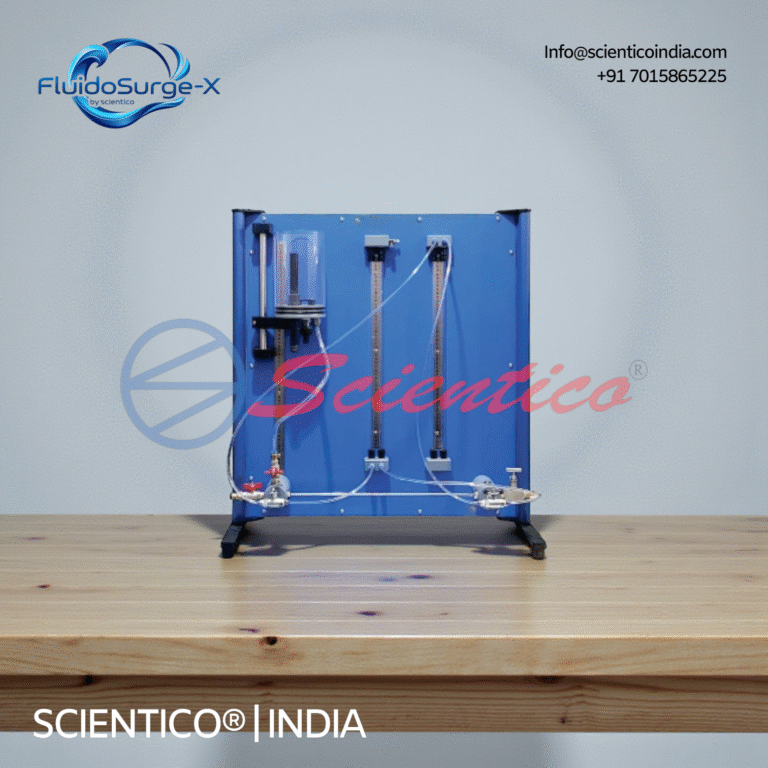
Pipe Friction Apparatus | FluidoSurge-X 168
The Pipe Friction Apparatus FluidoSurge-X 168 is designed for experimental determination of friction losses in pipe flow. It enables study of both laminar and turbulent flow regimes under controlled conditions. The apparatus allows measurement of head loss and determination of critical Reynolds number. It is suitable for fluid mechanics laboratory instruction and experimental analysis.
View product detailsThe short answer
For a diploma or ITI lab on a tight capital budget, I would start with an orifice and mouthpiece apparatus. It is cheaper, the plates are swappable, and Cd variation between sharp-edged, rounded and Borda mouthpieces gives you four experiments from one rig. For a BTech mechanical or civil department that already owns a hydraulic bench, the venturi is the smarter buy because it pairs with a pitot tube on the same manifold and teaches the pressure recovery concept properly. Research groups should stop deliberating and specify both, calibrated, on the same supply loop.
Head-to-head at a glance
| Parameter | Venturi meter | Orifice meter |
|---|---|---|
| Working principle | Gradual convergent-divergent contraction with Bernoulli plus continuity | Sudden contraction through a sharp-edged plate, vena contracta downstream |
| Typical Cd | 0.95 to 0.98 | 0.60 to 0.65 for sharp-edged |
| Permanent head loss | Low, roughly 10 to 20 percent of differential | High, often 50 to 70 percent of differential |
| Accuracy on a teaching rig | Typically within 1 to 2 percent of true discharge | Typically within 2 to 4 percent, plate-dependent |
| Length required | Long, around 5 to 8 pipe diameters upstream plus a divergent cone | Compact, plate thickness plus tappings |
| Interchangeable elements | No, the throat is fixed | Yes, plates and mouthpieces swap in minutes |
| Applicable reference | IEC and general Bernoulli literature, built to ISO 9001:2015 | ISO 5167 series for orifice geometry, built to CE marking |
| Cost tier | Mid to high | Low to mid |
| Best fit | BTech, research, thermofluid electives | Diploma, ITI, first-year mech and civil |
Working principle: how each one operates
The venturi is a shaped tube. Flow accelerates through a smooth convergent section, hits a throat of reduced diameter where static pressure drops, then decelerates through a long divergent cone that recovers most of that pressure. The two manometer tappings, inlet and throat, give the differential head h and the discharge follows Q = Cd A1 A2 sqrt(2gh) divided by sqrt(A1 squared minus A2 squared). Because the geometry is gentle, separation is minimal and Cd sits near unity. Students see the theory work almost cleanly, which is exactly what you want in an undergraduate class.
The orifice is brute simple. A flat plate with a machined hole is bolted between two flanges. Flow squeezes through, forms a vena contracta a short distance downstream where actual jet area is smaller than the hole area, and pressure is read from tappings on either side. The same discharge equation applies but Cd is lower and it hides two physical effects at once: contraction of the jet and viscous losses. That is pedagogically useful. Students learn why Cd matters and why real installations do not obey ideal Bernoulli.
venturi vs orifice meter comparison, which for which department
Diploma polytechnics under HSBTE, MSBTE, SBTET or WBSCTE. Pick the orifice. The DGT and state-board syllabi treat coefficient of discharge and coefficient of contraction as separate learning outcomes, and only a swappable plate rig hits both cleanly in one lab session. Pair it with a small hydraulic bench and you cover a full semester of measurement.
BTech mechanical or civil under AICTE, AKTU, GTU, VTU or MAKAUT. Pick the venturi. The theory chapter runs deeper here and the low head loss lets students see pressure recovery on a piezometer bank. If the lab already has a pipe network, the venturi drops into the loop with less pump derating than an orifice bank.
Research labs and PG thermofluid work. Buy both, and insist on ISO 17025 calibration on the venturi throat. My rule: never publish a friction factor or turbine efficiency paper using an uncalibrated orifice plate. See the full complete fluid mechanics lab setup buyers guide for how these tie into pipe friction, notches and turbine rigs.
ITI vocational shops under NCVT. Orifice, no debate. Budget is the constraint and the plate rig teaches installation, tapping placement and manometer reading, which is what the trainee actually needs on a shop floor.
Common mistakes when choosing
Buying only the venturi because it looks premium. I have watched departments spend two years wishing they had a swappable orifice for the Cd experiment because the syllabus demands it. The venturi is elegant but it teaches one number well, not five.
Ignoring pump head. An orifice at 50 to 70 percent permanent loss will starve a small centrifugal pump. If your supply is a modest bench pump, either upsize the pump or take the venturi. Check the pump curve against the meter loss before you order.
Skipping the mouthpiece variants. The whole point of an orifice and mouthpiece apparatus is the comparison between sharp-edged, external cylindrical, convergent-divergent and Borda mouthpieces. If a supplier ships only two plates, you are buying half a rig.
Confusing accuracy with repeatability. A student rig that reads 3 percent low every time is fine for teaching. A rig that scatters 3 percent randomly is not. Ask for the manometer resolution and the machining tolerance on the throat or plate, not just a headline accuracy number.
Scientico’s recommendation
For a mixed department that will run both experiments, I specify the Venturi and Pitot Apparatus alongside the Orifice and Mouthpiece Apparatus, both connected to a common bench return. That way one pump serves both experiments and you do not double the plumbing. If the buyer can only pick one this fiscal year, and the college teaches BTech, the venturi and pitot combo wins because it doubles as the velocity profile experiment. For a diploma-only lab, the orifice rig is my default.
Round out the fluid mechanics room with a flow measurement apparatus for rotameter comparison, a pipe friction apparatus for Darcy Weisbach work, and the FluidoSurge X multi-pump test rig if the department has centrifugal pump characteristics on the syllabus. See the full fluid mechanics lab equipment range for the complete catalogue.
Cost & delivery framework
I do not publish fixed prices here because manometer type, tube material, frame finish and calibration certification move the number meaningfully. As a tier reference, the orifice and mouthpiece apparatus sits in the low to mid bracket, the venturi and pitot combo lands mid, and a research-grade unit with ISO 17025 traceable calibration sits mid to high. Ask for a written quote with the manometer specification called out.
Incoterms: Scientico ships EXW Ambala for domestic, FOB Mundra or Nhava Sheva for international sea freight, and CIF is available on request. Lead time is several weeks of production for a standard build, and sea transit adds more depending on destination. Air freight is possible for compact orifice rigs but rarely economical for the venturi because of the length.
Scientico has been manufacturing lab equipment since 1993 from Ambala, ships to more than 60 countries, and every fluid mechanics rig leaves the floor under ISO 9001:2015 with CE marking where applicable. If you want the certificate pack quoted upfront, say so in the RFQ.
Ready to specify your rig? Share your syllabus, pump specification and preferred manometer type and I will send back a tailored comparison quote within a working day. Contact Scientico to start the conversation.
Frequently Asked Questions
Which is more accurate, a venturi or an orifice meter?
The venturi is more accurate on a teaching rig, typically within 1 to 2 percent of true discharge with a Cd of 0.95 to 0.98. A sharp-edged orifice sits at Cd 0.60 to 0.65 and delivers 2 to 4 percent accuracy. For research work, the venturi wins. For teaching the concept of coefficient of discharge, the orifice is actually the better tool because the deviation from ideal is visible.
Why is the head loss so much higher in an orifice meter?
An orifice forces flow through a sudden contraction and then lets it re-expand as a turbulent jet with significant eddy losses. Permanent head loss is typically 50 to 70 percent of the measured differential. A venturi uses a gentle divergent cone that recovers most of the pressure, so permanent loss is only 10 to 20 percent. If your bench pump is small, this difference matters.
Can one rig replace both meters in a diploma syllabus?
No. The syllabi under HSBTE, MSBTE, SBTET and similar boards ask for separate experiments on Cd for orifice plates and Bernoulli demonstration through a venturi. A combined single-tube rig cannot swap plate geometries. Scientico offers both as independent apparatuses that share a hydraulic bench return, which is the most cost-efficient way to hit the full syllabus.
What standards should the venturi and orifice apparatus meet?
Manufacturing quality should be under ISO 9001:2015 with CE marking. For research-grade orifice geometry, the reference is the ISO 5167 series. If the rig is going into a NABL-accredited lab, ask for ISO 17025 traceable calibration on the throat diameter or plate bore. Scientico ships all three levels of documentation on request.
What is the typical lead time and shipping arrangement?
Standard production runs several weeks from order confirmation. Domestic orders ship EXW Ambala. International orders ship FOB Mundra or Nhava Sheva by default, with CIF available on request. Sea transit adds further weeks depending on destination port. Air freight is only economical for compact orifice rigs, not the longer venturi tube.
One honest ask
We don't gate anything on this site. You just read the whole thing free. If it was useful, leave your email and two things happen: we send you this page as a plain-text block you can paste into a tender file or an internal email, and we notify you the next time we publish a buyer tool like this one. Nothing else. No drip sequence, no sales calls booked without asking.