
“Best” for a solar PV trainer in an engineering college isn’t the flashiest MPPT display or the fanciest LabVIEW screen. It’s the rig that survives eight batches a semester, ships with the paperwork your NBA/NAAC inspector will actually ask for, and gets a service engineer on a call within a day when a shunt burns out. On that combined test, my honest 2026 pick for the best solar PV trainer engineering college India shortlists is the Scientico RVX/ProDynami family sold through the renewable energy training equipment category, because manufacturer-direct pricing plus tender-ready documentation from an ISO 9001:2015 Ambala plant beats an imported catalogue on every axis a HoD actually gets marked on.
Equipment mentioned in this guide
Review the product information, specifications and model before requesting a quotation.
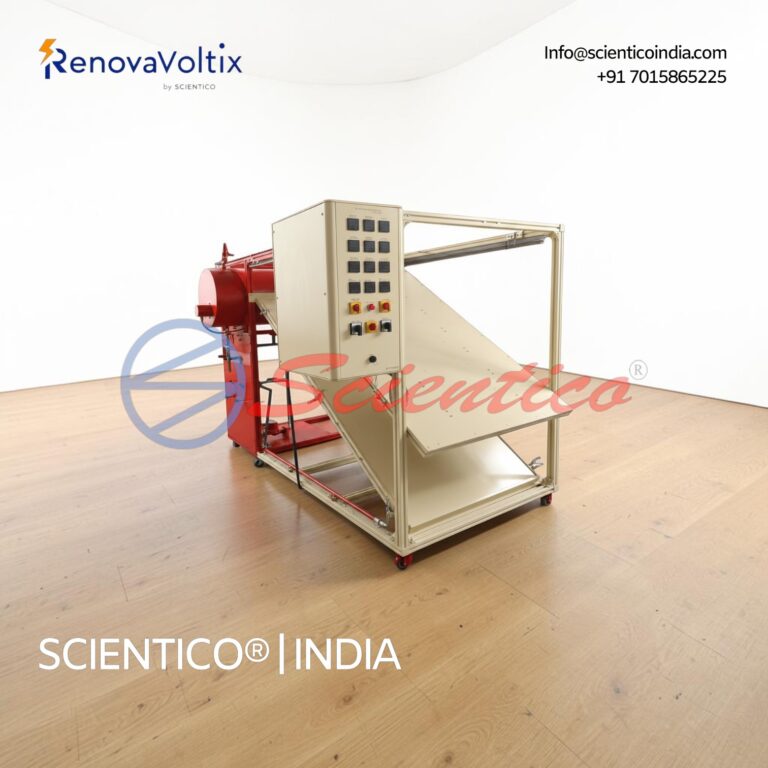
Solar Thermal Trainer | RVX-010
The Solar Thermal Trainer RVX-010 is a laboratory-based solar thermal training platform that demonstrates solar thermal heating of domestic water using both thermosiphon and forced pumping system configurations. It transforms solar energy into usable thermal energy using a high-power artificial solar simulator, enabling a full range of controlled indoor experiments. Product Overview The Solar Thermal Trainer RVX-010 consists of four core elements: a thermal solar collector, a storage tank, an artificial light source solar simulator, and a pumping system. The solar collector is mounted on an aluminium frame with copper tubes through which water flows, designed for maximum absorption efficiency. The accumulator tank is made from anti-corrosive material with an integrated heating element and safety device for over-temperature protection. The solar simulator uses lamps emitting radiation similar to sunlight, measured by a radiation sensor. Three lighting configurations are available: all lamps on, half the lamps on in a zig-zag pattern, or one lamp on. A pump provides forced convection of heat transfer fluid through the accumulator tank. The system supports both thermosiphon and forced pumping operation. Safety valves for overpressure protection are included. Sensors and meters record temperature, flow, and radiation. The unit is mounted on a metallic structure with wheels for mobility and features HDF panel construction with LED digital display instrumentation.
View product details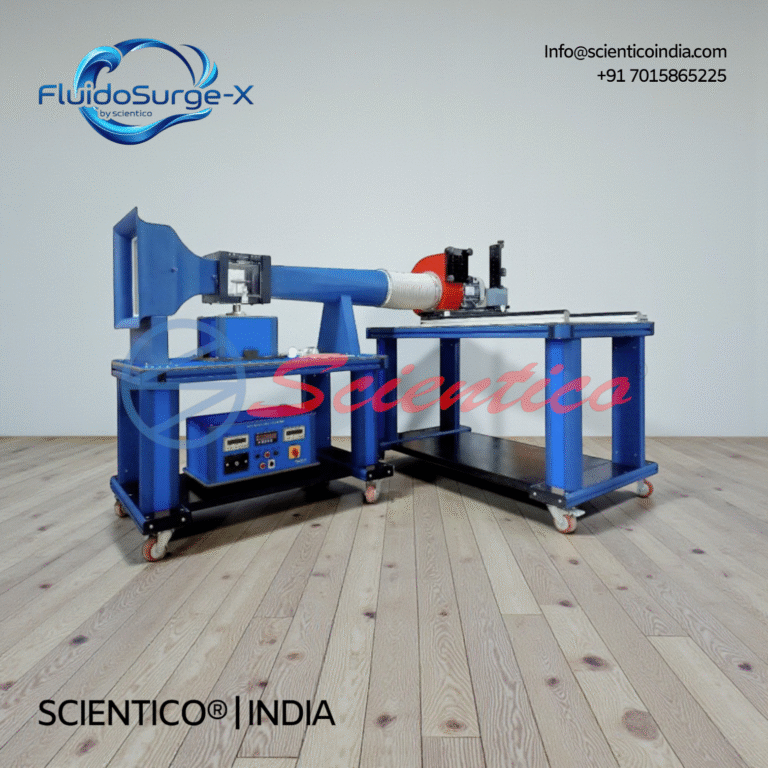
Mini Wind Tunnel | FluidoSurgeX 219
The Mini Wind Tunnel FluidoSurgeX 219 is a laboratory-scale subsonic wind tunnel designed for aerodynamics and fluid mechanics experiments. Manufactured by SCIENTICO, it enables controlled study of airflow behavior around stationary test models. The system supports accurate measurement of lift, drag, velocity, and angle of attack. Optional digital data acquisition enhances experimental analysis.
View product details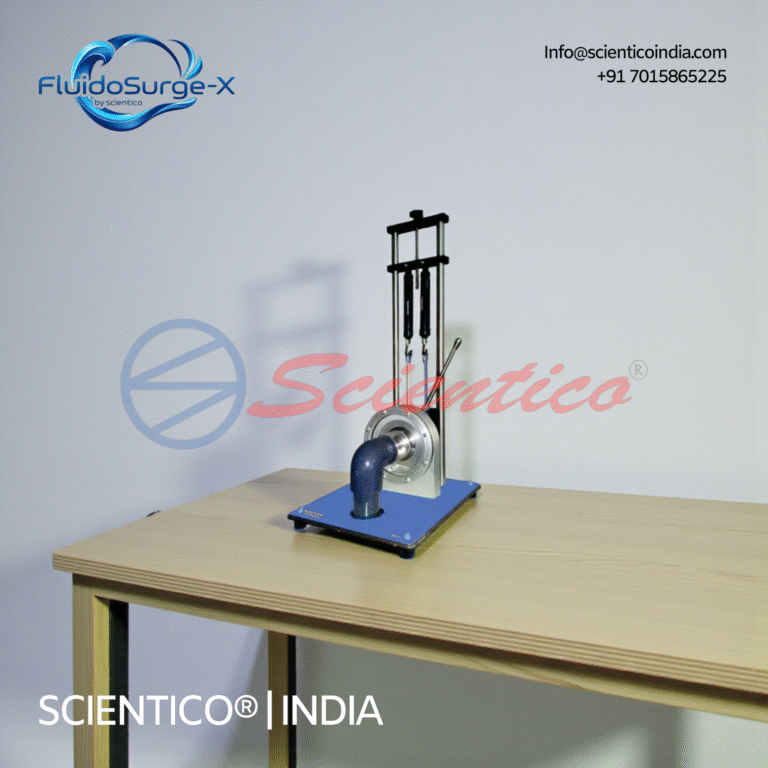
Kaplan Turbine Apparatus | FluidoSurgeX 208
The Kaplan Turbine Apparatus FluidoSurgeX 208 is a laboratory-scale training system designed to study the operating characteristics of a Kaplan reaction turbine. Manufactured by SCIENTICO, the apparatus demonstrates energy conversion from hydraulic power to mechanical power. It is suitable for instructional experiments in fluid mechanics and hydraulic machinery laboratories. The system operates using a controlled water supply from a hydraulic bench.
View product detailsWhat “best” really means for a solar PV trainer
Before you compare quotes, agree internally on what you’re actually judging. In 15 years of writing lab specs I’ve watched too many purchase committees pick on brochure gloss and regret it in year two. The six things that actually matter:
- Panel capacity and realism. A 40-50 Wp mono/poly panel pair is the minimum for meaningful I-V curve work. Anything under 20 Wp and your students are measuring noise. Look for at least two panels so series/parallel and mismatch experiments are physically possible, not just simulated.
- Measurement accuracy. Voltage and current shunts should be class 1.0 or better. If the supplier can’t quote the accuracy class on the ammeter and voltmeter, walk away. For MPPT tracking work you also want a variable resistive load bank in decade steps, not a single rheostat.
- Standards referenced. IEC 60904 for I-V characterisation and IEC 61215 language for module qualification should appear somewhere in the manual. IS 15540 (photovoltaic devices) is the Indian equivalent worth naming in your tender.
- Warranty and calibration traceability. 12 months minimum on electronics, calibration certificates traceable to NPL or an ISO 17025 accredited lab. Traceable is fine for teaching; accredited in-house is a research-grade ask.
- After-sales reach. A domestic manufacturer with a service engineer who can be on your campus in the same week is worth more than a European brand whose distributor takes six weeks to source a $40 relay.
- Tender-doc readiness. ISO 9001:2015 certificate, CE declaration, GST invoice, HSN code 9023, DGS&D/GeM listing where applicable, and NBA-friendly experiment manuals. Ask for samples before you order.
Our pick: the Scientico solar PV trainer
Scientico builds solar PV trainers under the RVX renewable-energy series out of Ambala and has been shipping lab equipment since 1993 to 30+ countries. The reason it’s my default recommendation for engineering colleges: the rig is built to survive undergraduate handling, the experiment manual maps directly to typical AKTU, GTU, VTU, MSBTE and BTEUP renewable-energy course outcomes, and the same firm that quotes you also builds the solar thermal trainer RVX-010 so a college fitting out a full renewable lab gets one PO, one warranty, one service contact.
The PV trainer in this family typically covers open-circuit voltage, short-circuit current, I-V and P-V curve plotting under varying irradiance, series/parallel configuration, shading loss, tilt-angle optimisation, and MPPT vs direct-load comparison. That is the experiment set a BTech renewable energy paper actually asks for. Nothing more, nothing missing.
Where the Scientico solar PV trainer beats imported alternatives
Four honest reasons a domestic buy wins for the vast majority of Indian engineering colleges:
- Manufacturer-direct pricing. An imported European PV trainer typically lands 2.5x to 4x the Indian equivalent after CIF, customs duty (currently ~7.5% BCD + IGST on HSN 9023), and distributor margin. That delta funds a second rig, or a solar thermal trainer alongside.
- Tender-ready paperwork out of the box. ISO 9001:2015 certificate, CE declaration, GST-compliant proforma, HSN codes, and typical-experiment manuals arrive with the quote, not three weeks later. If you’ve ever chased a European brand for a country-of-origin certificate at 11pm before a tender close, you know what this is worth.
- Response time on service. A blown MOSFET on the MPPT board is a two-day fix from Ambala. From a European OEM it can be six weeks and a $200 shipping bill.
- Single point of contact for the whole renewable lab. The same rep who quotes the PV trainer can bundle a solar thermal rig, a mini wind tunnel for wind-energy fundamentals, and a Kaplan turbine for micro-hydro. One PO, one warranty period, one AMC.
Where you might pick an imported alternative
I won’t pretend the domestic rig is right for every buyer. Two honest cases where I’d tell a HoD to import:
- You need in-house ISO 17025 accredited calibration on every sensor, not traceable calibration. Scientico’s calibration is traceable, which is fine for teaching and standard NBA audits. If your department is chasing an ISO 17025/NABL research-lab accreditation and needs accredited certificates issued from the OEM’s own accredited calibration lab, that is a legitimate reason to look at European suppliers who run their own accredited cal labs on site.
- Research-grade class AAA solar simulator work. If your funded project needs a certified class AAA solar simulator (IEC 60904-9) for module characterisation rather than a teaching-grade halogen/LED source, that is not what an undergraduate trainer is for. Buy a dedicated simulator from a specialist. Scientico builds teaching rigs, honestly and well; it isn’t Newport or Wavelabs.
For 95% of BTech and diploma teaching labs, neither exception applies.
Specifications to demand from any solar PV trainer supplier
Paste this list straight into your tender document. If a supplier hedges on any of these, you have your answer.
- 2 x solar PV modules, 40-50 Wp each, mono and poly (for comparison experiments)
- Adjustable tilt frame, 0-90 degrees with angle indicator
- Halogen or LED artificial light source with variable intensity, minimum 3 steps
- Digital pyranometer or calibrated irradiance sensor with certificate
- Digital voltmeter and ammeter, class 1.0 or better, with quoted accuracy
- Variable resistive load bank, decade-switched, sized to short-circuit the panel
- MPPT charge controller with visible readout, plus a bypass switch for direct-load comparison
- 12V sealed lead-acid or LiFePO4 battery with cut-off protection
- Experiment manual covering the eight experiments listed earlier
- ISO 9001:2015 and CE compliance certificates on the quote itself
- Calibration certificate traceable to NPL or an ISO 17025 lab
- 12-month comprehensive warranty, on-site where feasible
- Optional AMC quote for years 2-5 alongside the base price
How the Scientico solar PV trainer fits BTech renewable energy / electrical / mechanical labs
For a BTech engineering college running an AKTU, GTU, VTU or AKTU-affiliated renewable energy elective, the RVX solar trainer covers the practical component of typical unit-3 (solar photovoltaic systems) content: characterisation, MPPT, tilt optimisation, and load matching. Mechanical departments running a renewable-energy elective get the same value; the rig is a stand-alone bench and doesn’t need any electrical lab infrastructure beyond a 230V single-phase socket.
For polytechnic and diploma programmes under MSBTE, BTEUP, HSBTE, PSBTE, SBTET, DOTE or WBSCTE, the same rig maps to the standard solar energy practical in the third or fifth semester of the electrical/renewable branch. I’ve written that spec verbatim into diploma tender documents and it clears technical scrutiny on the first pass.
If you’re building the whole renewable-energy lab from scratch, pair the PV trainer with the renewable energy trainer buyer’s guide and consider adding a wind and a micro-hydro rig on the same PO for a genuine three-source teaching bench.
Cost & ordering framework
Solar PV trainer prices in the Indian market vary with panel wattage, whether the light source is halogen or LED, and whether an MPPT controller with data-logging is included. Expect a spread from entry-level teaching rigs up to feature-loaded units with data acquisition; ask for a written quote against the spec list above rather than trusting a headline number.
Domestic delivery is typically several weeks from PO for a stock-supported configuration. Export orders add sea transit time and Incoterms handling; Scientico quotes FOB Mundra or CIF destination port depending on the buyer’s preference. For colleges buying through GeM or a state tender portal, ask for the GeM catalogue reference and the seller CIN on the quote itself so the finance office isn’t chasing paperwork later.
If you’re comparing a domestic bid against an imported one, remember to load the imported quote with BCD (~7.5% on HSN 9023), IGST, port handling, and typical inland freight before the numbers are honest.
Next step
If you’re sizing a PV trainer for the 2026-27 academic session, send your syllabus outcomes and lab-space dimensions to the Scientico team via contact us and ask for a proforma against the spec list above. Cross-reference the quote against the renewable energy trainer buyer’s guide before you sign the PO. That’s the workflow I run for every college I advise, and it hasn’t produced a regret order yet.
Frequently Asked Questions
What panel wattage should a solar PV trainer have for a BTech lab?
For meaningful I-V and P-V curve work, aim for two panels of 40-50 Wp each, ideally one mono and one poly so series/parallel and technology-comparison experiments are physically possible. Anything under 20 Wp is measuring noise more than physics.
Is a domestic solar PV trainer acceptable for NBA and NAAC audits?
Yes, provided the supplier ships ISO 9001:2015 and CE certificates, calibration certificates traceable to NPL or an ISO 17025 lab, and an experiment manual that maps to your course outcomes. Scientico’s RVX series ships all of that as standard.
When should we import a solar PV trainer instead of buying domestic?
Two honest cases: you need in-house ISO 17025 accredited calibration on every sensor (not just traceable), or you need a certified class AAA solar simulator for funded research rather than a teaching-grade light source. For undergraduate teaching, neither applies.
What's the typical lead time for a Scientico solar PV trainer?
Several weeks for domestic delivery on a standard configuration; export orders add sea transit and Incoterms handling. Ask for a written commitment against your PO date, and load the imported alternative’s quote with BCD, IGST and freight before comparing.
Does the Scientico PV trainer support MPPT experiments?
Yes. The rig includes an MPPT charge controller with a bypass switch, so students can compare direct-load performance against MPPT tracking under varying irradiance, which is the standard experiment in most renewable-energy syllabi.
Can one supplier equip a complete renewable-energy lab?
Yes, that’s a real advantage of buying from Scientico. The same quote can bundle the solar PV trainer, a solar thermal rig, a mini wind tunnel for wind-energy fundamentals, and a Kaplan or Pelton turbine for micro-hydro, so you get one PO, one warranty window, and one service contact for the whole lab.
One honest ask
We don't gate anything on this site. You just read the whole thing free. If it was useful, leave your email and two things happen: we send you this page as a plain-text block you can paste into a tender file or an internal email, and we notify you the next time we publish a buyer tool like this one. Nothing else. No drip sequence, no sales calls booked without asking.