
A core aeronautical engineering lab equipment list for an undergraduate or polytechnic aero lab centres on three groups: a subsonic wind tunnel (open- or closed-circuit) as the main test rig, a set of aerofoil and pressure-distribution models with a multi-tube manometer, and boundary layer, drag and flow-visualisation apparatus that plug into or sit alongside the tunnel. Together these let students measure lift, drag, pressure distribution and velocity profiles, and connect classroom aerodynamics to repeatable bench results. Below is a buyer- and student-friendly breakdown of what to specify, why each item matters, and how to plan a procurement that survives audits and accreditation.
Equipment mentioned in this guide
Review the product information, specifications and model before requesting a quotation.
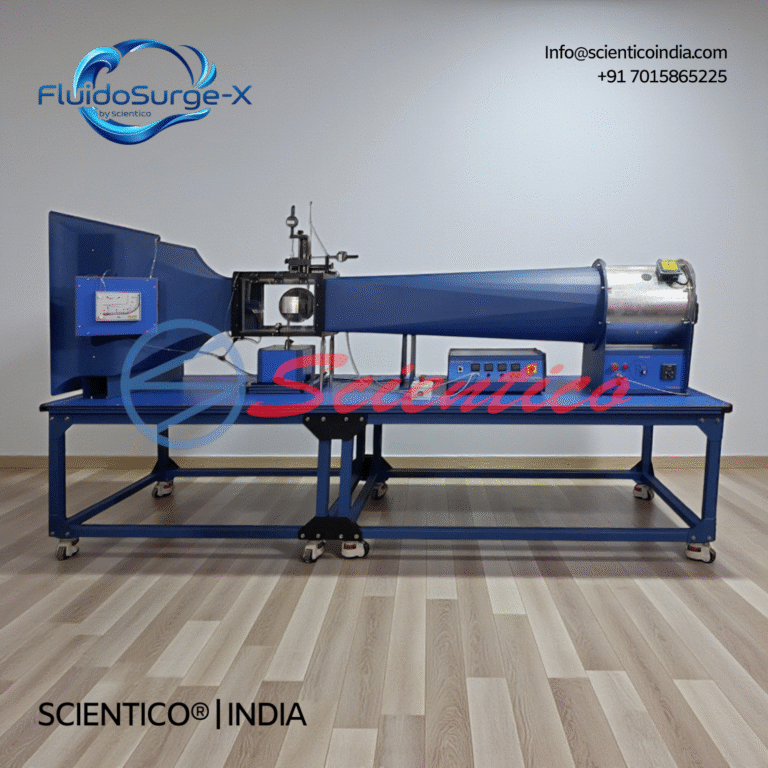
Wind Tunnel | FluidoSurge-X 216
The Wind Tunnel FluidoSurge-X 216 is designed for experimental study of aerodynamic flow and force characteristics on bodies in air. It enables controlled investigation of lift, drag, pressure distribution, and boundary layer behavior. The system uses an Eiffel type open circuit configuration with a transparent measuring section. It is suitable for aerodynamics and fluid mechanics laboratory instruction.
View product detailsWhat equipment is essential for an aeronautical engineering lab?
An aero lab is built around the wind tunnel, but a well-equipped lab adds dedicated apparatus for boundary layers, flow visualisation and force measurement so multiple experiments can run in parallel. Aerodynamics also sits on a foundation of fluid mechanics, so many departments pair these rigs with general flow benches. If you are scoping a broader hydraulics and flow section alongside aerodynamics, browse Fluid Mechanics Lab Equipment to see the supporting category.
Core aeronautical lab equipment list
| Equipment | What it teaches | Typical use |
|---|---|---|
| Subsonic wind tunnel (open-circuit) | Airflow over bodies, lift/drag basics | Primary test rig for most experiments |
| Aerofoil models (symmetric & cambered) | Lift, stall, angle of attack | Pressure-distribution and force tests |
| Multi-tube / inclined manometer bank | Pressure measurement across taps | Reading model surface pressures |
| Pitot-static tube & traverse | Velocity and dynamic pressure | Calibrating tunnel speed, velocity profiles |
| Boundary layer apparatus / flat plate | Laminar vs turbulent layers | Velocity-profile and thickness studies |
| Drag/force balance (lift & drag) | Aerodynamic force coefficients | Measuring CL and CD |
| Smoke / tuft flow-visualisation kit | Streamlines, separation, wakes | Qualitative airflow demonstration |
| Bluff-body models (cylinder, sphere, plate) | Pressure drag, wake formation | Comparative drag experiments |
How does a wind tunnel work in a teaching lab?
A teaching wind tunnel draws or pushes air at a controlled speed through a working (test) section where a model is mounted. The basic open-circuit layout has a few clear stages, and understanding them helps a buyer write a sensible specification rather than copying a generic one.
- Settling chamber and honeycomb/screens straighten the incoming air and reduce turbulence.
- Contraction cone accelerates the flow smoothly into the test section.
- Test section holds the model, pressure taps and instrumentation; this is where measurements happen.
- Diffuser slows the air gradually to recover pressure and reduce fan load.
- Fan/blower and drive set the airspeed, often with variable-speed control.
For most diploma and degree courses a low-speed subsonic tunnel is sufficient. When you request a quote, state your available floor space, single- or three-phase power, and whether you want an open-circuit (smaller footprint, simpler) or closed-circuit (quieter, more uniform flow) design.
What experiments can students perform with aerofoil and boundary layer apparatus?
The point of buying dedicated models and probes is experiment variety. A single tunnel plus a good accessory set can support an entire semester of practicals.
- Pressure distribution over an aerofoil at varying angles of attack, read from a multi-tube manometer.
- Lift and drag measurement using a force balance to compute CL, CD and the lift-to-drag ratio.
- Stall behaviour by observing the angle at which lift drops sharply.
- Boundary layer velocity profile along a flat plate using a pitot traverse.
- Laminar-to-turbulent transition studies with the boundary layer apparatus.
- Drag on bluff bodies comparing a cylinder, sphere and flat plate.
- Flow visualisation with smoke or surface tufts to see separation and wake structure.
Matching equipment to your syllabus
Before finalising a list, map each rig to the experiments named in your university or AICTE-aligned syllabus. Buying one well-supported tunnel with a full accessory set usually beats buying several single-purpose rigs that overlap. Confirm that pressure taps, manometer range and the force balance capacity suit the model sizes you intend to test, so readings stay within scale.
How do you choose a supplier for aeronautical lab equipment?
Equipment that students handle daily must be safe, repeatable and well documented, especially for NBA/NAAC accreditation visits and for export installations where local inspection matters. Use a short checklist when comparing suppliers.
- Quality certification: ISO 9001:2015 quality management and CE conformity for the relevant items.
- Documentation: calibration certificates and conformity papers supplied with the equipment, so lab manuals and audits line up.
- Manufacturing track record: a maker that builds rather than only trades can supply spares and support specifications over a rig’s life.
- Export readiness: clear CIF quoting, packing and shipping experience for overseas labs.
- Procurement fit: for Indian government and institutional buyers, GeM registration simplifies tendering and purchase orders.
Scientico India is an ISO 9001:2015 and model-specific manufacturer and exporter of engineering, nursing, medical and pharmacy lab equipment, based in Ambala, Haryana, and supplying institutions across India and 30+ countries since 1993. As a GeM-registered manufacturer, it provides quote-based pricing with a CIF proforma invoice typically issued within 24 hours, and ships items with calibration and conformity documentation suitable for college labs and export installations. To scope an aerodynamics section together with supporting flow rigs, start from the Fluid Mechanics Lab Equipment category and request a tailored list for your syllabus.
How to plan procurement and budget
Because most lab-equipment suppliers quote per institution rather than publish fixed list prices, the smart approach is to send a clear scope and let the manufacturer return a proforma. A tidy enquiry speeds everything up and gets you an accurate CIF figure faster.
- List experiments first, hardware second. Derive the equipment from your practical syllabus.
- State site constraints. Floor area, ceiling height, power supply (single/three phase), and ventilation for tunnel exhaust.
- Specify quantities and model sizes. Number of aerofoils, manometer tubes, and balance capacity.
- Ask for documentation up front. Calibration and conformity certificates, plus user manuals for lab files.
- Request a CIF proforma if you are an export buyer, so customs and freight are clear before you commit.
Quick pre-purchase checklist
| Check | Why it matters |
|---|---|
| Tunnel type (open vs closed circuit) | Decides footprint, noise and flow quality |
| Test section size | Limits maximum model dimensions |
| Instrumentation included | Manometer, pitot, balance must match models |
| Power & safety | Matches lab supply; guards and emergency stop |
| Certificates & manuals | Needed for accreditation and maintenance |
| Spares & support | Keeps the rig usable for years |
With the right combination of a subsonic wind tunnel, aerofoil and pressure apparatus, and boundary-layer and flow-visualisation tools, a college or polytechnic can deliver a complete, accreditation-ready aerodynamics practical course. Build your list from the syllabus, write a precise specification, and ask a certified manufacturer for a documented quote. For India-based and export labs, you can request a tailored list and a CIF proforma invoice from Scientico India via WhatsApp at +91-7015865225.
Frequently Asked Questions
What is the most important item on an aeronautical engineering lab equipment list?
The subsonic wind tunnel is the central rig, because most aerodynamics experiments run inside its test section. Around it you add aerofoil models, a multi-tube manometer, a pitot-static probe, a force balance and boundary layer apparatus so a single tunnel supports many experiments.
What is the difference between an open-circuit and closed-circuit wind tunnel for teaching?
An open-circuit tunnel draws air from and exhausts to the room, giving a smaller footprint and simpler installation, which suits most diploma and degree labs. A closed-circuit tunnel recirculates air for quieter operation and more uniform flow but needs more space and budget. Choose based on your floor area, noise tolerance and ventilation.
Which experiments can students do with aerofoil and boundary layer apparatus?
Common practicals include pressure distribution over an aerofoil at different angles of attack, lift and drag measurement to find C_L and C_D, stall observation, boundary layer velocity profiles on a flat plate, laminar-to-turbulent transition studies, bluff-body drag comparison, and smoke or tuft flow visualisation.
How do I get pricing if no prices are listed?
Most lab-equipment makers quote per institution rather than publish fixed prices. Send your experiment list, site constraints (space, power, ventilation) and quantities, and request a proforma invoice. Scientico India typically issues a model-specific CIF proforma invoice after technical review for Indian and export buyers.
Why do certification and documentation matter when buying aero lab equipment?
Certificates such as ISO 9001:2015 and CE, plus calibration and conformity documents, support repeatable measurements and help during NBA/NAAC accreditation visits and customs clearance for export. They also make maintenance and lab manuals easier to keep aligned with the installed equipment.
One honest ask
We don't gate anything on this site. You just read the whole thing free. If it was useful, leave your email and two things happen: we send you this page as a plain-text block you can paste into a tender file or an internal email, and we notify you the next time we publish a buyer tool like this one. Nothing else. No drip sequence, no sales calls booked without asking.
For equipment selection, choose between Hele-Shaw and open-channel flow visualization.