
A tender calling for a “grid-connected solar trainer” does not specify whether learners need only to measure power exchange with the mains, investigate battery storage under grid-connected operation, or build both off-grid and on-grid circuits. Those are different teaching outcomes. Scientico lists three relevant products: Solar Energy Trainer with Connection to Mains | RVX-003, On-Grid Solar Energy with Storage | RVX-005, and Photovoltaic Solar Energy Advanced Trainer | RVX-006. This guide helps a technical college, TVET centre or distributor turn the course requirement into a comparable bill of quantities (BOQ).
Equipment mentioned in this guide
Review the product information, specifications and model before requesting a quotation.
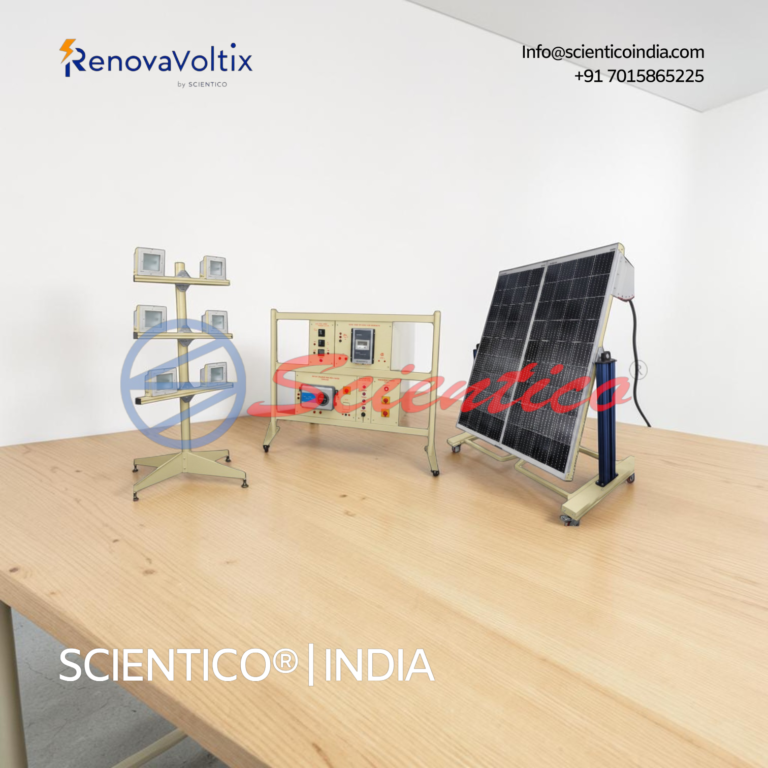
Solar Energy Trainer with Connection to Mains | RVX-003
The Solar Energy Trainer with Connection to Mains RVX-003 is a grid-integrated solar power training system designed for technical schools, vocational training centres, and educational institutions. It provides hands-on experience in solar energy technology, grid integration, and mains-connected solar power applications.
View product details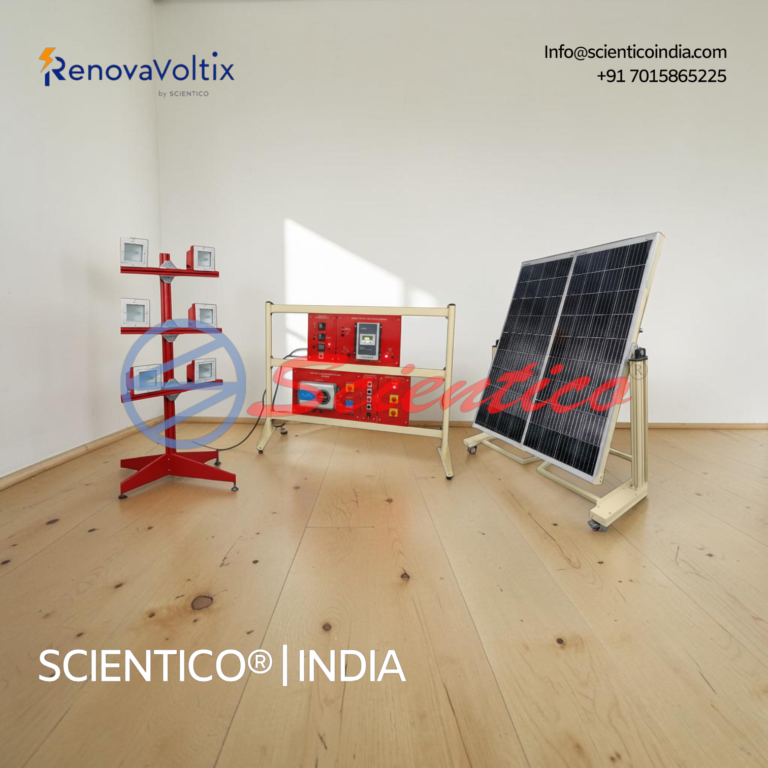
On-Grid Solar Energy with Storage | RVX-005
The On-Grid Solar Energy with Storage RVX-005 is a grid-tied solar power training system that combines grid-connected solar panels with battery storage capabilities. It demonstrates solar energy generation, excess energy storage, and live interaction with the main electrical grid.
View product details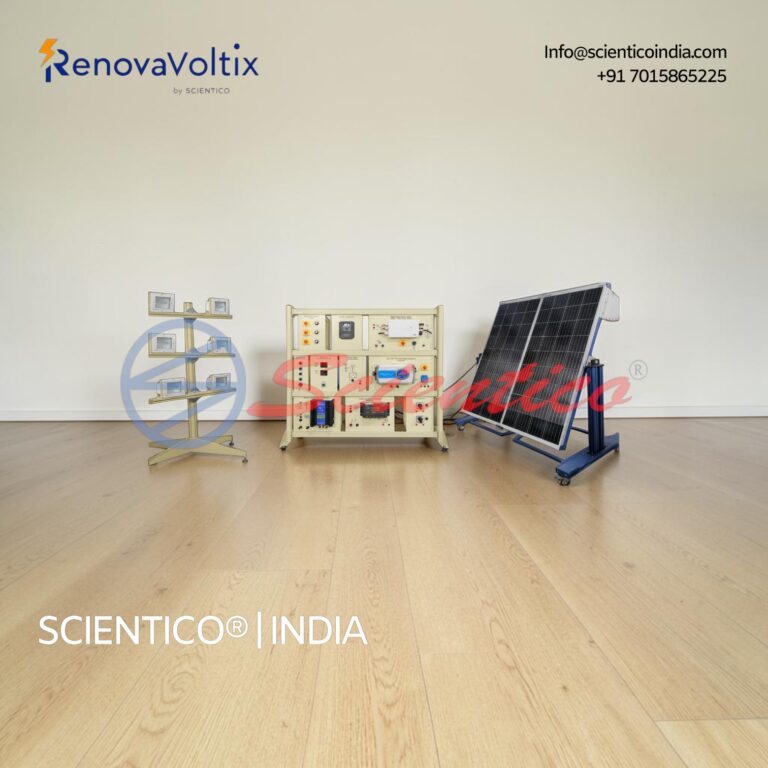
Photovoltaic Solar Energy Advanced Trainer | RVX-006
The Photovoltaic Solar Energy Advanced Trainer RVX-006 is a modular solar power training system for the theoretical and practical study of electric energy generation from photovoltaic panels. It covers PV panel characterisation, off-grid battery storage operation, and on-grid mains-connected operation in a single integrated platform. Product Overview The Photovoltaic Solar Energy Advanced Trainer RVX-006 supports three operational domains: PV panel characterisation, off-grid system operation, and on-grid system operation. For panel characterisation, the system supports solar radiation measurement, inclination and azimuth adjustment, shadow formation response investigation, and recording of voltage-irradiation, current-irradiation, current-voltage, and current-power curves. Inner resistance of the solar panel is calculable. Voltage and current measurement under overload is supported. For off-grid operation, the system measures generated power and battery charging, supports supplying a DC load from solar panel and battery, and enables design and testing of a standalone PV system in direct storage operation and 230V AC. For on-grid operation, the system measures electricity delivered to the mains grid, electricity produced by the solar panel and exchanged with the mains grid alongside AC lamp loading, and grid-connected inverter efficiency. Response of a PV system to mains failure can be investigated. An Artificial Light Source Module with intensity control is included as standard for indoor use.
View product detailsStart with the circuit students must assemble
RVX-003 is the focused mains-connection option. Its published experiments include mains voltage measurement, solar-panel inclination and azimuth, irradiance measurement, PV current–voltage curves and energy exchanged with the grid. The listed hardware includes a Grid ON inverter, electric-energy measurement, irradiance measurement, artificial light with intensity control, a lamp load, power rheostat, network distributor and an earth-leakage breaker module. It is the first model to examine when the assessed output is a grid-interactive PV circuit and measured exchange, without a separate storage lesson in the specification.
RVX-005 adds a documented storage teaching path to grid interaction. Its product record groups the exercises into panel characterisation, on-grid operation and on-grid storage operation. The listed modules include a dual-panel PV module, Grid ON inverter, energy meter, three-phase analyser, MPPT charge controller, PV simulator and load-management module. The published exercises cover battery charging, solar-panel and battery supply of an AC load, inverter efficiency and response to mains failure. Specify RVX-005 when the syllabus expressly tests how charging, stored energy and grid-connected loading behave together.
RVX-006 is the broader mixed-mode platform. Its product record covers PV characterisation, off-grid battery operation and on-grid mains operation. It lists both a Grid ON inverter module and a separate inverter module, along with MPPT control, DC load, network monitor, breaker, single-phase power supply and artificial-light source. Choose it for a curriculum in which students must trace and test standalone as well as grid-connected power paths, rather than assuming that an on-grid storage demonstration alone covers the off-grid assessment.
Compare teaching outputs rather than module counts
All three product pages describe measurements around solar irradiance, panel orientation and electrical output. A purchase decision should therefore start with what students must submit. For PV characterisation, ask for the actual voltage, current, irradiance and power readings and the plotted curves the department expects. For grid operation, define how import or export energy is measured and which inverter behaviour is assessed. For storage, define when battery charging, discharge and load supply are recorded. For a mixed-mode lab, require separate off-grid and on-grid wiring exercises and an instructor sign-off for switching between them.
RVX-003’s published list describes grid exchange but does not present the same explicit battery-storage programme as RVX-005. RVX-005 describes both grid and storage functions, while RVX-006 names off-grid and on-grid operation as distinct domains. That is a scope distinction, not a quality ranking. Ask the supplier to map each required experiment to its model and included modules before accepting a generic claim that all three teach “solar PV.”
Make the grid connection and battery scope explicit
A trainer with a grid-tied inverter needs a supervised, approved connection arrangement at the destination. Give the supplier the lab supply, phase, voltage and frequency, protection requirements and local approval constraints. Request the current electrical schematic, protection schedule, isolation procedure and demonstration conditions for the offered configuration. Do not connect a teaching inverter to live mains solely because a product page mentions grid integration; the institution and supplier must agree the permitted installation and commissioning method.
RVX-005’s published bill of materials marks the battery as excluded and to be arranged by the end user. For RVX-006, ask for a current signed BOQ that states the battery specification, who supplies it, module quantities, accessories, wiring, safety controls and whether the grid and standalone inverter modules are both included. The same written check is useful for RVX-003 because a mains-connection lesson does not automatically include a storage lesson.
DAQ scope also differs: the RVX-003 page describes LabVIEW-based acquisition as included, while RVX-005 and RVX-006 describe it as optional. Confirm the edition, licence, sensors, operating-system support and exported data format in the quote. If assessment requires a saved data file or graph, make a live demonstration of that output an acceptance test.
Use one RFQ to compare the three offers
| Decision | What to write in the RFQ |
|---|---|
| Teaching outcome | List the exact PV curves, grid-exchange, battery and standalone exercises students must complete. |
| Model and modules | Ask for an itemised, current BOQ for RVX-003, RVX-005 or RVX-006, identifying included and optional modules. |
| Electrical interface | Provide site supply and request the connection schematic, protection and supervised commissioning scope. |
| Battery | State the required storage exercise and ask who supplies the battery, its approved type and interface. |
| Assessment evidence | Specify measured variables, displayed readings, graphs, data-export files and an acceptance demonstration. |
| Delivery scope | Give quantity, country, course schedule, training needs, documents and tender deadline. |
If the institution is still deciding between simulated indoor light and outdoor field measurement, first use the RVX-001 versus RVX-002 indoor/outdoor comparison. For the full range of alternatives, browse the renewable-energy equipment catalogue. When the required circuit is clear, request a model-specific solar PV trainer quotation and attach the experiment list and site details.
One honest ask
This article and public product information are available to browse without an account. To open a product datasheet, complete the contact form shown with its download link. If this article was useful, leave your email and two things happen: we send you this page as a plain-text block you can paste into a tender file or an internal email, and we notify you the next time we publish a buyer tool like this one. Nothing else. No drip sequence, no sales calls booked without asking.