
“Wind trainer” can mean a turbine-generator circuit, a vertical-axis comparison, a controlled-wind blade experiment or a combined wind-and-solar system. Those requests cannot be priced against one another until the experiment is stated. Scientico’s Wind Energy Training System | RVX-007, Wind Energy Training System (Vertical Type) | RVX-008, Wind Energy Trainer with Wind Tunnel | RVX 112 and Wind / Solar Hybrid Energy System | RVX 101 serve different teaching plans. This buyer guide maps each plan to the model evidence and a useful request for quotation (RFQ).
Equipment mentioned in this guide
Review the product information, specifications and model before requesting a quotation.
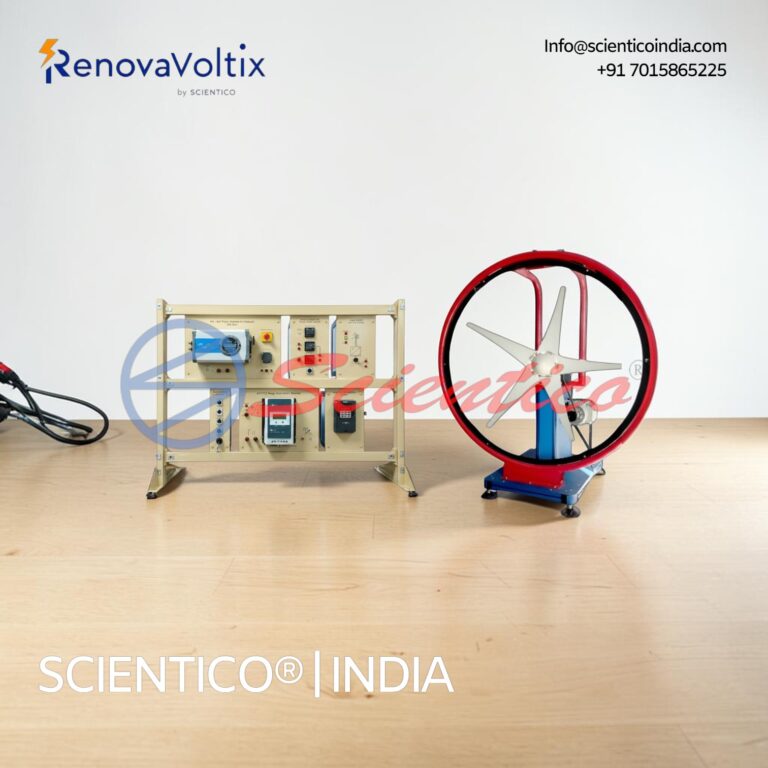
Wind Energy Training System | RVX-007
The Wind Energy Training System RVX-007 is a live demonstration wind power training platform that introduces the fundamental concepts of wind turbine operation, kinetic-to-mechanical energy conversion, and mechanical-to-electrical energy generation. It provides hands-on experience in wind turbine concepts and applications in a single integrated setup. Product Overview The Wind Energy Training System RVX-007 demonstrates the complete energy conversion chain of a wind turbine system. The platform covers no-load voltage measurement of the wind turbine, investigation of wind turbine velocity and output relationships, and independent wind energy AC output system operation. The setup includes an AC three-phase motor with AC motor driver simulating wind turbine drive, an AC to DC converter, MPPT charge controller for battery charging, and an off-grid inverter for AC output. Measurement capability includes voltage, current, and RPM. The system operates as a live wind power training demonstration unit covering both conceptual and applied aspects of wind turbine and generator operation.
View product details
Wind Energy Training System (Vertical Type) | RVX-008
The Wind Energy Training System (Vertical Type) RVX-008 is a live demonstration wind power training platform built around a vertical axis wind turbine, introducing the fundamental concepts of kinetic-to-mechanical and mechanical-to-electrical energy conversion. It provides hands-on experience in vertical type wind turbine concepts and applications in a single integrated setup. Product Overview The Wind Energy Training System (Vertical Type) RVX-008 demonstrates the complete energy conversion chain of a vertical axis wind turbine system. The platform covers no-load voltage measurement of the wind turbine, investigation of wind turbine velocity and output relationships, and independent wind energy AC output system operation. The setup includes an AC three-phase motor with AC Motor Driver simulating vertical type wind turbine drive, an AC to DC Converter, MPPT Charge Controller for battery charging, and an off-grid inverter for AC output. Measurement capability includes voltage, current, and RPM. The system operates as a live wind power training demonstration unit covering both conceptual and applied aspects of vertical type wind turbine and generator operation.
View product details
Wind Energy Trainer with Wind Tunnel | RVX 112
The Wind Energy Trainer with Wind Tunnel RVX 112 is an educational apparatus for studying kinetic wind energy conversion to electrical energy with controlled wind conditions. This wind energy trainer features enclosed wind tunnel with axial fan, horizontal axis wind turbine with interchangeable blades, and stand-alone electrical system for energy generation and storage.
View product details
Wind / Solar Hybrid Energy System | RVX 101
The Wind / Solar Hybrid Energy System RVX 101 is an educational apparatus for studying renewable energy generation from combined wind turbine and solar module sources. This wind solar hybrid energy system demonstrates how wind and solar resources integrate in consumer and industrial markets to supplement power needs and reduce dependence on non-renewable fuels.
View product detailsChoose by assessed experiment, not the word “wind”
RVX-007 is the standard wind-energy conversion platform in this group. Its product record lists a turbine module, three-phase motor and driver, AC-to-DC converter, MPPT charge controller, off-grid inverter and a measuring module for rotational speed, voltage and current. Its three listed exercises are turbine no-load voltage, a velocity/output relationship and independent AC output. Ask for this scope when students must follow the electrical chain from turbine drive to rectification, charge control and load.
RVX-008 is the vertical-axis version. Its page describes the same broad energy-conversion chain and the same three exercise types, but names a vertical turbine module. A buyer seeking a comparison of rotor architectures should request an itemised offer for both units and confirm the RVX-007 rotor orientation in writing. The product pages alone do not prove that a single system contains interchangeable rotor types. If only one rotor architecture is assessed, identify it in the BOQ.
RVX 112 serves a different experiment: a turbine operating in a controlled air stream. Its product page describes an enclosed wind tunnel with variable-speed fan, flow straightener, horizontal-axis rotor, interchangeable blades and electrical measurements. This is the model to investigate when students must vary air speed or blade configuration and compare measured turbine response. It is not simply a replacement for a general aerodynamics wind tunnel: specify the wind-energy and generator measurements you require. If the course asks for lift/drag testing of non-turbine models, use the separate aerodynamics wind-tunnel selection guide instead.
RVX 101 is the hybrid choice. The product page describes a movable PV module with controlled artificial light, a wind turbine with motor driver, a wind/solar hybrid controller, variable resistive load and measurements of wind speed surrogate, electrical output and load. Its distinctive lesson is the combined power path: how two teaching sources are monitored and managed. It should be considered when the syllabus calls for wind–solar integration, not when a buyer needs only rotor or blade characteristics.
Write the measurement and site tests before the tender
For RVX-007 or RVX-008, describe the rotational-speed settings and the voltage/current readings students will record at no load and under the agreed electrical load. Ask the supplier which measurements are directly displayed, which require external instruments and how an instructor can demonstrate the AC output path. For a two-rotor teaching objective, require a comparable run sheet that keeps the load and measurement method the same across the offered systems.
For RVX 112, identify the air-speed range and blade changes actually required by the curriculum, plus the graph or calculation students must produce. Ask for the current dimensions, fan power, airflow precautions, guarding and emergency-stop procedure for the offered unit. The page lists a stand-alone 12 V DC storage path and a user-supplied accumulator; confirm the battery and load arrangement in writing. Controlled air speed helps repeat a blade trial, but the setup still needs laboratory space, electrical supply and supervised operation.
For RVX 101, specify whether the acceptance test will compare wind-only, solar-only and simultaneous operation. Request the exact electrical diagram, controller operation, measured variables and load steps. Its product page says the battery is user-supplied and software acquisition is optional. Ask for the battery specification and the optional software scope separately so the lab can run the assessed exercise on delivery.
Check exclusions and inconsistencies before ordering
RVX-007 and RVX-008 product records both indicate that the battery is not included and must be arranged by the buyer. Request a current signed battery and module schedule for the selected configuration. The RVX 112 record also calls for a user-supplied accumulator. RVX 101 states that its battery is user-supplied and its LabVIEW-based DAQ option is separate. Across all four, ask the supplier to list the supplied controller, inverter, cables, instruments, software, training and manual, plus any excluded local consumables.
Do not equate a listed experiment with an automatically approved site installation. Obtain the offered electrical supply and protection requirements, footprint, safety instructions and an instructor demonstration plan. Where the procurement is for a distributor or a multi-campus TVET programme, include the destination country, site utilities at each campus, concurrent student groups, spare parts and requested commissioning documents. That produces a quote that can be checked against the actual teaching outcome.
Send a wind-energy trainer RFQ that can be answered
| Teaching objective | Model to evaluate | Evidence to request |
|---|---|---|
| Wind-to-electrical conversion | RVX-007 | No-load, speed/output and independent AC-output demonstration; confirm rotor orientation. |
| Vertical-axis wind conversion | RVX-008 | Vertical turbine module and comparable measurement schedule. |
| Blade tests under controlled air speed | RVX 112 | Fan/tunnel scope, interchangeable blades, air-speed and electrical readings. |
| Combined wind and PV generation | RVX 101 | Wind-only, solar-only and simultaneous-source controller demonstration. |
Attach the experiment list, quantity, electrical supply, room or site constraints, country and procurement deadline. Ask for a current itemised BOQ and a table of deviations from the specification. The renewable-energy equipment category shows the broader catalogue. To compare specific configurations, request a model-specific wind-energy trainer quotation with the intended practical and destination details.
One honest ask
This article and public product information are available to browse without an account. To open a product datasheet, complete the contact form shown with its download link. If this article was useful, leave your email and two things happen: we send you this page as a plain-text block you can paste into a tender file or an internal email, and we notify you the next time we publish a buyer tool like this one. Nothing else. No drip sequence, no sales calls booked without asking.